
Can You Lay Down an Oil Free Air Compressor? Transport Guide
Moving an air compressor is not always as simple as putting it in the back of a truck and driving away. Upright compressors can be tall, heavy, and awkward, which often makes owners wonder whether they can transport the machine on its side.
If you are asking can you lay down an oil free air compressor, the answer is usually more favorable than it would be for an oil-lubricated compressor. Because an oil-free compressor does not have a crankcase full of lubricating oil that can leak or flow into the pump, many oil-free units can be laid horizontally for short-term transportation. However, that does not mean every compressor can be placed on any side without risk.
The compressor’s shape, motor position, pressure switch, air filter, drain valve, wheels, protective shrouds, and tank fittings all matter. Large vertical models can also be damaged if their weight rests on components that were never designed to support the machine.
This guide explains when laying an oil-free compressor down is generally acceptable, the risks to watch for, how to position it safely in a vehicle, and what you should check before using it again.
Can You Lay Down an Oil Free Air Compressor?
Yes, you can lay down an oil free air compressor in many cases, especially for temporary transportation. Because there is no pump oil that can spill into the cylinders or leak through the breather, an oil-free compressor is generally less sensitive to orientation than an oil-lubricated model.
However, you should still check the manufacturer’s instructions before transporting it horizontally.
The main concerns are usually physical rather than lubrication-related.
Laying the compressor incorrectly can damage:
- Air filters
- Pressure switches
- Gauges
- Regulator assemblies
- Drain valves
- Plastic motor covers
- Wheels
- Pump components
- Tank fittings
If the manufacturer requires upright transport, follow that instruction.
Why Oil-Free Compressors Are Easier to Lay Down
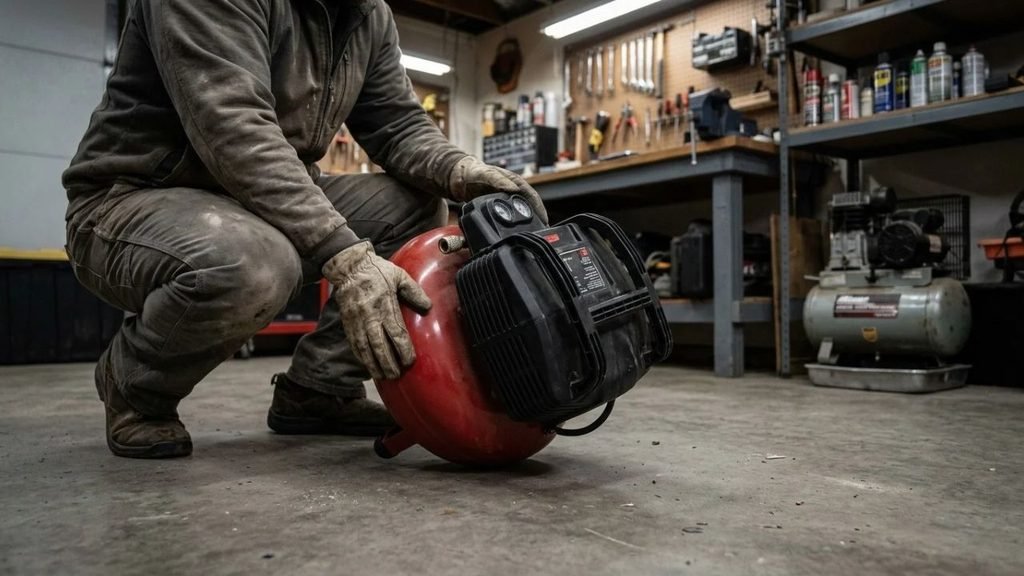
An oil-free compressor uses a pump design that does not require the owner to maintain a crankcase filled with lubricating oil.
Instead, these compressors may use:
- Permanently lubricated bearings
- Low-friction materials
- Special piston rings
- Coated cylinders
- Sealed components
Because there is no liquid compressor oil in a crankcase, laying the machine on its side does not normally create the same oil-migration problems seen with conventional oil-lubricated compressors.
That is the primary reason horizontal transport is often possible.
Why Oil-Lubricated Compressors Are Different
Oil-lubricated compressors generally need to remain upright during transportation unless the manufacturer specifically allows another position.
When an oil-filled pump is placed on its side, oil may move into areas where it does not belong.
Potential problems include:
- Oil entering the cylinder
- Oil reaching the intake system
- Oil leaking through the breather
- Oil contaminating filters
- Excessive smoke or oil discharge after startup
- Incorrect oil-level readings
An oil-free compressor avoids most of these lubrication-related concerns.
However, “oil-free” does not mean “orientation-proof.”
You still need to protect the physical components.
Check the Manufacturer’s Manual First
Before laying down any compressor, look for transportation or handling instructions in the owner’s manual.
Manufacturers may specify:
- Upright-only transportation
- Approved laying position
- Which side should face down
- Whether accessories should be removed
- Whether the tank should be depressurized
Model-specific instructions take priority over general advice.
This is especially important with large vertical compressors because their layout can vary significantly.
Portable vs. Vertical Oil-Free Compressors
The answer depends partly on the compressor’s design.
Small Portable Oil-Free Compressor
Small pancake, hot-dog, and portable compressors are generally easier to transport.
Many already operate in a horizontal orientation or have frames designed to tolerate movement.
Examples include:
- Pancake compressors
- Small hot-dog compressors
- Compact jobsite units
- Portable wheeled compressors
These are generally easier to place in a vehicle securely.
Large Vertical Oil-Free Compressor
A large upright compressor requires more caution.
Even if the pump itself can tolerate horizontal positioning, the machine may have fragile components attached to its upper section.
These can include:
- Motor shrouds
- Air filters
- Control boxes
- Pressure switches
- Regulators
- Gauges
- Plumbing
The tank itself is strong, but many attached components are not designed to carry the full weight of the compressor.
Which Side Should an Oil-Free Air Compressor Be Laid On?
If horizontal transport is allowed, choose the side that keeps vulnerable components facing upward.
Avoid placing the compressor directly on:
- Pressure gauges
- Regulator
- Pressure switch
- Air filter
- Safety valve
- Drain valve
- Plastic housing
- Electrical connection box
Ideally, the compressor should rest on a strong section of the tank or frame.
Use padding between the compressor and vehicle floor to prevent scratches and reduce vibration.
If one side has fewer fittings and controls than the other, that is often the better side to place downward, assuming the manual does not specify otherwise.
Should You Drain the Air Tank Before Laying It Down?
Yes, depressurizing the air tank before transportation is generally a good practice.
Turn the compressor off and disconnect power.
Then release stored air through the appropriate valve or outlet.
Transporting a compressor with a fully pressurized tank provides no practical benefit.
A depressurized tank is easier and safer to handle during loading and unloading.
Drain Condensation Before Transport
The receiver tank can accumulate water from compressed air.
Before laying the compressor down, open the tank drain valve according to the manufacturer’s procedure and drain accumulated moisture.
This helps prevent water from moving around inside the tank during transport.
After draining:
- Allow the tank to empty.
- Close the drain valve securely.
- Check that the valve cannot be damaged while the compressor is lying down.
Do not confuse tank condensation with compressor pump oil. An oil-free compressor can still collect substantial water inside its air receiver.
Remove Loose Accessories
Before transport, remove anything that could fall off or become damaged.
This may include:
- Air hose
- Blow gun
- Tire inflator
- Power cord
- Quick-connect accessories
- Extension cords
- Loose tools
Wrap or secure the power cord so it cannot become trapped under the compressor.
A hose attached during transport can place unnecessary force on the regulator or outlet fitting.
Protect the Air Filter
The intake air filter can be particularly vulnerable.
Many filters protrude from the compressor pump or motor assembly.
If the full weight of the machine rests on the filter, the:
- Filter housing
- Intake fitting
- Pump connection
could crack.
Remove the filter for transportation if the manufacturer allows it, or position the compressor so the filter faces upward.
Do not operate the compressor with the air filter removed unless specifically allowed.
Protect the Pressure Switch and Gauges
Pressure switches and gauges are also vulnerable during horizontal transport.
A gauge can bend or break if it becomes a contact point against the vehicle floor.
The pressure switch may contain:
- Electrical connections
- Small air lines
- Plastic covers
- Mechanical contacts
Place protective padding around these components if needed.
Never use the gauges, regulators, or plumbing as lifting handles.
How to Lay Down an Oil-Free Compressor Safely
If your compressor can be transported horizontally, use a controlled process.
1. Turn the Compressor Off
Switch the compressor off before moving it.
Do not attempt to reposition a machine while it is running.
2. Disconnect the Power
Unplug a portable compressor.
For stationary equipment, follow the appropriate electrical shutdown procedure.
3. Release Tank Pressure
Drain stored compressed air according to the manufacturer’s instructions.
4. Drain Tank Moisture
Open the tank drain and remove accumulated condensation.
Close the drain before moving the compressor.
5. Remove Accessories
Disconnect hoses and loose fittings.
Secure the electrical cord.
6. Inspect Both Sides
Determine which side has the fewest vulnerable components.
Look for:
- Gauges
- Filters
- Switches
- Regulators
- Electrical boxes
- Drain fittings
7. Add Padding
Use blankets, foam, rubber mats, or another suitable protective material.
Do not allow the compressor to rest directly on fragile components.
8. Lower It Carefully
Large compressors can be extremely heavy.
Use enough people or proper moving equipment to control the machine.
Do not allow it to fall onto its side.
9. Secure It in the Vehicle
Use suitable tie-down straps so the compressor cannot:
- Slide
- Roll
- Bounce
- Tip
- Strike other cargo
Never rely on the compressor’s weight alone to keep it in place.
How to Secure an Air Compressor in a Truck
A pickup truck bed can work well for transporting a compressor if the unit is secured properly.
Position the compressor against a stable surface and use rated tie-down straps.
Attach straps around strong structural areas such as:
- Tank
- Frame
- Approved lifting points
Avoid pulling straps tightly against:
- Air lines
- Gauges
- Plastic covers
- Regulators
- Electrical wiring
Use multiple straps when necessary to prevent movement in more than one direction.
Can You Lay an Oil-Free Compressor in an SUV?
Yes, many portable oil-free compressors can be transported in an SUV if they physically fit.
Take precautions to protect the interior.
Use:
- Heavy blanket
- Rubber cargo mat
- Cardboard
- Protective padding
Make sure the compressor cannot move during braking or cornering.
Also consider its weight before lifting it into the vehicle.
A large compressor may require a ramp, dolly, or additional people.
Can You Store an Oil-Free Compressor on Its Side?
Transportation and long-term storage are different situations.
Even when a compressor can tolerate temporary horizontal positioning, upright storage is generally preferable unless the manufacturer specifically approves side storage.
Keeping the machine in its normal operating position:
- Protects fittings
- Prevents uneven loading
- Reduces the chance of condensation reaching unexpected areas
- Makes future inspection easier
- Prevents accidental damage to controls
If you must store it horizontally, follow the same precautions used during transportation.
Can You Run an Oil-Free Air Compressor While It Is Lying Down?
Do not assume that a compressor that can be transported on its side can also operate on its side.
Many compressors are designed to operate only in their normal position.
Operating horizontally may affect:
- Cooling airflow
- Drainage
- Vibration control
- Rubber mounts
- Tank stability
- Internal pump design
The machine could also move unexpectedly due to vibration.
Operate the compressor only in the orientation approved by its manufacturer.
How Long Should You Wait Before Using It After Transport?
Unlike an oil-lubricated compressor, an oil-free compressor generally does not need a long waiting period for crankcase oil to settle after being transported horizontally.
However, once you arrive:
- Set the compressor upright in its normal operating position.
- Check for damaged fittings.
- Inspect the pressure switch and gauges.
- Check the intake filter.
- Verify that nothing is loose.
- Confirm that the tank drain is closed.
- Allow the compressor to stabilize before startup.
If the compressor was handled roughly or dropped, inspect it more carefully before use.
Inspect the Compressor After Transportation
Even a properly secured compressor can experience vibration during travel.
Before reconnecting power, inspect:
- Air fittings
- Drain valve
- Safety valve
- Pressure switch
- Regulator
- Gauges
- Air filter
- Wheels
- Motor housing
- Pump assembly
- Power cord
Look for:
- Cracks
- Bent fittings
- Loose bolts
- Broken plastic
- Damaged wiring
- Air leaks
Do not operate the unit if a pressure-related component has been damaged.
What If Water Comes Out After You Stand It Up?
Some condensation may move around inside the tank while the compressor is horizontal.
This is another reason draining the tank before transport is helpful.
Once the compressor is upright again, check the tank drain.
If moisture remains, drain it normally.
Water inside an air receiver is a routine byproduct of compressing humid air, but allowing large quantities to remain in the tank can promote corrosion.
Can Laying an Oil-Free Compressor Damage the Motor?
Simply changing orientation usually does not damage a typical motor if the machine is designed to tolerate transport that way.
Physical impact is the bigger concern.
Motor damage can occur if:
- The unit is dropped.
- The cooling shroud cracks.
- The shaft is subjected to severe impact.
- The motor housing supports the machine’s weight improperly.
- Electrical components are crushed.
Control the compressor carefully during loading rather than allowing it to tip over.
Is It Safe to Transport a Vertical Compressor Upright?
If you have enough clearance and can secure it adequately, upright transportation is often the preferred method.
However, a tall compressor presents its own risk: it can tip.
A large vertical compressor must be firmly restrained in all directions.
Use appropriate tie-downs and make sure the vehicle can safely carry the compressor’s weight.
Never transport a tall compressor standing freely without restraints.
Upright vs. Sideways Transport
The better position depends on the machine and vehicle.
| Transport Position | Advantages | Potential Concerns |
| Upright | Normal machine orientation | Tall unit can tip over |
| On its side | Lower center of gravity, may fit under low roof | Fittings or controls may be damaged |
| Oil-free compressor sideways | No crankcase oil migration in most designs | Physical components still need protection |
| Oil-lubricated compressor sideways | Sometimes possible only with special preparation | Oil leakage and internal oil migration |
For an oil-free compressor, safe restraint and component protection usually matter more than lubricant position.
Common Mistakes When Transporting an Oil-Free Compressor
Assuming Oil-Free Means It Can Be Put on Any Side
An oil-free pump eliminates one major problem, but fragile components can still be damaged.
Inspect the machine before choosing a side.
Leaving the Tank Fully Pressurized
Depressurize the compressor before moving it.
Resting the Compressor on the Gauges
Pressure gauges are not structural supports.
They can easily bend or break.
Leaving the Hose Connected
A hose can snag during loading and damage the regulator or outlet.
Disconnect it first.
Failing to Secure the Compressor
A heavy compressor can slide with enormous force during sudden braking.
Use proper tie-downs.
Using the Plastic Housing as a Lifting Point
Plastic shrouds protect internal components but may not be designed to support the compressor’s weight.
Lift from approved handles or structural areas.
Operating It While Still on Its Side
Transport orientation and operating orientation are not necessarily the same.
Return the unit to its approved operating position before starting it.
What About a New Oil-Free Air Compressor?
A new oil-free compressor can generally be transported according to the same rules.
However, packaging may be designed to maintain a particular orientation.
If the box includes arrows or instructions such as:
- This side up
- Keep upright
- Do not lay flat
follow those instructions.
The packaging may contain components positioned in ways that make one orientation safer than another.
Can a Pancake Compressor Be Laid Down?
A pancake compressor is already built around a relatively flat, horizontal air tank.
Because of its compact design, orientation during transport is usually less complicated than with a tall vertical compressor.
Still, avoid placing the machine in a way that puts its weight on:
- Gauges
- Regulator
- Handle
- Pressure switch
Secure it so it cannot roll or slide.
Can a Hot-Dog Compressor Be Laid on Its Side?
Many small hot-dog-style oil-free compressors can tolerate temporary side transport.
The cylindrical tank may roll, however, so restraint is particularly important.
Use padding and straps to prevent movement.
Keep the motor and control assembly from supporting the compressor’s full weight unless that orientation is specifically intended.
When Should You Avoid Laying the Compressor Down?
Avoid horizontal transport if:
- The manual requires upright transport.
- Fragile components cannot be protected.
- The compressor contains pump oil.
- A drain or fitting would bear the machine’s weight.
- The unit has damaged mounts.
- You cannot secure it properly.
- The compressor has been modified in a way that changes its balance.
- The manufacturer provides no safe horizontal position for the unit.
In these situations, upright transport may be safer.
Moving a Heavy Vertical Compressor
Large stationary compressors may weigh hundreds of pounds.
Do not attempt to control one by hand if its weight exceeds what you can safely manage.
Useful equipment can include:
- Appliance dolly
- Heavy-duty hand truck
- Loading ramp
- Lift gate
- Engine hoist
- Forklift, where appropriate
Secure tall compressors before releasing lifting equipment.
Avoid placing your hands or feet beneath the tank during movement.
FAQs About Can You Lay Down an Oil Free Air Compressor
Can you lay down an oil free air compressor for transport?
Yes, many oil-free compressors can be transported on their side because there is no crankcase oil to leak or migrate into the pump.
However, check the manufacturer’s instructions and protect vulnerable components.
Which side should you lay an oil-free compressor on?
Choose the side that keeps gauges, pressure switches, regulators, air filters, and other fragile components facing upward.
If the manufacturer specifies a particular orientation, follow that recommendation.
Do I need to wait before turning on an oil-free compressor after laying it down?
Usually, an oil-free compressor does not require the same oil-settling period as an oil-lubricated compressor.
Return it to its normal operating position and inspect it for damage before startup.
Can you operate an oil-free compressor on its side?
Only if the manufacturer specifically approves that operating orientation.
A compressor that can be transported sideways is not necessarily designed to run sideways.
Should I empty the air tank before moving an air compressor?
Depressurizing the tank before transportation is generally recommended.
It is also a good opportunity to drain accumulated condensation.
Can laying an oil-free air compressor down damage it?
It can if the machine’s weight rests on gauges, filters, electrical components, plastic covers, or other vulnerable parts.
Rough handling can also damage the pump or motor.
Is it better to transport an oil-free air compressor upright?
Upright transportation is often ideal when the compressor can be safely restrained and the vehicle has enough clearance.
Sideways transport may be more practical for a tall compressor, provided the manufacturer allows it.
Can you lay a 60-gallon oil-free compressor on its side?
Possibly, but large 60-gallon vertical compressors require particular care because of their weight and attached components.
Check the manufacturer’s transport instructions, depressurize the tank, protect fittings, use adequate lifting equipment, and secure the compressor firmly.
Conclusion
So, can you lay down an oil free air compressor? In many cases, yes. Oil-free compressors are generally easier to transport horizontally because they do not have a crankcase full of oil that can leak or migrate into the pump when the machine is tilted.
The practical issue is protecting the compressor itself. Before moving it, shut it off, disconnect the power, depressurize the receiver, drain accumulated tank moisture, remove loose accessories, and choose a side that keeps gauges, filters, regulators, switches, and other vulnerable components away from the floor. Secure the machine firmly so it cannot roll or slide during transportation.
For small portable oil-free compressors, laying the unit down temporarily is often straightforward. Large vertical compressors need much more care because their weight can easily damage fittings or make handling unsafe. In every case, the manufacturer’s transport instructions should be the final authority. Once you reach your destination, return the compressor to its normal operating position, inspect it for damage or loose components, and only then put it back into service.