
What Is Oil Free Air Compressor? How It Works and Key Types
An air compressor needs some way to reduce friction, control heat, and keep moving parts from wearing out. Traditional compressors often use oil inside the compression system for lubrication, sealing, and cooling. Oil-free compressors take a different approach: they are designed so the air being compressed does not rely on injected lubricating oil inside the compression chamber.
If you are wondering what is oil free air compressor, it is an air compressor designed to compress air without introducing lubricating oil into the compression chamber. Depending on the design, it may use self-lubricating materials, special coatings, precision clearances, water cooling, or separately lubricated bearings and gears.
This does not necessarily mean that absolutely no lubricant exists anywhere inside the machine. Some oil-free compressors still use grease or oil in bearings, gearboxes, or other isolated mechanical parts. The important distinction is that the lubricant is kept out of the compression chamber and compressed-air path.
Oil-free compressors are commonly used for home projects, portable tools, medical and dental systems, laboratories, food and beverage production, electronics manufacturing, painting, and other applications where reducing the risk of oil contamination is valuable.
This guide explains what does oil free air compressor mean, how oil-free air compressors work, how an oil-free scroll compressor operates, and how oil-free designs compare with conventional oil-lubricated compressors.
What Is Oil Free Air Compressor and What Does It Mean?
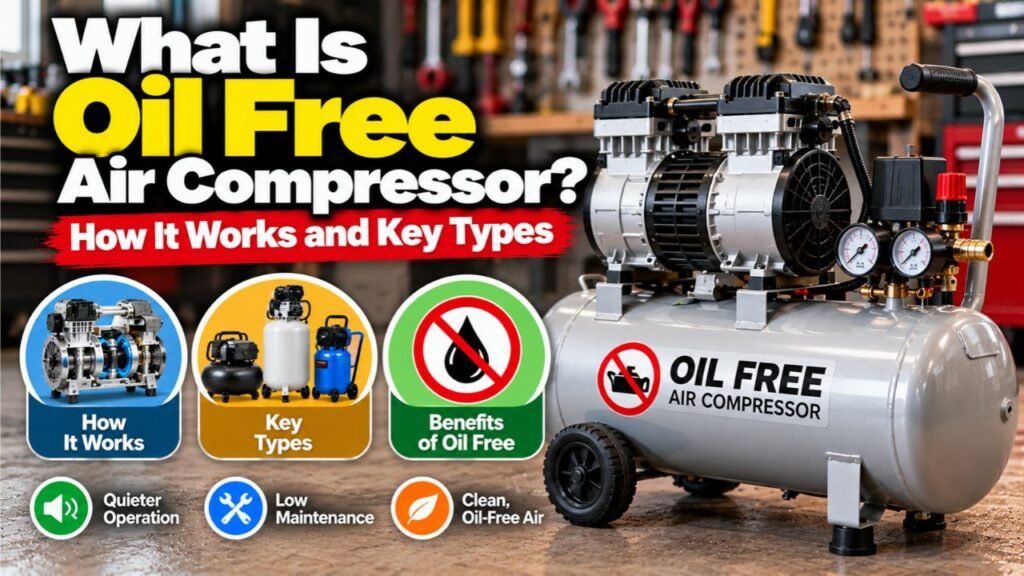
An oil-free air compressor compresses air without using lubricating oil inside the compression chamber.
In an oil-lubricated compressor, oil may perform several jobs at once. It can reduce friction, help seal clearances, remove heat, and protect internal components.
An oil-free compressor must accomplish those same basic tasks differently.
Depending on the compressor type, it may use:
- PTFE or composite piston rings
- Low-friction cylinder coatings
- Permanently lubricated bearings
- Precision-machined components
- Separate gearbox lubrication
- Water cooling
- Non-contacting compression elements
- Specialized heat-resistant materials
The result is compressed air with a much lower risk of oil contamination originating from the compressor’s compression process.
What Does Oil Free Air Compressor Mean in Practical Terms?
For the average homeowner, the term usually means you do not need to check, add, or replace compressor pump oil as part of normal maintenance.
For industrial users, the term oil free has a more important meaning: oil is not intentionally introduced into the compression chamber.
However, “oil-free” does not automatically mean that the delivered air contains absolutely zero hydrocarbons.
Ambient air can contain:
- Oil vapor
- Vehicle exhaust
- Industrial fumes
- Other airborne hydrocarbons
Filters, dryers, and air-treatment equipment may still be necessary when very high air purity is required.
How Do Oil Free Air Compressors Work?
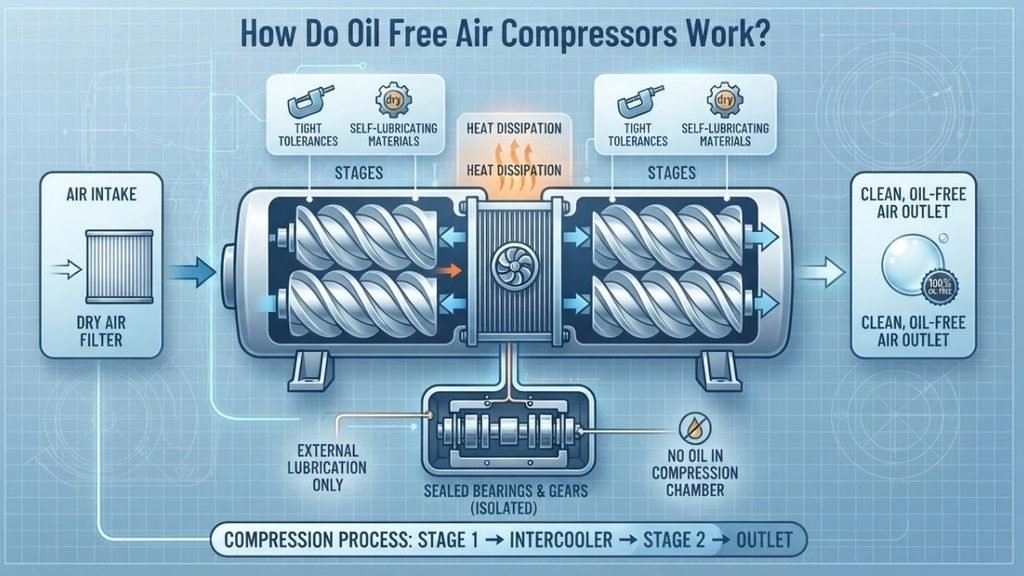
To understand how do oil free air compressors work, it helps to separate the compression process from lubrication.
Every compressor needs to:
- Draw atmospheric air into the machine.
- Reduce the volume occupied by that air.
- Increase its pressure.
- Remove excess heat.
- Deliver or store the compressed air.
An oil-free compressor performs those steps without injecting lubricating oil into the air-compression chamber.
Exactly how it does this depends on the compressor design.
How an Oil-Free Piston Air Compressor Works
Small portable oil-free compressors commonly use a reciprocating piston.
The basic cycle is simple.
Intake Stroke
The piston moves downward.
An intake valve opens, allowing atmospheric air to enter the cylinder.
Compression Stroke
The piston moves upward.
The intake valve closes, and the trapped air is squeezed into a smaller volume.
As the volume decreases, pressure increases.
Discharge
When cylinder pressure becomes high enough, a discharge valve opens.
Compressed air moves toward the storage tank.
The cycle then repeats rapidly.
How Does It Operate Without Pump Oil?
Instead of relying on an oil film between the piston and cylinder, many oil-free piston compressors use low-friction rings or coatings.
Common materials may include PTFE-based composites and other engineered polymers.
These materials allow the piston assembly to move inside the cylinder without requiring conventional oil lubrication in the compression chamber.
That is why many small pancake, hot-dog, and portable compressors are advertised as maintenance-free or oil-free.
How an Oil-Free Scroll Air Compressor Works
A scroll compressor operates very differently from a piston compressor.
It uses two spiral-shaped components called scrolls.
One scroll remains stationary while the other moves in a small orbit.
The scrolls do not simply spin against each other.
As the moving scroll orbits, pockets of air become trapped between the two spiral shapes.
Those pockets gradually move toward the center while becoming smaller.
As the trapped volume decreases, air pressure increases.
The compressed air then exits through a discharge port near the center of the assembly.
What Is an Oil Free Scroll Air Compressor?
An oil-free scroll air compressor is a compressor that uses orbiting and fixed scroll elements to compress air without injecting oil into the compression chamber.
Its basic components usually include:
- Fixed scroll
- Orbiting scroll
- Electric motor
- Bearings
- Cooling system
- Tip seals or sealing elements
- Discharge port
The scroll elements are precisely manufactured so they can compress air efficiently without the oil injection normally found in some other compressor technologies.
Why Scroll Compressors Can Operate Oil-Free
Scroll compressors can be designed so the primary compression surfaces do not require an oil bath.
Low-friction materials, precision clearances, and specialized tip seals help control leakage and wear.
Lubricated bearings may still exist elsewhere in some designs, but they are isolated from the compressed-air chamber.
This makes oil-free scroll technology attractive for applications requiring clean compressed air.
Advantages of Oil-Free Scroll Compressors
Scroll compressors offer several practical benefits.
Very Clean Compressed Air
Because no lubricating oil is injected into the compression chamber, the risk of compressor-generated oil carryover is greatly reduced.
Quiet Operation
Scroll compressors typically produce less mechanical vibration than many reciprocating compressors.
This makes them popular in environments such as:
- Dental offices
- Laboratories
- Medical facilities
- Indoor workshops
Smooth Air Delivery
The continuous scroll motion produces relatively smooth compressed-air flow compared with the distinct compression pulses of a piston machine.
Fewer Compression Components
A scroll compression mechanism can have relatively few moving components in the compression section.
That can contribute to reliable operation when properly maintained.
Types of Oil-Free Air Compressors
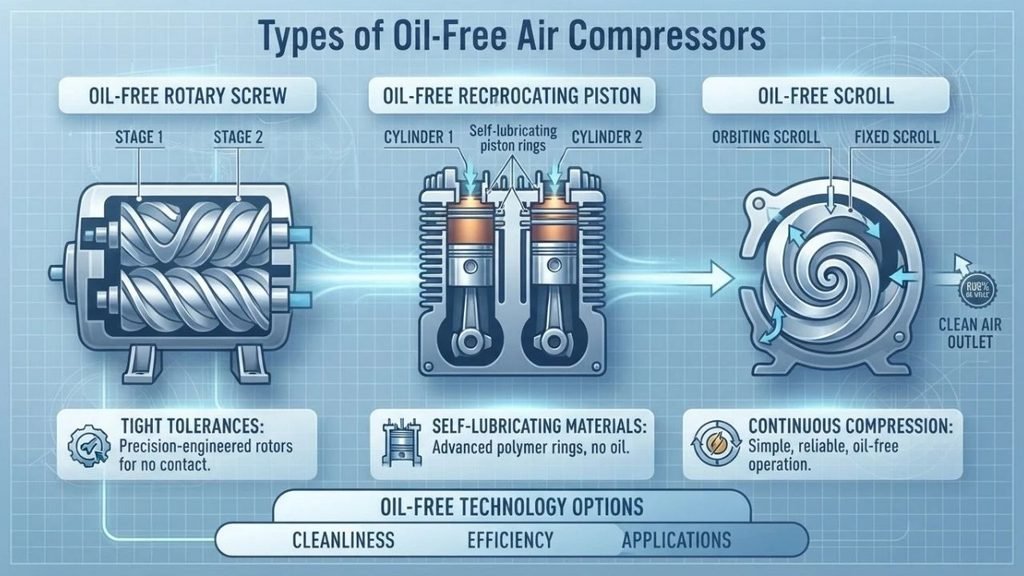
“Oil-free” describes the lubrication approach, not one specific compressor mechanism.
Several compressor technologies can be oil-free.
| Compressor Type | How It Compresses Air | Common Uses |
| Oil-free piston | Reciprocating piston | Home garages, portable tools, DIY |
| Oil-free scroll | Orbiting scrolls | Dental, medical, laboratory, light industry |
| Oil-free rotary screw | Intermeshing rotors | Industrial facilities |
| Oil-free centrifugal | High-speed impellers | Large industrial systems |
| Diaphragm compressor | Flexible diaphragm | Specialty gases, laboratories |
Each type has different pressure, airflow, noise, cost, and maintenance characteristics.
Oil-Free Piston Compressors
These are among the most common consumer air compressors.
You often see them in:
- 1-gallon compressors
- 3-gallon compressors
- 6-gallon pancake compressors
- Small portable units
- Nail-gun compressors
They are inexpensive, portable, and easy to maintain.
Their main disadvantage is that some models can be relatively loud and may not be designed for continuous heavy-duty operation.
Oil-Free Rotary Screw Compressors
Industrial rotary screw compressors use two intermeshing rotors to compress air.
Traditional oil-injected screw compressors use oil extensively in the compression chamber.
An oil-free screw compressor separates lubrication from the compression process.
In many designs, timing gears keep the rotors synchronized so the compression elements do not depend on an oil film for sealing and lubrication.
Some large oil-free screw machines use multiple compression stages because compressing air without injected oil creates additional heat-management challenges.
These systems are commonly found in industries where oil contamination could damage products or processes.
Oil-Free Centrifugal Compressors
A centrifugal compressor uses rapidly rotating impellers rather than pistons or screws.
Air enters near the center of the impeller, accelerates outward, and then passes through diffuser sections that convert velocity into pressure.
Because there is no oil injected into the compression path, centrifugal systems can provide oil-free compressed air.
These machines are generally intended for large industrial airflow requirements rather than typical home workshops.
Oil-Free Diaphragm Compressors
A diaphragm compressor uses a flexible membrane to change the volume of a sealed chamber.
Because the gas being compressed does not need to contact lubricated pistons or crankcase oil, diaphragm compressors can provide highly clean air or gas.
They are commonly used in specialized applications rather than general-purpose pneumatic-tool systems.
Oil-Free vs. Oil-Lubricated Air Compressor
The choice between these compressor types depends on what you need from the machine.
| Feature | Oil-Free Compressor | Oil-Lubricated Compressor |
| Oil in compression chamber | No | Usually yes |
| Pump oil changes | Usually not required | Required |
| Portability | Often excellent in small models | Often heavier |
| Maintenance | Generally simpler | More oil-related maintenance |
| Air contamination risk | Lower from compressor oil | Higher without proper separation |
| Noise | Depends on design | Depends on design |
| Continuous-duty capability | Model dependent | Often strong in industrial designs |
| Initial cost | Varies widely | Varies widely |
Neither type is automatically better in every situation.
Does Oil-Free Mean Maintenance-Free?
No.
An oil-free compressor may eliminate oil changes, but it still requires maintenance.
Depending on the model, maintenance can include:
- Draining tank moisture
- Cleaning or replacing intake filters
- Inspecting hoses
- Checking fittings
- Cleaning cooling surfaces
- Inspecting belts
- Replacing scroll tip seals
- Checking safety valves
- Inspecting electrical components
- Servicing dryers and filters
The manufacturer’s maintenance schedule should always be followed.
Why Oil-Free Compressors Still Generate Heat
Compressing air naturally generates heat.
In an oil-lubricated compressor, circulating oil can help remove some of this heat.
Oil-free machines must control temperature through other methods.
These can include:
- Cooling fans
- Finned cylinders
- Intercoolers
- Aftercoolers
- Water cooling
- Multi-stage compression
- Carefully controlled operating cycles
Small consumer oil-free compressors can become very hot during operation.
Allowing the compressor to exceed its intended duty cycle can shorten component life.
What Is Compressor Duty Cycle?
Duty cycle describes how much of a given period the compressor is designed to spend running.
A compressor designed for intermittent use may need regular cooling periods.
For example, a small portable compressor intended primarily for nailers may not be suitable for continuously operating an air grinder.
The fact that a compressor is oil-free does not determine its duty cycle.
Check the manufacturer’s rating.
Benefits of an Oil-Free Air Compressor
Oil-free compressors offer several advantages.
Less Routine Maintenance
You generally do not need to:
- Check pump oil level
- Change compressor oil
- Deal with oil leaks from the pump
This makes small oil-free compressors especially convenient for homeowners.
Cleaner Compressed Air
No lubricating oil is intentionally introduced into the compression chamber.
That can be valuable for:
- Painting
- Dental equipment
- Food production
- Electronics
- Laboratory work
- Medical applications
Easy Cold-Weather Starting
Many small oil-free designs avoid the thick pump oil that can make some lubricated compressors harder to start in very cold temperatures.
Actual cold-weather capability still depends on the compressor model.
Portability
Consumer oil-free compressors are often lightweight and compact.
This makes them useful for:
- Trim work
- Roofing
- Framing nailers
- Tire inflation
- DIY projects
Disadvantages of Oil-Free Air Compressors
Oil-free does not mean superior in every category.
Some Consumer Models Are Noisy
Small direct-drive oil-free piston compressors can produce substantial noise.
Wear Components May Need Replacement
Self-lubricating piston rings, cylinder coatings, scroll tip seals, and other components eventually wear.
Limited Continuous-Duty Performance
Some inexpensive portable units are intended for intermittent tasks rather than long periods of continuous operation.
Industrial Oil-Free Compressors Can Be Expensive
Large oil-free rotary screw and scroll systems can cost more than comparable oil-lubricated equipment because of their specialized materials and engineering.
Is Oil-Free Air Really Completely Free of Oil?
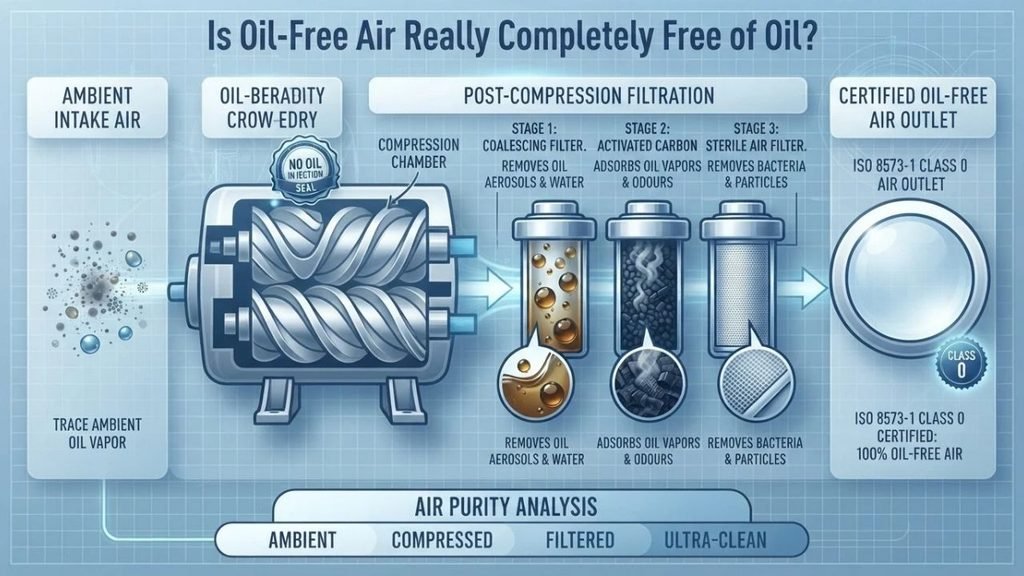
This question requires an important distinction.
An oil-free compressor is designed not to introduce lubricating oil into the compression chamber.
That does not automatically guarantee that the final compressed air contains absolutely no oil-related contaminants.
The intake air itself may already contain:
- Hydrocarbon vapor
- Industrial pollution
- Vehicle exhaust
- Aerosols
For applications requiring extremely high air purity, the system may also use:
- Coalescing filters
- Activated carbon filters
- Dryers
- Specialized air treatment
What Does Class 0 Oil-Free Mean?
Industrial compressed-air purity is often discussed using ISO 8573-1, which classifies contaminants in compressed air.
Class 0 represents a user-specified requirement stricter than Class 1 for a particular contaminant category.
A compressor being marketed as oil-free does not automatically mean that every complete system should be assumed to meet a particular Class 0 requirement.
If your application requires certified air purity, verify the manufacturer’s test data, certification, and complete air-treatment system.
This is particularly important in:
- Pharmaceutical production
- Food processing
- Medical applications
- Electronics manufacturing
- Critical painting or coating processes
Do Oil-Free Compressors Need an Air Filter?
Yes.
Oil-free refers to compressor lubrication, not dirt or moisture removal.
Atmospheric air contains particles and water vapor.
A compressed-air system may still need:
- Intake filter
- Particulate filter
- Moisture separator
- Air dryer
- Coalescing filter
- Activated carbon filtration
The required treatment depends on what you are using the compressed air for.
Do Oil-Free Compressors Produce Water?
Yes.
Oil-free compressors still produce condensate.
Atmospheric air contains water vapor.
When air is compressed and later cools, some of that moisture condenses into liquid water.
Water can collect in:
- Receiver tank
- Air lines
- Filters
- Tools
Drain the tank according to the manufacturer’s instructions.
Oil-free does not mean water-free.
Are Oil-Free Compressors Good for Air Tools?
Yes, if the compressor provides enough CFM, pressure, tank capacity, and duty cycle for the tool.
The compressor’s lubrication type does not determine whether it can operate an air tool.
For example, a 6-gallon oil-free pancake compressor may work very well with:
- Brad nailer
- Finish nailer
- Pin nailer
- Stapler
The same compressor may struggle with continuously demanding tools such as:
- Die grinder
- Air sander
- Large impact wrench used continuously
Always compare the tool’s airflow requirement with the compressor’s rated airflow.
Are Oil-Free Compressors Good for Painting?
They can be.
Oil-free compression reduces one possible source of oil contamination, which is helpful when spray painting.
However, moisture and particles can still ruin a paint job.
A painting setup may still require:
- Moisture separator
- Air dryer
- Particulate filtration
- Proper hose
- Regulator
For automotive painting, airflow capacity is also critical because many spray guns require substantial CFM.
Are Oil-Free Compressors Good for Home Garages?
Yes.
For many homeowners, an oil-free compressor offers a convenient balance of:
- Low routine maintenance
- Easy portability
- Simple operation
- Good performance for intermittent tasks
They are especially useful for:
- Inflating tires
- Blowing dust
- Using nail guns
- Light impact-wrench work
- Small painting jobs
- General DIY projects
For continuous high-CFM tools, a larger industrial compressor may be more appropriate.
Oil-Free Compressor Maintenance Tips
Even without pump oil changes, a few maintenance habits can extend compressor life.
Drain the Tank
Moisture accumulates inside the air receiver.
Drain it regularly according to the manufacturer’s instructions.
Keep the Intake Filter Clean
A clogged intake filter makes the compressor work harder and can reduce airflow.
Maintain Cooling Airflow
Keep cooling fins, vents, and fan areas free from dust.
Inspect Hoses and Fittings
Replace damaged hoses and repair air leaks.
Leaks make the compressor cycle more frequently.
Respect the Duty Cycle
Do not operate a small intermittent-duty compressor continuously for tasks it was not designed to handle.
Follow Model-Specific Service Intervals
Scroll compressors, industrial oil-free screw compressors, and small piston compressors have very different maintenance requirements.
How Long Do Oil-Free Air Compressors Last?
There is no single lifespan for all oil-free compressors.
Service life depends on:
- Compressor design
- Build quality
- Operating hours
- Duty cycle
- Temperature
- Maintenance
- Air cleanliness
- Operating pressure
A lightly used home compressor may last many years, while a compressor that runs near its limits every day can wear much faster.
Industrial oil-free machines are designed very differently from inexpensive portable units, so comparing them solely by the “oil-free” label is misleading.
Is an Oil-Free Air Compressor Better?
It depends on your priorities.
Choose oil-free when you value:
- Low routine maintenance
- Portable operation
- Lower risk of compressor-oil contamination
- Clean-air applications
- Convenient home use
An oil-lubricated compressor may be preferable when you need a machine specifically designed for heavy workshop duty and do not mind oil-related maintenance.
Industrial buyers should compare complete system efficiency, duty cycle, air quality, service requirements, and lifecycle cost rather than focusing only on oil-free versus lubricated.
Common Misconceptions About Oil-Free Air Compressors
Oil-Free Means There Is No Lubricant Anywhere
Not necessarily.
Some oil-free compressors have lubricated bearings or gearboxes isolated from the compressed-air path.
Oil-Free Means No Maintenance
False.
Filters, drains, seals, cooling systems, and other components still require attention.
Oil-Free Means No Moisture
False.
Water vapor comes from atmospheric air and can condense during compression and cooling.
Oil-Free Automatically Means Class 0 Air
Not necessarily.
High-purity compressed air should be verified against applicable air-quality requirements and manufacturer documentation.
Oil-Free Compressors Cannot Handle Professional Work
False.
Large oil-free scroll, screw, and centrifugal compressors are used in demanding industrial applications.
Small consumer oil-free compressors and large industrial oil-free systems are simply different classes of equipment.
FAQs About What Is Oil Free Air Compressor
What does oil free air compressor mean?
It means the compressor is designed to compress air without introducing lubricating oil into the compression chamber.
Some mechanical components elsewhere in the compressor may still use isolated lubrication.
How do oil free air compressors work?
They compress air using mechanisms such as pistons, scrolls, screws, diaphragms, or centrifugal impellers while using special materials, coatings, precision clearances, or isolated lubrication instead of injecting oil into the compression chamber.
What is an oil free scroll air compressor?
An oil-free scroll compressor uses one fixed spiral scroll and one orbiting scroll to trap and progressively compress pockets of air.
No lubricating oil is injected into the compression chamber.
Does an oil-free air compressor need oil changes?
Normally, small consumer oil-free compressor pumps do not require routine pump-oil changes.
However, larger industrial systems may have separately lubricated gearboxes or bearings that require maintenance.
Is an oil-free compressor better for painting?
It can reduce the risk of compressor-oil contamination, making it useful for painting.
You may still need moisture removal, filtration, and adequate airflow for good spray results.
Does an oil-free compressor make clean air?
It generally reduces compressor-generated oil contamination, but the air can still contain water, dust, and contaminants drawn from the surrounding environment.
Air treatment may still be necessary.
Are oil-free compressors louder?
Some small direct-drive oil-free piston compressors are relatively loud, but oil-free technology itself is not inherently noisy.
Oil-free scroll compressors can be very quiet.
Do oil-free air compressors last as long as oil compressors?
It depends on the compressor design and operating conditions.
A small consumer oil-free compressor cannot be directly compared with a heavy-duty industrial lubricated compressor. High-quality industrial oil-free compressors can be designed for long service life.
Conclusion
Understanding what is oil free air compressor is easier once you separate compressor lubrication from the actual compression process. An oil-free compressor compresses air without injecting lubricating oil into the compression chamber, using engineered materials, coatings, precision components, or alternative compressor designs instead.
Small oil-free piston compressors are popular for home and portable use, while oil-free scroll, rotary screw, centrifugal, and diaphragm compressors serve more demanding applications. An oil-free scroll air compressor uses fixed and orbiting spiral elements to compress air while keeping lubricating oil out of the compression chamber.
Oil-free compressors reduce routine oil maintenance and the risk of compressor-generated oil contamination, but they still need proper filtration, moisture management, cooling, and scheduled maintenance. Choosing the right compressor ultimately depends on the airflow, pressure, duty cycle, air-quality requirements, and type of work you plan to perform.