
What Type of Oil Does an Air Compressor Take? Complete Guide
Most oil-lubricated air compressors use a non-detergent compressor oil, commonly ISO 68 or SAE 30 for warmer conditions and ISO 32 or SAE 20 for colder conditions. However, the correct oil depends on the compressor manufacturer, pump design, and operating temperature.
If you are wondering what type of oil does an air compressor take, the safest choice is always the oil grade listed in the owner’s manual or on the compressor pump. Air-compressor oil is specifically formulated to lubricate the pump while resisting heat, oxidation, carbon buildup, and foaming.
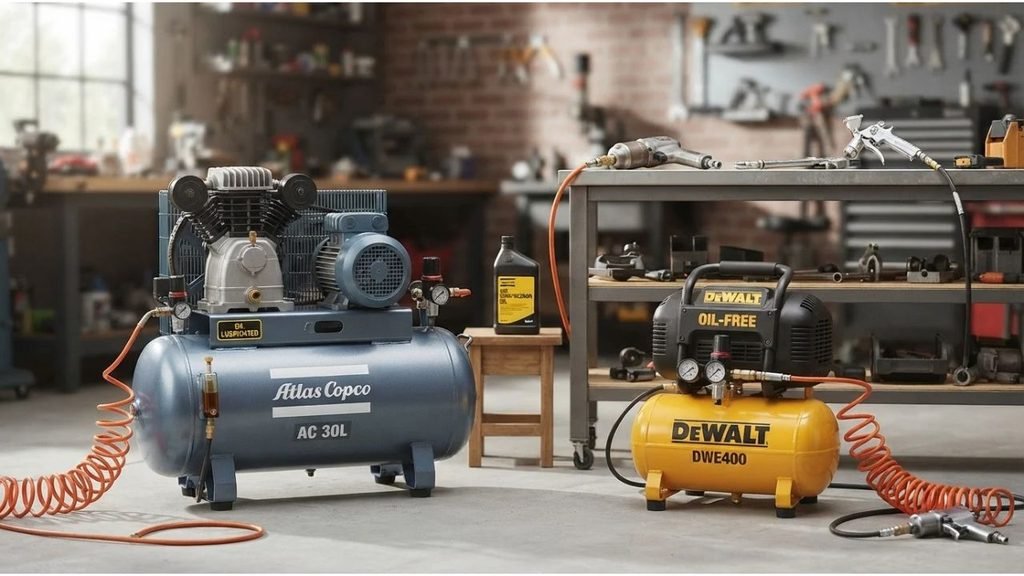
Not every compressor needs oil. Many small portable and pancake compressors use oil-free pumps, which require no crankcase oil at all. Larger reciprocating compressors, shop compressors, and many belt-driven models are commonly oil-lubricated.
Choosing the wrong lubricant can cause overheating, excessive deposits, poor cold-weather starting, premature pump wear, or inadequate lubrication.
This guide explains the common air-compressor oil types, viscosity grades, synthetic versus conventional options, oils you should avoid, and how to determine exactly what your compressor needs.
What Type of Oil Does an Air Compressor Take?
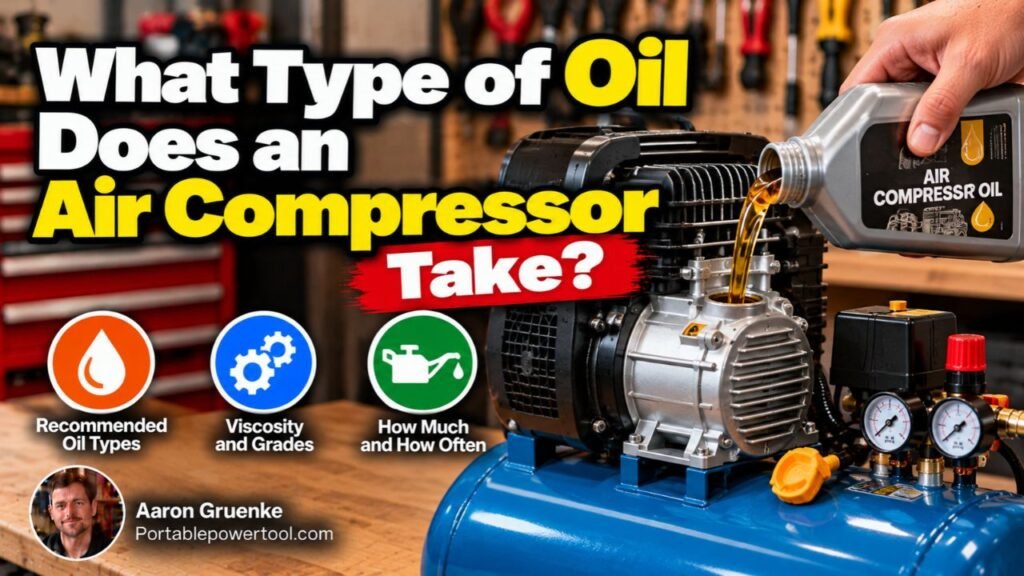
Most oil-lubricated reciprocating air compressors use a specially formulated, non-detergent compressor oil.
Common viscosity grades include:
- ISO 32 for colder operating conditions
- ISO 46 for moderate temperatures and some industrial applications
- ISO 68 for warmer conditions and many reciprocating compressors
- SAE 20 in some cooler-temperature applications
- SAE 30 in many warmer-temperature applications
These classifications are not perfectly interchangeable. ISO viscosity grades and SAE engine-oil grades use different rating systems, so you should not assume that oils with similar-looking numbers are identical.
The correct oil depends on your specific compressor.
Always check:
- Owner’s manual
- Pump identification label
- Manufacturer specifications
- Service documentation
If the manufacturer specifies a particular compressor lubricant, use that recommendation whenever possible.
Does Every Air Compressor Need Oil?
No.
Air compressors generally fall into two broad categories:
Oil-Lubricated Compressors
These compressors contain oil in the pump crankcase.
The lubricant helps protect:
- Bearings
- Connecting rods
- Crankshaft
- Cylinder surfaces
- Other moving components
Oil-lubricated designs are common on:
- Larger shop compressors
- Belt-driven compressors
- Some portable compressors
- Heavy-duty reciprocating compressors
- Industrial units
Oil-Free Compressors
An oil-free air compressor does not require the user to add compressor oil to its pump.
These designs typically use permanently lubricated bearings and low-friction materials or coatings.
Oil-free compressors are common among:
- Pancake compressors
- Small portable compressors
- Trim and finish-nailer compressors
- Home DIY units
Never add oil to a pump specifically designed to operate oil-free.
What Is Air Compressor Oil?
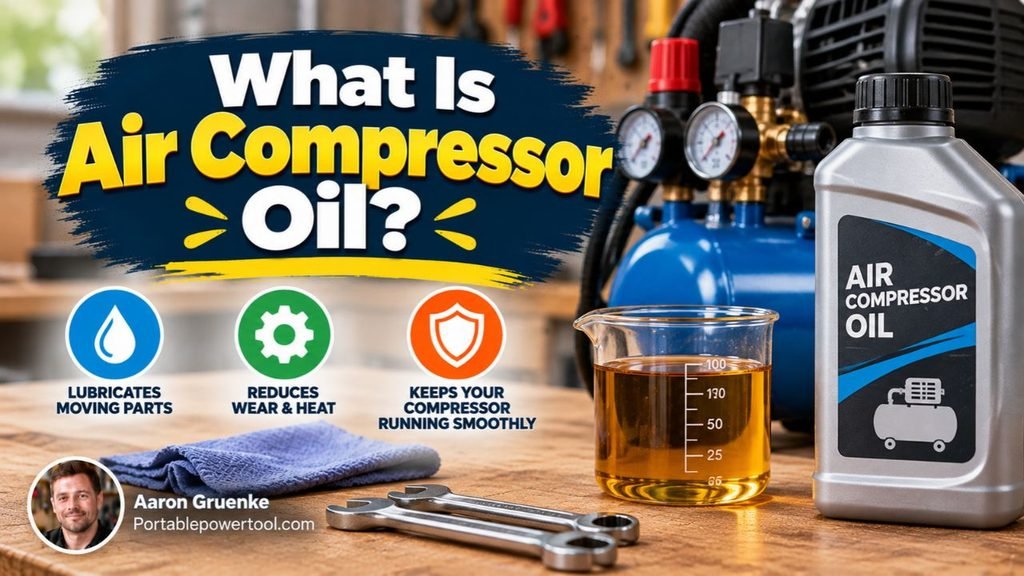
Air compressor oil is a lubricant designed for the operating conditions inside a compressor pump.
It must handle:
- High temperatures
- Continuous mechanical movement
- Pressure
- Moisture exposure
- Oxidation
- Long operating cycles
Unlike many automotive engine oils, compressor oils are often non-detergent.
Non-detergent oil does not contain the same cleaning additive package commonly used in modern motor oils.
This can be beneficial in certain compressor pumps because the lubricant is designed specifically around compressor operation rather than an internal-combustion engine.
Why Do Air Compressors Need Special Oil?
A compressor pump operates differently from a car engine.
An automotive engine deals with:
- Fuel combustion
- Soot
- Combustion byproducts
- Fuel contamination
- Very high localized temperatures
An air compressor pump primarily deals with:
- Mechanical friction
- Compression heat
- Moisture
- Oxidation
- Continuous pumping cycles
Compressor oil is formulated around these conditions.
Using the correct lubricant helps:
- Reduce friction
- Control wear
- Remove heat
- Protect internal parts
- Minimize carbon deposits
- Reduce oxidation
- Extend pump life
What Viscosity Air Compressor Oil Should You Use?
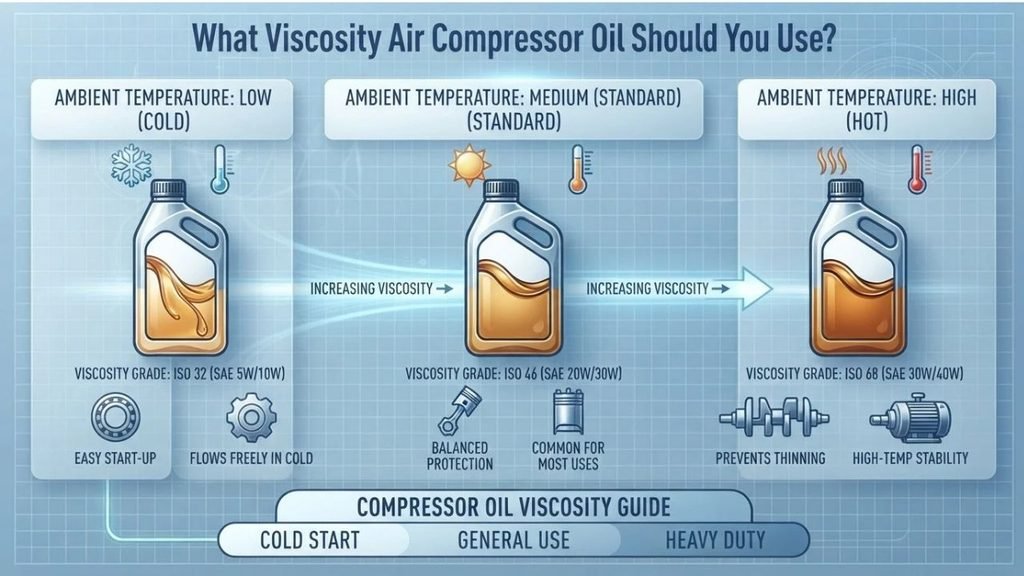
Viscosity describes how easily an oil flows.
A lower-viscosity oil flows more easily, especially in cold conditions. A higher-viscosity oil remains thicker at higher temperatures.
Common compressor oil grades include ISO 32, ISO 46, and ISO 68.
ISO 32 Compressor Oil
ISO 32 is relatively light.
It may be useful in:
- Cooler environments
- Applications requiring easier cold starts
- Equipment specifically designed for lower-viscosity lubricant
Do not switch to ISO 32 simply because the weather is cold unless the manufacturer allows it.
ISO 46 Compressor Oil
ISO 46 sits between ISO 32 and ISO 68 in viscosity.
It is widely used in various industrial lubrication applications and may be specified for certain compressor systems.
Always confirm that your pump calls for it.
ISO 68 Compressor Oil
ISO 68 is a common choice for many oil-lubricated reciprocating compressors.
It provides a relatively heavier oil film and is often used in moderate to warm environments.
Some compressor manufacturers specify an SAE 30 non-detergent oil for similar applications, but you should follow the exact stated specification rather than automatically substituting one for another.
SAE 20 vs. SAE 30 Compressor Oil
Some air-compressor manuals use SAE viscosity grades rather than ISO grades.
SAE 20
SAE 20 may be recommended for colder operating temperatures on certain compressors.
The thinner oil flows more easily at lower temperatures.
SAE 30
SAE 30 non-detergent oil is commonly recommended for many reciprocating compressors operating in moderate or warm conditions.
It maintains a thicker lubricating film as temperatures rise.
Do not automatically switch between SAE 20 and SAE 30 unless the manufacturer’s temperature recommendations permit it.
Can You Use 10W-30 in an Air Compressor?
Usually, you should not use ordinary 10W-30 motor oil unless the compressor manufacturer specifically approves it.
Most automotive 10W-30 oils contain detergent and additive packages designed for internal-combustion engines.
These additives may not be ideal for all compressor pumps.
If your compressor calls for non-detergent compressor oil, use the specified compressor lubricant rather than substituting ordinary automotive oil.
Can You Use 5W-30 in an Air Compressor?
The same general rule applies.
Do not use 5W-30 merely because it works in a vehicle engine.
A compressor’s lubrication requirements are different.
If the manual specifically approves a multi-viscosity synthetic or automotive-type lubricant, then follow that recommendation. Otherwise, use proper compressor oil.
Can You Use Motor Oil in an Air Compressor?
Sometimes a manufacturer may approve a specific motor-oil grade, but ordinary automotive engine oil should not be treated as a universal substitute for compressor oil.
The biggest difference is often the additive package.
Modern motor oils contain detergents, dispersants, friction modifiers, and other additives designed around engine operation.
Many reciprocating air compressors call for a non-detergent lubricant instead.
Using the wrong oil may contribute to:
- Foaming
- Deposits
- Increased oil carryover
- Poor lubrication
- Reduced compressor life
Always check the manual before substituting motor oil.
Can You Use Non-Detergent Motor Oil?
Some older or simpler reciprocating compressors specify non-detergent SAE oil.
If your compressor manual explicitly calls for SAE 30 non-detergent oil, an oil meeting that specification may be appropriate.
However, compressor-specific oil is generally the easier choice because it is formulated for compressor service.
Can You Use Synthetic Oil in an Air Compressor?
Yes, many oil-lubricated compressors can use synthetic compressor oil, provided the lubricant meets the manufacturer’s specifications.
Synthetic oil can offer advantages such as:
- Better cold-temperature flow
- Improved oxidation resistance
- Longer oil life
- Better high-temperature stability
- Reduced deposit formation
Synthetic lubricant can be especially useful for compressors that:
- Operate for long periods
- Work in temperature extremes
- See frequent use
- Experience demanding workloads
Do not assume every synthetic oil is compatible.
Use a synthetic compressor lubricant with the correct viscosity and specification.
Synthetic vs. Conventional Air Compressor Oil
Both can work well when approved for the compressor.
| Feature | Conventional Compressor Oil | Synthetic Compressor Oil |
| Initial cost | Lower | Higher |
| Heat resistance | Good | Usually better |
| Oxidation resistance | Good | Usually better |
| Cold-temperature flow | Adequate | Often better |
| Service interval | Typically shorter | May be longer |
| Best use | Normal household/shop use | Heavy or demanding operation |
The manufacturer’s maintenance interval still takes priority, even when synthetic oil is used.
Can You Mix Synthetic and Conventional Compressor Oil?
It is better to avoid mixing lubricants unless their compatibility is specifically confirmed.
Different oils can use different:
- Base stocks
- Additive systems
- Viscosities
- Formulations
Mixing may reduce some of the benefits of either lubricant.
If changing oil types, drain the old oil according to the manufacturer’s procedure and refill with the correct new lubricant.
Can You Use Hydraulic Oil in an Air Compressor?
Not automatically.
Hydraulic oil and compressor oil may share similar ISO viscosity ratings, but they can contain different additive packages.
For example, an ISO 46 hydraulic oil is not necessarily equivalent to an ISO 46 compressor oil.
Only use hydraulic oil if the compressor manufacturer explicitly specifies or approves it.
Can You Use Gear Oil in an Air Compressor?
Generally, no.
Gear oil is usually much heavier and contains additives intended for gear systems under extreme pressure.
It can be far too thick for a compressor pump.
Using gear oil may:
- Increase pump resistance
- Make cold starting difficult
- Reduce lubrication flow
- Increase motor load
- Cause overheating
Use the specified compressor lubricant instead.
Can You Use Engine Oil in an Air Compressor?
Only when specifically approved by the manufacturer.
Do not choose engine oil simply because the viscosity number appears similar.
An SAE 30 engine oil and an SAE 30 non-detergent compressor lubricant can contain very different additive packages.
The specification matters as much as the viscosity.
Can You Use Automatic Transmission Fluid?
ATF should not be used as a general substitute for compressor oil.
Automatic transmission fluid has its own viscosity, friction characteristics, and additive package.
Unless the compressor manufacturer specifically calls for ATF, use compressor oil.
What Oil Does a Small Portable Air Compressor Take?
First determine whether the compressor is oil-free.
Many small portable compressors require no oil at all.
If the compressor has:
- An oil sight glass
- An oil-fill cap
- A crankcase drain plug
- Oil-level markings
it is likely an oil-lubricated model.
Check its manual for the required grade.
Do not assume that all small compressors use the same oil.
What Oil Does a 20-Gallon Air Compressor Take?
Tank size does not determine oil type.
A 20-gallon compressor could use:
- An oil-free pump
- SAE 30 non-detergent compressor oil
- ISO 68 compressor oil
- Another manufacturer-specified lubricant
The pump design determines the lubricant, not the number of gallons in the air tank.
This applies to 6-gallon, 30-gallon, 60-gallon, and 80-gallon compressors as well.
What Oil Does a 60-Gallon Air Compressor Take?
Many stationary 60-gallon compressors use oil-lubricated reciprocating pumps, but there is no universal oil grade for every 60-gallon unit.
Depending on the manufacturer, the compressor may specify:
- ISO 68 compressor oil
- SAE 30 non-detergent oil
- Synthetic compressor lubricant
- A manufacturer-specific oil
Check the pump manual rather than selecting oil based on tank capacity.
How Do You Know What Oil Your Air Compressor Needs?
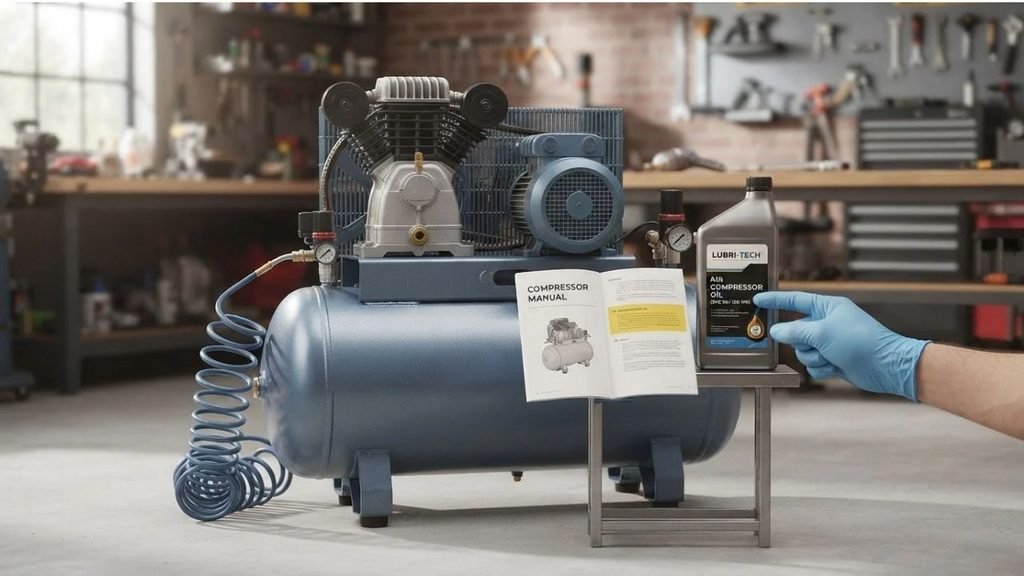
The safest method is to find the manufacturer’s specification.
Check the following places.
Owner’s Manual
The lubrication or maintenance section should list:
- Oil type
- Viscosity
- Oil capacity
- Change interval
- Temperature recommendations
Compressor Label
Some pumps have an oil specification printed or stamped near the fill port or sight glass.
Manufacturer Documentation
If the paper manual is missing, search using the exact compressor model and pump model.
The pump model can be especially important because different compressors may use the same tank size with different pumps.
How Much Oil Does an Air Compressor Need?
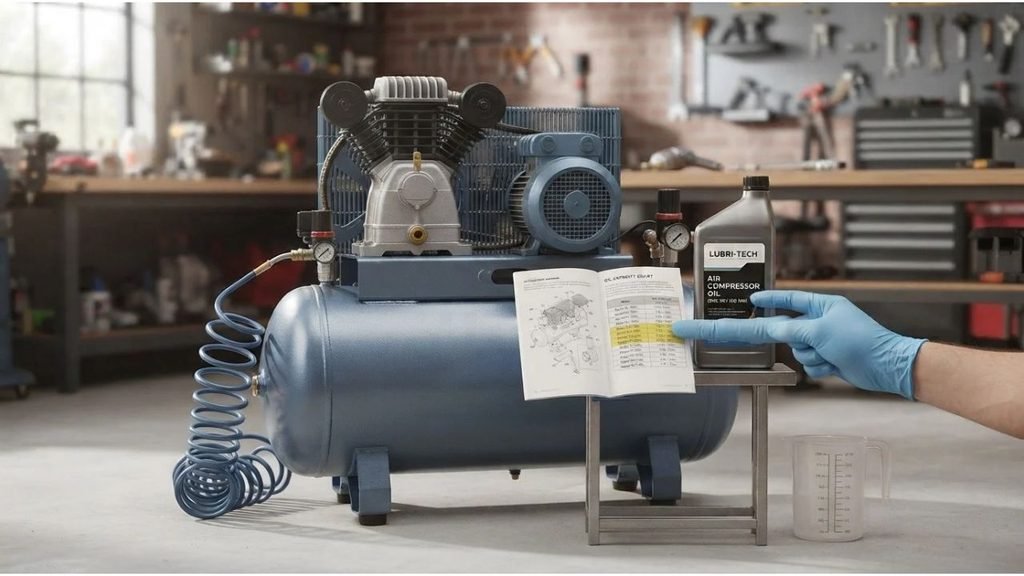
Oil capacity depends on the compressor pump.
Do not fill based on a guessed volume.
Many oil-lubricated compressors have a sight glass.
The correct level may be around the center of the sight glass, but designs vary.
Others use a dipstick.
Too little oil can cause inadequate lubrication.
Too much oil can cause:
- Foaming
- Excessive oil carryover
- Increased crankcase pressure
- Oil entering the compressed-air system
- Leaks
Always fill to the manufacturer’s specified level.
How to Check Air Compressor Oil Level
If your compressor has a sight glass:
- Turn the compressor off.
- Disconnect power.
- Place the unit on a level surface.
- Allow the oil to settle.
- Check the sight glass.
- Add oil only if the level is below the recommended mark.
If your compressor uses a dipstick, follow the manufacturer’s checking procedure because some dipsticks are read threaded in while others are read without threading them fully.
How Often Should You Change Air Compressor Oil?
Oil-change intervals vary by manufacturer, lubricant type, workload, and operating environment.
A compressor used every day may require more frequent servicing than one used occasionally in a home garage.
Factors that can shorten oil life include:
- High operating temperature
- Heavy use
- Dusty conditions
- Moisture
- Frequent long duty cycles
Follow the manufacturer’s hour-based or time-based maintenance schedule.
Synthetic lubricant may last longer in some applications, but do not automatically extend the interval beyond manufacturer recommendations.
Signs Your Air Compressor Oil Needs Changing
Oil may need attention if it becomes:
- Very dark
- Thick
- Contaminated
- Milky
- Full of visible particles
- Burnt smelling
A milky appearance can indicate water contamination.
However, oil color alone is not always a reliable measure of lubricant condition.
Scheduled maintenance remains the best approach.
What Happens If You Use the Wrong Air Compressor Oil?
Using an unsuitable lubricant can create several problems.
Possible effects include:
- Excessive heat
- Poor lubrication
- Increased pump wear
- Hard starting
- Carbon deposits
- Foaming
- Increased oil consumption
- Valve deposits
- Reduced compressor life
A compressor may continue operating for some time with the wrong oil, so lack of immediate failure does not mean the lubricant is appropriate.
What Happens If an Air Compressor Runs Without Oil?
An oil-lubricated pump depends on its lubricant to separate and protect moving metal parts.
Running it without adequate oil can lead to:
- Rapid bearing wear
- Scored cylinders
- Connecting-rod damage
- Crankshaft damage
- Severe overheating
- Pump seizure
If an oil-lubricated compressor has been operated with little or no oil and is making unusual noises, stop using it and inspect the pump before continuing.
Does Air Compressor Oil Go Into the Tank?
No.
Compressor oil goes into the pump crankcase, not the compressed-air storage tank.
The tank holds compressed air and collects some moisture that condenses out of the air.
Pouring oil into the tank would contaminate the compressed-air system and would not lubricate the compressor pump correctly.
Why Is There Oil in My Air Compressor Tank?
A small amount of oil carryover can occur in some oil-lubricated compressors, but excessive oil in the tank or air lines may indicate a problem.
Possible causes include:
- Overfilled crankcase
- Worn piston rings
- Excessive blow-by
- Incorrect lubricant
- Pump wear
- Long continuous operation
If substantial oil repeatedly appears in the tank or downstream air, inspect the compressor.
Does Compressor Oil Affect Air Tools?
The oil inside the compressor pump and the oil required by pneumatic tools are separate issues.
Some air tools need a small amount of pneumatic tool oil added through the tool’s air inlet or an inline lubricator.
Do not assume compressor crankcase oil is the correct lubricant for air tools.
Always use the lubricant specified by the air-tool manufacturer.
Air Compressor Oil vs. Air Tool Oil
These two oils serve different purposes.
Air compressor oil lubricates internal compressor-pump components.
Air tool oil lubricates pneumatic tools such as:
- Impact wrenches
- Air ratchets
- Nailers
- Pneumatic grinders
Never substitute one automatically for the other.
Tips for Choosing the Right Air Compressor Oil
Before purchasing oil, confirm:
- Compressor is oil-lubricated
- Correct viscosity grade
- Detergent or non-detergent requirement
- Synthetic or conventional approval
- Operating-temperature requirements
- Manufacturer specifications
The model-specific manual should always take priority over general advice.
Common Air Compressor Oil Mistakes
Choosing Oil Based Only on Tank Size
Tank size does not determine lubrication requirements.
The pump does.
Using Automotive Oil Without Checking
A similar viscosity number does not guarantee compatibility.
Overfilling the Pump
More oil does not mean better lubrication.
Maintain the specified level.
Mixing Random Oils
Different additive packages may not work well together.
Ignoring Temperature
Oil that is too thick in cold conditions can make starting difficult.
Oil that is too thin at high temperatures may provide inadequate protection.
Adding Oil to an Oil-Free Compressor
Oil-free pumps are not designed to receive crankcase oil.
Adding lubricant where it does not belong can damage the unit.
FAQs About What Type of Oil Does an Air Compressor Take
What type of oil does an air compressor take most commonly?
Many oil-lubricated reciprocating air compressors use non-detergent compressor oil, commonly ISO 68 or SAE 30 in moderate to warm conditions.
However, always follow the specific manufacturer’s recommendation.
Can I use SAE 30 motor oil in my air compressor?
Only if the manufacturer specifies or permits it.
Many compressors that call for SAE 30 specifically require a non-detergent oil rather than ordinary detergent motor oil.
Is ISO 68 good for an air compressor?
ISO 68 is commonly used in many reciprocating air compressors, particularly in moderate or warmer operating environments.
It is only appropriate if it matches the compressor manufacturer’s specification.
Is synthetic oil better for an air compressor?
Synthetic compressor oil can provide better high-temperature stability, oxidation resistance, and cold-weather flow.
However, conventional compressor oil can work perfectly well when it meets the manufacturer’s requirements.
Can I use 10W-30 motor oil in my air compressor?
Do not use 10W-30 unless the compressor manufacturer specifically approves it.
Most modern automotive 10W-30 oils contain detergent additives that may not be suitable for compressors requiring non-detergent oil.
Can I use hydraulic oil in my air compressor?
Only if the manufacturer approves that specific type and viscosity.
Hydraulic oil and compressor oil can have different additive packages even when their ISO viscosity grades match.
How do I know if my air compressor is oil-free?
Look for the manual or model specifications.
Oil-free compressors generally lack an oil-fill cap, crankcase sight glass, and oil drain plug.
Does a pancake air compressor need oil?
Many pancake compressors are oil-free and require no pump oil.
Some designs may differ, so check the specific model’s manual.
Conclusion
If you are trying to determine what type of oil does an air compressor take, start with the compressor manufacturer’s specifications rather than choosing oil by tank size or appearance. Many oil-lubricated reciprocating compressors use non-detergent compressor oil, with ISO 32, ISO 46, ISO 68, SAE 20, or SAE 30 being common depending on pump design and operating temperature.
Oil-free compressors need no crankcase lubricant, while oil-lubricated models must maintain the correct type and oil level to protect the pump.
Avoid substituting engine oil, hydraulic oil, gear oil, or other lubricants unless the manufacturer specifically approves them. Using the correct compressor oil helps control heat, reduce friction, prevent deposits, and extend the life of the compressor pump.