
How Much Oil Does an Air Compressor Take? Capacity Guide
Oil is essential in an oil-lubricated air compressor because it reduces friction, helps control heat, protects internal components, and allows the compressor pump to operate smoothly. However, the correct amount varies considerably from one compressor to another. Tank size alone does not determine oil capacity.
If you are trying to figure out how much oil does an air compressor take, the owner’s manual, pump data plate, and oil sight glass are the most reliable sources. A small portable compressor might require only several ounces, while a larger stationary compressor may need a quart or more depending on its pump design.
Many oil-lubricated air compressor pumps hold roughly 8 ounces to more than 1 quart of oil, but there is no universal capacity. A 60-gallon air compressor commonly requires roughly 16 to 32 ounces in many designs, although some models need more or less. Always use the manufacturer’s stated capacity and oil-level indicator for the final fill.
This distinction is especially important for 60-gallon compressors. Two compressors can both have 60-gallon tanks while using completely different pump assemblies, horsepower ratings, and oil capacities.
This guide explains typical compressor oil capacities, how much oil does a 60 gallon air compressor take, how to check the level correctly, why overfilling is harmful, and how to determine the exact amount for your compressor.
How Much Oil Does an Air Compressor Take?
The amount of oil an air compressor takes depends primarily on the compressor pump, not the size of the air receiver tank.
As a broad reference, oil-lubricated reciprocating compressors may hold anywhere from several ounces to more than a quart of compressor oil.
A rough planning guide looks like this:
| Air Compressor Type | Approximate Oil Capacity Range |
| Small portable oil-lubricated compressor | About 6–16 oz |
| Medium shop compressor | About 12–24 oz |
| 20–30 gallon compressor | Often about 12–24 oz |
| 60-gallon compressor | Often about 16–32 oz or more |
| Large two-stage compressor | About 24–40+ oz in some designs |
These ranges are only general examples.
Your compressor may fall outside them.
The correct amount is whatever brings the oil to the manufacturer’s specified level without exceeding it.
Why Air Compressor Oil Capacity Varies
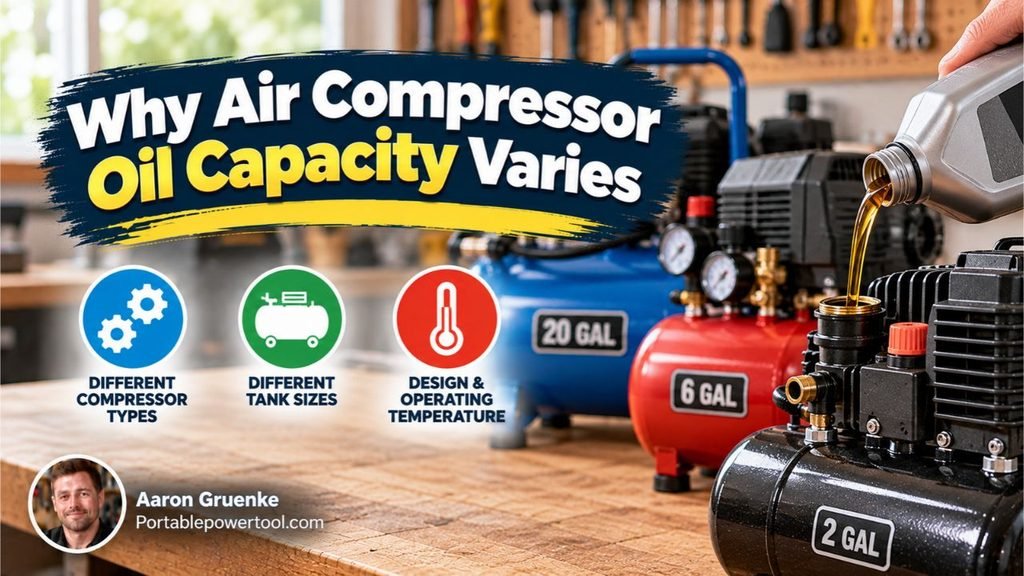
Air compressors that look similar can require very different amounts of oil.
Several design factors affect capacity.
Compressor Pump Size
Larger pumps generally contain:
- Larger crankcases
- Larger crankshafts
- More bearings
- Larger connecting rods
- Additional cylinders
A larger crankcase usually requires more lubricant.
Single-Stage vs. Two-Stage Pump
A single-stage compressor compresses air to its final pressure in one main compression stage.
A two-stage compressor compresses the air in one cylinder and then compresses it again in another.
Two-stage pumps are often larger and may contain more oil, although pump design matters more than the stage count alone.
Number of Cylinders
A small single-cylinder pump may require much less oil than a large twin-cylinder or multi-cylinder pump.
Pump Manufacturer
The tank manufacturer and pump manufacturer may not always be the same.
Different pump designs can be installed on similarly sized compressors.
This is one reason you should identify the actual model number instead of estimating oil capacity from tank size.
How Much Oil Does a 60 Gallon Air Compressor Take?
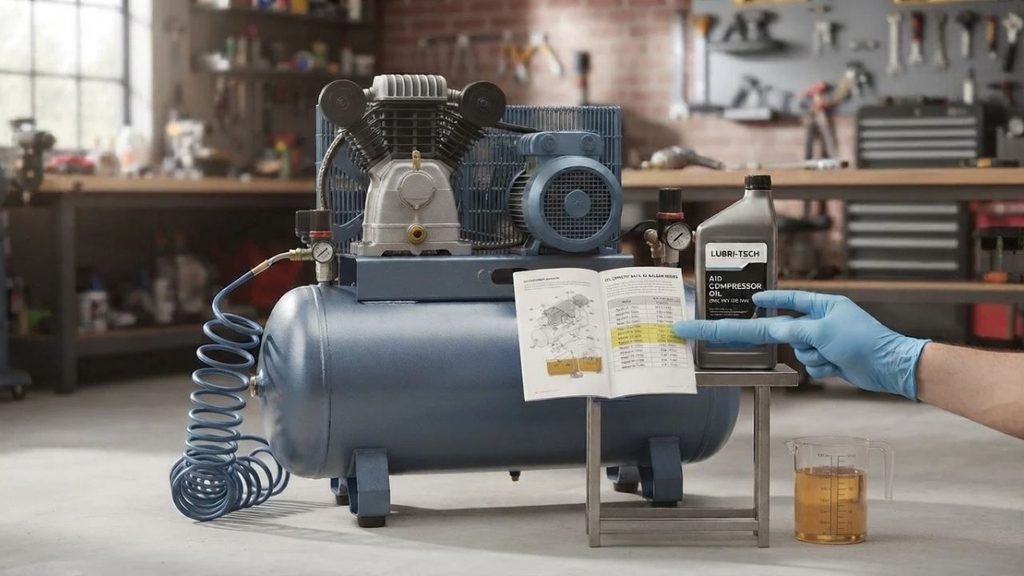
If you are asking how much oil does a 60 gallon air compressor take, a common range for many oil-lubricated models is approximately 16 to 32 fluid ounces, or roughly 0.5 to 1 quart.
Some heavy-duty or two-stage 60-gallon compressors may require more.
Others can require less.
The 60-gallon rating describes the air receiver tank capacity, not the crankcase oil capacity.
For example, two 60-gallon compressors might have:
- Different horsepower motors
- Different compressor pumps
- Different RPM ratings
- Single-stage or two-stage designs
- Different crankcase dimensions
One might take around half a quart while another might require closer to a full quart or more.
Never automatically pour an entire quart into a 60-gallon compressor unless the manufacturer’s specifications call for that amount.
Does Air Tank Size Determine Oil Capacity?
No.
This is one of the most common misunderstandings about compressor oil.
The air tank stores compressed air.
The oil is stored in the compressor pump crankcase.
These are separate systems.
A 60-gallon compressor does not need more oil simply because its tank is larger than a 20-gallon tank.
Pump design determines oil capacity.
A large tank can even be paired with a relatively modest pump, while a smaller industrial compressor may use a much larger pump assembly.
How to Find the Exact Oil Capacity of Your Compressor
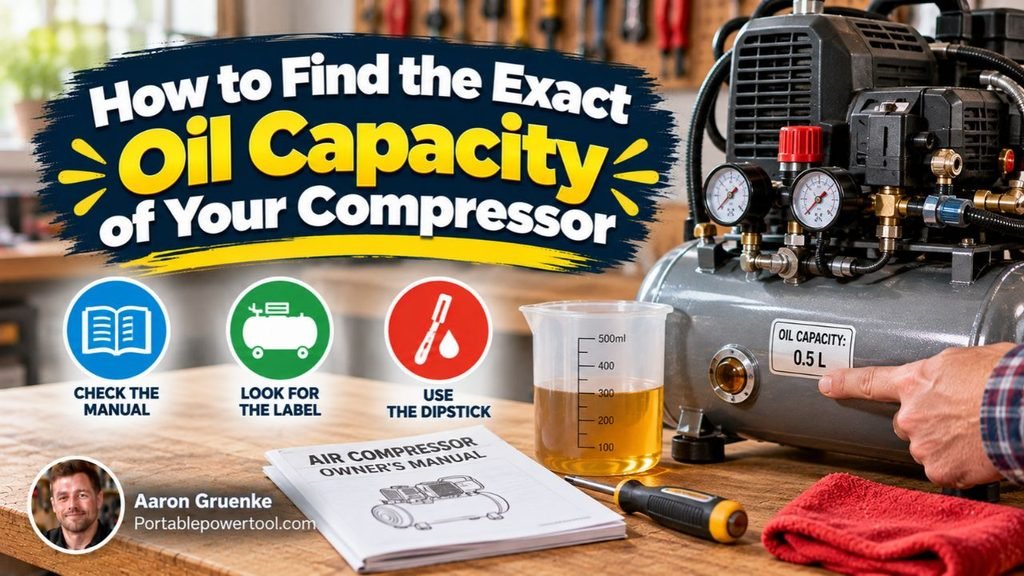
There are several reliable methods.
Check the Owner’s Manual
The owner’s manual should be your first source.
Look under sections such as:
- Lubrication
- Maintenance
- Specifications
- Pump oil
- Oil change
- Crankcase capacity
The manual may list oil capacity in:
- Fluid ounces
- Quarts
- Liters
- Milliliters
Use the stated specification rather than a general internet estimate whenever possible.
Check the Pump Label
Some compressor pumps have a label or data plate containing the pump model.
Once you identify the pump model, you can locate its correct lubrication specifications.
This can be especially useful on older compressors where the tank or motor may have been replaced.
Use the Oil Sight Glass
Many oil-lubricated compressors have an oil sight glass on the side of the pump crankcase.
This gives you a direct visual indication of oil level.
A common sight glass has:
- A center dot
- Maximum/minimum marks
- A red reference point
The correct level is often near the center of the sight glass, although you should follow the markings for your particular pump.
Check the Dipstick
Some compressors use an oil dipstick instead of a sight glass.
Remove the dipstick according to the manufacturer’s instructions, wipe it clean, reinstall it as specified, and check the level again.
Follow the particular procedure because some dipsticks are checked threaded in while others are checked resting on the opening.
How to Check Air Compressor Oil Level Correctly
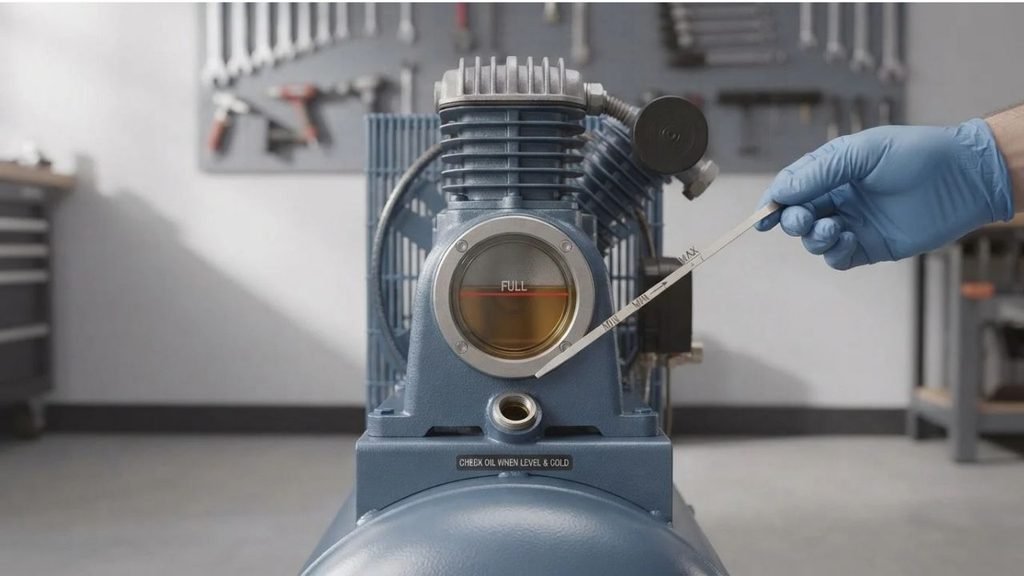
Checking the oil on an uneven surface can give you an inaccurate reading.
For most compressors:
- Turn the compressor off.
- Disconnect electrical power.
- Allow the pump to cool.
- Place the compressor on a level surface.
- Allow oil to settle in the crankcase.
- Check the sight glass or dipstick.
- Add small amounts if the level is low.
Do not check the oil immediately after moving or tilting the compressor.
Oil may temporarily collect on one side of the crankcase.
Where Should the Oil Level Be in the Sight Glass?
On many compressors, the oil should appear approximately around the middle of the sight glass when the machine is level and turned off.
Some sight glasses have a red dot or line marking the target level.
However, not every compressor uses the same design.
If the manufacturer marks:
- Minimum
- Maximum
- Full
follow those marks.
Do not assume filling the sight glass completely means the compressor is properly filled.
In many pumps, a completely full sight glass indicates overfilling.
How to Add Oil to an Air Compressor
Adding oil is usually straightforward.
1. Turn Off and Disconnect the Compressor
Unplug a portable unit or disconnect power to a hardwired compressor according to safe electrical procedures.
Never add oil while the compressor is running.
2. Locate the Oil Fill Port
The fill opening may have:
- A threaded cap
- A vented breather cap
- A dipstick
- A plug
Do not confuse the oil-fill opening with another pump plug.
3. Check the Existing Oil Level
Before adding anything, determine whether the compressor is actually low.
Adding oil without checking can lead to overfilling.
4. Add Oil Slowly
Pour a small amount at a time.
Use a clean funnel if necessary.
Give the oil a moment to settle before checking again.
5. Stop at the Correct Level
Once the sight glass or dipstick indicates the proper level, stop adding oil.
More oil is not better.
6. Reinstall the Fill Cap
Make sure the cap or breather is installed correctly before operating the compressor.
What Happens If You Put Too Much Oil in an Air Compressor?
Overfilling an air compressor can cause operational problems.
Too much oil can cause the crankshaft or moving components to churn the lubricant excessively.
Possible symptoms include:
- Oil leaking from the breather
- Excessive oil mist
- Oil entering the intake system
- Foaming
- Increased crankcase pressure
- Oil being carried into compressed air
- Higher operating temperature
- Poor compressor performance
In severe cases, excess oil may contribute to mechanical problems.
If you accidentally overfill the compressor, remove the excess before operating it.
What Happens If an Air Compressor Does Not Have Enough Oil?
Running an oil-lubricated compressor with insufficient oil can cause serious pump damage.
Oil provides lubrication for internal components such as:
- Crankshaft
- Bearings
- Connecting rods
- Cylinder-related components
Low oil can increase:
- Friction
- Heat
- Metal wear
Potential consequences include:
- Knocking or unusual noises
- Overheating
- Accelerated bearing wear
- Scoring
- Seized pump components
- Complete pump failure
Some compressors have a low-oil shutdown system, but you should never rely on it as a substitute for checking the oil level.
What Type of Oil Should You Put in an Air Compressor?
Oil quantity and oil type are equally important.
Many reciprocating compressors use a specific air compressor oil rather than ordinary automotive engine oil.
The correct viscosity may vary.
Common compressor-oil viscosity grades include products comparable to:
- ISO 68
- SAE 20
- SAE 30
But these are not interchangeable recommendations for every compressor.
Always check the manufacturer’s specification.
Detergent vs. Non-Detergent Oil
Many traditional reciprocating compressors specify non-detergent compressor oil.
Automotive engine oils often contain detergent and additive packages designed for internal-combustion engines.
Those additives may not be ideal for every compressor pump.
Some modern manufacturers approve specific synthetic compressor oils or other specialized lubricants.
Use the oil type listed for your pump.
Can You Use Motor Oil in an Air Compressor?
Only if the manufacturer specifically permits it.
Using ordinary automotive motor oil simply because the viscosity seems similar is not always appropriate.
Motor oil may contain:
- Detergents
- Friction modifiers
- Other automotive additives
A compressor oil is formulated specifically for compressor operating conditions.
If the manual specifies non-detergent compressor oil, use that type.
How Much Oil Should You Buy for an Oil Change?
You do not necessarily need to know the capacity perfectly before purchasing oil.
For many small or medium reciprocating compressors, buying a 1-quart bottle may provide enough oil for a change, depending on the pump.
For larger compressors, purchasing additional oil may be necessary.
For example, if the manual states:
- 20 ounces capacity
a 1-quart container holds 32 fluid ounces, leaving some oil for future top-offs.
If the compressor holds more than a quart, buy enough to meet the actual specification.
Should You Drain All the Old Oil Before Refilling?
For a normal oil change, yes.
Removing old oil helps eliminate:
- Contaminants
- Oxidized oil
- Moisture
- Fine wear particles
A typical oil-change process is:
- Warm the compressor briefly if recommended so the oil flows easily.
- Turn off and disconnect power.
- Relieve pressure and allow safe access.
- Place a container under the drain plug.
- Remove the oil-fill cap.
- Open the drain plug.
- Allow old oil to drain.
- Reinstall the drain plug.
- Add fresh oil gradually.
- Check the final level.
Follow your manufacturer’s instructions because drain locations and procedures vary.
How Often Should Air Compressor Oil Be Changed?
There is no universal interval for every compressor.
Oil-change frequency depends on:
- Compressor design
- Oil type
- Operating hours
- Ambient temperature
- Work environment
- Duty cycle
- Manufacturer recommendations
A compressor used every day in a hot, dusty shop may require maintenance more frequently than a homeowner’s compressor used occasionally.
Many manufacturers base oil changes on operating hours rather than calendar time.
Always follow the maintenance schedule for your specific model.
Why Air Compressor Oil Level Can Drop
A compressor should not consume large amounts of oil rapidly under normal conditions.
If the oil level keeps dropping, inspect for possible problems.
Common causes include:
- Oil leaks
- Loose drain plug
- Damaged gasket
- Crankcase breather problems
- Excessive blow-by
- Worn piston rings
- Oil carryover
- Overheating
Adding oil repeatedly without finding the cause can allow a mechanical problem to become worse.
Does a New Air Compressor Come With Oil?
It depends on the model.
Some oil-lubricated compressors are shipped with oil already in the crankcase.
Others:
- Include a bottle of oil separately
- Require the owner to purchase oil
- Contain only shipping oil that must be handled according to instructions
Never assume a new compressor is ready to operate.
Check the oil level before the first startup.
Running a dry compressor pump can cause damage very quickly.
Do Oil-Free Air Compressors Need Oil?
An oil-free air compressor does not normally require the user to add crankcase oil to the compressor pump.
Oil-free designs use different materials and lubrication methods.
If your compressor is labeled:
- Oil-free
- Maintenance-free
- Oil-less
do not pour compressor oil into it.
The presence of a 60-gallon tank also does not automatically mean the unit is oil-lubricated.
Identify the pump type first.
60-Gallon Air Compressor Oil Capacity: Why Model Matters
A 60-gallon compressor is a popular size for:
- Home garages
- Automotive shops
- Woodworking
- Impact tools
- Spray equipment
- General pneumatic tools
However, the tank capacity tells you very little about the amount of oil.
A 60-gallon machine may use a:
- Single-stage pump
- Two-stage pump
- Belt-driven pump
- Direct-drive system
- Oil-lubricated pump
- Oil-free pump
Even two 60-gallon compressors from the same brand may have different pump designs depending on model and production year.
That is why the question how much oil does a 60 gallon air compressor take should always be answered using the specific compressor’s model number.
Common Mistakes When Filling Air Compressor Oil
Filling Based Only on Tank Size
A 60-gallon tank does not automatically equal a particular oil capacity.
Check the pump.
Filling the Sight Glass Completely
On many compressors, full coverage of the sight glass means the pump is overfilled.
Use the indicated center or full mark.
Guessing the Oil Type
The correct amount of the wrong lubricant can still cause problems.
Verify the required oil specification.
Adding a Full Quart Without Checking
Do not empty an entire oil bottle into the compressor simply because it is convenient.
Add gradually and monitor the level.
Checking Oil on an Uneven Floor
Even a slight tilt can change the sight-glass reading.
Level the compressor first.
Running the Compressor With Low Oil
Do not continue operating an oil-lubricated compressor when the oil level is below the specified minimum.
FAQs About How Much Oil Does an Air Compressor Take
How much oil does an air compressor take?
Oil-lubricated compressor pumps can take anywhere from several ounces to more than a quart depending on the pump.
Many small-to-medium reciprocating compressors fall roughly in the 8–32 ounce range, but you should always check the model-specific specification.
How much oil does a 60 gallon air compressor take?
Many 60-gallon oil-lubricated air compressors take approximately 16–32 ounces of oil, although some pumps require more or less.
Tank size does not determine oil capacity, so verify the pump specification before filling.
How do I know when my air compressor has enough oil?
Check the sight glass or dipstick while the compressor is off and level.
On many models, the proper oil level is approximately at the middle of the sight glass or at the manufacturer’s marked fill line.
Can you put too much oil in an air compressor?
Yes.
Overfilling can cause foaming, oil leakage, excessive crankcase pressure, oil carryover, and other operating problems.
Drain excess oil until the level reaches the correct mark.
How much oil does a 20-gallon air compressor take?
There is no universal amount.
Some 20-gallon oil-lubricated compressors may hold roughly 8–20 ounces, while other pump designs can differ.
Check the manufacturer’s specifications.
Do you fill compressor oil to the top of the sight glass?
Usually, no.
Many compressor pumps should have oil around the center mark of the sight glass, not completely covering it.
Follow the marks on your specific compressor.
Can I use SAE 30 oil in my air compressor?
Some compressors specify SAE 30 or a comparable compressor lubricant, but not all do.
Use SAE 30 only when it matches the manufacturer’s requirements.
What happens if I run my air compressor with no oil?
An oil-lubricated compressor can overheat and suffer severe internal wear or seizure if operated without sufficient oil.
Turn it off immediately if you discover the pump is running with little or no oil.
Conclusion
The answer to how much oil does an air compressor take depends on the compressor pump rather than the size of its air tank. Small compressors may require only several ounces, while larger stationary pumps can hold a quart or more.
For anyone asking how much oil does a 60 gallon air compressor take, roughly 16–32 ounces is a reasonable range for many oil-lubricated models, but it should never replace the specification for your particular pump.
Check the owner’s manual, model number, sight glass, or dipstick before adding oil. Fill gradually, keep the compressor level, use the correct compressor oil, and avoid both underfilling and overfilling. The correct oil level and lubricant type can significantly affect pump reliability and service life.