
Can You Use Air Compressor Oil in a Vacuum Pump? Or Vice Versa
Air compressors and vacuum pumps both use lubricating oil in some designs, and the oils can look very similar. That makes it tempting to use whichever lubricant is already available in the shop. However, the two machines operate under different conditions, and their oils are formulated around different lubrication, sealing, vapor-pressure, and contamination requirements.
In most cases, you should not use air compressor oil in a vacuum pump, and you should not use vacuum pump oil in an air compressor unless the equipment manufacturer specifically approves the substitution.
So, can you use air compressor oil in a vacuum pump? Usually, no. A vacuum pump—especially a rotary-vane HVAC vacuum pump—normally requires dedicated vacuum pump oil with very low vapor pressure and specific viscosity characteristics so the pump can achieve and maintain a deep vacuum. Ordinary compressor oil may vaporize more readily under vacuum, reduce ultimate vacuum performance, increase oil mist, or interfere with proper sealing inside the pump.
The reverse substitution is also generally not recommended. If you are wondering, can you use vacuum pump oil in an air compressor, the answer is usually no because compressor oil is selected to handle the heat, oxidation, mechanical loads, moisture, and operating conditions inside a compressor pump.
Although both are lubricants, they are not automatically interchangeable. This article explains the differences, what can happen if you use the wrong oil, whether temporary substitution is ever acceptable, and how to choose the correct lubricant for each machine.
Can You Use Air Compressor Oil in a Vacuum Pump?
Generally, air compressor oil should not be used in a vacuum pump unless the vacuum pump manufacturer specifically lists that oil as acceptable.
Vacuum pumps depend on their oil for more than simple lubrication. In many oil-sealed vacuum pumps, the lubricant also helps:
- Seal internal clearances
- Carry away heat
- Protect moving parts
- Trap or transport contaminants
- Help the pump achieve a low absolute pressure
Because the pump operates below atmospheric pressure, the oil’s vapor pressure becomes especially important.
An oil that performs perfectly well inside an air compressor may not perform correctly in a deep vacuum.
Can You Use Vacuum Pump Oil in an Air Compressor?
Usually, no.
Vacuum pump oil should not automatically be used in an air compressor because the compressor may require a different viscosity, additive package, oxidation resistance, or anti-wear performance.
Air compressors operate by increasing air pressure, which creates substantial heat. Compressor lubricant may need to withstand:
- High discharge temperatures
- Oxidation
- Mechanical loading
- Moisture
- Long operating periods
- Carbon and deposit formation
Vacuum pump oil is optimized for a different operating environment.
If the compressor manufacturer specifies a certain compressor oil, ISO viscosity grade, synthetic lubricant, or proprietary fluid, that specification should be followed.
Is Vacuum Pump Oil the Same as Air Compressor Oil?
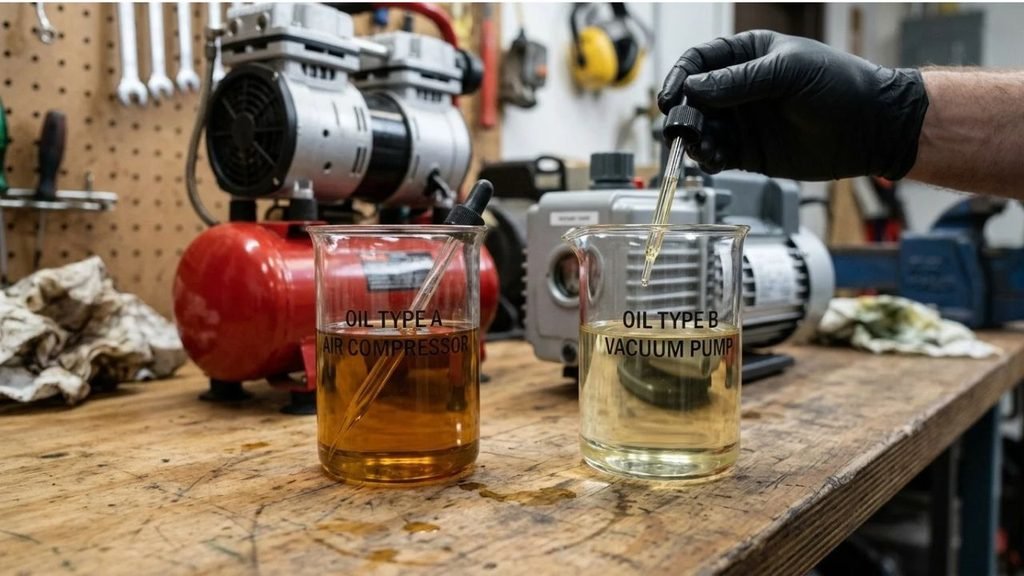
No. Vacuum pump oil and air compressor oil are not necessarily the same product, even though they may both be mineral-based or synthetic lubricants.
A simple comparison is:
| Feature | Vacuum Pump Oil | Air Compressor Oil |
| Primary application | Oil-sealed vacuum pumps | Oil-lubricated compressors |
| Key concern | Low vapor pressure | Heat and oxidation resistance |
| Helps provide sealing | Often yes | Depends on compressor design |
| Typical operating environment | Below atmospheric pressure | Above atmospheric pressure |
| Additive requirements | Often carefully controlled | Depends on compressor type |
| Interchangeable? | Usually no | Usually no |
The exact chemistry depends on the manufacturer and machine type, but the intended service is different.
Why Vacuum Pumps Need Special Oil
A vacuum pump creates pressure below normal atmospheric pressure.
As the pressure drops, liquids can evaporate more easily. That includes lubricant.
If the oil evaporates significantly inside the pump, those vapor molecules contribute to the pressure inside the vacuum system.
This can prevent the pump from reaching the vacuum level it was designed to achieve.
That is why good vacuum pump oil has a low vapor pressure.
What Is Vapor Pressure?
Vapor pressure describes how readily a liquid produces vapor at a given temperature.
A lubricant with relatively high vapor pressure releases more molecules into the gas phase.
Inside a deep vacuum system, that can become a serious limitation.
Vacuum pump oil is selected so that it remains stable and produces relatively little vapor at the pump’s operating pressure and temperature.
Why Compressor Oil May Not Work Well in a Vacuum Pump
Compressor oil is designed around compressor operation, not necessarily deep-vacuum conditions.
Using it in a vacuum pump can potentially cause several problems.
Reduced Ultimate Vacuum
The pump may not be able to pull down to its normal vacuum level.
The oil itself may contribute vapor that increases the measured pressure.
Increased Oil Mist
An unsuitable oil may generate more mist or vapor through the exhaust.
Poor Internal Sealing
The wrong viscosity may reduce the pump’s ability to seal clearances between internal components.
Increased Wear
If the oil does not provide the required film strength or lubrication characteristics, internal wear can increase.
Deposit Formation
Some oils may form residues or deposits under operating conditions for which they were not intended.
Contamination of the Vacuum System
Oil vapor or mist can migrate into hoses, manifolds, chambers, or other connected equipment.
Why HVAC Vacuum Pumps Are Especially Sensitive
Vacuum pumps used for HVAC and refrigeration service often need to pull very deep vacuums before a system is charged with refrigerant.
Technicians may evacuate a system to a pressure measured in microns, where lubricant quality and contamination can have a noticeable effect on pump performance.
Vacuum pump oil in these applications helps the pump:
- Reach low micron levels
- Maintain internal sealing
- Remove heat
- Protect rotary vanes and bearings
If the oil contains moisture or is the wrong formulation, evacuation may take longer or stall at a higher pressure.
For HVAC vacuum pumps, use the oil specified by the pump manufacturer.
What Happens If You Put Air Compressor Oil in a Vacuum Pump?
The result depends on the pump and the oil, but possible symptoms include:
- Pump cannot reach normal vacuum
- Slow evacuation
- Higher micron readings
- Increased exhaust mist
- Louder pump operation
- Elevated pump temperature
- Poor lubrication
- Shorter pump life
A small accidental amount may not immediately destroy the pump, but continued operation with an unsuitable lubricant is not a good idea.
If the wrong oil was added, draining and replacing it with the correct vacuum pump oil is usually the sensible next step.
What Happens If You Put Vacuum Pump Oil in an Air Compressor?
Again, the consequences depend on the compressor design and lubricant.
Possible problems include:
- Incorrect viscosity
- Inadequate bearing protection
- Increased wear
- Excessive oxidation
- Foaming
- Higher operating temperature
- Shortened compressor life
Some vacuum pump oils may be chemically similar to certain non-detergent compressor oils, but similarity does not guarantee suitability.
A compressor manufacturer may require a lubricant with specific:
- ISO viscosity grade
- Flash point
- Oxidation resistance
- Anti-wear characteristics
- Base oil
- Additive package
Always match the lubricant to the equipment specification.
The Importance of Oil Viscosity
Viscosity is the oil’s resistance to flow.
If an oil is too thin, it may not maintain a strong enough lubricating film or seal internal clearances properly.
If it is too thick, it can:
- Increase drag
- Make cold starting difficult
- Reduce pumping efficiency
- Increase energy consumption
Both vacuum pumps and air compressors are designed around a certain lubricant viscosity.
That is why matching viscosity alone is useful—but still not enough to prove that two oils are interchangeable.
Vacuum Pump Oil Needs More Than the Correct Viscosity
Two oils can have similar viscosity but very different performance under vacuum.
Vacuum pump oil also needs appropriate:
- Vapor pressure
- Volatility
- Thermal stability
- Oxidation resistance
- Moisture behavior
- Seal compatibility
A compressor oil with a similar ISO grade may still produce more vapor under deep vacuum.
That can prevent the pump from achieving its rated performance.
Compressor Oil Needs More Than the Correct Viscosity
The same principle works in reverse.
A vacuum pump oil might have a viscosity that appears suitable for an air compressor, but the compressor may need different resistance to:
- High-temperature oxidation
- Water separation problems
- Foaming
- Deposit formation
- Mechanical loading
The compressor oil specification is chosen around the pump design and operating temperature.
Mineral vs Synthetic Oil
Both vacuum pump oil and compressor oil can be made from mineral or synthetic base stocks.
That does not make oils interchangeable.
Mineral Oils
Mineral oils are refined from petroleum.
They are common in:
- Reciprocating compressors
- Rotary-vane vacuum pumps
- General industrial lubrication
Synthetic Oils
Synthetic lubricants may offer advantages such as:
- Better oxidation resistance
- Longer service life
- Wider temperature range
- Reduced deposits
However, one synthetic lubricant is not automatically compatible with another application.
The correct equipment specification still matters.
Can You Use Non-Detergent Compressor Oil in a Vacuum Pump?
Not automatically.
Some people assume that because certain vacuum pump oils and compressor oils are both non-detergent mineral oils, they are interchangeable.
That is not a safe general rule.
A vacuum pump lubricant must still have sufficiently low vapor pressure and the right viscosity for the pump.
Use non-detergent compressor oil only if the vacuum pump manufacturer explicitly identifies it as an approved alternative.
Can You Use Vacuum Pump Oil in a Reciprocating Air Compressor?
Usually not unless approved.
A reciprocating air compressor uses a piston and crankshaft system that places mechanical and thermal demands on the lubricant.
The compressor manufacturer may require a particular ISO-grade compressor oil.
Vacuum pump oil may not provide the desired:
- Load-carrying capability
- Oxidation stability
- Deposit resistance
- Temperature performance
Even if the compressor runs initially, long-term performance may suffer.
Can You Use Vacuum Pump Oil in a Rotary Screw Compressor?
Do not substitute it unless specifically approved.
Rotary screw compressors can be especially sensitive to lubricant formulation.
The lubricant may perform several jobs at once:
- Lubricating bearings
- Sealing between rotors
- Removing heat
- Protecting against oxidation
- Managing water
- Carrying contaminants
Many rotary screw compressors require proprietary or highly specific synthetic fluids.
Using generic vacuum pump oil could cause major maintenance or reliability problems.
Can You Use Air Compressor Oil in a Rotary-Vane Vacuum Pump?
It is usually better not to.
Rotary-vane vacuum pumps rely heavily on the oil for internal sealing as well as lubrication.
The oil circulates through areas where maintaining low vapor pressure is important.
For this type of pump, dedicated vacuum pump oil is generally the correct choice.
Why Oil Condition Matters in a Vacuum Pump
Even the correct vacuum pump oil loses performance when contaminated.
Oil can absorb or collect:
- Moisture
- Refrigerant vapor
- Solvents
- Process gases
- Dirt
- Acids
- Fine particles
Contamination can increase the oil’s effective vapor pressure or interfere with sealing.
This can make a good pump look weak even though nothing mechanical is wrong.
Signs Vacuum Pump Oil Needs Changing
Possible signs include:
- Oil appears cloudy
- Oil becomes dark
- Pump cannot reach normal vacuum
- Evacuation becomes slower
- Oil smells contaminated
- Moisture exposure is suspected
For HVAC work, changing oil frequently during difficult evacuations can noticeably improve performance.
Why Water Contamination Is a Problem
Water can be especially troublesome in vacuum pump oil.
At low pressure, water boils at much lower temperatures than it does at atmospheric pressure.
Water trapped in the oil can therefore vaporize during evacuation and make it harder to reach a deep vacuum.
This is one reason fresh vacuum pump oil matters during HVAC evacuation.
Oil Condition Also Matters in Air Compressors
Air compressors also face contamination problems.
Atmospheric air contains moisture, and compression can cause water to condense.
Oil can become contaminated by:
- Water
- Dust
- Oxidation products
- Carbon deposits
- Wear particles
Compressor oil should be changed at the interval specified by the manufacturer.
Do not judge oil condition only by color unless the manufacturer provides that guidance.
Can Oil Affect Vacuum Pump Micron Readings?
Yes.
Poor-quality, contaminated, or unsuitable oil can prevent a vacuum pump from achieving a deep vacuum.
A technician may see the micron reading:
- Drop slowly
- Stall at a relatively high level
- Rise rapidly after isolation
However, a poor micron reading can also result from:
- System leaks
- Moisture in the system
- Leaking hoses
- Valve problems
- Contaminated manifolds
- Improper gauge placement
Oil condition is only one part of the diagnosis.
Can the Wrong Oil Damage Pump Seals?
Potentially.
Vacuum pumps and air compressors may contain:
- O-rings
- Shaft seals
- Gaskets
- Elastomer components
Oil chemistry can affect these materials.
An incompatible lubricant may contribute to:
- Swelling
- Hardening
- Shrinking
- Softening
- Leakage
Using the manufacturer’s recommended lubricant reduces this risk.
Is It Ever Safe to Substitute One Oil for the Other?
Only when the equipment manufacturer says the substitute meets the required specification.
A legitimate substitute should match all relevant requirements, such as:
- Viscosity
- Base oil
- Additive profile
- Vapor pressure
- Temperature rating
- Seal compatibility
Do not rely solely on:
- Similar color
- Similar thickness
- Similar bottle labeling
- Similar smell
Lubricants can appear nearly identical while performing very differently.
What If You Accidentally Used the Wrong Oil?
Do not panic.
A short period of operation with the wrong oil may not necessarily ruin the machine.
A reasonable approach is:
- Turn the equipment off.
- Allow it to cool if necessary.
- Drain the incorrect oil according to the manufacturer’s procedure.
- Refill with the correct lubricant.
- Run briefly if the manual recommends flushing.
- Drain again if necessary.
- Refill to the proper level.
- Monitor operation.
If the equipment has been operated for a long time with the wrong oil or shows unusual noise, temperature, pressure, or vacuum performance, professional inspection may be appropriate.
Should You Flush a Vacuum Pump After Using Compressor Oil?
A flush may be appropriate if a significant amount of the wrong lubricant was used.
Some vacuum pump manufacturers recommend draining contaminated oil while the pump is warm and performing additional oil changes until the oil runs clean.
Follow the specific manual.
Do not flush the pump with:
- Gasoline
- Brake cleaner
- Solvents
- Water
- Random chemicals
unless the manufacturer explicitly approves the procedure.
Should You Flush an Air Compressor After Using Vacuum Pump Oil?
If the compressor contains a meaningful amount of incorrect oil, draining and refilling with the correct compressor lubricant is generally appropriate.
Whether a formal flush is required depends on:
- Compressor type
- Oil chemistry
- Amount of incorrect oil
- Manufacturer recommendations
Rotary screw compressors in particular may require careful attention because different lubricant chemistries can be incompatible.
How to Choose the Correct Vacuum Pump Oil
Check the vacuum pump manual and identify:
- Manufacturer
- Model
- Recommended oil
- Viscosity
- Oil capacity
- Service interval
For HVAC vacuum pumps, manufacturers often sell oil specifically designed for their pump models.
Using the recommended oil is usually inexpensive compared with replacing a worn vacuum pump or spending extra time trying to reach a deep vacuum.
How to Choose the Correct Air Compressor Oil
Check the compressor’s manual or pump identification plate.
Look for specifications such as:
- ISO 46
- ISO 68
- Synthetic compressor oil
- Non-detergent compressor oil
- Manufacturer-specific lubricant
The correct specification varies by compressor.
Do not assume that every reciprocating air compressor uses the same oil.
Vacuum Pump Oil vs Air Compressor Oil: Practical Differences
| Consideration | Vacuum Pump Oil | Air Compressor Oil |
| Low vapor pressure | Critical | Usually less critical |
| Deep vacuum performance | Critical | Not applicable |
| High-pressure operation | Not primary purpose | Critical |
| Oxidation resistance | Important | Very important |
| Internal sealing | Often essential | Design-dependent |
| Moisture exposure | Important | Important |
| Main equipment | Vacuum pumps | Air compressors |
| Best substitution practice | Do not substitute without approval | Do not substitute without approval |
Common Mistakes to Avoid
Assuming All Clear Oils Are the Same
Lubricant appearance tells you very little about performance.
Matching Only Viscosity
The correct viscosity does not guarantee correct vapor pressure or additive chemistry.
Using Automotive Motor Oil
Engine oil is designed for combustion engines and should not be treated as a universal compressor or vacuum pump lubricant.
Mixing Different Oil Types
Mixing oils can alter:
- Viscosity
- Additive performance
- Seal compatibility
- Oxidation characteristics
Avoid mixing unless compatibility is confirmed.
Overfilling
Both compressors and vacuum pumps can malfunction if overfilled.
Follow the oil sight glass, dipstick, or fill specification.
Ignoring Contaminated Vacuum Pump Oil
Even the correct oil performs poorly after absorbing enough moisture or process contamination.
FAQs About Can You Use Air Compressor Oil in a Vacuum Pump
Can I Use Compressor Oil in an HVAC Vacuum Pump?
Generally, no.
HVAC vacuum pumps are designed to use dedicated vacuum pump oil with low vapor pressure so they can achieve a deep vacuum.
Use the oil recommended by the vacuum pump manufacturer.
Can You Use Vacuum Pump Oil in an Air Compressor?
Usually not.
Vacuum pump oil may not have the viscosity, oxidation resistance, or additive characteristics required by the compressor.
Use the compressor manufacturer’s specified lubricant.
Is Vacuum Pump Oil Thinner Than Compressor Oil?
Not always.
Both products are available in different viscosity grades.
Viscosity alone cannot determine whether the oils are interchangeable.
What Is Special About Vacuum Pump Oil?
Vacuum pump oil is designed with very low vapor pressure, appropriate viscosity, and good sealing and lubrication characteristics under vacuum.
These properties help the pump reach and maintain low absolute pressures.
What Happens If I Use the Wrong Oil in a Vacuum Pump?
The pump may have difficulty reaching its rated vacuum, run hotter, produce more oil mist, or experience increased wear.
Drain the wrong oil and replace it with the proper vacuum pump lubricant.
Can I Use Vacuum Pump Oil in a Small Piston Compressor?
Only if the compressor manufacturer specifically approves it.
Even small reciprocating compressors require oil selected for their operating temperature, bearings, crankcase, and pump design.
Can I Mix Vacuum Pump Oil and Compressor Oil?
It is generally better not to.
Mixing lubricants can change viscosity and performance characteristics. If the oils were accidentally mixed, follow the equipment manufacturer’s guidance for draining and refilling.
Is Vacuum Pump Oil the Same as Refrigeration Compressor Oil?
No.
Vacuum pump oil and refrigeration compressor oil serve different purposes. Refrigeration lubricants must also be compatible with specific refrigerants and system designs.
Conclusion
The practical verdict on can you use air compressor oil in a vacuum pump is that you generally should not. Vacuum pump oil is specifically designed to provide lubrication and sealing while maintaining very low vapor pressure, which is essential for achieving a deep vacuum. Ordinary compressor oil may have suitable lubricating properties in its intended application but still prevent a vacuum pump from reaching its rated pressure or operating efficiently.
The reverse substitution is also usually a poor choice. If you are asking can you use vacuum pump oil in an air compressor, the safest answer is no unless the compressor manufacturer explicitly approves that lubricant. Air compressors operate under different temperatures, pressures, mechanical loads, and oxidation conditions, so they need oil formulated for those requirements.
The best long-term approach is simple: use dedicated vacuum pump oil in an oil-sealed vacuum pump and the manufacturer-specified compressor oil in an oil-lubricated air compressor. If the wrong lubricant has already been added, drain it, refill with the correct oil, and follow the equipment manufacturer’s flushing or service procedure if one is specified.