
Can an Air Compressor Be Used as a Vacuum Pump Safely at Home?
An air compressor can create suction at its intake, and some reciprocating compressors can technically be modified to pull a vacuum. That does not make a standard compressor a good substitute for a purpose-built vacuum pump. Vacuum depth, cooling, lubrication, contamination, valve design, and equipment safety can all become problems after conversion.
A compressor and a vacuum pump perform opposite-looking jobs, but their basic operating principles are related. A piston compressor draws air into a cylinder before compressing and discharging it. That intake stroke produces lower pressure on the suction side.
This is why people sometimes connect a hose to a compressor intake and attempt to use the machine for vacuum work. Some setups can produce moderate suction, particularly with reciprocating pumps, but performance varies greatly between compressor designs.
For can an air compressor be used as a vacuum pump, the practical answer is yes in a limited technical sense, but usually no if you need reliable, clean, continuous, or deep vacuum. A real vacuum pump is designed to work efficiently as inlet pressure continues falling.
The related question can you turn an air compressor into a vacuum pump depends on the compressor. A simple piston pump may be easier to adapt than a complex oil-free, scroll, screw, or multi-stage compressor, but modifying any compressor can create mechanical and safety problems.
For HVAC evacuation, resin degassing, vacuum chambers, refrigeration work, laboratory use, or other applications where vacuum level matters, a dedicated vacuum pump is normally the better tool.
How an Air Compressor and Vacuum Pump Differ
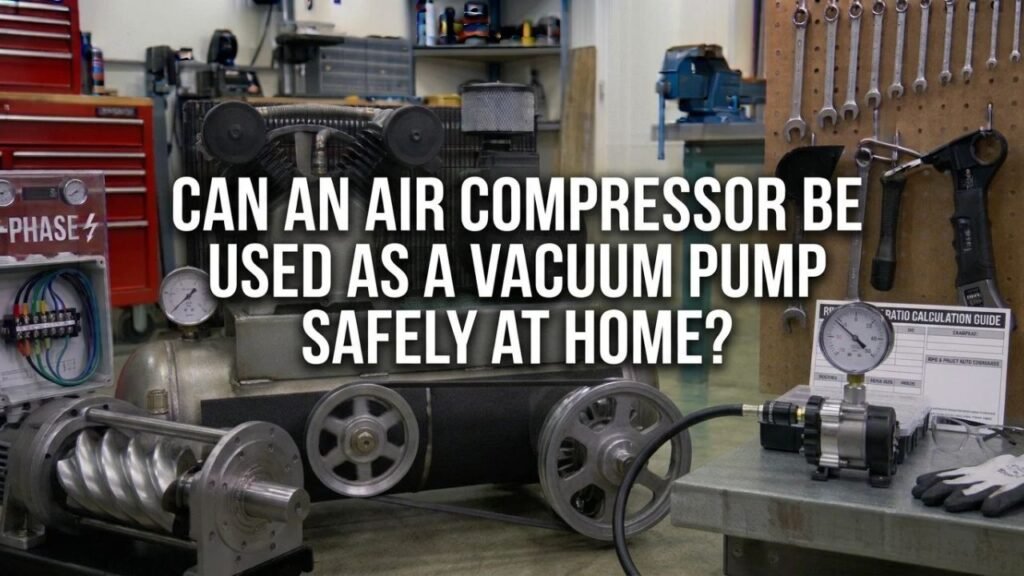
Both machines move gas, but they are optimized for different pressure conditions.
An Air Compressor Raises Pressure
A compressor draws atmospheric air through its intake and compresses it before sending it to a receiver or air line.
The normal sequence is:
- Air enters the intake.
- The piston or compression element reduces its volume.
- Pressure rises.
- The discharge valve opens.
- Compressed air leaves the pump.
The intake normally remains close to atmospheric pressure.
A Vacuum Pump Lowers Pressure
A vacuum pump removes gas from a closed system.
As more air is removed, pressure inside the vessel falls below atmospheric pressure.
The pump must continue operating as fewer and fewer gas molecules remain.
That operating condition is very different from normal air-compressor service.
Vacuum Pumps Are Built for Low Inlet Pressure
Purpose-built vacuum pumps account for problems such as:
- Gas expansion
- Low-density airflow
- Oil sealing
- Internal leakage
- Heat management
- Vapor removal
- Exhaust contamination
A compressor may create suction, but its internal clearances and valves were selected for compression rather than deep evacuation.
Key Takeaway: Compressors and vacuum pumps both move air, but compressors are optimized to produce positive pressure while vacuum pumps are designed to keep removing gas as inlet pressure drops.
Can an Air Compressor Be Used as a Vacuum Pump?
A reciprocating compressor may produce usable vacuum at its intake, but several limitations need to be considered.
The Intake Already Creates Suction
During the intake stroke, the piston moves away from the cylinder head.
Cylinder pressure drops.
Atmospheric pressure then pushes air through the intake valve and into the cylinder.
If a sealed hose is attached to the intake, the pump begins removing air from whatever is connected to that hose.
This is the basic reason conversion is possible.
Vacuum Depth Is Limited
A compressor may initially pull air out quickly but lose pumping performance as pressure falls.
Internal leakage through:
- Piston rings
- Reed valves
- Gaskets
- Shaft seals
becomes increasingly important at lower absolute pressure.
A machine that works well at producing 125 PSI does not automatically work well at creating a deep vacuum.
Some Compressors Work Better Than Others
Older or simple reciprocating compressors are usually easier to understand and adapt.
Other pump designs may depend heavily on:
- Intake cooling
- Oil circulation
- Integrated valves
- Electronic controls
- Special seals
Modification may damage the machine or prevent it from operating correctly.
Key Takeaway: A piston air compressor can often create some vacuum through its intake, but the achievable vacuum level and long-term reliability may be far below a real vacuum pump.
Can You Turn an Air Compressor Into a Vacuum Pump?
It is technically possible with some compressors, but it should not be treated as a universal conversion.
Reciprocating Compressors Are the Most Obvious Candidates
A piston compressor already contains:
- Intake valve
- Compression chamber
- Discharge valve
- Piston
- Crank mechanism
Connecting the system being evacuated to the intake lets the piston remove air during each cycle.
The Discharge Still Needs Somewhere to Go
Air removed from the vacuum side must still leave the compressor.
The discharge should never simply be blocked.
Doing so can cause:
- Rapid pressure buildup
- Overheating
- Motor overload
- Component failure
The compressor must still discharge safely.
Intake Filtration May Need to Be Retained
Removing the normal intake filter can expose the pump to:
- Dust
- Resin vapor
- Liquid droplets
- Debris
Those contaminants may damage valves or cylinders.
A vacuum application may require a proper trap or filter rather than an open hose connection.
Modification May Void the Warranty
Changing:
- Intake plumbing
- Pressure controls
- Lubrication
- Valves
- Motor wiring
can place the machine outside its intended operating conditions.
For a relatively inexpensive vacuum pump, sacrificing a good air compressor rarely makes economic sense.
Key Takeaway: Converting a piston compressor is mechanically possible in some cases, but the discharge, filtration, cooling, lubrication, and control systems still need to operate safely.
How Much Vacuum Can an Air Compressor Pull?
There is no single number.
Performance depends on:
- Compressor design
- Valve condition
- Piston-ring leakage
- Pump speed
- Seal condition
- Temperature
- Hose leakage
- Fittings
- Vacuum gauge accuracy
Atmospheric Pressure Sets the Absolute Limit
At sea level, atmospheric pressure is roughly 29.9 inches of mercury.
A perfect vacuum would therefore read close to 29.9 inHg vacuum on a conventional gauge at sea level.
No real mechanical pump produces a mathematically perfect vacuum.
Moderate Vacuum Is Easier Than Deep Vacuum
Pulling a container from atmospheric pressure down to a moderate vacuum is relatively easy.
Removing the last remaining portion of air becomes progressively harder.
This is where a converted compressor tends to struggle.
Vacuum Gauge Readings Can Be Misleading
A standard inHg vacuum gauge is useful for rough vacuum.
Deep-vacuum applications often use a micron gauge because small pressure differences become important.
A system that looks close to maximum vacuum on an ordinary dial gauge may still contain far too much air and moisture for refrigeration evacuation.
Key Takeaway: A converted compressor may create moderate vacuum, but its final vacuum depends heavily on internal leakage and cannot be predicted from its PSI rating.
Why Compressor PSI Does Not Tell You Vacuum Strength
A common mistake is assuming a high-pressure compressor will also create a strong vacuum.
It does not work that way.
PSI Measures Discharge Capability
A compressor rated for 150 PSI is designed to compress incoming atmospheric air to high positive pressure.
That rating says little about how well it performs at very low intake pressure.
Vacuum Depends on Intake-Side Leakage
As pressure falls, any small leakage becomes increasingly important.
Air can leak:
- Across valves
- Around piston rings
- Through fittings
- Through hose connections
The pump eventually reaches a point where leakage equals the amount of gas being removed.
Pumping Speed Also Matters
Two pumps can reach similar final vacuum levels but take very different amounts of time.
Vacuum performance involves both:
- Ultimate vacuum
- Pumping speed
A converted compressor may perform poorly in either area.
Why a Converted Air Compressor May Overheat
Normal compressor cooling assumes a steady supply of atmospheric air.
Changing the intake conditions can change heat behavior.
Intake Air Carries Away Some Heat
Incoming air moves through the pump and can contribute to internal cooling.
Under deep vacuum, the mass of air moving through the machine becomes much lower.
Continuous Runtime Can Become a Problem
A normal compressor often cycles:
- Tank pressure rises.
- Pressure switch stops the motor.
- Air is consumed.
- Compressor restarts.
A vacuum application may make the compressor run continuously.
A unit with a limited duty cycle may overheat.
Pump Speed Was Chosen for Compression
Running continuously at normal compressor RPM under an unusual suction condition can create temperatures the machine was not designed to handle.
Watch for:
- Hot motor housing
- Strong oil smell
- Thermal shutdown
- Discolored lubricant
- Unusual mechanical noise
Key Takeaway: Vacuum use may force a compressor to run continuously with less airflow than normal, increasing the chance of overheating or exceeding its duty cycle.
Oil-Lubricated Compressor Problems When Used for Vacuum
Oil-filled compressors add another complication.
Oil Can Move Toward the Intake
Low intake pressure may encourage oil mist or crankcase vapor to migrate through areas that normally see atmospheric pressure.
This can contaminate:
- Vacuum hoses
- Chambers
- Workpieces
- Filters
Oil Carryover Can Ruin Some Processes
Oil contamination is undesirable for applications such as:
- Resin work
- Laboratory systems
- Refrigeration circuits
- Electronics
- Food packaging
A pump that creates sufficient vacuum may still be unsuitable because the vacuum is dirty.
Lubrication Behavior Can Change
An oil-lubricated compressor pump was engineered around its normal pressure difference.
Changing inlet pressure can affect:
- Oil misting
- Seal behavior
- Crankcase ventilation
Do not assume the lubrication system remains fully protected after conversion.
Key Takeaway: An oil-filled compressor may contaminate the vacuum side with oil vapor and may not lubricate or vent exactly as intended under prolonged vacuum operation.
Can an Oil-Free Air Compressor Be Used as a Vacuum Pump?
Oil-free construction eliminates some contamination concerns, but it does not solve every problem.
No Oil Reservoir Is an Advantage
An oil-free pump reduces the risk of liquid pump oil entering the vacuum line.
This can make the idea attractive for clean applications.
Seals Still Have Limits
Oil-free compressors may use:
- Coated piston rings
- Diaphragms
- Special cylinder coatings
These parts are selected for compressor operation.
Their leakage rate may limit vacuum depth.
Cooling Still Matters
An oil-free pump can run very hot even during normal compression.
Continuous vacuum operation can place additional thermal stress on the machine.
Not Every Oil-Free Design Can Be Modified
Integrated pump assemblies may have no practical vacuum connection or may rely on airflow paths that should not be altered.
Key Takeaway: Oil-free compressors avoid crankcase-oil contamination, but leakage, cooling, seal life, and design restrictions still make them poor substitutes for many vacuum pumps.
Can You Use an Air Compressor for HVAC Vacuum?
A standard air compressor should not replace a proper HVAC vacuum pump.
HVAC Systems Need Deep Evacuation
Refrigeration systems contain:
- Air
- Moisture
- Water vapor
Removing bulk air is only the first part of evacuation.
The pump must also reduce pressure enough for trapped moisture to boil at a low temperature and be removed as vapor.
A Compressor May Stop Too Early
A modified compressor may show strong suction on a basic vacuum gauge while still leaving too much:
- Air
- Moisture
- Non-condensable gas
inside the system.
HVAC Vacuum Pumps Are Built for This Work
A dedicated one- or two-stage rotary-vane vacuum pump is designed for deep evacuation.
Technicians commonly use a micron gauge to measure the actual vacuum level rather than judging evacuation by compressor noise or a basic manifold gauge.
Contamination Is Another Risk
Using an old air compressor may introduce:
- Compressor oil
- Dirt
- Moisture
- Unknown residue
into the refrigeration circuit.
Key Takeaway: HVAC and refrigeration evacuation requires a proper deep-vacuum pump and micron-level measurement, not a converted shop air compressor.
Can an Air Compressor Be Used for a Vacuum Chamber?
Technically, moderate vacuum may be possible, but the vessel and pump setup both need to be suitable.
The Chamber Must Be Vacuum-Rated
This point is critical.
A container holding vacuum experiences atmospheric pressure pushing inward from every direction.
Improvised containers can collapse violently.
Use a chamber specifically rated for full vacuum.
A Compressor Tank Is Not Automatically a Vacuum Chamber
Air-receiver tanks are designed primarily for internal positive pressure.
That does not automatically certify them for external atmospheric loading under vacuum.
Do not assume a compressor tank is safe for vacuum service simply because it handles high PSI internally.
Resin Degassing Needs Reliable Vacuum
Resin and silicone degassing can require substantial vacuum to expand and remove trapped gas.
A dedicated rotary-vane pump is a more predictable choice.
Use a Trap When Vapors Are Present
Resin, solvents, water, and process vapors can enter the pump.
A suitable trap protects the pump and reduces contamination.
Key Takeaway: Vacuum chamber work requires both a suitable pump and a vessel specifically capable of handling external atmospheric pressure.
Can an Air Compressor Create Vacuum Without Modification?
Yes, through a different method: a pneumatic vacuum generator.
Venturi Vacuum Generators Use Compressed Air
A Venturi device passes compressed air through a narrow nozzle.
The high-speed airflow creates a low-pressure region that draws air from a vacuum port.
In this arrangement:
- The air compressor stays unchanged.
- Compressed air powers the vacuum generator.
- The generator produces suction.
Common Uses
Venturi vacuum generators are common for:
- Vacuum cups
- Pick-and-place systems
- Small clamps
- Automation
- Material handling
They Consume a Lot of Compressed Air
The disadvantage is efficiency.
Producing vacuum from compressed air requires the compressor to run and can consume substantial CFM.
For continuous vacuum, an electric vacuum pump may use much less energy.
Key Takeaway: A Venturi generator lets an air compressor power a vacuum system without modifying the compressor itself, though compressed-air consumption can be high.
Air Compressor vs Vacuum Pump
The better machine depends on the job.
| Feature | Air Compressor Used for Vacuum | Dedicated Vacuum Pump |
| Intended Purpose | Positive pressure | Vacuum |
| Moderate Suction | Possible | Yes |
| Deep Vacuum | Often poor | Much better |
| Continuous Vacuum Use | Questionable | Designed for it |
| Vacuum Rating | Usually not specified | Specified |
| Oil Contamination | Possible | Depends on pump type |
| HVAC Evacuation | Poor choice | Correct tool |
| Vacuum Chamber | Limited | Better |
| Reliability | Uncertain after modification | Predictable |
| Warranty | May be affected | Normal intended use |
When Might a Converted Compressor Make Sense?
There are limited experimental or low-demand situations where moderate suction is all that is needed.
Hobby Experimentation
An old compressor pump that would otherwise be discarded can be useful for understanding:
- Vacuum gauges
- Pressure differences
- Pneumatic systems
Do not use an untested homemade system for hazardous materials or critical work.
Moderate Vacuum Tasks
Some non-critical operations need only partial vacuum rather than deep evacuation.
A compressor may provide enough suction if:
- Vacuum level is verified
- Pump temperature is monitored
- System is properly rated
Temporary Testing
A converted pump might demonstrate that a component responds to vacuum.
It should not be assumed suitable for long-term service based on a short successful test.
Key Takeaway: Conversion makes the most sense for low-risk experiments or moderate-vacuum hobby applications, not critical work requiring known vacuum performance.
When Should You Buy a Dedicated Vacuum Pump?
A dedicated pump is the better choice when vacuum quality matters.
Use one for applications such as:
- HVAC evacuation
- Refrigeration service
- Resin degassing
- Silicone degassing
- Vacuum chambers
- Composite bagging
- Laboratory work
- Vacuum filtration
- Vacuum forming
- Frequent vacuum clamping
Vacuum Pumps Provide Published Performance
A proper pump may specify:
- Pumping rate
- Ultimate vacuum
- Oil capacity
- Motor size
- Duty rating
That makes it possible to select a pump based on the job.
Conversion Costs Can Add Up
Adapting a compressor may require:
- Fittings
- Hose
- Vacuum gauge
- Separator
- Filter
- Trap
- Check valve
By the time these are purchased, an entry-level vacuum pump may be the simpler option.
Safety Risks of Converting an Air Compressor
The main concern is not just whether suction can be created.
The entire system has to tolerate vacuum safely.
Never Use a Non-Rated Container
Atmospheric pressure is powerful.
At full vacuum, every square inch of chamber surface has roughly one atmosphere of external pressure pushing inward.
A weak container can implode.
Protect the Pump From Liquids
Liquid drawn into a reciprocating pump can cause serious mechanical damage.
Use a suitable separator or trap when liquid carryover is possible.
Do Not Block the Compressor Discharge
Air removed from the vacuum system must have a safe exhaust route.
Blocking the outlet turns the compressor back into a pressure-producing machine with nowhere for that pressure to go.
Protect Against Moving Parts
If conversion requires exposing:
- Belt
- Pulley
- Flywheel
restore proper guards before operation.
Do Not Modify Pressure Controls Casually
Bypassing switches or wiring the motor for continuous running can defeat:
- Thermal protection
- Pressure protection
- Automatic shutdown
Electrical modifications should follow the manufacturer’s design and applicable electrical requirements.
Avoid Hazardous Vapors
A standard compressor may not be suitable for drawing:
- Flammable vapor
- Fuel vapor
- Solvents
- Corrosive gas
- Toxic gas
The motor may contain ignition sources, and compressor materials may not resist chemical attack.
Key Takeaway: The largest risks are imploding vessels, liquid ingestion, blocked discharge, overheating, exposed moving parts, electrical modifications, and drawing hazardous vapors through an unsuitable pump.
Common Mistakes When Trying to Use a Compressor for Vacuum
Several assumptions cause trouble.
Judging Vacuum by Suction Feel
Strong suction against your hand does not prove the pump can reach the vacuum level required for the job.
Use a proper vacuum gauge.
Using the Receiver Tank as a Vacuum Vessel
Do not assume a pressure-rated tank is also certified for full external vacuum.
Running the Compressor Continuously
A compressor with a limited duty cycle may overheat.
Removing the Intake Filter
This leaves the pump vulnerable to contamination.
Ignoring Oil Carryover
Oil vapor can ruin a supposedly clean vacuum process.
Using It for Refrigeration Evacuation
Moderate suction is not the same as deep dehydration vacuum.
Expecting 150 PSI Rating to Mean Strong Vacuum
Pressure capability and vacuum capability are separate performance characteristics.
Key Takeaway: Verify actual vacuum performance, vessel ratings, temperature, contamination control, and duty cycle instead of assuming normal compressor specifications apply to vacuum service.
Better Alternatives to Converting an Air Compressor
Several options are safer and simpler.
Rotary-Vane Vacuum Pump
Good for:
- HVAC
- Vacuum chambers
- Resin
- Composite work
These pumps are available in single- and two-stage versions.
Diaphragm Vacuum Pump
Useful where clean, oil-free operation matters.
They commonly provide less vacuum depth than rotary-vane units but avoid pump-oil contamination.
Venturi Vacuum Generator
Useful when compressed air is already available and the job needs:
- Vacuum cups
- Clamping
- Automation
Hand Vacuum Pump
Ideal for small tasks such as:
- Testing vacuum actuators
- Brake-related diagnostic work
- Small sealed systems
Dedicated Shop Vacuum System
For woodworking hold-down or dust-related suction, equipment made specifically for that purpose may be more appropriate than modifying a compressor.
Key Takeaway: Rotary-vane, diaphragm, Venturi, and hand vacuum pumps each serve different vacuum jobs without requiring a standard air compressor to operate outside its intended design.
Conclusion
For can an air compressor be used as a vacuum pump, some reciprocating compressors can create vacuum at the intake and may provide enough suction for limited, non-critical tasks. That does not mean every compressor can be converted safely or that it will reach a useful deep vacuum.
For can you turn an air compressor into a vacuum pump, a basic piston compressor offers the most realistic starting point, but conversion introduces questions about cooling, duty cycle, oil contamination, valve leakage, filtration, exhaust routing, and equipment ratings.
Do not use a converted compressor as a substitute for a proper HVAC vacuum pump, and do not connect vacuum to an improvised vessel that is not rated for external atmospheric pressure. A pressure tank’s ability to contain compressed air does not automatically make it safe under vacuum.
For occasional moderate suction, a pneumatic Venturi generator or inexpensive dedicated vacuum pump is often a simpler solution. For deep evacuation, refrigeration, resin degassing, laboratory work, or repeated vacuum use, buy a pump designed and rated for that job.
FAQs About Using an Air Compressor as a Vacuum Pump
Can a regular air compressor pull a vacuum?
A reciprocating compressor can create suction at its intake and may pull a partial vacuum. The final vacuum depends on valve leakage, piston seals, pump design, hose connections, and operating conditions.
Can you reverse an air compressor to make a vacuum pump?
You normally do not reverse the motor or airflow. A piston compressor already draws air through its intake, so any experimental vacuum connection is made on the suction side while the discharge continues exhausting normally.
Can I use an air compressor vacuum for HVAC work?
A standard air compressor is not a suitable replacement for an HVAC vacuum pump. Refrigeration evacuation requires deep vacuum and accurate micron measurement to remove air and moisture from the system.
Can an oil-free compressor work as a vacuum pump?
Some oil-free piston compressors can produce partial vacuum through their intake. They avoid crankcase-oil contamination but may still have limited vacuum depth, overheating issues, seal leakage, and duty-cycle restrictions.
Will using an air compressor as a vacuum pump damage it?
It can. Continuous operation, reduced intake airflow, unusual lubrication conditions, contamination, and operation outside the machine’s design limits can shorten pump or motor life.
Can I use an air compressor tank as a vacuum tank?
Do not assume that you can. A tank designed for positive internal pressure is not automatically certified for external atmospheric pressure under vacuum. Use a vessel specifically rated for vacuum service.
How can I make vacuum using an air compressor without modifying it?
Use a pneumatic Venturi vacuum generator. Compressed air passes through the device and creates suction at a separate vacuum port, leaving the compressor itself in normal operation.
Is it cheaper to convert a compressor or buy a vacuum pump?
For most practical jobs, buying a dedicated vacuum pump is the better route. Conversion may require fittings, gauges, filters, traps, hoses, and other components while still giving uncertain vacuum performance.