How to Change Speed on a Drill Press: Step-by-Step Guide
Changing drill press speed is usually easier than it looks. On many machines, you simply move the drive belt between different pulley positions inside the top cover. Other drill presses use a variable-speed dial or lever that lets you adjust RPM without manually repositioning the belt.
Learning how to change speed on a drill press helps you match the spindle speed to the drill bit size and the material you are drilling. Using the correct speed can produce cleaner holes, reduce heat, protect drill bits, and make the machine easier to control.
This guide explains the most common speed-control systems, how to adjust them safely, how to read the pulley chart, and how to choose a practical RPM for wood, metal, and other materials.
How to Change Speed on a Drill Press
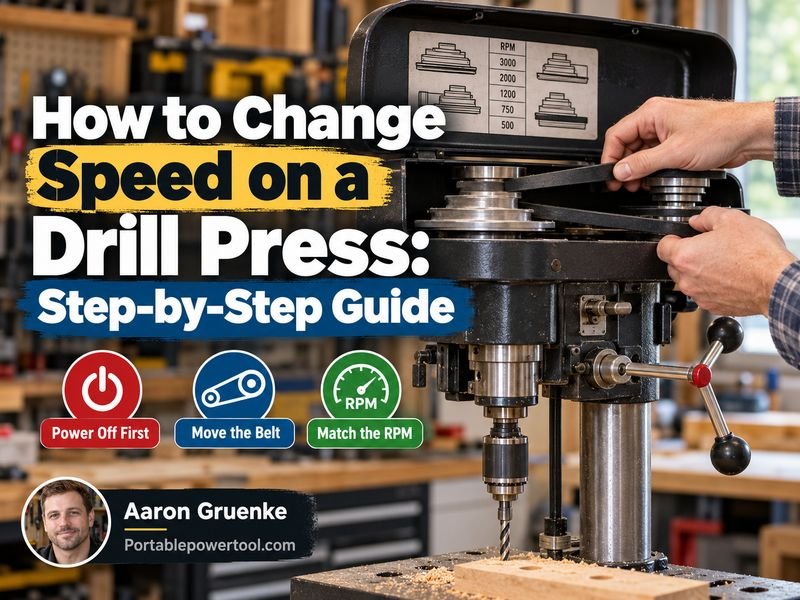
To change speed on a drill press, first turn the machine off and disconnect it from power. Then identify whether your drill press uses stepped pulleys, a variable-speed mechanism, or electronic speed control.
On a belt-driven drill press, open the pulley cover and reposition the drive belt according to the speed chart inside the cover. Moving the belt to different pulley diameters changes the relationship between the motor speed and spindle speed.
On a variable-speed drill press, speed is normally adjusted using a lever, handwheel, or control dial.
The exact procedure depends on the drill press design, but the basic goal is always the same: adjust the spindle RPM (revolutions per minute) to suit the drill bit and material.
Before Changing the Speed
Always make sure the spindle has completely stopped before making adjustments.
For belt-driven models:
- Turn the drill press off.
- Unplug the power cord.
- Wait for all moving parts to stop.
- Open the pulley cover.
- Check the speed chart provided by the manufacturer.
Never move belts while the motor is running. The pulleys can easily catch fingers, clothing, or tools.
Understanding Drill Press Speed
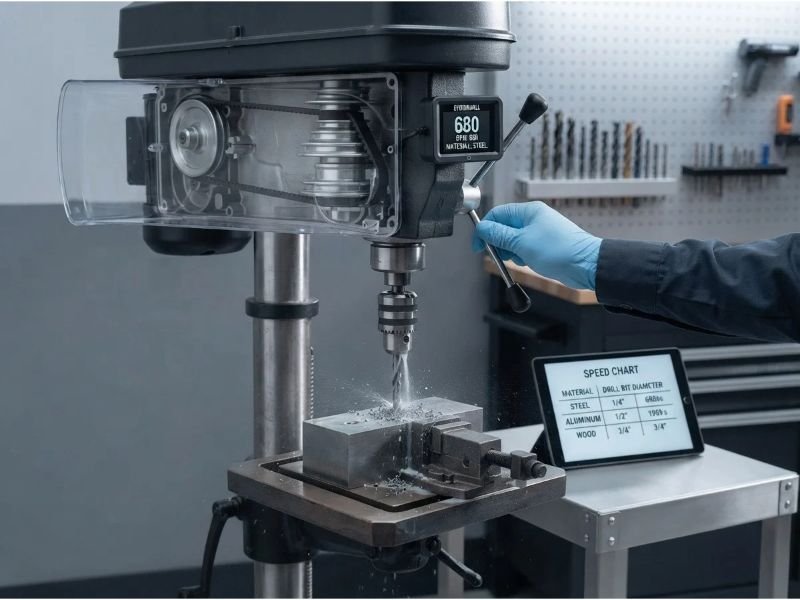
Drill press speed refers to how quickly the spindle rotates. It is normally measured in RPM, or revolutions per minute.
For example:
- 500 RPM means the spindle rotates about 500 times per minute.
- 1,500 RPM means it rotates about 1,500 times per minute.
- 3,000 RPM means it rotates about 3,000 times per minute.
Most drill presses provide several speeds rather than one fixed speed.
A typical benchtop model may offer speeds ranging from several hundred RPM to more than 3,000 RPM, although the exact range varies by machine.
Why Drill Press Speed Matters
Different materials and drill bit sizes perform better at different speeds.
As a general rule:
Larger drill bits require slower speeds.
Smaller drill bits can usually run faster.
Hard materials such as steel normally require slower speeds than soft materials such as wood.
Running too fast can overheat the drill bit and workpiece. Running too slowly may reduce drilling efficiency or produce a rougher cut in some materials.
How Belt-Driven Drill Press Speed Control Works
Many traditional drill presses use a simple belt-and-pulley system.
Inside the top housing are usually two or three pulleys:
- Motor pulley
- Spindle pulley
- Sometimes an idler pulley
The motor turns one pulley. A belt transfers that rotation to the spindle.
The pulley has several steps with different diameters. Moving the belt from one step to another changes the final spindle speed.
Basic Pulley Principle
The relationship is similar to bicycle gears.
A belt running from a larger motor pulley to a smaller spindle pulley normally creates a higher spindle speed.
A belt running from a smaller motor pulley to a larger spindle pulley normally creates a lower spindle speed.
You generally do not need to calculate this yourself because manufacturers provide a speed chart showing the correct belt positions.
Step-by-Step: Changing Speed on a Belt-Driven Drill Press
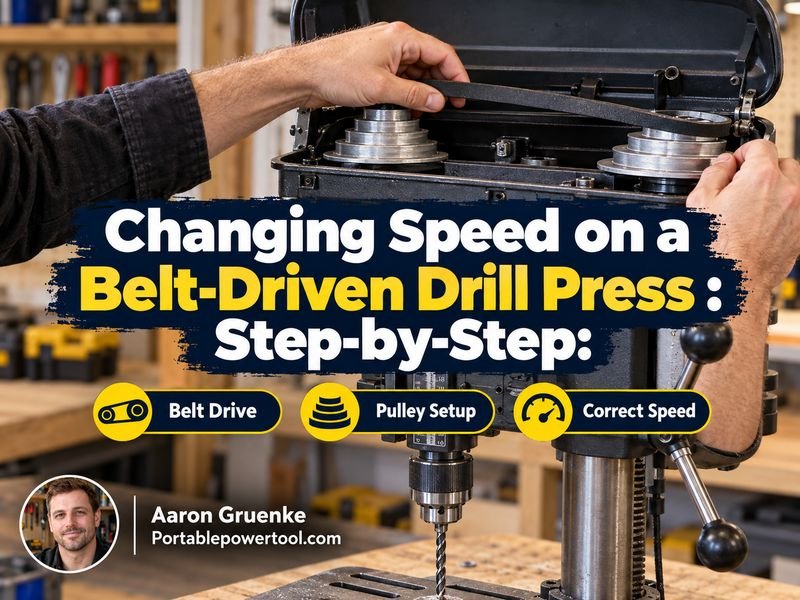
Most basic drill presses use this system.
1. Turn Off and Unplug the Drill Press
Switch the machine off and disconnect the power plug.
Do not rely only on the power switch. Unplugging the machine prevents it from starting accidentally while your hands are near the pulleys.
2. Open the Pulley Cover
The pulley housing is normally located on top of the drill press.
Lift or release the cover.
Inside, you should see the pulleys, drive belt, and often a diagram showing available spindle speeds.
3. Find the Speed Chart
Look for a label inside the cover.
The chart normally shows:
- Belt positions
- Pulley combinations
- Corresponding RPM
For example, one arrangement might produce approximately 600 RPM while another produces 2,500 RPM.
Always follow the chart for your specific machine.
4. Release Belt Tension
Many drill presses have a motor adjustment or tension-release mechanism.
You may need to loosen:
- A motor-locking knob
- A tension lever
- One or more bolts
The motor can then move slightly toward the spindle, reducing belt tension.
Do not force a tight belt off the pulley.
5. Move the Belt to the Correct Pulley Steps
Place the belt in the pulley grooves shown on the speed chart.
If your drill press uses three pulleys, you may need to reposition two belts.
Make sure each belt sits fully inside its pulley groove.
6. Restore Belt Tension
Move the motor or tensioning mechanism back into position.
The belt should be firm enough to transfer power without slipping, but it should not be excessively tight.
A belt that is too loose may slip.
A belt that is too tight can place unnecessary load on the motor bearings and spindle bearings.
Follow the manufacturer’s tension instructions whenever available.
7. Tighten the Adjustment Mechanism
Retighten the locking knob, lever, or bolts that hold the motor position.
Check the belt alignment before closing the cover.
8. Close the Pulley Cover
Never operate the drill press with the pulley cover open.
Close and secure the cover before reconnecting power.
9. Test the Drill Press
Plug the machine back in and briefly run it.
Listen for unusual vibration, belt slippage, or rubbing.
If everything sounds normal, the drill press is ready to use at the new speed.
How to Change Speed on a Variable-Speed Drill Press
Variable-speed drill presses are more convenient because belt repositioning is often unnecessary.
These machines may use:
- A mechanical variable-speed pulley system
- Electronic motor control
- A digital RPM controller
The adjustment may be made with a speed lever, handwheel, or control dial.
Mechanical Variable-Speed Models
Some mechanical systems require the motor to be running while the speed control is adjusted.
This allows the variable pulley mechanism to move smoothly.
However, this is model-specific. Always follow the manufacturer’s instructions because operating procedures vary.
Do not open the pulley housing or touch internal components while the machine is running.
Electronic Variable-Speed Models
Electronically controlled drill presses usually have a dial or control panel.
You may simply select the desired RPM and allow the electronics to control the motor speed.
Some models also have a digital display showing the actual spindle RPM.
What Drill Press Speed Should You Use?
The correct speed depends mainly on:
- Material
- Drill bit diameter
- Drill bit type
- Hole depth
- Cooling or lubrication
- Machine capability
There is no single RPM that works best for every drilling job.
General Drill Press Speed Guidelines
| Material or Operation | Typical Speed Approach |
| Softwood | Medium to high speed |
| Hardwood | Medium speed |
| Aluminum | Medium to high speed |
| Mild steel | Low to medium speed |
| Stainless steel | Lower speed |
| Large drill bits | Lower speed |
| Small drill bits | Higher speed |
| Hole saws | Low speed |
| Forstner bits | Low to medium speed |
These are general guidelines rather than exact settings. Drill bit manufacturers often provide recommended speed ranges for specific bit sizes and materials.
Drill Press Speed for Wood
Wood can usually be drilled faster than metal.
Small twist drills in wood often work well at relatively high speeds. However, large bits generate more heat and require greater torque, so the speed should be reduced.
Forstner Bits
Forstner bits cut flat-bottomed holes and often have relatively large diameters.
They generally perform better at moderate or low speeds compared with small twist bits.
Running a large Forstner bit too fast can cause:
- Excessive heat
- Burning
- Rough hole edges
- Faster bit wear
Hole Saws
Hole saws should normally run much slower than small drill bits.
Because a hole saw has a large cutting diameter, its cutting edge travels much faster around the outside of the tool.
Using excessive RPM can create significant heat and make the drill press harder to control.
Drill Press Speed for Metal
Metal drilling usually requires lower speeds than wood drilling.
Steel especially generates substantial heat at the cutting edge.
The larger the drill bit becomes, the slower the spindle should usually rotate.
Using the correct cutting fluid may also reduce heat and improve tool life when drilling many metals.
Signs Your Speed May Be Too High
Possible signs include:
- Drill bit becoming extremely hot
- Smoke from the cutting area
- Blue or discolored drill bit edges
- Rapid bit wear
- Squealing
- Poor chip formation
When drilling metal, steady feed pressure and proper speed are often more important than simply pushing harder.
How Drill Bit Diameter Affects Speed
Drill bit diameter has a major effect on recommended RPM.
The outside cutting edge of a large bit travels much farther during every revolution than the edge of a small bit.
That means a large drill bit can reach a very high surface speed even when the spindle RPM is relatively low.
For this reason:
Small bit = usually higher RPM
Large bit = usually lower RPM
This principle applies to twist drills, Forstner bits, hole saws, and many other rotating cutting tools.
How to Read a Drill Press Speed Chart
Most belt-driven drill presses have a speed diagram under the top cover.
A typical chart may show drawings of the motor pulley and spindle pulley with lines indicating where the belt should be installed.
Beside each diagram, you may see an RPM number.
Choose the RPM you want, then duplicate the belt arrangement shown beside it.
If your machine has an intermediate pulley, the chart may show two belt positions.
Do not assume the pulley layout is identical across drill press brands. Use the chart installed on your particular machine.
How Tight Should a Drill Press Belt Be?
A drill press belt should be tight enough that it does not slip during drilling but not so tight that it places unnecessary pressure on the bearings.
If the belt is extremely loose, you may notice:
- Belt slipping
- Reduced spindle power
- Squealing
- Irregular spindle speed
If the belt is excessively tight, it can increase wear on bearings and other components.
Some manufacturers provide a recommended amount of belt deflection when moderate finger pressure is applied. Follow that specification when available.
Common Mistakes When Changing Drill Press Speed
Several simple mistakes can cause poor performance.
Forgetting to Disconnect Power
On belt-driven machines, always unplug the drill press before placing your hands near the pulleys.
Ignoring the Speed Chart
Pulley arrangements can vary significantly between machines. Follow the diagram provided for your model instead of guessing.
Running Large Bits Too Fast
Large hole saws, Forstner bits, and twist drills often require much lower RPM than small bits.
Leaving the Belt Too Loose
A loose belt may slip when the bit encounters resistance.
Overtightening the Belt
Extra tension does not necessarily improve drilling. Excessive tension can increase bearing load.
Leaving the Pulley Cover Open
Close the guard before restarting the drill press.
The cover protects you from exposed rotating belts and pulleys.
Safety Tips When Adjusting Drill Press Speed
A drill press is a powerful rotating machine, so a few precautions matter.
Before drilling:
- Secure the workpiece with a clamp or vise when appropriate.
- Remove the chuck key before starting the machine.
- Avoid loose clothing, jewelry, and gloves near rotating parts.
- Tie back long hair.
- Wear appropriate eye protection.
- Keep hands away from the rotating bit and chuck.
- Stop the machine before adjusting the workpiece.
Do not try to stop the chuck with your hand.
If the drill press makes unusual noises after a speed adjustment, shut it off and inspect the belt position and tension.
When Should You Use the Slowest Drill Press Speed?
The lowest speed is often useful when using large-diameter cutting tools or drilling hard materials.
Examples include:
- Large twist drills
- Large Forstner bits
- Hole saws
- Fly cutters
- Thick steel
- Stainless steel
Low spindle speed also provides more usable torque on many belt-driven drill presses.
However, always confirm that the selected speed is suitable for the tool being used.
When Should You Use a Higher Drill Press Speed?
Higher speeds are commonly used with small drill bits and softer materials.
Examples may include:
- Small twist bits
- Thin wood
- Plastics that tolerate the speed
- Some aluminum drilling operations
Too much speed can still cause overheating, melting, burning, or poor hole quality, so faster is not automatically better.
Do You Need to Change Drill Press Speed for Every Bit?
Not necessarily.
If you are changing between similar drill bit sizes while drilling the same material, the existing speed may still fall within a practical range.
However, a major change in bit diameter or material usually deserves a speed adjustment.
For example, switching from a small 1/8-inch twist drill to a 2-inch hole saw is a major change. The hole saw will generally require a much lower RPM.
FAQs About How to Change Speed on a Drill Press
Can You Change Drill Press Speed While It Is Running?
It depends on the drill press.
Do not move belts manually while the drill press is running.
Some mechanical variable-speed models are specifically designed to have the speed lever adjusted while the motor is operating. Electronic models may also allow adjustments during operation.
Follow the operating manual for your machine.
Why Does My Drill Press Have Different Pulley Sizes?
Different pulley diameters change the ratio between motor speed and spindle speed.
This allows one motor to provide several spindle RPM settings without requiring a different motor for each speed.
Which Pulley Position Gives the Slowest Drill Press Speed?
On most belt-driven systems, a smaller motor pulley driving a larger spindle pulley produces a lower spindle speed.
However, multi-pulley systems can be more complicated, so the safest approach is to use the manufacturer’s speed chart.
What Happens If a Drill Press Runs Too Fast?
Excessive speed can generate too much heat, dull cutting edges, burn wood, overheat metal, or damage certain drill bits.
Large-diameter tools are particularly sensitive to excessive RPM.
Why Does My Drill Press Belt Slip?
Common causes include insufficient belt tension, worn belts, contaminated pulleys, or excessive drilling load.
Check that the belt is correctly positioned and properly tensioned before assuming the motor is the problem.
Should Metal Be Drilled Faster or Slower Than Wood?
Metal is generally drilled at a slower spindle speed than wood, especially when drilling steel or using large-diameter bits.
The ideal RPM depends on the metal type and drill bit diameter.
How Do I Know What RPM My Drill Press Is Running?
Belt-driven drill presses usually provide an RPM chart showing the speed produced by each pulley configuration.
Variable-speed machines may have a mechanical indicator or digital RPM display.
A handheld tachometer can also measure spindle speed when a more precise reading is necessary.
Conclusion
Learning how to change speed on a drill press mainly comes down to understanding the speed-control system on your machine. Belt-driven models require repositioning the belt on different pulley steps, while variable-speed machines usually use a lever, handwheel, dial, or electronic control.
Always disconnect a belt-driven drill press from power before working near the pulleys, follow the manufacturer’s speed chart, and match spindle RPM to the material and drill bit size. In general, small bits can run faster, while larger bits and harder materials require slower speeds.
Choosing the right drill press speed improves hole quality, reduces heat, protects cutting tools, and makes drilling safer and more predictable.