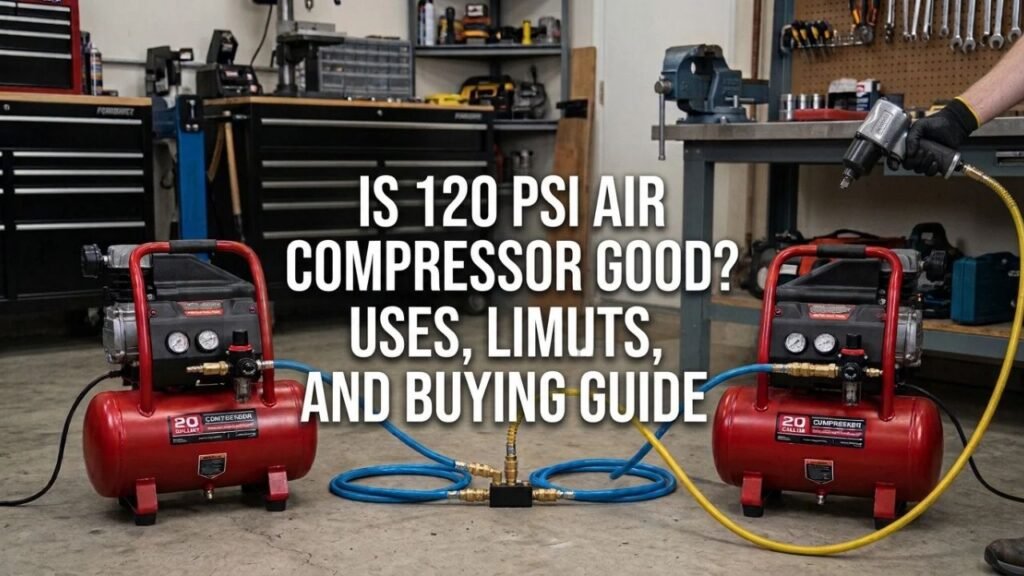
Is 120 PSI Air Compressor Good? Uses, Limits, and Buying Guide
A 120 PSI air compressor is good for many home, garage, and light jobsite tasks, including tire inflation, brad and finish nailers, staplers, airbrushing, and short blow-gun use. The 120 PSI rating alone does not tell you which air tools it can run; pump CFM and tank size matter just as much.
The main mistake is assuming higher maximum pressure automatically means more air-tool capability. PSI measures pressure, while CFM measures airflow over time. A compact compressor may reach 120 PSI yet supply less than 1 CFM, making it unsuitable for a grinder or sander that consumes several CFM continuously.
For perspective, California Air Tools currently lists a compact compressor with a 120 PSI maximum pressure, while Makita pneumatic nailers commonly operate within pressure ranges that extend up to 120 PSI. This shows that 120 PSI is plenty of pressure for many fastening and inflation jobs.
So, is 120 psi air compressor good for general use? Yes, if its airflow matches the job. For tires and nail guns, 120 PSI is normally more than enough. For impact wrenches, spray guns, sanders, grinders, and other high-air-demand tools, the compressor’s SCFM rating becomes the deciding specification.
A good buying decision starts by checking three numbers together: maximum PSI, SCFM at 90 PSI, and tank capacity. The sections below explain what 120 PSI means, what tools it can run, when it is too small, and how it compares with 150 PSI and higher-pressure compressors.
What Does 120 PSI Mean on an Air Compressor?
PSI stands for pounds per square inch.
A compressor labeled 120 PSI can pressurize its receiver tank up to approximately 120 PSI under its designed operating conditions.
That number describes pressure, not airflow.
Maximum PSI Is Tank Pressure
If the compressor is rated for 120 PSI maximum, the pump normally fills the tank until it reaches its cut-out pressure.
The motor then stops.
As you use air and tank pressure falls to the cut-in point, the motor starts again automatically.
You do not normally send the full 120 PSI to every connected tool.
The Regulator Controls Tool Pressure
Most compressors have a pressure regulator between the tank and air outlet.
Suppose:
- Tank pressure = 115 PSI
- Nail gun requirement = 90 PSI
You set the regulator so the outlet gauge reads about 90 PSI.
The tank can remain at a higher pressure while the tool receives only its required pressure.
120 PSI Does Not Mean 120 PSI at Unlimited Airflow
A small compressor may reach 120 PSI but struggle to supply much air at that pressure.
For example, California Air Tools lists one compact 120 PSI compressor with 1.2 CFM at 90 PSI. That is enough for many intermittent jobs but far below the airflow required by many continuous pneumatic tools.
Key Takeaway: A 120 PSI rating tells you how much pressure the compressor can store, while CFM tells you how much air it can keep supplying to a tool.
Is 120 PSI Enough for Most Air Tools?
It provides enough pressure for many pneumatic tools, but airflow requirements still determine compatibility.
A large number of common pneumatic fastening tools operate below or up to 120 PSI.
Makita lists operating ranges around 60–120 PSI or 65–120 PSI for several pneumatic nailers.
That makes a 120 PSI compressor suitable from a pressure standpoint for many:
- Brad nailers
- Finish nailers
- Pin nailers
- Staplers
- Framing nailers
- Roofing nailers
The compressor still needs enough CFM for the firing rate.
Why Firing Rate Changes Air Demand
A nail gun does not use air continuously.
Each shot releases a short burst.
If you fire one nail every few seconds, a small compressor has time to recover.
If you fire dozens of nails per minute, air consumption rises sharply.
Makita’s pneumatic nailer documentation gives an example where roughly 3.0 CFM or more is needed at 120 PSI when nailing at about 50 fasteners per minute.
The same tool may need much less compressor output when used slowly.
Key Takeaway: 120 PSI is enough pressure for many pneumatic tools, but fast or continuous use can require far more CFM than a small compressor produces.
Is 120 PSI Good for Inflating Car Tires?
Yes.
A 120 PSI compressor has far more pressure capability than a normal passenger-car tire requires.
Passenger tires commonly run at pressures far below 120 PSI. Always use the vehicle manufacturer’s recommended cold tire pressure shown on the door-jamb placard or owner’s information.
Do Not Inflate the Tire to 120 PSI
The compressor’s maximum rating is not the target tire pressure.
If your compressor can reach 120 PSI and the vehicle calls for 35 PSI, inflate the tire to the vehicle’s specified 35 PSI.
The regulator, tire inflator, or inflator gauge lets you control the delivery.
120 PSI Is Also Useful for Smaller Tires
A 120 PSI compressor can work well for:
- Passenger-car tires
- Motorcycle tires
- Bicycle tires
- Lawn-equipment tires
- Small trailer tires
- Sports balls with the proper adapter
Makita currently sells a portable inflator rated to 120 PSI specifically for tasks such as car tires, light-truck tires, bicycle tires, and sports equipment.
Large Tires Depend More on Air Volume
A high-pressure rating does not guarantee fast inflation.
A large truck or off-road tire contains much more air than a passenger tire.
A low-CFM 120 PSI compressor can still raise the pressure, but it may take considerably longer.
Key Takeaway: 120 PSI is more than enough pressure for passenger-tire inflation, but CFM and pump size determine how quickly larger tires fill.
Is 120 PSI Good for Nail Guns?
Yes, from a pressure standpoint.
Many pneumatic nailers operate somewhere between roughly 60 and 120 PSI.
The exact range depends on the nailer.
Brad Nailers
Brad nailers use relatively small amounts of air per shot.
A small 120 PSI compressor is often a good match for:
- Trim
- Cabinet work
- Decorative molding
- Small furniture projects
- Light woodworking
Finish Nailers
Finish nailers also work well with many portable compressors.
Tank size starts to matter more if you fire rapidly.
Framing Nailers
A 120 PSI compressor can supply enough pressure for many framing nailers, but the pump needs enough CFM to keep up with frequent firing.
The tool may work perfectly for occasional framing shots and then outrun a small compressor during production work.
Roofing Nailers
Roofing involves rapid fastening.
A small 120 PSI compressor may cycle constantly or lose outlet pressure if its airflow is too low.
Choose by the nailer’s air-consumption requirement, not just its maximum PSI.
Key Takeaway: 120 PSI is suitable for many nail guns, but framing and roofing work may need higher pump CFM and more tank reserve than light trim work.
Is 120 PSI Enough for an Impact Wrench?
Pressure may be enough, but many small 120 PSI compressors do not produce enough airflow.
Most pneumatic impact wrenches are commonly operated around the pressure specified by their manufacturer, often near 90 PSI.
The bigger challenge is CFM.
A 1/2-inch impact wrench can consume several cubic feet of air per minute.
What Happens With a Small Compressor?
The tank may contain enough stored air for a few short impact bursts.
Then:
- Tank pressure drops.
- The compressor starts.
- Pump output cannot match tool consumption.
- Outlet pressure falls.
- Impact power drops.
You then have to pause while the tank refills.
Tank Size Helps Only Temporarily
A larger tank gives an impact wrench more stored air before pressure drops.
It does not increase the pump’s continuous CFM.
A 20-gallon compressor with a weak pump can still struggle with a high-demand impact tool once the stored air is consumed.
Check CFM at 90 PSI
If you plan to use an air impact wrench regularly, compare:
Impact wrench required CFM at 90 PSI
against
Compressor SCFM at 90 PSI
Choose a compressor that can exceed the tool’s average airflow requirement.
Key Takeaway: 120 PSI can provide enough pressure for an impact wrench, but airflow—not maximum PSI—is usually the reason a small compressor struggles.
Is 120 PSI Enough for a Spray Gun?
Pressure is usually not the problem.
Airflow is.
Paint spray guns can require a steady flow of air for the entire time the trigger is held.
A small 120 PSI compressor may supply the required pressure initially, then lose pressure as the tank empties.
Symptoms of an Undersized Compressor
You may notice:
- Changing spray pattern
- Poor atomization
- Pressure falling during a pass
- Compressor running constantly
- Long pauses between spray passes
This makes consistent paint application difficult.
Airbrushes Are Different
Airbrushes use much less air than automotive or production spray guns.
A compact 120 PSI compressor with a regulator can be a good airbrush source if its minimum pressure control and airflow fit the airbrush.
Choose a Spray Compressor by CFM
Read the spray gun’s required CFM at its specified pressure.
For serious painting, buy around that airflow figure rather than focusing on 120 vs. 150 PSI.
Is 120 PSI Good for a Blow Gun?
Yes for short bursts.
It does not mean you should use a blow gun at the full 120 PSI.
For workplace cleaning, OSHA limits compressed air used for cleaning to less than 30 PSI under specified conditions and requires suitable guarding and protective equipment.
For home or shop use, avoid directing compressed air at:
- Skin
- Eyes
- Other people
- Clothing being worn
Air can drive debris into the eyes or skin.
A small compressor may also empty rapidly with a blow gun because blowing uses air continuously.
Can a 120 PSI Compressor Run an Air Sander?
A small one usually cannot run it well.
Pneumatic sanders are high-air-consumption tools.
The compressor may reach 120 PSI, but if it supplies only 1–3 CFM and the sander consumes much more, pressure will fall quickly.
Typical symptoms include:
- Sander slowing after a few seconds
- Pump running constantly
- Weak sanding action
- Frequent waiting
- Rapid tank cycling
For regular pneumatic sanding, focus heavily on SCFM at 90 PSI.
A larger tank also improves working time between pressure drops.
Can a 120 PSI Compressor Run a Die Grinder?
The same problem applies.
Die grinders need sustained airflow while the trigger is held.
A compact compressor can sometimes spin the tool briefly from stored tank air but cannot keep it running at full speed.
A compressor intended for grinders usually needs substantially more pump airflow than one designed mainly for inflation or nailers.
What Can a 120 PSI Air Compressor Run?
The answer changes with CFM, but this quick chart gives a useful starting point.
| Job or tool | Is 120 PSI enough pressure? | Main concern |
| Car tire inflation | Yes | Inflation speed |
| Bicycle tires | Yes | Pressure control |
| Sports balls | Yes | Avoid overinflation |
| Brad nailer | Yes | Usually low air demand |
| Finish nailer | Yes | Firing rate |
| Stapler | Yes | Usually low air demand |
| Framing nailer | Usually | Pump CFM during rapid firing |
| Roofing nailer | Usually | High firing rate |
| Blow gun | Yes | Continuous air use |
| Airbrush | Yes | Fine pressure regulation |
| 1/2-inch impact wrench | Pressure often adequate | CFM |
| Spray gun | Pressure often adequate | High continuous CFM |
| Die grinder | Pressure often adequate | High continuous CFM |
| Orbital sander | Pressure often adequate | Very high continuous CFM |
| Sandblaster | Pressure may be adequate | Very high CFM and storage |
The pattern is clear: 120 PSI handles pressure requirements for many tools, but it does not guarantee enough airflow.
120 PSI vs 150 PSI Air Compressor
A 150 PSI compressor stores air at higher pressure than a 120 PSI unit.
That can provide more usable stored air in the same-size tank.
Advantages of 150 PSI
Possible advantages include:
- More stored air per tank volume
- Longer interval before pressure falls to tool pressure
- Greater pressure reserve
- More flexibility for higher-pressure applications
Advantages of a 120 PSI Compressor
A 120 PSI compressor may still be the better purchase if it offers:
- Higher SCFM
- Larger tank
- Better duty cycle
- Lower noise
- Lower price
- Easier portability
A 120 PSI compressor producing 5 CFM at 90 PSI can be far more useful for air tools than a tiny 150 PSI compressor producing 1 CFM.
Maximum Pressure Is Not the Main Performance Number
For most standard pneumatic tools, you are likely regulating the output well below maximum tank pressure anyway.
Once the compressor can exceed the tool’s operating PSI, airflow becomes more important.
Key Takeaway: A 150 PSI tank stores more compressed air, but a 120 PSI compressor with stronger SCFM can outperform it for many real air-tool jobs.
120 PSI vs 135 PSI Compressor
The pressure difference between 120 and 135 PSI is modest for normal shop work.
If both compressors have similar:
- Tank size
- Pump CFM
- Duty cycle
- Build quality
the 135 PSI model stores somewhat more usable air.
But I would choose the 120 PSI model if it has meaningfully higher SCFM at 90 PSI.
A stronger pump saves more time than a small increase in maximum tank pressure during most pneumatic-tool use.
Does Tank Size Matter on a 120 PSI Compressor?
Yes.
Tank capacity affects how much compressed air is available before pressure falls.
1-Gallon 120 PSI Compressor
Best suited to:
- Tire inflation
- Airbrushing
- Brad nailers
- Pin nailers
- Light blowing
California Air Tools lists a compact 1-gallon model at 120 PSI maximum and 1.2 CFM at 90 PSI, which illustrates the light-duty end of this category.
6-Gallon Compressor
A 6-gallon pancake-style unit provides more stored air.
This class is often better for:
- Finish nailers
- Framing nailers
- Roofing nailers
- Garage inflation
- Multiple fastening jobs
20-Gallon or Larger Compressor
A larger tank gives more reserve for garage air tools.
You still need adequate pump CFM for impacts, painting, grinding, and sanding.
Tank Size Does Not Change Pump Output
If a 2 CFM pump is attached to a 30-gallon tank, it remains a 2 CFM pump.
The tank simply takes longer to empty and longer to refill.
Key Takeaway: More tank capacity increases stored-air runtime, but the pump’s CFM still determines long-term tool performance.
What CFM Should a Good 120 PSI Compressor Have?
There is no single number because the answer depends on the tool.
A practical way to shop is to start with your highest-demand tool.
Light Inflation and Brad Nailing
Around 1 CFM at 90 PSI can handle many light intermittent jobs.
General Nailer Use
More airflow reduces recovery pauses, especially with framing or roofing nailers.
Makita’s example shows that a high nailing rate can require around 3 CFM at 120 PSI.
Automotive Pneumatic Tools
Impact wrenches and ratchets can need several CFM.
Check the exact tool rating.
Sanders, Grinders, and Spray Equipment
These often require much more sustained airflow.
A compressor intended for continuous tools should have pump output comfortably above the tool’s consumption rather than merely matching it.
Is 120 PSI Too Low?
For most common home and light shop tasks, no.
120 PSI is enough pressure for many:
- Tires
- Nailers
- Staplers
- Inflators
- Airbrushes
- Blow guns
- Light pneumatic accessories
It becomes limiting only if you need:
- A tool specifically rated for higher pressure
- More stored-air capacity from the same tank size
- Specialized high-pressure equipment
In many cases, people who think 120 PSI is too low actually need more CFM, not more PSI.
Is 120 PSI Too High for Some Tools?
Yes.
Never assume a tool can safely receive the compressor’s full maximum pressure.
If a tool is rated to 90 PSI maximum and the compressor tank contains 120 PSI, use the regulator to limit outlet pressure.
Makita’s pneumatic-tool manual states that regulators should limit pressure to the tool rating when the supply can exceed that rating.
Too much tool pressure can:
- Damage seals
- Increase wear
- Cause unsafe tool behavior
- Drive fasteners too deeply
- Damage workpieces
Set the compressor from the tool specification, not from the largest number on the compressor label.
How to Tell if a 120 PSI Compressor Is Good Before Buying
Check SCFM at 90 PSI
This is one of the most useful specifications.
Compare it directly with your air tool.
Check Tank Capacity
A larger tank reduces how quickly pressure falls during short periods of high demand.
Check Duty Cycle
Duty cycle shows how much the compressor is designed to run within a given period.
A light-duty pump may need cooling breaks during long inflation or pneumatic-tool use.
Check Recovery Time
Recovery time tells you how quickly the pump brings the tank back up after pressure drops.
For example, California Air Tools lists a 90-to-120 PSI recovery time of about 15 seconds for one compact current model.
Check Noise
If the compressor will run indoors or in an attached garage, noise level can matter as much as pressure.
Check Portability
Small 120 PSI compressors are attractive because they can be carried easily.
A larger unit gives more air reserve but may be less convenient to move.
Match It to Your Actual Tools
Write down the required PSI and CFM of every pneumatic tool you expect to use.
Size the compressor around the highest sustained demand.
Key Takeaway: A good 120 PSI compressor has enough SCFM for your tools, suitable tank capacity, a reasonable duty cycle, and enough recovery speed for the way you work.
Conclusion
Is 120 psi air compressor good for home and light workshop use? Yes. It provides enough pressure for tire inflation, brad and finish nailers, staplers, airbrushes, many framing nailers, and a range of other intermittent pneumatic jobs.
The 120 PSI number does not tell you how well it will run an impact wrench, grinder, sander, or spray gun. Those tools depend heavily on SCFM at their operating pressure. A high-CFM 120 PSI compressor can outperform a low-CFM 150 PSI unit for real tool use.
I would buy a 120 PSI compressor confidently for inflation and fastening if its tank and airflow suit the workload. For continuous pneumatic tools, choose by CFM first, then use maximum PSI and tank capacity as secondary specifications.
FAQs About 120 PSI Air Compressors
Is 120 PSI Enough for a Car Tire?
Yes. A 120 PSI compressor has more than enough pressure capability for normal passenger-car tires. Inflate the tire only to the vehicle manufacturer’s recommended pressure, not to the compressor’s 120 PSI maximum.
Is 120 PSI Enough for a Nail Gun?
Yes for many nail guns. Current pneumatic nailers commonly have operating ranges that extend up to 120 PSI. The compressor must also provide enough CFM for the rate at which you plan to fire fasteners.
Can a 120 PSI Compressor Run an Impact Wrench?
It may have enough pressure, but airflow is usually the bigger issue. A small 120 PSI compressor can provide a few short impact bursts, while regular impact-wrench use generally needs several CFM at operating pressure.
Is 120 PSI Better Than 150 PSI?
Not automatically. A 150 PSI compressor stores more air at maximum pressure, but a 120 PSI unit with higher SCFM can perform better with pneumatic tools. Compare CFM at 90 PSI, tank capacity, and duty cycle.
Is a 1-Gallon 120 PSI Compressor Good?
Yes for light work such as tire inflation, airbrushing, brad nailing, pin nailing, and short blow-gun use. It is usually too small for continuous sanders, grinders, spray guns, and regular impact-wrench operation.
Is 120 PSI Enough for a Spray Gun?
Pressure can be enough, but spray guns require steady airflow. Many small 120 PSI compressors cannot produce enough continuous CFM for consistent automotive or large-area spraying.
How Much CFM Should a 120 PSI Compressor Have?
That depends on the tool. Light inflating and fastening can work with low airflow, while impact wrenches, grinders, sanders, and spray guns may need several CFM or more. Check each tool’s CFM requirement at its specified pressure.
What Is More Important, PSI or CFM?
Both matter, but once the compressor can meet the tool’s required pressure, CFM becomes the more important performance number. PSI tells you pressure; CFM tells you how much air the compressor can keep delivering.