Speedway 7678 15-Gallon Vertical Air Compressor Review Guide
URL Slug: speedway-7678-review
The Speedway 7678 15-Gallon Vertical Air Compressor is an older portable electric compressor built for garage projects, tire inflation, painting, fastening, and other jobs that require a moderate supply of compressed air. Its combination of a 15-gallon vertical tank, oil-lubricated pump, cast-iron cylinder, direct-drive design, and approximately 5 CFM at 90 PSI makes it considerably more capable than a small pancake or inflator-style compressor.
What makes the Speedway 7678 interesting today is its relatively simple mechanical construction. It does not rely on the compact oil-free pump technology found in many newer consumer compressors. Instead, it uses an oil-lubricated, single-stage reciprocating pump intended to provide durability when properly maintained. The vertical tank also keeps its footprint reasonably small while still offering enough stored air for intermittent pneumatic-tool use.
However, this is an older model, and published specifications are not completely consistent across historical listings. The official operating manual identifies the compressor as 1.5 running horsepower with a 125 PSI maximum, while some retailer-era specifications describe a 2 HP motor and 115 PSI maximum. The important numbers that remain consistent are its 15-gallon tank, 6 CFM at 40 PSI, and 5 CFM at 90 PSI.
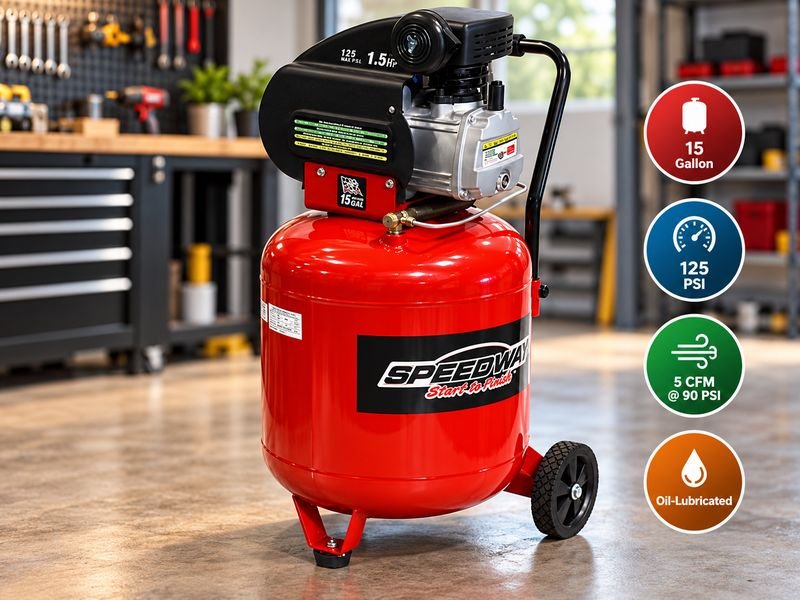
This Speedway 7678 review examines its airflow, tank capacity, pump design, portability, noise, pneumatic-tool compatibility, maintenance requirements, advantages, disadvantages, and overall practicality so you can understand where this compressor fits.
Read More: DEWALT D55141R Review: 2-Gallon Portable Air Compressor
Speedway 7678 Specifications
| Specification | Speedway 7678 |
| Compressor Type | Portable vertical air compressor |
| Tank Capacity | 15 gallons |
| Running Horsepower | 1.5 HP according to manual |
| Historical Marketed Motor Rating | Up to 2 HP |
| Maximum Pressure | 125 PSI according to manual |
| Air Delivery at 40 PSI | 6 CFM |
| Air Delivery at 90 PSI | 5 CFM |
| Voltage | 120V |
| Historical Motor Speed | 3,360 RPM |
| Pump Type | Oil-lubricated reciprocating |
| Drive Type | Direct drive |
| Cylinder | Solid cast iron |
| Configuration | Vertical tank |
| Air Connections | Dual quick-connect manifold |
| Noise Rating in Historical Listings | Approximately 93–95 dB |
| Mobility | Handle and wheels |
| Warranty When Originally Sold | 1-year limited warranty |
The owner’s manual confirms the 15-gallon capacity, 1.5 running HP rating, 125 PSI maximum pressure, and airflow ratings of 6 CFM at 40 PSI and 5 CFM at 90 PSI.
How Powerful Is the Speedway 7678?
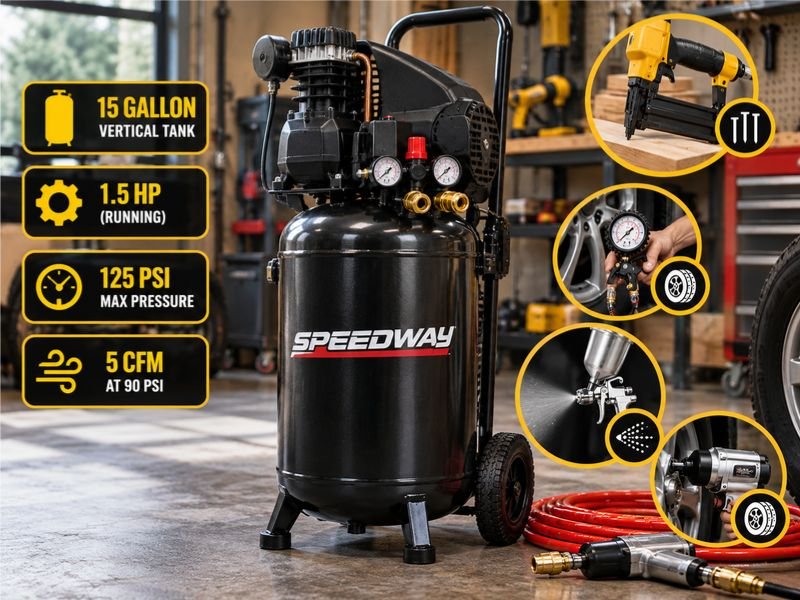
For understanding an air compressor’s real capability, CFM is generally more useful than horsepower alone.
The Speedway 7678 is rated for approximately:
6 CFM at 40 PSI
and
5 CFM at 90 PSI
Those figures make it suitable for a fairly broad range of intermittent garage and DIY pneumatic applications.
At 90 PSI, 5 CFM can support many nail guns, staplers, blow guns, tire inflators, small impact tools, and other moderate-demand air tools, provided the individual tool does not require substantially more airflow.
The 15-gallon tank acts as an air reserve. This allows a tool to temporarily consume more air than the pump itself produces before tank pressure falls enough for the compressor to cycle.
That does not mean a 15-gallon compressor can continuously operate every pneumatic tool.
High-air-demand equipment such as large sanders, grinders, sandblasters, and continuous spray equipment can consume air faster than a 5-CFM pump replaces it. In those situations, the user may need to pause periodically while pressure recovers.
15-Gallon Vertical Tank
The 15-gallon air tank is one of the strongest features of the Speedway 7678.
A compressor tank does not determine the actual amount of air the pump can continuously produce, but a larger tank provides a useful reserve.
Compared with very small portable compressors, 15 gallons can provide:
- Longer intervals before the motor restarts
- Better support for intermittent pneumatic tools
- More stored air for tire inflation
- Smoother pressure delivery
- More flexibility for garage projects
- Better performance during short bursts of high airflow
The tank’s vertical configuration also reduces the amount of floor space required.
Instead of extending horizontally across a workshop floor, most of the tank volume is stacked upward. The manual specifically identifies the vertical layout as a space-saving design.
That can be helpful in a home garage where floor space is often limited.
Oil-Lubricated Cast-Iron Pump
One important difference between the Speedway 7678 and many newer consumer compressors is its oil-lubricated pump.
The manual describes an oil-lubricated solid cast-iron pump, direct-drive motor, single-stage reciprocating mechanism, and air-cooled construction.
An oil-lubricated compressor requires more maintenance than an oil-free design, but it can offer advantages.
Lubrication helps reduce friction between moving pump components. When maintained correctly, this type of design can provide good durability and relatively smooth operation.
The tradeoff is that the owner needs to monitor oil condition and follow the maintenance schedule.
This is not a compressor that should simply be operated indefinitely without servicing.
Direct-Drive Motor
The Speedway 7678 uses a direct-drive compressor system.
In a direct-drive design, the electric motor directly powers the compressor mechanism instead of transferring power through a separate belt system.
Benefits can include:
- Fewer external drive components
- Compact packaging
- Straightforward construction
- Reduced belt maintenance
The manual identifies the pump as a single-stage, direct-drive reciprocating compressor.
For home and light workshop use, that is a sensible arrangement.
125 PSI Maximum Pressure
According to the model 7678 operating manual, the compressor has a maximum pressure rating of 125 PSI.
That is sufficient for many common pneumatic tools that normally operate around 90 PSI.
The additional stored pressure above a tool’s working pressure gives the regulator room to maintain a more consistent outlet pressure as air is consumed.
However, outlet pressure should always be adjusted to match the tool manufacturer’s recommendation.
The Speedway manual specifically warns that compressor outlet pressure should be regulated so it does not exceed the maximum permitted pressure of connected air tools or accessories.
Why Do Some Specifications Say 115 PSI?
Older commercial listings for the Speedway 7678 sometimes state 115 PSI maximum pressure and describe the motor as 2 HP.
By contrast, the operating manual identifies:
Horsepower: 1.5 Running
Maximum PSI: 125
Because manufacturer documentation is normally the stronger reference for operating specifications, 1.5 running HP and 125 PSI are the figures used as the primary ratings in this review. Anyone examining a used compressor should still verify the specifications printed on that individual unit’s data plate.
Dual Air Couplers
The Speedway 7678 includes a dual quick-connect manifold designed to support multiple air connections.
This can be useful when two hoses need to remain connected without repeatedly disconnecting fittings.
For example, a garage setup might keep:
- One hose connected to an inflator
- Another connected to a nailer or blow gun
The manual specifically lists the dual quick-connect manifold as one of the compressor’s major features.
However, two couplers do not double compressor airflow.
Both tools still share the same pump capacity and tank reserve. Running two high-demand pneumatic tools simultaneously can therefore drain the tank quickly.
Portability and Vertical Design
A 15-gallon compressor is not something most users will want to carry around manually.
For that reason, the Speedway 7678 uses a vertical tank, transportation handle, wheels, and vibration-reducing feet.
Historical product specifications describe 6-inch wheels and an ergonomic handle designed to make the compressor easier to move.
This arrangement makes sense for moving the unit:
- Around a garage
- Between work areas
- Into storage
- Around a driveway
- Between nearby job locations
It is portable in the workshop sense rather than compact enough to carry like a small pancake compressor.
Noise Level
Historical specifications place the Speedway 7678 at approximately 93–95 dB. The reference listing currently identifies a 95 dB noise figure.
That should not be interpreted as genuinely quiet by modern standards.
A compressor operating in the mid-90-decibel range is clearly audible and can become uncomfortable during prolonged exposure.
For garage operation, sensible practices include keeping some distance from the compressor and using appropriate hearing protection when exposure warrants it.
Anyone specifically looking for a quiet compressor may prefer a modern low-noise model designed around reduced pump speed and acoustic isolation.
What Can the Speedway 7678 Run?
The Speedway 7678 is best matched with tools whose airflow demands are reasonably close to its 5 CFM at 90 PSI output.
Tire Inflation
The compressor should be well suited to car, truck, bicycle, trailer, and recreational-equipment tire inflation, assuming appropriate fittings and pressure limits are observed.
The 15-gallon tank provides considerably more reserve than a small portable tire inflator.
Nail Guns and Staplers
Most pneumatic nailers operate intermittently rather than consuming air continuously.
That makes the Speedway 7678 a practical match for many:
- Brad nailers
- Finish nailers
- Framing nailers
- Roofing nailers
- Pneumatic staplers
The tank can recover between firing cycles.
Blow Guns
Cleaning dust or debris with a compressed-air blow gun is another suitable application, although prolonged continuous blowing can eventually cause tank pressure to drop.
Impact Wrenches
Some smaller or moderate-air-consumption impact wrenches may work reasonably well for intermittent automotive use.
The key is comparing the impact wrench’s rated CFM requirement with the compressor’s 5 CFM at 90 PSI output.
Spray Painting
The model was historically promoted for applications ranging from tire inflation to painting.
Small spray guns with moderate airflow requirements may be usable.
Large automotive spray guns demanding sustained high CFM, however, can exceed the compressor’s continuous air delivery. For painting, always compare the gun’s SCFM/CFM requirement against compressor output.
Sanders and Grinders
Pneumatic sanders and grinders often consume significant amounts of compressed air continuously.
Although the Speedway may operate some of them for short periods, the 15-gallon tank and 5-CFM-at-90-PSI pump make it less suitable for extended continuous use with high-demand tools.
Maintenance Requirements
The Speedway 7678 requires more maintenance than a modern oil-free compressor.
The manual calls for lubrication, periodic oil replacement, air-filter cleaning, tank draining, and inspection.
Compressor Oil
The pump must contain proper lubricating oil before operation.
The manual recommends different machine-oil grades depending on seasonal temperature and specifies an oil change after approximately 500 hours of operation.
For a used compressor, it is wise to inspect oil level and condition before putting it into regular service.
Drain Moisture From the Tank
Compressed air naturally produces condensation.
Moisture collecting inside a steel receiver tank can promote internal corrosion.
The manual instructs users to drain accumulated water regularly and emphasizes keeping the tank dry.
This is especially important when buying an older compressor because tank condition is a major safety consideration.
Clean the Air Filter
A dirty intake filter restricts airflow and can reduce compressor output.
The manual recommends cleaning the filter regularly and identifies clogged intake filtration as one possible cause of reduced performance.
Speedway 7678 Pros
Good 5 CFM at 90 PSI output: Provides useful airflow for many common pneumatic tools.
15-gallon air reserve: More usable stored air than small portable compressors.
Oil-lubricated pump: A traditional design that can offer good durability with proper maintenance.
Cast-iron cylinder: Helps give the pump a more substantial construction.
Vertical tank: Saves floor space in crowded garages and workshops.
Dual quick-connect manifold: Convenient for keeping multiple air lines connected.
Wheels and handle: Easier to reposition than a stationary compressor.
120V operation: Designed for conventional household electrical service according to historical specifications.
Speedway 7678 Cons
Older design: Replacement parts and model-specific support may be harder to obtain than for current compressors.
Requires oil maintenance: Owners need to monitor lubrication rather than treating it as maintenance-free.
Not truly quiet: Historical noise figures around 93–95 dB are fairly loud.
Limited continuous airflow: 5 CFM at 90 PSI is useful but insufficient for many continuously operated professional pneumatic tools.
Specification inconsistency: Historical listings disagree with the owner’s manual regarding horsepower and maximum PSI.
Used-unit condition matters: Because these compressors are now old, tank corrosion, damaged fittings, worn seals, poor maintenance, and shipping damage deserve careful inspection.
Historical customer comments also include reports of damaged wheels, shrouds, valves, or packaging-related damage alongside positive reports about compressor performance, so physical condition should be checked carefully when considering a second-hand unit.
Who Is the Speedway 7678 Best For?
The Speedway 7678 15-Gallon Vertical Air Compressor makes the most sense for a home garage or workshop where the compressor will be used for a mixture of jobs rather than continuous industrial production.
It is particularly appropriate for:
- DIY mechanics
- Homeowners
- Garage users
- Woodworkers using pneumatic nailers
- Tire and vehicle maintenance
- General pneumatic-tool operation
- Occasional spray work
- Workshop cleaning and inflation
It is less suitable for someone who requires continuous airflow for professional sandblasting, large pneumatic grinders, sustained body-shop spray work, or other applications demanding considerably more than 5 CFM at 90 PSI.
Is the Speedway 7678 Still Worth Considering?
As an older compressor, the answer depends more on condition and price than on specifications alone.
From a performance standpoint, the fundamentals remain useful: a 15-gallon vertical tank, 5 CFM at 90 PSI, oil-lubricated cast-iron pump, dual quick connects, and portable wheel design provide enough capability for a wide variety of household and garage jobs.
The bigger consideration is age.
A carefully maintained compressor with a clean tank, functional pressure switch, healthy safety valve, good hoses and fittings, proper lubrication, and no significant corrosion may still be useful.
A neglected unit with internal tank rust, oil starvation, air leaks, damaged wiring, or malfunctioning safety components should be treated very differently.
For used compressors in particular, receiver-tank condition and safety components should never be ignored.
Frequently Asked Questions About the Speedway 7678
How many gallons is the Speedway 7678?
The Speedway 7678 has a 15-gallon vertical air tank.
How much CFM does the Speedway 7678 produce?
It is rated at approximately 6 CFM at 40 PSI and 5 CFM at 90 PSI.
What is the maximum PSI of the Speedway 7678?
The operating manual lists a 125 PSI maximum. Some older seller specifications state 115 PSI, so the data plate on an individual compressor should be checked when dealing with a used unit.
Is the Speedway 7678 a 2 HP compressor?
The model’s manual lists 1.5 running horsepower. Some historical commercial listings advertised a 2 HP motor rating, which may reflect a different marketing or peak-power convention.
Is the Speedway 7678 oil-free?
No. It uses an oil-lubricated compressor pump and therefore requires lubrication and periodic maintenance.
Can the Speedway 7678 run an impact wrench?
It can operate some pneumatic impact wrenches intermittently, provided their airflow requirement is compatible with the compressor’s 5 CFM at 90 PSI rating. High-consumption impact tools may drain the tank faster than the pump can refill it.
Can the Speedway 7678 be used for painting?
Yes, the compressor was designed for applications that include painting. However, the spray gun’s airflow requirement must remain within the compressor’s available CFM, particularly for extended spraying.
Does the Speedway 7678 have two air outlets?
The owner’s manual lists a dual quick-connect manifold, allowing multiple air lines to be connected.
Is a 15-gallon compressor enough for home garage use?
For tire inflation, nailers, blow guns, light pneumatic fastening, and intermittent automotive work, a 15-gallon compressor can provide a useful balance between capacity and portability. Continuous high-CFM tools may require a larger compressor.
Final Thoughts
The Speedway 7678 15-Gallon Vertical Air Compressor offers a practical combination of tank capacity, usable airflow, traditional pump construction, and garage-friendly dimensions.
Its strongest specifications are the 15-gallon tank, 6 CFM at 40 PSI, 5 CFM at 90 PSI, oil-lubricated cast-iron pump, dual air connections, and vertical layout. These features make it suitable for tire inflation, pneumatic nailers, general garage maintenance, cleaning, light impact-tool use, and other intermittent compressed-air jobs.
It is not the best match for continuous high-air-demand applications, and because model 7678 is now an older compressor, the condition of any individual unit matters enormously.
For a well-maintained example, though, the Speedway 7678 remains a capable 15-gallon portable air compressor whose basic mechanical design can still handle many common workshop and DIY tasks.