Steele Products SP-CE415M Review: 15-Gallon Air Compressor
The Steele Products SP-CE415M is a portable 15-gallon horizontal air compressor designed for homeowners, garage users, DIY projects, pneumatic tools, tire inflation, and other jobs that need more stored air than a small pancake or trim compressor can provide.
Its combination of a 15-gallon air tank, oil-lubricated pump, 2.5 HP continuous / 3.5 peak HP motor, dual quick-connect couplers, pressure gauges, thermal overload protection, and pneumatic wheels makes it considerably more substantial than a compact 3- or 6-gallon compressor. Archived product information lists the SP-CE415M as a 120V/60Hz machine with a horizontal tank and heavy-duty pneumatic tires.
The larger tank is particularly useful because it provides a greater reservoir of compressed air before the motor needs to cycle. That can make the compressor better suited to garage and workshop work where smaller compressors may recover too frequently.
However, the Steele SP-CE415M is an older compressor model, and that matters when considering one today. Sears PartsDirect still identifies the exact SP-CE415M and provides parts diagrams, but several original components are now listed as no longer manufactured.
This review covers the SP-CE415M’s motor, tank capacity, oil-lubricated pump, portability, controls, pneumatic-tool compatibility, maintenance requirements, advantages, limitations, and what to inspect before buying a used unit.
Steele Products SP-CE415M Overview
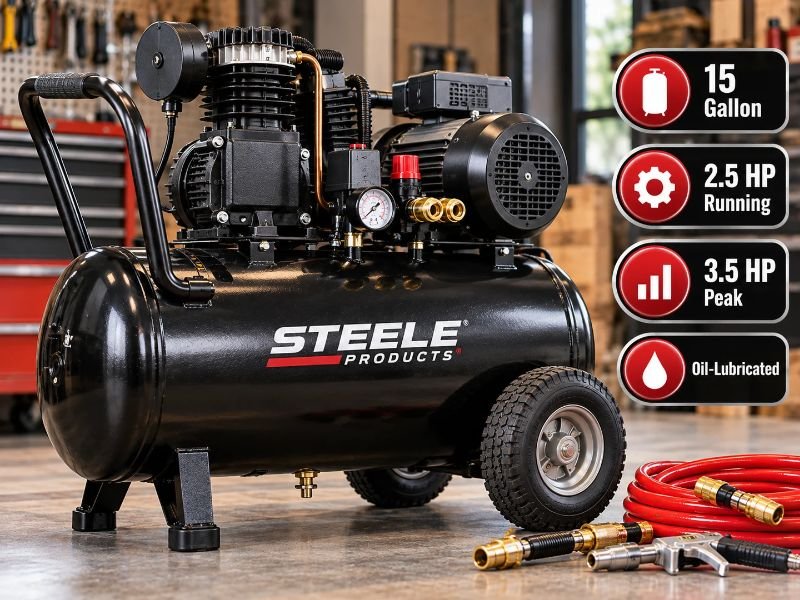
The Steele Products SP-CE415M air compressor sits between lightweight portable compressors and much larger stationary garage compressors.
A 15-gallon tank offers significantly more compressed-air storage than the 3-, 4-, and 6-gallon compressors commonly used for basic trim work.
At the same time, the SP-CE415M remains movable thanks to its horizontal tank layout, handle, and pneumatic wheel kit.
Archived specifications identify several key features:
- 15-gallon horizontal tank
- 2.5 HP continuous motor output
- 3.5 peak HP
- 120V / 60Hz power
- Oil-lubricated pump
- Thermal overload protection
- Dual quick-connect couplers
- Two pressure gauges
- Heavy-duty pneumatic tires
These characteristics position it primarily as a portable garage and workshop compressor rather than an ultralight jobsite compressor.
Key Specifications
| Specification | Steele Products SP-CE415M |
| Compressor Type | Portable electric air compressor |
| Tank Capacity | 15 gallons |
| Tank Style | Horizontal |
| Motor Power | 2.5 HP continuous |
| Peak Motor Rating | 3.5 HP peak |
| Electrical Supply | 120V / 60Hz |
| Pump Type | Oil-lubricated |
| Quick Couplers | 2 |
| Pressure Gauges | 2 |
| Overload Protection | Thermal |
| Mobility | Pneumatic wheel kit |
| Pump Oil Required | Yes |
| Intended Environment | Garage, workshop, home and light pneumatic work |
The official owner’s manual also makes clear that the SP-CE415M requires pump oil before operation. It specifies SAE 10W-30 synthetic oil meeting the stated API grade or suitable 10W-20 air-compressor oil.
15-Gallon Tank Gives It More Working Air
One of the biggest reasons to choose a compressor like the SP-CE415M over a small pancake model is its 15-gallon tank.
The tank does not directly determine how powerful the pump is. Instead, it determines how much compressed air can be stored before the compressor needs to replenish the supply.
That distinction is important.
A larger tank can provide several practical advantages:
- Longer intervals between motor cycles
- Better support for tools used in short bursts
- More convenient tire inflation
- Greater reserve for blow-gun work
- Improved usability with some pneumatic tools
- Less frequent recovery compared with very small tanks
For tasks such as driving nails or operating an air ratchet briefly, the tank can supply stored air before pressure drops enough to make the compressor restart.
The SP-CE415M’s 15-gallon capacity therefore provides considerably more reserve than a typical 6-gallon compressor while remaining portable enough to move around a garage.
2.5 HP Continuous and 3.5 Peak HP Motor
Archived product literature describes the SP-CE415M as using a motor rated at 2.5 HP continuous and 3.5 HP peak.
The distinction between continuous and peak horsepower is worth understanding.
Continuous horsepower is more useful when judging sustained motor capability.
Peak horsepower generally represents a short-duration maximum rather than the power continuously available during normal compressor operation.
Therefore, the 2.5 HP continuous rating is the more meaningful figure when comparing its working motor capacity.
The motor operates from a standard 120V, 60Hz electrical supply, which makes the compressor more convenient for residential garages and workshops than large stationary compressors requiring 240V wiring.
Electrical load still needs to be considered. Large electric motors draw significant current during startup, so appropriate wiring and properly rated extension cords are important.
Oil-Lubricated Pump
The oil-lubricated compressor pump is one of the most notable characteristics of the Steele SP-CE415M.
Unlike an oil-free compressor, the pump requires lubrication to reduce friction between internal moving components.
Oil lubrication can offer advantages such as:
- Reduced internal friction
- Improved component lubrication
- Potentially longer pump life with proper maintenance
- Better suitability for repeated workshop use
- Smoother mechanical operation
The tradeoff is additional maintenance.
The owner’s manual specifically warns not to start the compressor until oil has been added and identifies suitable oil types for the pump.
That means the SP-CE415M should never be treated like a maintenance-free oil-less compressor.
Why Oil Level Matters
Running an oil-lubricated air compressor with insufficient oil can accelerate wear and potentially damage internal pump components.
Before operation, the oil level should be checked through the compressor’s oil-level window or according to the procedure in the owner’s manual.
Oil condition also matters.
Old, dirty, or degraded compressor oil cannot lubricate as effectively as clean oil of the correct specification.
This becomes especially important when considering a used SP-CE415M because previous maintenance history may not be known.
Dual Quick-Connect Couplers
The SP-CE415M includes two quick-connect couplers.
Quick couplers allow compatible air hoses and pneumatic tools to be attached or removed rapidly.
Having two connections can be convenient in a workshop because two hoses can remain connected at the same time.
For example:
One outlet could remain connected to a tire inflation hose.
The second could be connected to a pneumatic nailer or blow gun.
This reduces the need to repeatedly swap hoses.
However, having two outlets does not double the compressor’s airflow.
If two air tools are operated simultaneously, their combined CFM requirement still needs to remain within what the compressor pump can realistically supply.
Two Pressure Gauges
Another useful feature is the pair of easy-to-read pressure gauges.
A typical compressor setup uses one gauge to show tank pressure and another to indicate regulated outlet pressure.
These two readings serve different purposes.
Tank Pressure
Tank pressure shows how much compressed air is currently stored inside the receiver tank.
As air is used, this pressure falls.
The compressor’s pressure switch automatically cycles the motor to restore pressure when needed.
Regulated Outlet Pressure
Different pneumatic tools require different working pressures.
The regulator allows the pressure delivered through the hose to be adjusted without changing the actual pressure stored inside the tank.
This is particularly important because operating a pneumatic tool above its rated pressure can cause excessive wear or create a safety hazard.
Always follow the pressure requirement specified by the tool manufacturer.
Thermal Overload Protection
The SP-CE415M includes thermal overload protection.
An electric compressor motor generates heat during operation.
If operating conditions cause excessive temperature, thermal protection is intended to help protect the motor from damaging overheating.
Conditions that can contribute to overheating include:
- Restricted airflow around the motor
- Extended compressor operation
- Very high ambient temperature
- Electrical voltage problems
- Improper extension cords
- Mechanical problems in the pump
- Excessive air demand
Thermal protection is valuable, but it should not be treated as a substitute for proper compressor operation.
If the motor repeatedly trips its thermal protection, the cause should be investigated rather than repeatedly restarting the unit.
Pneumatic Wheels Improve Portability
A 15-gallon compressor is substantially larger than a hand-carry pancake compressor, so mobility matters.
The SP-CE415M uses heavy-duty pneumatic tires to make the horizontal compressor easier to roll.
Pneumatic tires have an advantage on uneven workshop and garage floors because they can absorb small bumps better than small hard-plastic wheels.
This makes moving the compressor between:
- Garage bays
- Workbenches
- Driveways
- Storage areas
- Home renovation projects
more manageable.
Even with wheels, this should not be considered a highly portable compressor in the same sense as a 25- or 30-pound trim compressor.
Its portability is better described as roll-around mobility.
What Can the Steele Products SP-CE415M Run?
Matching an air compressor to a pneumatic tool requires looking primarily at the tool’s CFM or SCFM requirement at its specified PSI.
Tank size and horsepower alone do not guarantee compatibility.
The SP-CE415M’s 15-gallon reservoir makes it potentially useful for a broad range of intermittent air-tool applications.
Likely applications include:
- Tire inflation
- Brad nailers
- Finish nailers
- Pneumatic staplers
- Blow guns
- Airbrush-type equipment where specifications match
- Intermittent air ratchet use
- Light garage air-tool work
Higher-demand tools require more caution.
These can include:
- Die grinders
- Pneumatic sanders
- Large impact wrenches
- Continuous spray guns
- Sandblasters
- Cut-off tools
These tools can consume air continuously and may empty a 15-gallon tank much faster than intermittent tools.
For that reason, the exact air-delivery rating on the compressor’s nameplate should be compared with the CFM requirement of the tool being used.
Is It Good for Tire Inflation?
Yes, tire inflation is one of the most practical uses for a 15-gallon garage compressor.
The larger reservoir lets the compressor store enough air to inflate several tires without behaving like a small portable inflator that must run almost continuously.
Potential uses include:
- Car tires
- Light truck tires
- Trailer tires
- Lawn equipment tires
- Bicycle tires with the correct adapter
- Sports equipment
Always regulate the pressure and follow the tire manufacturer’s specified cold inflation pressure.
The compressor’s maximum tank pressure should never be confused with the correct tire pressure.
Is It Good for Nail Guns?
The SP-CE415M’s 15-gallon tank is well suited in principle to many nailers because nail guns use compressed air intermittently rather than continuously.
This can include:
- Brad nailers
- Finish nailers
- Staplers
- Some framing nailers
Whether a specific tool is compatible depends on its actual operating pressure and air consumption.
Compared with a small 3- or 6-gallon compressor, the larger tank provides a greater reserve between recovery cycles.
For remodeling and workshop work, this can be especially useful when multiple fasteners need to be installed rapidly.
Can It Run an Impact Wrench?
An impact wrench presents a more complicated case.
Pneumatic impact wrenches can consume significantly more air than nailers.
A 15-gallon tank can provide enough stored air for short bursts, which may make the SP-CE415M usable for occasional automotive fastener removal if the specific wrench’s airflow requirement matches the compressor.
For continuous impact-wrench work, however, pump output becomes more important than tank size.
If the tool consumes air faster than the compressor replaces it, tank pressure will continue falling.
For frequent professional automotive work, a compressor with a larger tank and verified higher SCFM at 90 PSI is generally more appropriate.
Can It Run a Paint Sprayer?
Possibly for some low-air-demand applications, but spray equipment requires careful compressor matching.
Many conventional spray guns require continuous airflow.
Painting differs from using a nailer because the trigger may remain open for extended periods.
This means the compressor must continuously replace air at nearly the same rate the spray gun consumes it.
The safest approach is to compare the gun’s stated CFM requirement directly with the SP-CE415M’s rating plate.
A large spray gun that requires more airflow than the compressor can deliver will cause pressure to fall during spraying, potentially leading to inconsistent atomization and finish quality.
Maintenance Requirements
Maintenance is particularly important with the Steele Products SP-CE415M because it uses an oil-lubricated pump.
Check Pump Oil
The manual specifically states that oil must be added before startup and provides suitable oil specifications.
Check the oil level regularly and change the oil according to the maintenance schedule.
Drain Moisture From the Tank
Compressing air naturally causes moisture to condense inside the tank.
The tank should be drained regularly.
Leaving moisture inside a steel receiver can contribute to internal corrosion, which is a serious safety concern in any older compressor.
Inspect the Air Filter
A dirty intake filter restricts airflow and can reduce compressor efficiency.
Clean or replace it when necessary.
Inspect Hoses and Fittings
Look for:
- Cracks
- Air leaks
- Damaged quick couplers
- Loose fittings
- Bulges in hoses
Air leaks make the compressor cycle more frequently and waste energy.
Check the Safety Valve
The pressure relief valve is an important safety component.
It should be maintained according to the owner’s manual and should never be modified or disabled.
Steele Products SP-CE415M Pros and Cons
Pros
- Large 15-gallon air tank
- 2.5 HP continuous motor rating
- 3.5 peak HP
- Oil-lubricated pump
- Standard 120V / 60Hz operation
- Dual quick-connect couplers
- Two pressure gauges
- Thermal overload protection
- Heavy-duty pneumatic tires
- More air storage than typical pancake compressors
- Useful for garages and home workshops
- Suitable for many intermittent pneumatic tools
- Good format for tire inflation
- Horizontal layout provides stable roll-around design
Cons
- Requires pump-oil maintenance
- Larger and heavier than small portable compressors
- Older/discontinued product platform
- Some original replacement parts are no longer manufactured
- Pneumatic tires require their own maintenance
- Not ideal for highly air-hungry tools unless airflow requirements match
- Older used tanks require careful corrosion inspection
- Considerably less convenient to transport up stairs than a small compressor
Replacement Parts and Long-Term Ownership
Parts availability is an important consideration today.
Sears PartsDirect continues to list the SP-CE415M compressor and its exploded parts diagram, confirming the model and many original component numbers. However, components including some original motor, quick-connect, pressure-switch, pipe, and related parts are listed as no longer manufactured.
Some compatible or superseded parts may still be available through other suppliers. For example, parts databases continue to cross-reference certain SP-CE415M compressor components with other compressor models.
That does not guarantee that every repair will be economical.
Anyone buying one today should therefore consider the condition of the pump, motor, tank, regulator, and pressure switch carefully.
What to Check Before Buying a Used SP-CE415M
Because this is now a legacy compressor, condition matters more than cosmetic appearance.
Inspect the Tank Carefully
Look for:
- Heavy exterior rust
- Severe pitting
- Damage around welded areas
- Signs of previous tank repair
- Water remaining inside the tank
A compromised pressure vessel should not be repaired casually.
Check the Pump Oil
Very low, contaminated, or milky oil can indicate poor maintenance or moisture contamination.
Let the Compressor Build Pressure
Listen for unusual knocking, grinding, or excessive vibration.
The compressor should build pressure normally and cycle off through its pressure-switch system.
Check for Air Leaks
After the tank reaches pressure, listen around:
- Quick couplers
- Regulator
- Pressure switch
- Safety valve
- Tank fittings
- Drain valve
Persistent leakage can significantly reduce usable performance.
Test Both Gauges
The tank and regulated-output gauges should respond properly.
Check the Regulator
Turn the regulator through its adjustment range and confirm that outlet pressure responds smoothly.
Inspect the Electrical Cord
Avoid compressors with damaged plugs, exposed conductors, or questionable wiring repairs.
Test Thermal and Pressure Controls
Do not buy a compressor with bypassed safety devices.
Who Is the Steele SP-CE415M Best For?
The SP-CE415M fits users who want more air storage than a small portable compressor but do not need a large stationary shop machine.
It can make sense for:
Home garage users who need compressed air for tires, cleaning, and occasional pneumatic tools.
DIY mechanics using air tools intermittently.
Woodworkers and remodelers running nailers and staplers.
Homeowners who prefer a larger compressor that can remain in the garage but still be rolled where needed.
Workshop users who value an oil-lubricated pump and 15-gallon air reserve.
Who Should Consider a Different Compressor?
A smaller compressor may be better if portability is the top priority.
A modern 6-gallon pancake compressor is easier to carry into houses or upstairs.
Conversely, a larger 30-, 60-, or 80-gallon compressor may be a better choice for users regularly operating:
- Sanders
- Die grinders
- High-CFM impact tools
- Spray equipment
- Sandblasting equipment
- Multiple continuous-use air tools
The SP-CE415M occupies the middle ground between those categories.
Frequently Asked Questions About the Steele Products SP-CE415M
What is the Steele Products SP-CE415M?
The Steele Products SP-CE415M is a portable electric horizontal air compressor with a 15-gallon tank, oil-lubricated pump, and wheel kit.
How many gallons is the SP-CE415M?
It has a 15-gallon air receiver tank.
How much horsepower does the SP-CE415M have?
Archived specifications list 2.5 HP continuous and 3.5 HP peak.
Is the Steele SP-CE415M oil-free?
No. It uses an oil-lubricated pump and requires appropriate compressor oil. The owner’s manual specifically warns against starting the unit before adding oil.
What oil does the SP-CE415M use?
The owner’s manual states that SAE 10W-30 synthetic oil meeting the specified API grade or 10W-20 air-compressor oil can be used.
Is the SP-CE415M portable?
Yes, but it is best described as a wheeled portable compressor rather than a hand-carry compressor. It uses a horizontal tank and heavy-duty pneumatic tires.
Does it have two air connections?
Yes. Archived product specifications list dual quick-connect couplers.
Does it have thermal protection?
Yes. The motor system includes thermal overload protection.
Can the SP-CE415M inflate car tires?
Yes. A 15-gallon compressor is well suited to tire inflation when used with an appropriate hose, tire chuck, pressure regulator, and gauge.
Can it run a nail gun?
Many pneumatic nailers have intermittent air requirements that can work well with a 15-gallon compressor. The nailer’s PSI and CFM specifications should still be compared with the compressor’s rated output.
Can it run an impact wrench?
It may handle an impact wrench for intermittent use if the wrench’s airflow requirement is compatible. Continuous automotive air-tool use may require a compressor with greater verified SCFM output.
Is the Steele SP-CE415M still made?
The model should be treated as a legacy/discontinued compressor. Sears PartsDirect still maintains a model-specific parts listing, but several original parts are identified as no longer manufactured.
Final Verdict
The Steele Products SP-CE415M is a substantial step up from a small pancake compressor for someone who wants a larger supply of compressed air while retaining the ability to move the machine around a garage or workshop.
Its major strengths are the 15-gallon horizontal tank, 2.5 HP continuous / 3.5 peak HP motor, oil-lubricated pump, 120V power system, dual quick-connect couplers, two pressure gauges, thermal overload protection, and pneumatic wheel kit.
The 15-gallon tank provides a useful air reserve for tire inflation, nailers, blow guns, staplers, and a range of intermittent workshop tasks. An oil-lubricated pump also gives the compressor a more traditional serviceable design, though it comes with the responsibility of checking and changing oil.
Its main disadvantage today is age.
The SP-CE415M is no longer a current mainstream compressor, and several original parts have become difficult to source. This makes the condition of any used example particularly important.
A clean compressor with a sound tank, healthy pump, properly functioning pressure controls, and evidence of regular oil maintenance can still be useful in a home garage or workshop. By contrast, a heavily rusted tank, neglected pump, failing pressure switch, or extensive air leaks can quickly turn a low purchase price into an expensive repair project.
For users whose needs fall between a small portable compressor and a large stationary machine, the Steele Products SP-CE415M 15-gallon air compressor remains an interesting middle-ground design. Its large air reservoir, oil-lubricated pump, dual air outlets, pressure control system, and wheeled horizontal chassis give it the basic features needed for a wide variety of garage, DIY, inflation, and pneumatic-tool applications.