
What Is the Power Output of an Air Compressor? HP, CFM, and Watts
Air-compressor power output is not represented by one number. Horsepower or kilowatts describe motor power, while CFM or SCFM at a stated PSI shows how much usable compressed air the machine delivers. For choosing a compressor for air tools, its SCFM at the required pressure is usually more useful than horsepower alone.
A compressor may have a powerful electric motor but still deliver less usable air than another design with a similar motor rating. Pump efficiency, compression stages, operating pressure, speed, cooling, and mechanical losses all affect the amount of compressed air available at the outlet.
PSI adds another piece to the picture. It tells you the pressure of the compressed air, while CFM tells you the volume delivered over time. A compressor that reaches 150 PSI but supplies only 1 SCFM is very different from one that delivers 10 SCFM at 90 PSI.
For someone asking what is the power output of an air compressor, the most useful answer is to separate motor power from air output. Motor power is stated in horsepower, watts, or kilowatts. Compressor output is normally stated as CFM or SCFM at a specific PSI.
Atlas Copco recommends sizing compressors from required airflow and pressure first rather than horsepower, and Ingersoll Rand gives the same guidance because two machines with the same horsepower can deliver different airflow at the same pressure.
The sections below explain horsepower, watts, CFM, PSI, tank size, electrical input, rough CFM-per-horsepower ranges, and how to compare compressors for nailers, impact wrenches, spray guns, sanders, and other tools.
How Is Air Compressor Power Output Measured?
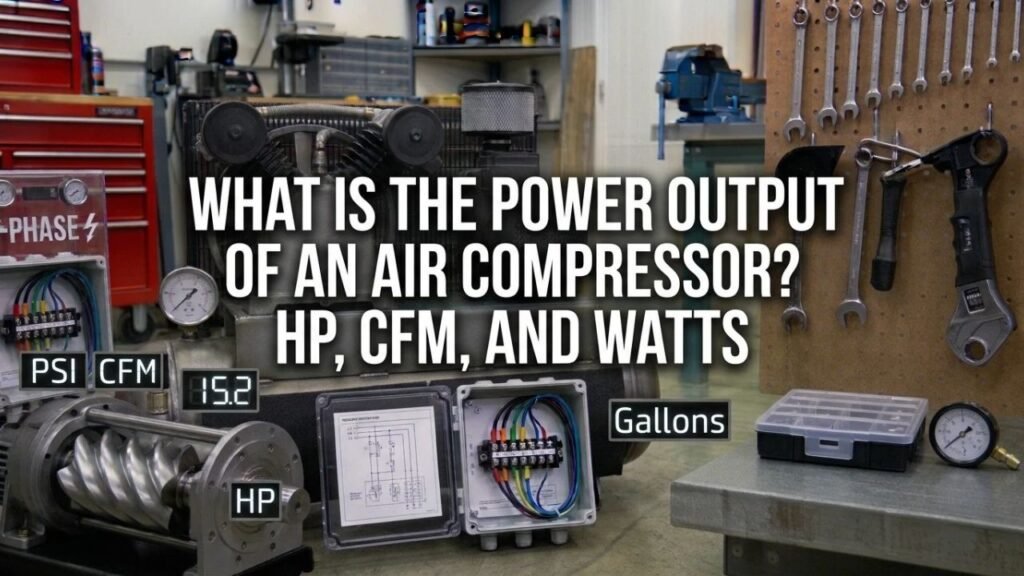
There are several ratings on an air-compressor specification label, and they describe different parts of performance.
The main ones are:
| Specification | What it measures | Common unit |
| Motor power | Mechanical motor rating | HP or kW |
| Electrical input | Electricity used by motor/package | W or kW |
| Airflow | Air delivered over time | CFM or SCFM |
| Pressure | Force of compressed air | PSI |
| Tank capacity | Stored compressed-air volume | Gallons |
| Specific power | Energy needed for a given airflow | kW/100 CFM |
Horsepower Measures Motor Power
Horsepower tells you about the motor driving the compressor pump.
A larger motor can generally drive a larger pump or move more air, but horsepower alone does not tell you how much usable compressed air reaches your tools.
Two 2 HP compressors can have different:
- Pump designs
- Maximum pressures
- CFM ratings
- Duty cycles
- Compression stages
- Operating speeds
That is why horsepower should not be your only buying specification.
CFM Measures Delivered Airflow
CFM means cubic feet per minute.
It describes how much air the compressor delivers over time.
Atlas Copco identifies CFM and pressure as the primary compressor-selection figures and describes horsepower as a secondary specification.
For pneumatic tools, check the compressor’s airflow at the pressure your tool requires.
PSI Measures Pressure
PSI means pounds per square inch.
It tells you the pressure at which air is stored or delivered.
Common air-tool operating pressure is around 90 PSI, though actual requirements vary.
A compressor may be rated:
- 2.6 SCFM at 90 PSI
- 4.0 SCFM at 90 PSI
- 6.2 SCFM at 90 PSI
The model producing 6.2 SCFM supplies much more air at that pressure than the 2.6 SCFM unit.
Key Takeaway: Horsepower measures motor power, CFM measures airflow, and PSI measures pressure. For air-tool capability, CFM at the required PSI is usually the strongest comparison.
How Much CFM Does 1 Horsepower Produce?
There is no exact CFM-per-horsepower conversion.
Pump type and pressure affect the result.
As a broad reference, Atlas Copco states that piston compressors often deliver around 3–4 CFM per horsepower, while rotary screw compressors may produce approximately 4–5 CFM per horsepower.
That gives a rough table:
| Motor size | Rough piston-compressor airflow |
| 1 HP | 3–4 CFM |
| 2 HP | 6–8 CFM |
| 3 HP | 9–12 CFM |
| 5 HP | 15–20 CFM |
| 7.5 HP | 22–30 CFM |
| 10 HP | 30–40 CFM |
These are estimates, not purchasing specifications.
Why CFM per HP Changes
A compressor’s airflow per horsepower changes with:
- Discharge pressure
- Pump efficiency
- Number of compression stages
- Pump speed
- Motor efficiency
- Compressor type
- Air temperature
- Altitude
- Mechanical losses
Producing 5 CFM at 40 PSI requires less compression work than delivering the same airflow at 150 PSI.
Do Not Convert HP to CFM Without Checking PSI
A statement such as “1 HP equals 4 CFM” leaves out the operating pressure.
Use the compressor’s published airflow rating at 90 PSI, 100 PSI, or the pressure required by your equipment.
Ingersoll Rand specifically cautions against treating horsepower as a universal CFM conversion because compressors with the same horsepower can deliver different airflow.
Key Takeaway: Around 3–4 CFM per HP is a useful piston-compressor estimate, but the published CFM at your required PSI should control the final comparison.
How Many Watts Is an Air Compressor?
Electrical air compressors are commonly rated in watts or kilowatts, especially outside the United States.
The basic mechanical conversion is:
1 horsepower ≈ 746 watts
So:
| Horsepower | Mechanical power equivalent |
| 0.5 HP | 373 W |
| 1 HP | 746 W |
| 1.5 HP | 1,119 W |
| 2 HP | 1,492 W |
| 3 HP | 2,238 W |
| 5 HP | 3,730 W |
| 10 HP | 7,460 W |
These numbers are mechanical-equivalent power, not necessarily the electrical wattage drawn from the outlet.
Why a 1 HP Motor Can Draw More Than 746 Watts
No electric motor is perfectly efficient.
Some electrical energy becomes:
- Heat
- Magnetic losses
- Bearing friction
- Fan losses
- Pump losses
A motor that produces about 1 HP mechanically therefore needs more than 746 watts of electrical input.
Voltage Times Amps Is Only a Starting Point
For simple DC circuits:
Watts = Volts × Amps
AC motors are more complicated because power factor and motor efficiency affect actual power.
A 120-volt compressor drawing 15 amps should not automatically be described as producing 1,800 watts mechanically.
The electrical circuit has to supply the motor, but only part of that input becomes useful shaft power.
Kilowatts on Larger Compressors
Industrial compressors commonly list motor size in kilowatts.
Atlas Copco gives the example that a 37 kW compressor motor is approximately 50 HP, while stressing that airflow and operating pressure still determine suitability.
Key Takeaway: One horsepower equals about 746 watts mechanically, but compressor electrical consumption is higher because motors and pumps have efficiency losses.
What Is the Actual Air Output of a Compressor?
For most owners, the practical “output” is the amount of compressed air the compressor can deliver.
That is why SCFM at PSI is so useful.
SCFM Means Standard Cubic Feet per Minute
SCFM expresses airflow referenced to standardized conditions.
This provides a more useful comparison between compressors than simply measuring the volume of air under changing atmospheric conditions.
You may also see:
- CFM
- SCFM
- ACFM
- FAD
The exact test method can differ, so manufacturer data measured under recognized standards is preferable.
Always Read the Pressure Beside the Airflow
A rating should look something like:
6.2 SCFM at 90 PSI
The 90 PSI matters because compressor airflow changes with discharge pressure.
A current DEWALT 25-gallon compressor, for example, lists 6.2 SCFM at 90 PSI and a 15-amp electrical rating.
This information is far more useful for an air-tool buyer than knowing only that the compressor plugs into a 120-volt circuit.
Higher Pressure Usually Reduces Available Flow
As the compressor works against higher discharge pressure, airflow may decline.
A specification sheet may therefore list separate figures such as:
- CFM at 40 PSI
- CFM at 90 PSI
The 40 PSI number is often higher.
Compare compressors at the same pressure.
Key Takeaway: The most practical air-compressor output rating is SCFM or CFM at a stated PSI because it describes the air actually available to run equipment.
What Is the Difference Between Input Power and Output Power?
Input and output should not be treated as the same thing.
Electrical Input Power
Electrical input is the electricity consumed by the motor and compressor package.
It can be expressed as:
- Watts
- Kilowatts
- Voltage and amperage
Industrial data sheets may list total package input power at rated operating conditions.
The U.S. Department of Energy’s compressed-air sourcebook includes total package input power in kW and specific power in kW per 100 CFM among standard compressor performance data.
Motor Shaft Output
The motor converts electrical energy into mechanical rotation.
That shaft power drives the compressor pump.
Some energy has already been lost through the motor before it reaches the pump.
Compressed-Air Output
The pump then converts mechanical energy into compressed air.
More energy is lost through:
- Pump friction
- Heat
- Valve losses
- Leakage
- Cooling systems
- Transmission losses
That is why a 2 HP motor does not mean 2 HP of usable pneumatic power reaches an air tool.
How Does PSI Affect Air Compressor Power?
Compressing air to a higher pressure takes more work.
If you require higher PSI while maintaining the same airflow, the compressor generally needs more power.
For example, producing:
10 CFM at 40 PSI
is less demanding than producing:
10 CFM at 175 PSI
with everything else equal.
Ingersoll Rand notes that increased airflow or increased pressure generally raises the power required from the compressor.
Do Not Run Higher Pressure Than Needed
Running an industrial compressed-air system at unnecessarily high pressure wastes energy and increases leakage.
For a portable compressor, the regulator should also be set according to the air tool’s required working pressure.
More PSI does not make every tool work better.
Does Tank Size Increase Compressor Power Output?
No.
Tank capacity changes how much compressed air can be stored.
It does not increase the compressor pump’s continuous output.
Example
Imagine two compressors with the same pump:
- Compressor A: 6-gallon tank, 3 CFM at 90 PSI
- Compressor B: 20-gallon tank, 3 CFM at 90 PSI
The 20-gallon model stores more air and can run a high-demand tool longer before pressure drops.
Once the stored air is used, both pumps still produce only 3 CFM.
Why Bigger Tanks Feel More Powerful
A larger receiver provides more reserve air.
That can improve short-duration jobs such as:
- Impact-wrench bursts
- Nail-gun bursts
- Blow-gun use
It also reduces how quickly the tank pressure falls.
For continuous tools, pump CFM still controls long-term performance.
Key Takeaway: A larger tank increases stored-air reserve and runtime between cycles, but only a larger or more capable pump raises continuous airflow output.
How Much Power Does a Small Portable Compressor Produce?
Small compressors vary widely.
A compact machine may use a fraction of a horsepower and deliver around 1 CFM at 90 PSI.
A larger portable shop model may use a stronger motor and supply 5–7 CFM at the same pressure.
The tank size alone does not reveal pump power.
A 1-gallon unit can have a stronger or weaker pump than another 1-gallon model.
The same applies to 6-, 10-, and 20-gallon compressors.
Look at:
- SCFM at 90 PSI
- Maximum PSI
- Motor HP or current rating
- Tank size
- Duty cycle
That combination gives a much better picture.
What Power Output Is Needed for Air Tools?
Air tools should be matched by airflow and pressure rather than compressor horsepower alone.
Atlas Copco provides representative air-demand ranges showing why tool type matters. Its sizing guide lists impact wrenches around 3–5 CFM at 90–100 PSI, grinders around 5–8 CFM at 90–120 PSI, and paint sprayers around 6–7 CFM at 30–50 PSI as general examples.
Brad and Finish Nailers
Nailers use air in short bursts.
A relatively low-CFM portable compressor can work because the tank and pump have time to recover between shots.
Impact Wrenches
Impact tools need larger bursts of air.
A small compressor may run the tool briefly, then lose pressure.
For frequent automotive work, choose a compressor whose rated CFM closely matches or exceeds the wrench’s requirement.
Air Sanders and Grinders
These are continuous-air tools.
A compressor that is too small may run constantly while the tool slows down.
For these tools, CFM output is much more important than having a high maximum tank PSI.
Spray Guns
Spray guns require consistent airflow for good atomization.
Low-CFM compressors can create pressure changes during a spray pass.
Check the exact gun’s airflow requirement before sizing the compressor.
Key Takeaway: Intermittent nailers can work with relatively low output, while impact tools, grinders, sanders, and spray guns need much stronger continuous airflow.
What Is Specific Power on an Air Compressor?
Specific power is mainly an industrial compressor efficiency measurement.
It relates electrical input to delivered airflow.
A common form is:
kW per 100 CFM
Lower specific power generally means less electrical energy is needed to produce a given airflow at the specified operating pressure.
The DOE sourcebook includes specific power at rated capacity and full-load operating pressure as a standard data-sheet metric.
Why Operating Pressure Must Be Included
Specific power cannot be judged without pressure.
Producing 100 CFM at low pressure requires less work than producing the same 100 CFM at much higher pressure.
DOE has also noted that kW-per-CFM performance depends on both pressure and flow.
For a homeowner buying a pancake compressor, specific power is rarely listed.
For a factory operating large compressors many hours per year, it can have a major effect on electricity costs.
How Do You Compare the Power of Two Air Compressors?
Start with the job rather than the motor.
Compare CFM at the Same PSI
If one compressor produces:
3.0 SCFM at 90 PSI
and another produces:
6.0 SCFM at 90 PSI
the second unit has roughly twice the rated airflow at that pressure.
That difference is directly relevant to air-tool operation.
Compare Maximum PSI
Higher maximum tank pressure stores more air in the same tank volume.
This can increase reserve capacity, but it does not replace strong pump airflow.
Compare Duty Cycle
A compressor that produces enough CFM for short periods may still be poorly suited to continuous operation if its duty cycle requires frequent cooling periods.
Compare Motor Rating
Use horsepower or kilowatts as supporting information.
If two compressors have similar airflow but one requires substantially more motor power, the designs may differ in pressure rating, efficiency, or operating conditions.
Compare Tank Capacity Last
Tank size affects storage and cycling.
It should not be used as the main measure of power output.
Key Takeaway: Compare SCFM at the same PSI first, then check maximum pressure, duty cycle, motor power, and tank capacity.
Can a Compressor Have High Horsepower but Low CFM?
Yes.
Horsepower and airflow are related, but not in a fixed one-to-one ratio.
A compressor may trade airflow for:
- Higher pressure
- Different pump speed
- Longer service life
- Different compression technology
Two machines can also have different mechanical and volumetric efficiencies.
This is why the printed HP number should never replace the published air-delivery specification.
Can a Compressor Have High PSI but Low Power Output?
Yes.
A small compressor can slowly build a tank to very high pressure.
That does not mean it can supply a large volume of air continuously.
For example, a tiny compressor reaching 150 PSI may be excellent for inflation but unable to keep an air sander running.
A lower-pressure compressor with far more CFM may be stronger for pneumatic tools.
Maximum PSI and airflow answer different questions.
How Much Air Compressor Output Do You Need?
Use the highest-demand tool you plan to operate.
A simple process is:
- Find the tool’s required CFM.
- Find its required PSI.
- Check if multiple tools will run at once.
- Compare that demand with compressor SCFM at the same pressure.
- Leave some airflow reserve for pressure drop and normal variation.
- Check duty cycle for long-running tools.
Ingersoll Rand recommends adding the airflow demand of tools that operate at the same time and sizing around required CFM and pressure.
Do not total every tool in the garage if only one will ever run at a time.
Conclusion
What is the power output of an air compressor cannot be answered accurately with horsepower alone. HP or kW describes motor power, while CFM or SCFM at a stated PSI describes the compressed-air output available for actual work.
For portable and garage compressors, I would compare SCFM at 90 PSI first if your tools operate around that pressure. Then check maximum PSI, duty cycle, tank size, and motor rating. A larger tank provides more reserve, but it does not raise the pump’s continuous CFM.
For industrial systems, electrical input and specific power also matter because they show how much energy the compressor needs to provide its rated airflow. In every case, matching CFM and PSI to the job gives a clearer picture than choosing the largest horsepower number.
FAQs About Air Compressor Power Output
Is Air Compressor Power Measured in HP or CFM?
Both figures may appear, but they measure different things. Horsepower describes motor power, while CFM measures delivered airflow. For deciding if a compressor can run a pneumatic tool, CFM at the required PSI is generally more useful.
How Much CFM Does a 1 HP Air Compressor Produce?
A piston compressor may deliver roughly 3–4 CFM per horsepower as a broad estimate. Actual output changes with pump design and pressure, so use the manufacturer’s CFM rating at your required PSI for final sizing.
How Many Watts Is a 1 HP Air Compressor?
One horsepower equals about 746 watts of mechanical power. The compressor’s electric motor will normally consume more electrical power than that because motors and pumps have efficiency losses.
Does Higher PSI Mean More Compressor Power?
Not by itself. Higher PSI means higher pressure. A compressor can reach high pressure while producing very little airflow. CFM must also be checked to judge how well it can run air tools.
Does a Bigger Tank Increase Air Compressor Output?
No. A bigger tank stores more compressed air and increases short-term runtime, but it does not change the pump’s continuous CFM rating. Once stored air is used, pump output controls performance.
Is 5 HP a Powerful Air Compressor?
A 5 HP compressor can be a strong shop machine, but actual capability depends on its CFM and operating pressure. A reciprocating 5 HP compressor may produce roughly 15–20 CFM as a broad reference, though model specifications take priority.
What Is More Important, HP or CFM?
For pneumatic-tool operation, CFM at the required PSI is usually more useful. Horsepower tells you about motor size, but it does not guarantee a specific amount of airflow.
How Do I Know if My Compressor Has Enough Power for a Tool?
Find the tool’s required CFM and PSI, then compare those numbers with the compressor’s rated SCFM at the same pressure. If the compressor cannot supply the required airflow, the tool may slow down or require frequent recovery pauses.