
Is a 6 Gallon Air Compressor Good for Air Tools? Complete Guide
Yes, a 6-gallon air compressor is good for many air tools, especially nail guns, staplers, blow guns, tire inflators, and other tools that use compressed air intermittently. However, it is usually too small for continuous-use air tools such as sanders, grinders, full-size paint guns, and some high-demand impact wrenches. The most important specification is not the 6-gallon tank itself—it is the compressor’s CFM output at the pressure your tool requires.
Six-gallon pancake compressors are popular because they are relatively compact, portable, and capable of powering a useful range of pneumatic tools. For home repairs, woodworking, trim installation, framing, tire inflation, and occasional automotive work, they can be extremely practical.
The limitation appears when an air tool consumes air continuously. A 6-gallon tank may let a demanding tool run briefly, but if the compressor pump cannot replace air as quickly as the tool consumes it, tank pressure falls and performance eventually drops.
In this guide, I’ll explain will a 6 gallon air compressor run air tools, which pneumatic tools are a good match, which ones are not, how much CFM and PSI matter, and when a larger compressor is the better choice.
Is a 6 Gallon Air Compressor Good for Air Tools?
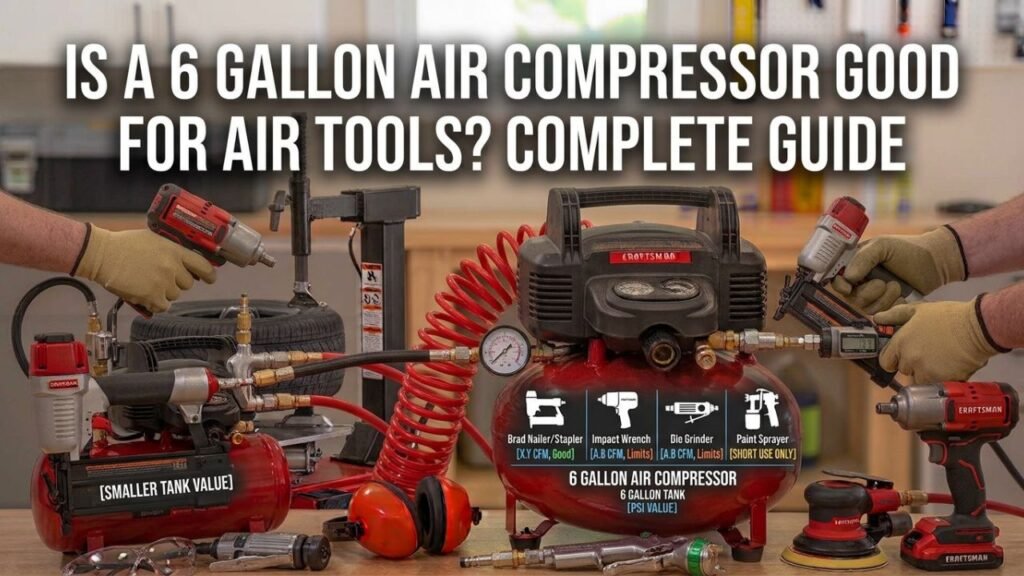
For light and intermittent pneumatic tools, a 6-gallon air compressor is an excellent portable size.
It is particularly well suited to tools that use a short burst of compressed air and then stop consuming air while you reposition the tool or prepare for the next cycle.
Examples include:
- Brad nailers
- Finish nailers
- Pin nailers
- Framing nailers
- Roofing nailers
- Pneumatic staplers
- Blow guns
- Tire inflators
A 6-gallon compressor may also operate some impact wrenches, ratchets, drills, and other automotive air tools, but performance depends much more heavily on CFM.
Where a 6-gallon compressor generally struggles is with tools that require a continuous high-volume airflow.
Examples include:
- Air sanders
- Die grinders used continuously
- Large pneumatic drills
- Full-size paint spray guns
- Body polishers
- Cutoff tools used for long periods
- Large impact wrenches
These tools can consume air faster than a typical small portable compressor can replace it.
What a 6-Gallon Tank Actually Tells You
The 6-gallon rating tells you how much compressed air the tank can store.
It does not tell you how quickly the pump can produce air.
Two 6-gallon compressors can therefore perform very differently.
One might deliver only around 2.5 SCFM at 90 PSI, while a higher-output model could produce around 4 SCFM or more.
For demanding air tools, that difference matters enormously.
Key Takeaways:
- A 6-gallon compressor is excellent for many intermittent-use pneumatic tools.
- Nailers and staplers are especially good matches.
- Continuous-use tools can empty a 6-gallon tank quickly.
- CFM output is more important than tank capacity when matching air tools.
Will a 6 Gallon Air Compressor Run Air Tools?
Yes, a 6-gallon air compressor will run many air tools, but it will not run every pneumatic tool equally well.
The easiest way to determine compatibility is to compare the tool’s required CFM and PSI with the compressor’s output.
For example, if an air tool requires:
2 CFM at 90 PSI
and your compressor delivers:
2.6 SCFM at 90 PSI
the compressor may handle it reasonably well, particularly if the tool is used intermittently.
If the tool requires:
8 CFM at 90 PSI
and the compressor supplies only:
2.6 SCFM at 90 PSI
the tool may operate temporarily using the air stored in the tank, but the compressor cannot maintain that airflow indefinitely.
Once the tank pressure falls, performance will decline.
Air Tool Compatibility With a 6-Gallon Compressor
| Air Tool | Typical 6-Gallon Compatibility | Practical Verdict |
| Pin nailer | Excellent | Highly suitable |
| Brad nailer | Excellent | Highly suitable |
| Finish nailer | Excellent | Highly suitable |
| Framing nailer | Very good | Good for most users |
| Roofing nailer | Very good | Good, depending on firing rate |
| Pneumatic stapler | Excellent | Highly suitable |
| Blow gun | Very good | Good for short bursts |
| Tire inflator | Excellent | Highly suitable |
| Air ratchet | Fair to good | Depends on CFM and runtime |
| 3/8-inch impact wrench | Fair to good | Usually workable intermittently |
| 1/2-inch impact wrench | Fair | Depends heavily on CFM |
| Air hammer | Fair | Short bursts are possible |
| Die grinder | Limited | Recovery pauses likely |
| Cutoff tool | Limited | Usually frustrating for long use |
| Orbital sander | Poor | Larger compressor preferred |
| Full-size paint gun | Poor | Usually needs much more airflow |
These are general recommendations. Actual tool requirements vary by brand, model, operating pressure, and how continuously the tool is used.
CFM Is the Most Important Specification for Air Tools
CFM stands for cubic feet per minute.
It measures airflow.
When deciding whether a 6-gallon compressor can run an air tool, CFM is usually more important than tank capacity.
Why CFM Matters
Imagine your pneumatic tool consumes 5 CFM while operating.
Your compressor pump can produce only 2.6 CFM at 90 PSI.
While the tank is fully charged, the tool may initially operate normally because it draws from the stored compressed air.
However, you are consuming air at approximately:
5 CFM
while replacing only:
2.6 CFM
That creates an airflow deficit.
The tank pressure therefore continues falling until the compressor can no longer maintain enough pressure at the tool.
You must then stop and allow the compressor to recover.
How Much Extra CFM Should You Have?
I prefer choosing a compressor with roughly 25–50% more CFM than the tool requires when continuous operation matters.
For example:
Tool requirement: 4 CFM at 90 PSI
Comfortable compressor target: roughly 5–6 CFM at 90 PSI
That extra capacity helps account for:
- Hose losses
- Fitting restrictions
- Regulator pressure drop
- Compressor cycling
- Real-world operating conditions
For intermittent tools such as nail guns, matching the CFM exactly is less critical because the tank has time to recover between shots.
Pro Tip: Always compare CFM ratings at the same pressure. A compressor’s CFM at 40 PSI should not be directly compared with a tool requirement listed at 90 PSI.
Key Takeaways:
- CFM determines how quickly the compressor supplies usable air.
- A large enough tank cannot permanently compensate for insufficient CFM.
- Continuous tools benefit from significant airflow headroom.
- Intermittent tools are much more forgiving.
How Much CFM Does a Typical 6-Gallon Compressor Produce?
Many portable 6-gallon pancake compressors produce somewhere around 2.5–3 SCFM at 90 PSI, although higher-output models may provide approximately 4 CFM or more.
That airflow is enough for a broad range of pneumatic fastening tools.
It can also provide short-burst operation for some automotive air tools.
However, tools requiring 5, 8, 10, or even 20 CFM continuously will exceed the pump capacity of most 6-gallon compressors.
This is why you should never assume:
6 gallons = enough for any air tool
A more accurate approach is:
Tool CFM requirement ≤ compressor CFM capability
with some additional capacity whenever possible.
How Much PSI Does a 6-Gallon Compressor Need for Air Tools?
Many common pneumatic tools operate at approximately 90 PSI, though exact requirements vary.
A typical portable compressor may have a maximum tank pressure of:
- 125 PSI
- 135 PSI
- 150 PSI
- 165 PSI
- 175 PSI
- 200 PSI
That maximum tank pressure is not necessarily the pressure you should send directly to the tool.
The compressor regulator reduces the pressure to the tool’s required working pressure.
For example:
Tank pressure: 165 PSI
Regulated tool pressure: 90 PSI
Is Higher Maximum PSI Better?
Higher tank pressure can store more usable compressed air inside a tank of the same physical volume.
That can extend tool runtime somewhat between compressor cycles.
However, high PSI does not replace adequate CFM.
A compressor producing 2.5 CFM at 90 PSI will still struggle with a tool that consumes 10 CFM, even if the compressor’s maximum tank pressure is 200 PSI.
Important Tip: Never exceed the pneumatic tool manufacturer’s maximum operating pressure. More pressure does not automatically create better performance and can damage the tool or create a safety hazard.
Can a 6 Gallon Air Compressor Run a Nail Gun?
Yes. Nail guns are among the best air tools to use with a 6-gallon compressor.
Pneumatic nailers use relatively small amounts of air in short bursts.
Between shots, the compressor has time to replenish the tank.
A 6-gallon compressor can generally work very well with:
- Brad nailers
- Finish nailers
- Pin nailers
- Framing nailers
- Roofing nailers
- Siding nailers
- Pneumatic staplers
Brad and Finish Nailers
These have relatively low air consumption.
A 6-gallon compressor is generally more than adequate for normal DIY and professional trim work with one nailer.
Framing Nailers
A 6-gallon compressor is also a practical choice for a framing nailer.
Rapid bump firing can increase air demand, but one nailer is usually manageable with a capable 6-gallon jobsite compressor.
Roofing Nailers
Roofing nailers can be fired rapidly, which puts more demand on the compressor.
A good 6-gallon model can still work well, although the pump may cycle frequently during fast roofing work.
Can a 6 Gallon Air Compressor Run an Impact Wrench?
A 6-gallon compressor can run many impact wrenches intermittently, but it is not ideal for every impact wrench.
The answer depends primarily on:
- Impact-wrench size
- Tool CFM requirement
- Compressor CFM at 90 PSI
- How long you hold the trigger
- How frequently you use the wrench
3/8-Inch Impact Wrench
A 3/8-inch pneumatic impact may require around 3 CFM in typical automotive use.
A higher-output 6-gallon compressor can often handle this reasonably well.
1/2-Inch Impact Wrench
A common 1/2-inch impact wrench may average around 4 CFM, although actual air consumption under sustained load can be much higher.
A typical 6-gallon compressor can often operate one for short bursts, such as removing lug nuts.
However, frequent continuous use may drain the tank quickly.
If impact-wrench use is one of your primary reasons for purchasing a compressor, I would prefer a 15- to 20-gallon unit with at least approximately 4–6 CFM at 90 PSI.
3/4-Inch and 1-Inch Impact Wrenches
These larger impact wrenches can require substantially more airflow.
A 6-gallon compressor is generally not a good match.
A larger high-CFM compressor is the appropriate choice.
Can a 6 Gallon Air Compressor Run an Air Ratchet?
It can run some air ratchets, but performance may be limited.
Air ratchets often use more sustained airflow than nail guns because the motor runs continuously while the trigger is held.
Some automotive air ratchets can require around 4–6 CFM or more depending on the model.
A typical 6-gallon compressor producing only 2.5–3 CFM at 90 PSI may therefore fall behind during extended operation.
For occasionally spinning bolts on and off, it may work.
For frequent automotive work, I would prefer a larger compressor with stronger airflow.
Can a 6 Gallon Air Compressor Run an Air Hammer?
A 6-gallon compressor can run an air hammer for short intermittent bursts.
An air hammer may require around 4 CFM or more depending on the tool.
That means a typical pancake compressor may rely heavily on stored tank air.
For tasks such as:
- Removing a stubborn component
- Light chiseling
- Brief exhaust work
- Occasional automotive repairs
a 6-gallon compressor may be usable.
For long periods of continuous hammering, you will probably experience pressure loss and recovery pauses.
A larger compressor is the better choice for frequent air-hammer use.
Can a 6 Gallon Air Compressor Run a Die Grinder?
Technically yes for short periods, but I would not choose a 6-gallon compressor for regular die-grinder use.
Die grinders operate continuously and may consume around 5 CFM or more.
That is substantially more than many portable 6-gallon compressors can produce.
The grinder may start at full speed, then gradually lose performance as tank pressure falls.
You then have to stop and wait for the compressor.
For quick spot grinding, deburring, or very short tasks, this may be acceptable.
For sustained grinding, I recommend a larger high-CFM compressor.
Can a 6 Gallon Air Compressor Run a Cutoff Tool?
A pneumatic cutoff tool has similar limitations.
It needs continuous airflow while the cutting wheel is spinning.
A 6-gallon compressor may run the tool briefly, but the compressor can quickly fall behind.
You may experience:
- Falling tool speed
- Slow cutting
- Frequent compressor operation
- Long recovery pauses
If you need a cutoff tool regularly and only own a small compressor, an electric or cordless cutoff tool may be a more practical choice.
Can a 6 Gallon Air Compressor Run an Air Sander?
A typical 6-gallon air compressor is not a good choice for an air sander.
Pneumatic sanders are among the more air-hungry portable tools.
Depending on the type, they can require around 10 CFM, 15 CFM, or considerably more during continuous operation.
An automotive body sander may consume far more air than a small compressor can provide.
The tool may operate briefly from the stored tank air, but pressure will fall quickly.
For regular pneumatic sanding, I would look for a substantially larger compressor capable of providing the sander’s continuous airflow requirement.
Better Alternative for a Small Shop
If you have only a 6-gallon compressor, an electric random-orbit sander is usually a much better option.
It avoids the huge compressed-air demand and lets the compressor remain available for nailers, inflation, and other intermittent tools.
Can a 6 Gallon Air Compressor Run a Paint Gun?
It depends heavily on the paint gun, but most full-size spray guns require more airflow than a typical 6-gallon compressor can sustain.
A production paint gun may require around 8 CFM, while certain guns can require considerably more or less.
A typical 6-gallon compressor producing around 2.5–3 CFM at 90 PSI will usually struggle with full-size continuous spraying.
What Paint Guns May Work?
A 6-gallon compressor may work with:
- Airbrushes
- Mini spray guns
- Touch-up guns
- Some very low-CFM LVLP guns
Even then, check the exact airflow requirement.
For painting entire vehicles, large furniture pieces, cabinets, or other surfaces requiring uninterrupted passes, I would choose a larger compressor.
Can a 6 Gallon Air Compressor Run a Blow Gun?
Yes.
A blow gun can work well with a 6-gallon compressor when used in short bursts.
It is useful for:
- Blowing dust from a workbench
- Cleaning small equipment
- Removing debris
- Drying parts
- General garage cleanup
However, holding the blow gun open continuously can consume significant airflow and cause a small compressor to run frequently.
Use compressed air carefully and never direct high-pressure air toward yourself or another person.
Can a 6 Gallon Air Compressor Inflate Tires?
Yes. Tire inflation is one of the easiest jobs for a 6-gallon compressor.
A 6-gallon compressor can easily handle:
- Passenger-car tires
- SUV tires
- Light-truck tires within its pressure capability
- Motorcycle tires
- Bicycle tires
- Trailer tires
- Sports equipment
For normal car tire inflation, a 6-gallon tank is more capacity than you actually need.
A much smaller portable compressor can accomplish the same job.
Always inflate vehicle tires to the pressure specified on the vehicle’s tire-information placard, commonly located on the driver’s door jamb.
Do not use the maximum pressure printed on the tire sidewall as the normal vehicle inflation target.
Key Takeaways:
- A 6-gallon compressor is excellent for nailers and tire inflation.
- It can run impact wrenches and air hammers intermittently.
- Die grinders, cutoff tools, and ratchets may require recovery pauses.
- Sanders and full-size spray guns generally need a larger compressor.
Intermittent vs. Continuous Air Tools
Understanding this difference is one of the easiest ways to decide whether a 6-gallon compressor will work.
Intermittent Air Tools
These use compressed air only for short periods.
Examples include:
- Nail guns
- Staplers
- Impact wrenches used in bursts
- Blow guns
- Tire inflators
A 6-gallon compressor works relatively well because the tank provides a short reserve and the pump can recover during pauses.
Continuous Air Tools
These consume air for as long as you hold the trigger.
Examples include:
- Sanders
- Grinders
- Drills
- Paint guns
- Polishers
- Cutoff tools
These tools require the compressor pump to provide sustained CFM.
If the pump cannot keep up, tank size only delays the pressure drop.
6 Gallon vs. 20 Gallon Compressor for Air Tools
A 20-gallon compressor is generally better for pneumatic tools, but that does not mean it is automatically the right choice for everyone.
| Feature | 6-Gallon Compressor | 20-Gallon Compressor |
| Portability | Excellent | Moderate |
| Nail guns | Excellent | Excellent |
| Tire inflation | Excellent | Excellent |
| Impact wrench | Occasional use | Much better |
| Air ratchet | Limited to moderate | Better |
| Air hammer | Intermittent | Better |
| Die grinder | Limited | Better with adequate CFM |
| Air sander | Usually poor | Depends on CFM |
| Paint gun | Limited | Better with suitable CFM |
| Storage space | Small | Larger |
| Home DIY work | Excellent | Excellent |
| Automotive air tools | Limited | Much better |
If your primary tools are nailers, staplers, and an inflator, I would choose a 6-gallon compressor for its portability.
If your priority is automotive pneumatic tools, a 20-gallon compressor with at least around 5 CFM at 90 PSI is generally a better starting point.
6 Gallon vs. 30 Gallon Compressor for Air Tools
A 30-gallon compressor gives you even more air reserve.
It is better suited to:
- Frequent impact-wrench use
- Air ratchets
- Die grinders
- Air hammers
- Light spray work
- General automotive repair
However, you must still check CFM.
A weak 30-gallon compressor will eventually struggle with a high-CFM continuous-use tool just as a smaller one will.
The larger tank simply allows longer operation before the pressure falls.
What Air Tools Are Best for a 6 Gallon Compressor?
For a typical homeowner or DIY user, I would consider these the best matches:
Excellent Matches
- Pin nailer
- Brad nailer
- Finish nailer
- Stapler
- Framing nailer
- Tire inflator
Good With Reasonable Use
- Roofing nailer
- Blow gun
- Small impact wrench
- 1/2-inch impact wrench in short bursts
- Small air hammer
Usable but Limited
- Air ratchet
- Die grinder
- Cutoff tool
- Pneumatic drill
Usually Better With a Larger Compressor
- Random-orbit sander
- Body sander
- Large grinder
- Full-size paint gun
- Polisher
- Large impact wrench
How to Check Whether Your 6 Gallon Compressor Can Run an Air Tool
You can determine compatibility in a few simple steps.
- Find the tool’s required CFM.
Check the manufacturer’s manual, label, or specification sheet. - Find the required operating PSI.
Many pneumatic tools are rated around 90 PSI, but not all are. - Check the compressor’s CFM at that pressure.
The specification commonly appears as SCFM at 90 PSI. - Consider whether the tool runs intermittently or continuously.
Intermittent tools are much easier for a small compressor. - Add airflow headroom when possible.
Approximately 25–50% additional compressor capacity is useful for continuous tools. - Check the hose and fittings.
Restrictions can reduce airflow before it reaches the tool.
Example 1: Brad Nailer
Tool requires very little average airflow.
Compressor provides 2.6 SCFM at 90 PSI.
Result: Excellent match.
Example 2: Impact Wrench
Tool averages approximately 4 CFM.
Compressor provides 2.6 SCFM.
Result: Can operate in short bursts using tank reserve, but sustained performance will be limited.
Example 3: Air Sander
Tool requires 10 CFM continuously.
Compressor provides 2.6 SCFM.
Result: Poor match. Choose a larger compressor.
Why an Air Tool May Feel Weak on a 6-Gallon Compressor
Sometimes the compressor itself is not the only problem.
Hose Is Too Small
An undersized air hose can restrict flow.
Many higher-demand pneumatic tools work better with a 3/8-inch inside-diameter hose, although you should follow the individual tool manufacturer’s recommendation.
Hose Is Too Long
Pressure drop increases as hose length increases.
A long narrow hose can noticeably reduce performance.
Quick Couplers Restrict Airflow
Small or restrictive couplers can become bottlenecks.
High-flow fittings may help demanding tools receive more of the compressor’s available airflow.
Regulator Is Set Too Low
Make sure the working pressure is correctly adjusted while the tool is operating.
Static pressure with no airflow can appear normal even when pressure drops significantly under load.
Air Filter or Regulator Is Restrictive
Dirty filters or undersized regulators can reduce airflow.
There Is an Air Leak
Check:
- Hose connections
- Couplers
- Fittings
- Tool inlet
- Regulator connections
Even small leaks waste compressor capacity.
Pro Tip: If the compressor gauge shows adequate pressure but the tool becomes weak only when you pull the trigger, look for airflow restrictions and pressure drop under load.
Should You Buy a 6 Gallon Air Compressor for Air Tools?
A 6-gallon compressor is a good purchase if your main jobs involve:
- Carpentry
- Trim work
- Framing
- Roofing
- Home repairs
- Tire inflation
- Cleaning with a blow gun
- Occasional short-burst automotive work
It is compact enough to move from place to place while offering much more usefulness than tiny inflator-style compressors.
When I Would Choose a Larger Compressor
I would skip a 6-gallon compressor and choose something larger if your primary goal involves:
- Regular impact-wrench use
- Automotive repair
- Grinding
- Sanding
- Painting
- Polishing
- Multiple pneumatic tools
- Long continuous tool operation
For automotive DIY work, a 20- to 30-gallon compressor with stronger CFM output is often much more satisfying.
For high-air-demand shop equipment, a 60-gallon or larger compressor may make more sense.
Common Mistakes When Choosing a 6-Gallon Compressor for Air Tools
Looking Only at Tank Capacity
Six gallons tells you storage capacity—not sustained airflow.
Always check CFM.
Assuming High PSI Means High Airflow
A 175-PSI compressor can still have a relatively low CFM rating.
PSI and CFM measure different things.
Ignoring Tool Duty Cycle
A tool that requires 5 CFM for three seconds is much easier to support than one that needs 5 CFM continuously for several minutes.
Buying for One Tool Without Considering Future Tools
A 6-gallon compressor may be perfect for your nailer today but too small when you later buy an air sander or spray gun.
Consider your likely future tool collection before choosing.
Ignoring Hose and Fitting Size
The compressor cannot deliver full performance if the rest of the air system restricts airflow.
Safety Tips for Using a 6 Gallon Compressor With Air Tools
Always follow the pressure limits listed by the compressor and air-tool manufacturers.
Do not exceed a tool’s maximum operating pressure.
Wear appropriate eye, hearing, respiratory, or other personal protective equipment for the specific pneumatic tool you are using.
Disconnect the air supply before:
- Servicing an air tool
- Clearing a nailer jam
- Changing grinding accessories
- Changing cutting wheels
- Performing maintenance
Inspect hoses and fittings regularly for:
- Cuts
- Cracks
- Leaks
- Damaged couplers
- Loose connections
Drain condensation from the compressor tank according to the manufacturer’s maintenance instructions.
Never modify pressure-relief devices or safety valves.
FAQs about Is a 6 Gallon Air Compressor Good for Air Tools
Is a 6 gallon air compressor good for air tools?
Yes. A 6-gallon compressor is very good for low- and intermittent-air-demand tools such as nailers, staplers, tire inflators, and blow guns. It is less suitable for continuous high-CFM tools.
Will a 6 gallon air compressor run air tools?
Yes, but compatibility depends on CFM and PSI rather than tank size alone. Match the compressor’s airflow at the required pressure with the specifications of the tool.
What air tools can a 6 gallon compressor run?
A 6-gallon compressor can typically run brad nailers, finish nailers, framing nailers, roofing nailers, staplers, blow guns, tire inflators, and some impact wrenches used intermittently.
Can a 6 gallon compressor run a 1/2-inch impact wrench?
Yes, many can run a 1/2-inch impact wrench for short bursts. However, a typical 6-gallon compressor may not provide enough continuous CFM for prolonged impact-wrench use.
Can a 6 gallon air compressor run a framing nailer?
Yes. A 6-gallon compressor is one of the most practical portable sizes for a framing nailer.
Can a 6 gallon compressor run a roofing nailer?
Yes. A capable 6-gallon compressor can run a roofing nailer, although very rapid firing may cause frequent compressor cycling.
Can a 6 gallon compressor run an air sander?
Usually not very well. Pneumatic sanders consume substantial continuous airflow, often far beyond the output of a typical 6-gallon compressor.
Can a 6 gallon compressor run a paint gun?
Some small touch-up, airbrush, or low-CFM spray guns may work. Most full-size spray guns require more sustained airflow than a typical 6-gallon compressor supplies.
Can a 6 gallon compressor run an air ratchet?
It can run some air ratchets intermittently. Because ratchets can consume several CFM continuously, a small compressor may require frequent recovery pauses.
Can a 6 gallon compressor run a die grinder?
It can operate a die grinder for short periods, but sustained grinding will usually drain the tank faster than the compressor can recover.
How many CFM does a 6 gallon air compressor have?
Tank size does not determine CFM. Many 6-gallon portable compressors produce roughly 2.5–3 SCFM at 90 PSI, while higher-output models may produce around 4 CFM or more. Check the exact compressor specification.
Is 6 gallons enough for automotive air tools?
It is enough for tire inflation and occasional short-burst operation of some impact wrenches or air hammers. For regular automotive pneumatic-tool use, I would choose a 20- to 30-gallon compressor with stronger CFM output.
Is a 20 gallon compressor better than a 6 gallon for air tools?
Yes, for many automotive and continuous-use tools. A 20-gallon compressor generally provides more stored air and may have a stronger pump. However, its CFM rating still needs to match the tool.
Is a 6 gallon pancake compressor worth it?
Yes. For nail guns, home repairs, inflation, framing, roofing, and other intermittent pneumatic tasks, a 6-gallon pancake compressor offers an excellent combination of portability and usefulness.
Conclusion
Is a 6 gallon air compressor good for air tools? Yes, as long as you choose the right air tools. A 6-gallon compressor is particularly well suited to brad nailers, finish nailers, framing nailers, roofing nailers, staplers, tire inflators, and other tools that consume compressed air intermittently.
And will a 6 gallon air compressor run air tools? It certainly will, but tank capacity alone does not guarantee compatibility. A typical 6-gallon compressor may run a 1/2-inch impact wrench, air hammer, ratchet, or die grinder for short periods while struggling to provide enough sustained airflow for continuous operation.
For high-CFM tools such as sanders, grinders, full-size spray guns, and larger impact wrenches, I would choose a larger compressor with substantially higher airflow.
If your main work involves carpentry, fastening, home maintenance, or tire inflation, a 6-gallon compressor is one of the most useful portable sizes you can buy. If your focus is automotive repair or continuous pneumatic tools, I would move up to at least a 20- to 30-gallon compressor and prioritize CFM at 90 PSI over tank size alone.
The simplest rule is to check the tool’s required CFM and PSI, compare them with the compressor’s output at the same pressure, and consider whether the tool operates in short bursts or continuously. That will tell you far more than the gallon rating by itself.