What Tools Can You Use With an Air Compressor? Complete Guide
If you are wondering what tools can you use with an air compressor, the answer includes nail guns, staplers, impact wrenches, air ratchets, air hammers, drills, grinders, sanders, spray guns, blow guns, tire inflators, grease guns, riveters, and many other pneumatic tools. However, not every air compressor can run every air tool. The important question is whether your compressor can supply enough CFM at the required PSI for the particular tool.
Small compressors are excellent for intermittent tools such as brad nailers, finish nailers, staplers, and tire inflators. Medium-size compressors can handle many impact wrenches, air ratchets, framing nailers, and other automotive tools. High-demand tools such as grinders, sanders, spray guns, and sandblasters generally need substantially more continuous airflow.
Tank capacity also matters, but gallons alone do not tell you whether a compressor can run a tool. A 20-gallon compressor with a weak pump can provide less continuous airflow than a smaller compressor with a higher-output pump.
In this guide, I’ll explain which tools work with an air compressor, which ones need the most CFM, what you can realistically run from small and large compressors, how to match a pneumatic tool to your compressor, and which air tools I recommend for different garage, automotive, woodworking, and DIY applications.
What Tools Can You Use With an Air Compressor?
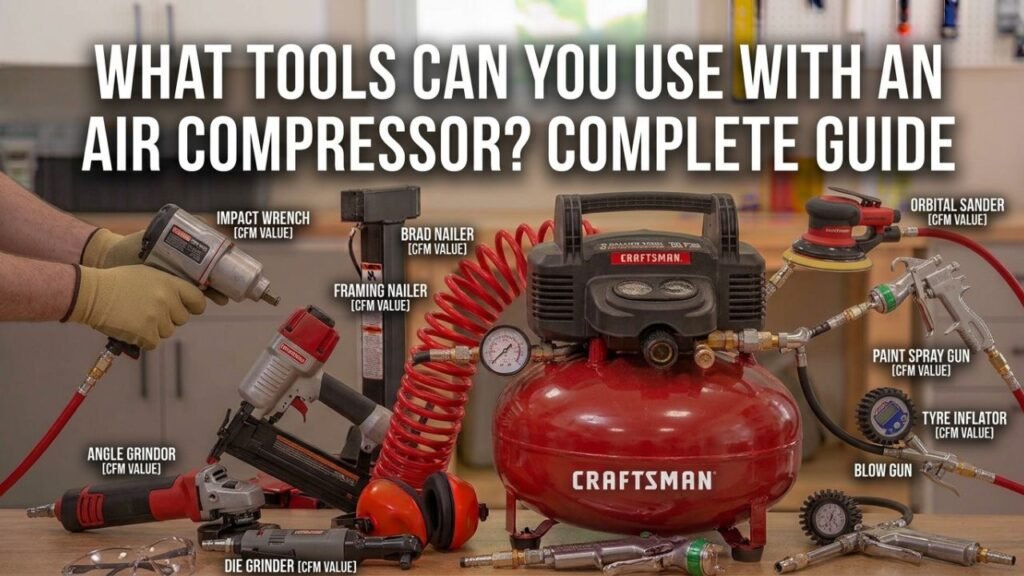
An air compressor can power a surprisingly wide range of equipment. The most common tools and accessories fall into several groups:
• Nail guns and staplers
• Impact wrenches and air ratchets
• Air hammers and chisels
• Pneumatic drills and screwdrivers
• Die grinders and cut-off tools
• Sanders and polishers
• Paint and finishing spray guns
• Tire inflators and air chucks
• Blow guns
• Grease guns and fluid-delivery tools
• Rivet guns
• Needle scalers
• Caulking and dispensing guns
• Sandblasting equipment
• Certain tire-service and automotive shop machines
The compressor does not directly determine which tool category you can use. Its airflow, pressure, tank capacity, and duty cycle determine whether it can keep up with the tool.
That is why a small pancake compressor may work beautifully with a brad nailer but struggle to run an orbital sander.
The Three Specifications You Need to Check
Before connecting any pneumatic tool, check:
CFM or SCFM: This measures airflow. It is usually the most important number for determining whether the compressor can keep up.
PSI: This measures air pressure. Many conventional shop air tools operate around 90 PSI, while nailers commonly work across broader pressure ranges depending on the model.
Tank capacity: Measured in gallons, tank capacity determines how much compressed air is stored for temporary use.
A compressor must provide enough pressure, but it also needs enough airflow.
For example, a compressor may be capable of 150 PSI but deliver only 2.6 CFM at 90 PSI. That is plenty of pressure for many air tools but nowhere near enough continuous airflow for some sanders or grinders.
Key Takeaways:
• Air compressors can power dozens of pneumatic tools, from nailers to impact wrenches and spray guns.
• CFM at the required PSI is usually more important than maximum tank pressure.
• Low-demand intermittent tools work with small compressors more easily than continuous-use air tools.
• Always compare your exact tool specification with your compressor’s output.
Nail Guns and Staplers
Pneumatic fastening tools are among the best tools to use with small air compressors because they consume air in short bursts rather than continuously.
Brad Nailers
An 18-gauge brad nailer is one of the easiest pneumatic tools for a small compressor to run.
It only uses a small amount of compressed air each time a nail is fired.
A compact 1- to 3-gallon compressor can often be sufficient for:
• Trim work
• Furniture assembly
• Cabinet projects
• Decorative molding
• Small woodworking projects
For homeowners and DIY woodworkers, this is one of the best uses for a compact compressor.
Pin Nailers
Pin nailers generally have very modest air requirements.
Some pneumatic pin nailers require less than 1 SCFM at 90 PSI, making them particularly well suited to small portable compressors.
They are commonly used for:
• Delicate trim
• Cabinet work
• Small moldings
• Holding glued pieces in position
Finish Nailers
Finish nailers are also relatively compressor-friendly.
Both 15-gauge and 16-gauge finish nailers can normally operate from portable compressors because air consumption occurs only when the tool fires.
Typical uses include:
• Baseboards
• Door trim
• Window casing
• Crown molding
• Cabinets
• Interior finishing
A small portable or pancake compressor is usually much more practical for this type of work than a large stationary compressor.
Framing Nailers
Framing nailers use more air than small finish nailers, particularly when nails are fired rapidly.
Some framing nailers may require roughly 4–6 SCFM at 90 PSI under high-production conditions, although actual requirements vary substantially between models. Current manufacturer specifications illustrate this variation, with some framing nailers listing around 4.3 SCFM and others more than 6 SCFM at 90 PSI.
A 6-gallon pancake compressor can still run many framing nailers because the tool uses air intermittently.
However, if you are framing rapidly or running two nailers simultaneously, a higher-CFM compressor is much more comfortable.
Roofing Nailers
Roofing nailers are also intermittent-use tools and generally pair well with portable jobsite compressors.
Fast production increases the amount of air required, so professional roofers may benefit from a compressor designed to support multiple pneumatic nailers.
My recommendation: If your main tools are brad nailers, finish nailers, staplers, or occasional framing nailers, you usually do not need a huge compressor. A portable unit with adequate CFM is typically the most practical choice.
Impact Wrenches
Pneumatic impact wrenches are common in automotive repair, tire service, and mechanical work.
They are more demanding than most nail guns.
3/8-Inch Impact Wrench
A 3/8-inch impact wrench can be useful for:
• Brake work
• Smaller automotive fasteners
• Engine components
• General assembly and repair
A medium portable compressor can often operate one intermittently.
1/2-Inch Impact Wrench
The 1/2-inch impact wrench is one of the most common air tools in a home garage.
It is widely used for:
• Lug nuts
• Brake and suspension work
• Automotive repairs
• Larger bolts
• Equipment maintenance
Many 1/2-inch pneumatic impacts list average air consumption around 4–5 CFM, although their instantaneous airflow while working under load can be dramatically higher. For example, one current 1/2-inch professional model specifies 4.2 CFM average but 22 CFM under load.
This explains why a small compressor can operate an impact wrench for several short bursts but cannot necessarily keep it running continuously.
3/4-Inch and 1-Inch Impact Wrenches
Large impact wrenches require much more air.
They are used for:
• Heavy trucks
• Agricultural equipment
• Construction machinery
• Industrial maintenance
• Heavy mechanical work
A standard pancake compressor is not a good match.
Some professional 1-inch pneumatic impacts can consume several dozen CFM while working under load, so these tools typically need a substantial shop air system.
Important Tip: Use only impact-rated sockets with pneumatic impact wrenches. Standard chrome hand sockets are not designed for repeated impact loading.
Air Ratchets
An air ratchet is useful when you need to quickly remove or install fasteners without repeatedly turning a manual ratchet.
Common applications include:
• Engine work
• Brake repairs
• Interior automotive work
• Underbody repairs
• General mechanical assembly
Air ratchets are usually more demanding than nailers but easier to accommodate than the highest-demand grinders and sanders.
Do not assume that every ratchet has the same requirement. Some modern high-speed pneumatic ratchets can use well over 10 CFM at free speed.
For occasional garage use, a portable compressor may be adequate if you allow it to recover.
For frequent continuous use, I recommend a compressor with more sustained airflow.
Air Hammers and Pneumatic Chisels
An air hammer uses compressed air to drive a chisel or other attachment rapidly back and forth.
It can be extremely useful for automotive and fabrication work.
Common jobs include:
• Removing rusted components
• Separating ball joints
• Cutting sheet metal
• Removing exhaust components
• Breaking corrosion loose
• Removing rivets
• Chiseling material
Air hammers are commonly designed to operate around 90 PSI, but the amount of air they use can vary considerably.
For example, some standard-duty models may average only a few CFM during intermittent operation but consume more than 10 CFM while actually working under load.
This makes tank reserve important when using an air hammer with a small compressor.
A pancake compressor may run one briefly, but a higher-output compressor provides much better sustained performance.
Pneumatic Drills and Screwdrivers
Compressed air can also operate drills and screwdrivers.
Air Drills
Pneumatic drills are common in:
• Automotive shops
• Metal fabrication
• Manufacturing
• Bodywork
• Industrial maintenance
They are compact, relatively light, and can work well in environments where a pneumatic system already exists.
Air drills generally consume more air continuously than nail guns because the motor operates for as long as you hold the trigger.
Pneumatic Screwdrivers
Air-powered screwdrivers are commonly used where repetitive fastening is required.
Examples include:
• Assembly lines
• Manufacturing
• Cabinet production
• Appliance assembly
• Industrial maintenance
For a home workshop, an electric or cordless drill/driver is often simpler.
In a production environment with an existing air system, pneumatic tools can make more sense.
Die Grinders
A die grinder is one of the most useful but also one of the more air-hungry pneumatic tools.
Common applications include:
• Grinding metal
• Cleaning welds
• Deburring edges
• Removing corrosion
• Porting components
• Using carbide burrs
• Surface preparation
• Working in tight spaces
Die grinders spin continuously at very high RPM.
That continuous operation demands substantially more air than an intermittent tool such as a nailer.
Depending on the model and power level, professional die grinders can consume well into double-digit CFM while running, and heavy industrial models can require considerably more. Current professional specifications illustrate load requirements around 30 CFM or more for some high-output models.
A small pancake compressor may turn a die grinder, but it will generally drain the tank very quickly.
My recommendation: If die grinding will be a major part of your work, choose a compressor based on sustained CFM rather than simply purchasing a larger tank.
Key Takeaways:
• Impact tools can often tolerate small compressors because they are used in bursts.
• Rotary air tools such as drills and die grinders need more continuous airflow.
• Large impact wrenches and high-output grinders can demand far more air than portable compressors provide.
• Tank storage helps temporarily, but only adequate pump CFM supports sustained operation.
Air Cut-Off Tools
An air cut-off tool is essentially a compact pneumatic motor driving an abrasive cutting disc.
It is useful for:
• Sheet metal
• Exhaust pipes
• Bolts
• Small brackets
• Automotive bodywork
• Fabrication
Like a die grinder, it runs continuously during the cut.
That makes it relatively demanding.
A small compressor might allow a few short cuts before pressure falls, but repeated cutting is much easier with a medium or large compressor.
If you regularly use pneumatic cut-off tools, grinders, and sanders, I would generally look for a compressor with substantially more airflow than a typical 6-gallon pancake unit.
Air Sanders
Air sanders are among the most demanding common pneumatic tools.
Random Orbital Sanders
Pneumatic random orbital sanders are popular in:
• Automotive bodywork
• Paint preparation
• Woodworking
• Metal finishing
• Fiberglass work
They run continuously, which means the compressor must constantly replace the air they consume.
Professional random orbital sanders can require roughly 9 CFM to well over 15 CFM depending on the design, with some current models specifying around 17.5 CFM average consumption.
This is far beyond the continuous output of most small household compressors.
Straight-Line Sanders
Straight-line air sanders are commonly used for automotive body panels and large flat surfaces.
They are also continuous-use tools and can consume significant airflow.
A larger compressor is generally the better choice.
Dual-Action Sanders
Dual-action sanders combine rotating and orbital motion.
They are extremely useful for bodywork but are another category where adequate CFM matters much more than tank gallons.
My recommendation: If sanding is your main application, do not buy a compressor based on what works for an impact wrench or nail gun. Size it specifically around the sander’s continuous airflow requirement.
Air Polishers and Buffers
Pneumatic polishers and buffers are used for:
• Automotive detailing
• Paint correction
• Metal polishing
• Surface finishing
• Marine work
Because these tools operate continuously, they generally need a steady supply of compressed air.
A small compressor may run one briefly but will often cycle almost continuously and lose pressure.
For occasional vehicle polishing at home, a cordless or electric polisher is generally more practical than buying a large compressor specifically for pneumatic polishing.
Paint Spray Guns
Paint spraying is one of the applications most commonly misunderstood when choosing a compressor.
The tool may operate at relatively modest pressure but consume a large volume of air.
Touch-Up Spray Guns
Small touch-up guns use less air and are easier to operate with medium-size compressors.
They are useful for:
• Spot repairs
• Small panels
• Furniture
• Trim
• Small finishing projects
Conventional Spray Guns
Conventional spray guns can require substantial continuous airflow.
The compressor needs to maintain the correct pressure while the gun remains triggered.
HVLP Spray Guns
HVLP means high volume, low pressure.
The name explains the challenge: even though pressure at the air cap is relatively low, the gun may need a large volume of air.
Professional HVLP spray equipment can consume roughly 10–15 CFM or more, depending on the gun and setup. Current spray-gun specifications show examples around 11–15 CFM.
That makes many small compressors unsuitable for painting an entire vehicle.
Can a 6-Gallon Compressor Run a Paint Gun?
It may run a low-demand touch-up gun for short periods.
For full-size continuous spraying, however, the compressor often cannot replenish air fast enough.
Pressure drop can affect atomization and finish quality.
For painting cars, large furniture projects, or extended spray sessions, I recommend choosing a compressor specifically around the gun’s stated CFM requirement.
Tire Inflators and Air Chucks
Inflating tires is one of the easiest and most popular uses for an air compressor.
You can use an air chuck or inflator for:
• Car tires
• Truck tires
• Motorcycle tires
• Bicycle tires
• Lawn equipment tires
• Trailer tires
• Sports equipment with the correct adapter
• Inflatable equipment
Tire inflation generally does not require high continuous CFM.
Even a small compressor can fill ordinary passenger-car tires, although tank size and compressor output affect how quickly the job is completed.
Does Compressor PSI Matter for Tires?
Yes.
The compressor must be capable of producing pressure above the required tire pressure.
Most ordinary passenger tires are therefore well within the capability of common household compressors.
The important rule is to inflate the tire to the vehicle manufacturer’s specified pressure, not automatically to the maximum pressure printed on the tire sidewall.
Blow Guns
A blow gun turns compressed air into a directed stream for tasks such as:
• Clearing debris from equipment
• Drying certain components
• Cleaning work surfaces
• Blowing chips away from machinery
• Clearing inaccessible spaces
Blow guns can consume significant amounts of air if held open continuously.
They also require careful safety practices.
For U.S. workplaces, OSHA generally requires compressed air used for cleaning to be reduced to less than 30 PSI and used with effective chip guarding and personal protective equipment.
Do not use a blow gun to clean your skin or clothing.
High-pressure air and flying debris can cause serious injury.
Air Grease Guns
Pneumatic grease guns use compressed air to deliver lubricant into bearings, fittings, joints, and machinery.
They are useful for:
• Automotive maintenance
• Farm equipment
• Heavy machinery
• Construction equipment
• Industrial maintenance
Air consumption is generally intermittent, so many medium and small compressors can operate them.
Always follow the grease-gun manufacturer’s pressure limits and use fittings in good condition.
Pneumatic Rivet Guns
Air-powered riveters are commonly used for:
• Sheet-metal fabrication
• Automotive bodywork
• HVAC
• Trailers
• Aircraft and industrial applications
• Metal enclosures
The air requirement depends on rivet size and tool design.
Because riveting normally occurs one cycle at a time, these tools are easier for smaller compressors to support than continuous grinders and sanders.
Air-Powered Caulking and Dispensing Guns
Compressed-air dispensing guns can apply:
• Caulk
• Sealant
• Adhesives
• Certain automotive seam sealers
• Construction compounds
They are especially useful for repetitive work because compressed air reduces hand fatigue compared with a manual caulk gun.
Air demand is normally modest and intermittent, making them practical with many portable compressors.
Needle Scalers
A needle scaler uses multiple rapidly reciprocating steel needles to remove:
• Rust
• Paint
• Welding slag
• Scale
• Corrosion
• Surface coatings
These tools are useful for restoration, fabrication, ship work, and heavy-equipment maintenance.
Like air hammers, needle scalers are percussive tools and can demand substantial airflow during sustained operation.
A larger compressor is preferable when the tool will be used for long periods.
Sandblasting Tools
Sandblasting is one of the most demanding uses for a conventional air compressor.
Compressed air propels abrasive media at high speed to remove:
• Rust
• Paint
• Scale
• Corrosion
• Surface contamination
Air consumption depends heavily on:
• Nozzle diameter
• Blasting pressure
• Media
• Duty cycle
A larger nozzle can consume enormous amounts of air.
Small compressors may operate small spot-blasting guns intermittently, but serious blasting generally requires a high-CFM compressor.
For regular sandblasting, I recommend choosing the blasting nozzle first and sizing the compressor around its airflow requirement.
Automotive Tire-Service Equipment
Larger compressors can also operate shop equipment such as:
• Pneumatic tire changers
• Bead breakers
• Air-operated lifts in certain designs
• Brake-service equipment
• Pneumatic fluid pumps
• Lubrication systems
These machines can have very different pressure and airflow requirements from handheld tools.
Use the equipment manufacturer’s specifications rather than assuming that a compressor suitable for an impact wrench will automatically support a tire machine.
Air Compressor Tool CFM Guide
The following table is a practical starting point rather than a universal specification. Air consumption can vary substantially between individual tools.
| Air Tool | Relative Air Demand | Small Compressor? | Best Use Pattern |
| Pin nailer | Very low | Yes | Intermittent |
| Brad nailer | Very low | Yes | Intermittent |
| Finish nailer | Low | Yes | Intermittent |
| Stapler | Low | Yes | Intermittent |
| Roofing nailer | Low to moderate | Usually | Intermittent |
| Framing nailer | Low to moderate | Often | Intermittent |
| Tire inflator | Low | Yes | Intermittent |
| Grease gun | Low | Usually | Intermittent |
| Riveter | Low to moderate | Usually | Intermittent |
| Blow gun | Moderate | Usually | Short bursts |
| Air ratchet | Moderate | Sometimes | Intermittent |
| 3/8-inch impact | Moderate | Often | Short bursts |
| 1/2-inch impact | Moderate | Often, with recovery | Short bursts |
| Air hammer | Moderate to high | Limited | Short bursts |
| Pneumatic drill | Moderate to high | Limited | Continuous |
| Die grinder | High | Usually poor | Continuous |
| Cut-off tool | High | Usually poor | Continuous |
| Air sander | High | Usually poor | Continuous |
| Polisher | High | Usually poor | Continuous |
| Full-size spray gun | High | Often poor | Continuous |
| Sandblaster | Very high | Usually no | Continuous |
| Large 3/4- or 1-inch impact | Very high | Usually no | Heavy intermittent |
Key Takeaways:
• Nailers, staplers, inflators, and riveters are among the easiest tools for a small compressor to run.
• Impact tools work better than continuous tools when compressor CFM is limited because they are normally triggered in short bursts.
• Sanders, grinders, spray guns, and sandblasters need much more sustained airflow.
• Use this table only as a category guide; the exact tool specification always takes priority.
What Can You Run With a Small Air Compressor?
“Small compressor” can mean anything from a 1-gallon trim compressor to a 6-gallon pancake compressor.
Generally, these units are best for low-air-demand applications.
1- to 3-Gallon Compressor
A small 1- to 3-gallon compressor is best suited for:
• Pin nailers
• Brad nailers
• Finish nailers
• Light staplers
• Tire inflation
• Light blow-gun work
It may operate higher-demand tools briefly, but tank pressure drops quickly.
6-Gallon Pancake Compressor
A 6-gallon pancake compressor expands the range considerably.
Depending on its CFM output, it can often handle:
• Brad nailers
• Finish nailers
• Roofing nailers
• Framing nailers
• Staplers
• Tire inflation
• Small impact tools
• 1/2-inch impact wrenches intermittently
• Air ratchets intermittently
• Blow guns
It is not ideal for continuous sanding, grinding, painting, or sandblasting.
Pro Tip: Do not ask only, “How many gallons do I need?” Check the compressor’s SCFM at 90 PSI. Tank gallons mainly affect storage; CFM determines how quickly the compressor can replace the air your tool consumes.
What Can You Run With a 10- to 20-Gallon Compressor?
A compressor in this range can be a good compromise for a home garage.
Depending on pump output, it may comfortably support:
• Nail guns
• Staplers
• Impact wrenches
• Air ratchets
• Air hammers
• Tire inflation
• Blow guns
• Riveters
• Short periods of grinding
• Small spray jobs
However, a 20-gallon tank does not automatically mean the compressor is suitable for continuous sanding or full-car painting.
Some 20-gallon compressors still provide relatively modest CFM.
Look at pump output before buying.
What Can You Run With a 30- to 60-Gallon Compressor?
This size range becomes much more capable for serious garage use.
A properly sized 30- to 60-gallon compressor can support tools such as:
• Impact wrenches
• Air ratchets
• Air hammers
• Die grinders
• Cut-off tools
• Drills
• Sanders
• Spray guns
• Polishers
• Multiple nailers
Actual capability still depends on CFM.
A 60-gallon tank attached to a low-output pump is not automatically better than a smaller high-output compressor for continuous tools.
What Can You Run With a Large Shop Compressor?
Large stationary compressors can support high-demand applications such as:
• Continuous sanders
• Multiple grinders
• Full-size automotive spray guns
• Sandblasting
• Large impact wrenches
• Tire machines
• Multiple simultaneous workstations
• Industrial pneumatic equipment
At this level, compressor sizing should account for total simultaneous air demand rather than just the largest individual tool.
How to Match an Air Tool to Your Compressor
Matching an air compressor to a tool is straightforward once you understand what numbers matter.
Step 1: Find the Tool’s Required PSI
Look at:
• Tool label
• Owner’s manual
• Manufacturer specifications
Do not assume every air tool operates at 90 PSI.
Step 2: Find the Tool’s CFM or SCFM Requirement
This is the critical number.
If the tool requires 6 CFM at 90 PSI, compare that requirement with your compressor’s output at 90 PSI.
Step 3: Check the Compressor CFM at the Same Pressure
A compressor may be listed as:
5.1 CFM at 40 PSI
4.0 CFM at 90 PSI
For a 90-PSI air tool, the 4.0 CFM figure is the relevant one.
Do not compare the tool’s 90-PSI requirement with the compressor’s 40-PSI rating.
Step 4: Add Some Airflow Reserve
I generally prefer a compressor with more CFM than the tool’s stated average requirement rather than matching it exactly.
A practical target for many home-shop applications is approximately 25–50% additional capacity, especially for tools used frequently.
For example:
Tool requirement = 5 CFM
25% reserve = 6.25 CFM
50% reserve = 7.5 CFM
This is a sizing guideline, not a universal manufacturer rule.
Step 5: Consider Duty Cycle
A nailer requiring several CFM during rapid firing may still work beautifully with a small compressor because it spends most of its time idle.
A sander requiring similar average airflow can be far more difficult because it runs continuously.
Step 6: Consider Multiple Tools
If two tools will operate at the same time, calculate their combined airflow demand.
For example:
Tool A = 5 CFM
Tool B = 7 CFM
Combined demand = 12 CFM
Then add reasonable reserve capacity.
Why Tank Size Does Not Tell the Whole Story
One of the most common mistakes is purchasing an air compressor based almost entirely on gallons.
A larger tank stores more compressed air.
It does not automatically create more compressed air per minute.
Imagine two compressors:
Compressor A
20-gallon tank
4 CFM at 90 PSI
Compressor B
10-gallon tank
6 CFM at 90 PSI
Compressor A stores more air.
Compressor B can continuously replace air faster.
For an intermittent impact wrench, the larger tank may provide useful reserve.
For a continuously running pneumatic tool, the higher-CFM pump may be more important.
Think of tank capacity as the storage reservoir and CFM as the rate at which the compressor replenishes that reservoir.
Why Hose Size and Fittings Matter
Even if your compressor produces enough air, the tool may not receive it.
Restrictions can occur through:
• Undersized hoses
• Long hoses
• Small quick-connect fittings
• Restrictive regulators
• Dirty filters
• Water separators
• Excessive adapters
• Partially closed valves
A tool can show adequate pressure when idle and experience a large pressure drop as soon as you pull the trigger.
For higher-demand tools, a 3/8-inch air hose is often a better choice than a restrictive 1/4-inch hose, although you should follow the tool manufacturer’s minimum hose specification.
Many professional impact tools, air hammers, and grinders specify 3/8-inch or larger hose sizes.
Air Tool Lubrication and Moisture Control
Compressed air contains moisture that can condense inside the tank and lines.
That matters because water can contribute to:
• Corrosion
• Tool wear
• Poor paint finishes
• Contaminated air lines
• Freezing in certain conditions
Drain the compressor tank according to the manufacturer’s instructions.
Do All Air Tools Need Oil?
No.
Some pneumatic tools require regular air-tool oil.
Others are designed as oil-free or lube-free tools.
Follow the tool manual rather than automatically adding oil to everything connected to your compressor.
This is especially important with painting equipment because oil contamination in an air line can ruin a paint finish.
Dedicated filtration, moisture separation, and appropriately clean air are important for spray applications.
Safety When Using Air Compressor Tools
Compressed air stores significant energy, so treat the compressor and air hose as power equipment.
Wear Appropriate PPE
Depending on the tool, use:
• Safety glasses
• Face protection
• Hearing protection
• Gloves where appropriate
• Respiratory protection when required for dust or coatings
Grinding, sanding, chiseling, and blowing operations can send debris toward the operator.
Inspect Hoses and Fittings
Do not use:
• Cracked hoses
• Severely worn couplers
• Damaged fittings
• Improvised pressure connections
Make sure the tool is securely connected to its air supply.
Never Exceed Pressure Ratings
The compressor, hose, regulator, filter, couplings, and tool all have maximum allowable pressures.
Do not increase pressure beyond those ratings to make an underpowered tool perform better.
Disconnect Air Before Servicing Tools
Disconnect the air supply before:
• Clearing certain jams
• Changing chisels
• Changing blades or abrasive accessories
• Performing maintenance
Follow the procedure in the specific tool manual.
Never Point Compressed Air at People
Do not use compressed air to clean your body or clothing.
Compressed air and flying debris can cause serious injuries.
Drain the Air Tank
Moisture accumulates in receiver tanks.
Follow the manufacturer’s tank-draining instructions to reduce internal corrosion.
Key Takeaways:
• Correct hose diameter and unrestricted fittings help deliver available CFM to the tool.
• Water and oil management become especially important for painting and finishing.
• Never exceed pressure ratings to compensate for an undersized compressor.
• Eye, hearing, and other appropriate protection should be treated as part of the air-tool setup.
Which Air Tools Are Best for a Small Home Compressor?
For a typical homeowner with a small portable compressor, I would prioritize tools that use air intermittently.
The most practical choices are:
• Brad nailer
• Finish nailer
• Pin nailer
• Stapler
• Tire inflator
• Blow gun for appropriate cleaning applications
• Occasional framing nailer
• Small riveter
• Intermittent impact wrench if compressor output is adequate
I would generally avoid buying a small compressor specifically to power:
• Air sanders
• Die grinders
• Full-size spray guns
• Sandblasters
• Large impact wrenches
Those tools can quickly expose the airflow limitations of a small pump.
Pneumatic Tools vs. Cordless Tools
Modern cordless tools have changed when an air compressor makes sense.
For occasional home use, cordless tools may be more convenient for:
• Impact wrenches
• Ratchets
• Drills
• Grinders
• Sanders
They do not require:
• Air hoses
• Compressor recovery time
• Pneumatic fittings
• Compressor noise
• Air-tool lubrication
However, pneumatic tools still have advantages in many professional settings.
A shop with an existing high-capacity air system can run pneumatic tools all day without managing multiple battery packs.
Air tools can also be:
• Compact
• Relatively lightweight
• Durable
• Simple internally
• Convenient for repetitive shop work
When I Would Choose Pneumatic
I would choose pneumatic tools when the compressor already exists and the work involves frequent shop use.
When I Would Choose Cordless
For a homeowner buying only one impact wrench or grinder, I would usually choose cordless rather than purchasing a large compressor solely to operate that single tool.
FAQs about What Tools Can You Use With an Air Compressor
What are the most common tools used with an air compressor?
Common tools include nail guns, staplers, impact wrenches, air ratchets, air hammers, pneumatic drills, grinders, sanders, spray guns, tire inflators, blow guns, riveters, and grease guns.
What tools can a small air compressor run?
A small compressor is best for brad nailers, pin nailers, finish nailers, staplers, tire inflation, and other intermittent low-air-demand tools.
Some small compressors can also run impact wrenches briefly.
What tools can a 6-gallon air compressor run?
A typical 6-gallon compressor can often handle nail guns, staplers, tire inflators, blow guns, roofing nailers, framing nailers, and intermittent use of some impact wrenches and air ratchets.
It generally struggles with continuous sanders, grinders, sandblasters, and high-air-demand spray guns.
Can an air compressor run power tools?
Yes. Tools designed to operate on compressed air are called pneumatic or air tools.
Do not attempt to connect compressed air to an ordinary electric or cordless tool.
Can a pancake compressor run air tools?
Yes. A pancake compressor is especially good for nailers, staplers, inflation, and other intermittent tools.
Its low CFM output generally limits continuous-use tools such as sanders and grinders.
Can an air compressor run an impact wrench?
Yes, provided the compressor delivers enough pressure and airflow.
Small compressors may run a 1/2-inch impact wrench in short bursts, while frequent or heavy use requires more CFM.
Can an air compressor run a nail gun?
Yes. Pneumatic nail guns are among the easiest tools for a portable compressor to run because they consume air only when firing.
Can you use a paint sprayer with an air compressor?
Yes, if the spray gun is designed for compressed air and your compressor supplies its required CFM and pressure.
Full-size HVLP spray guns can require significant continuous airflow.
Can you use an air compressor for sanding?
Yes, with a pneumatic sander.
However, air sanders are high-demand continuous tools and usually require a larger compressor than nailers or impact wrenches.
Can an air compressor inflate car tires?
Yes. Tire inflation is one of the easiest compressor applications.
Use a gauge and inflate to the pressure specified by the vehicle manufacturer.
Can an air compressor run a grinder?
Yes, if it can supply enough CFM.
Pneumatic die grinders and angle grinders can consume substantial airflow during continuous operation, so small portable compressors are usually not ideal.
What PSI do air tools need?
Many common shop air tools are designed around approximately 90 PSI, but this is not universal.
Nailers, spray guns, specialty tools, and high-pressure equipment may use different pressure ranges. Always follow the exact tool specification.
Is CFM or PSI more important for air tools?
Both matter, but CFM is often the limiting factor once the compressor can produce the required pressure.
A compressor can reach a high PSI while still having insufficient airflow to keep a tool running.
Does a bigger air tank let you use more tools?
A larger tank gives you more stored compressed air, which increases temporary runtime.
It does not increase the pump’s continuous CFM.
Can you run two air tools from one compressor?
Yes, if the compressor can supply the combined airflow demand while maintaining the required pressure.
Use appropriately sized piping, hoses, and fittings.
Which air tools use the most air?
Sandblasters, large grinders, large impact wrenches, pneumatic sanders, polishers, and some full-size spray guns are among the higher-demand tools commonly encountered in home and automotive shops.
Which air tools use the least air?
Pin nailers, brad nailers, finish nailers, staplers, riveters, and other short-cycle fastening tools are generally among the easiest tools for small compressors to support.
Conclusion
If you are asking what tools can you use with an air compressor, the possibilities range from simple tire inflators and nail guns to professional impact wrenches, grinders, sanders, spray guns, riveters, air hammers, and industrial pneumatic equipment.
The real limitation is not whether a tool can physically connect to the compressor. It is whether the compressor can supply the tool’s required CFM at the correct PSI for the necessary length of time.
For a small portable compressor, I recommend focusing on nailers, staplers, tire inflation, and other intermittent tools. A 6-gallon pancake compressor can expand that list to include framing nailers and occasional impact-wrench or air-ratchet use.
If you regularly use die grinders, sanders, spray guns, large impact wrenches, or sandblasting equipment, I would choose a substantially higher-CFM compressor rather than constantly waiting for a small tank to recover.
Before buying any air tool, check its required CFM and PSI, compare those numbers with your compressor’s rated output at the same pressure, and leave some airflow reserve when practical. That simple comparison will tell you far more about compatibility than tank gallons or maximum PSI alone.