
Can I Add a Tank to My Air Compressor? Setup, Safety & Sizing
Yes, a second rated air receiver can be connected to many compressors to increase stored air and extend short bursts of tool use. The extra tank must be rated for the pressure it will see, fitted with proper safety hardware, drained regularly, and connected with hose and fittings that can handle the system pressure.
Can I add a tank to my air compressor is usually answered yes, but the extra tank does not turn a small compressor pump into a higher-CFM compressor. It stores more of the air the pump has already produced.
That distinction matters with sanders, grinders, spray guns, impact tools, and other high-air-demand equipment. A second tank may let the tool run longer before pressure falls, but once the stored air is depleted, the original pump still has to replace it at the same approximate flow rate.
An auxiliary tank can also change compressor cycling. More stored volume can reduce rapid starts and provide a steadier reserve during short bursts, but filling the larger combined volume takes longer. Atlas Copco describes air receivers as buffers for short-term air demand and notes that extra receiver capacity can reduce frequent compressor cycling.
Pressure-vessel safety is the bigger concern. In U.S. workplaces, OSHA 29 CFR 1910.169 requires covered air receivers to have an indicating pressure gauge, one or more spring-loaded safety valves, and provisions for draining accumulated water and oil.
The safest DIY approach is to use a purpose-built compressed-air receiver with a pressure rating at least as high as the pressure that can reach it, connect it through properly rated hose and fittings, and retain independent pressure-relief protection on the auxiliary tank.
Can I Add a Tank to My Air Compressor?
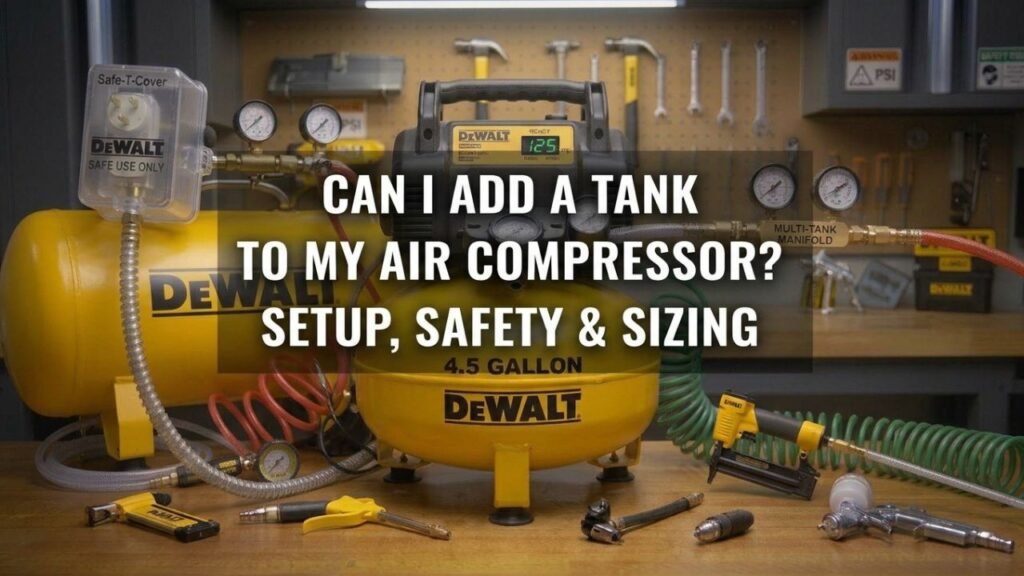
Yes, many portable and stationary compressors can use an auxiliary receiver.
You do not necessarily need to modify the compressor pump, pressure switch, or main tank.
A portable auxiliary tank can often be connected to the compressor outlet with a rated air hose. California Air Tools, for example, sells 2-, 5-, 10-, and 20-gallon auxiliary tanks made to connect to an air compressor and provide extra stored air.
The main requirements are that the tank, hose, fittings, gauge, valves, and relief protection all match the pressure of the system.
If your compressor reaches 175 PSI, do not connect a 125 PSI tank to an unregulated 175 PSI source.
A second tank is most useful when your compressor produces enough average air for the work but you need more reserve for short periods.
It is less useful when your tool continuously consumes far more CFM than the pump can produce.
What an Extra Air Tank Changes
An auxiliary receiver changes storage capacity, not the displacement or horsepower of the compressor pump.
More Stored Air
The most obvious change is additional reserve.
Suppose a compressor has a 6-gallon main tank and you add another 6-gallon receiver.
You now have about 12 gallons of total receiver volume available to store compressed air.
That can give a nailer, impact wrench, blow gun, or another intermittent tool a longer period before tank pressure falls to the compressor’s cut-in point.
A larger reserve can also reduce pressure swings during short bursts of demand.
It Does Not Increase Compressor CFM
This is the biggest misconception about adding another tank.
If your compressor produces 4 SCFM at 90 PSI before adding the tank, it still produces about 4 SCFM at 90 PSI afterward.
Imagine an air sander consumes 10 SCFM.
The compressor is short by approximately 6 SCFM while the tool runs continuously.
A larger receiver supplies that difference temporarily. Once its stored air falls, the compressor still cannot continuously feed a 10-SCFM tool with a 4-SCFM pump.
The extra tank changes how long you can work before waiting for recovery. It does not remove the need for recovery.
It Increases Fill and Recovery Time
More tank volume means more air must be compressed before the entire system reaches cut-out pressure.
If you roughly double receiver capacity without changing the pump, filling from empty can take close to twice as long under similar conditions.
Actual time varies because compressor output changes with pressure and temperature.
The motor may start less often, but each filling cycle can last longer.
That makes compressor duty cycle worth checking before installing a very large tank on a small portable unit.
Key Takeaway: A second tank increases stored air and may lengthen the time between compressor starts, but it does not increase the pump’s CFM and it makes complete refilling take longer.
What You Need Before Adding a Second Air Tank
Do not start with an old pressure vessel simply because it has threaded ports.
The tank is the most safety-sensitive part of the setup.
A Proper Compressed-Air Receiver
Use a tank manufactured and rated for compressed air.
Look for its maximum allowable working pressure or clearly stated maximum pressure.
For a straightforward setup, choose a tank rating equal to or higher than the highest pressure the compressor can deliver to that connection.
A California Air Tools 10-gallon portable auxiliary tank, for example, is rated for a maximum of 125 PSI and includes a pressure gauge and manual drain valve.
That 125 PSI tank should not be exposed to an unregulated compressor system that can reach 150, 175, or 200 PSI.
Do not repurpose a propane cylinder, damaged fire extinguisher, corroded compressor tank, or unidentified pressure vessel.
Do not drill or weld a pressure tank to create extra ports.
Pressure Gauge, Safety Relief Valve, and Drain
An auxiliary tank should give you a way to see pressure.
It also needs pressure-relief protection appropriate for the receiver.
OSHA’s workplace receiver standard requires a visible pressure gauge and spring-loaded safety valve and states that no valve should be installed between the receiver and its safety valve.
Moisture drainage matters too.
Compressed air cools inside the tank and leaves liquid water at the bottom. OSHA requires covered workplace receivers to have drainage provisions and calls for draining often enough to prevent excessive liquid accumulation.
Pressure-Rated Hose and Fittings
Every component between the two tanks must handle the intended pressure.
That includes the hose, nipples, tees, couplers, valves, regulator, and connectors.
Small fittings also restrict airflow.
If the purpose of the tank is to support a high-flow tool, a narrow hose or tiny quick connector can create pressure drop even when plenty of air remains in the tanks.
Key Takeaway: Use a real compressed-air receiver with a suitable pressure rating, its own relief protection, a gauge and drain, plus hoses and fittings rated for the complete system.
How to Add Extra Air Tank to Compressor
A portable downstream auxiliary tank is the simplest arrangement for many home shops.
The basic air path is:
Compressor → rated hose → auxiliary tank → tool hose → air tool
Permanent shop installations can use different piping layouts and should follow the compressor, tank, and local installation requirements.
1. Compare Maximum Pressure Ratings
Check the compressor’s maximum tank pressure or the maximum pressure available at the outlet you intend to use.
Then check the auxiliary tank.
The extra receiver must never be exposed to pressure beyond its rating.
If your compressor stores air at 175 PSI and the auxiliary receiver is rated for 125 PSI, the simplest choice is to use a higher-rated auxiliary tank.
A lower-rated receiver requires proper pressure control and independent relief protection designed so the tank cannot be overpressurized if another control component fails. That is not a good place for improvised plumbing.
2. Turn the Compressor Off and Depressurize the Connection
Unplug an electric compressor before changing plumbing.
If you are attaching to a quick-connect outlet, release downstream pressure before removing fittings.
For permanent plumbing changes, drain the system fully and verify zero pressure before loosening threaded components.
Never loosen a pressurized fitting.
3. Position the Auxiliary Tank Securely
Place the receiver where it cannot roll, tip, or be struck by vehicles or equipment.
Keep its drain accessible.
OSHA’s workplace rule requires covered receivers to be installed so drains and inspection openings remain accessible.
Do not bury or permanently conceal a receiver where its condition cannot be inspected.
4. Connect the Compressor to the Auxiliary Tank
For a portable arrangement, connect a pressure-rated hose from the compressor outlet to the auxiliary receiver inlet.
Purpose-built portable tanks may already include quick-connect hardware.
California Air Tools describes its auxiliary tanks as connecting to an air compressor through supplied hose and quick-connect fittings.
Make sure the coupler type matches and locks fully.
Do not mix fittings that only partially engage.
5. Set Pressure Correctly
If the extra tank is connected after the compressor’s regulator, it will normally fill toward the regulator’s outlet setting.
If connected upstream of the regulator, it may see full compressor tank pressure.
That difference is critical.
For a basic home setup, I would use an auxiliary receiver capable of safely handling the full pressure that could reach the connection instead of relying on a marginal tank rating.
Never alter the compressor pressure switch to gain extra storage pressure.
6. Connect the Tool Outlet
The tool can connect to an outlet on the auxiliary receiver or another properly designed downstream point.
Use a regulator before the tool when its working-pressure requirement is below tank pressure.
For example, tanks may store 125 PSI while a pneumatic tool calls for approximately 90 PSI.
Tank pressure and tool pressure do not need to be the same.
7. Fill the System and Check for Leaks
Start the compressor and let pressure rise gradually.
Watch both gauges.
The auxiliary tank should never climb above its rating.
Apply an approved leak-check solution to threaded fittings and look for growing bubbles.
A leak wastes stored air and causes the compressor to cycle more often.
If a joint leaks, depressurize the system before tightening or resealing it.
8. Test Compressor Cycling
Allow the combined tanks to reach normal cut-out pressure.
Use some air and verify that the compressor starts at its normal cut-in point and shuts off at its normal cut-out point.
Adding the receiver should not require changing those factory settings.
Pay attention to motor temperature and run duration during the first few cycles.
9. Drain Both Tanks
The extra receiver collects condensation just like the original tank.
Drain each receiver separately.
Do not assume draining the main compressor automatically empties water from a remotely connected auxiliary tank.
Key Takeaway: Verify pressure ratings first, connect the tanks with rated components, keep the auxiliary receiver protected by its own safety hardware, leak-test the system, and leave factory compressor pressure settings alone.
Can You Add a Second Tank Without Modifying the Compressor?
Yes, and this is often the easiest approach.
A portable auxiliary receiver can be attached to the existing air outlet.
That avoids opening the main compressor tank or changing the pressure switch plumbing.
The setup can be as simple as a hose from the compressor to the extra tank and another hose from the extra tank to the tool.
One tradeoff is that a standard regulated compressor outlet may restrict flow or limit how high the auxiliary tank can fill.
For nailers, tire inflation, and moderate intermittent use, that may be perfectly acceptable.
A permanent shop system needing high flow may call for larger piping, larger fittings, an unregulated receiver connection, or a professionally planned receiver installation.
Do not remove factory safety valves or repurpose a safety-valve opening as a convenient connection port.
How Big of an Extra Air Tank Should You Add?
There is no single ideal size.
The best size comes from the compressor’s pump output, duty cycle, tool demand, available space, and how long you need the stored-air burst to last.
2- to 5-Gallon Extra Tank
A small auxiliary tank makes sense when portability matters.
It can add reserve for:
Tire inflation, nailers, airbrush work, small blow guns, and occasional pneumatic tools.
It also places less extra refill demand on a small compressor than a 20- or 30-gallon receiver.
10-Gallon Extra Tank
Ten gallons provides a more noticeable increase in stored air.
It can work well in a garage where the compressor is still portable but you want longer intermittent tool runs.
California Air Tools currently offers 10-gallon auxiliary receivers specifically for adding stored air to compressor systems.
20 Gallons or More
A 20-gallon auxiliary tank creates a large storage increase when attached to a small compressor.
That can be useful for short peak demands, but the pump has to fill all that extra volume.
A small oil-free portable compressor may spend a long time running from low pressure to cut-out.
Check its duty-cycle limits before pairing a very small pump with a very large receiver.
For larger compressed-air installations, Atlas Copco gives roughly 3–4 gallons of receiver capacity per CFM as a general sizing reference, while also noting that actual sizing changes with the compressor and application.
For a home auxiliary-tank project, treat that figure as context rather than a fixed sizing formula.
Key Takeaway: Small tanks preserve portability, 10 gallons adds a useful reserve for many garages, and very large auxiliary tanks need to be matched carefully to pump output and duty cycle.
Does a Second Tank Make an Air Compressor More Powerful?
No.
It makes the compressed-air system larger, not the pump stronger.
Suppose your compressor produces 5 SCFM at 90 PSI.
Adding another tank gives you more stored air at 90 PSI, but once the reserve has been consumed, the compressor still produces about 5 SCFM.
This matters when trying to run tools such as pneumatic sanders.
If the sander needs 15 SCFM, an extra tank may let it run longer before slowing down, but you will then wait while the compressor replaces the air.
For continuous high-CFM work, upgrading pump capacity is more useful than endlessly adding storage.
Will a Bigger Tank Make the Compressor Run Less?
It may reduce how often the motor starts, but each cycle can be longer.
Imagine the tool removes enough air to cause a 6-gallon compressor to restart several times during a job.
With 12 or 20 gallons of combined receiver volume, pressure changes more slowly.
The compressor may wait longer before reaching cut-in.
Once it starts, there is also more volume to recharge before cut-out.
This can be easier on systems that suffer from very frequent starts, but it is not automatically easier on every pump.
A compressor with a low duty-cycle rating may not be designed for the long run periods created by a huge receiver.
Follow the compressor manufacturer’s run-time and duty-cycle limits.
Does the Second Tank Need a Check Valve?
Not every auxiliary-tank setup needs an added check valve between the two receivers.
In a simple shared air system, the tanks can equalize through the connecting hose.
The compressor itself normally has a check valve between its pump discharge and main receiver so tank air does not flow backward through the pump when the motor stops.
A separate check valve becomes useful only when the system design requires one-way flow, isolation, or a specific control arrangement.
Do not install one blindly.
Incorrect valve placement can interfere with draining, pressure control, unloading, or safety-relief arrangements.
A shutoff valve can be useful for isolating a portable auxiliary receiver, but never install a shutoff valve between a receiver and its dedicated pressure-relief valve. OSHA specifically prohibits that arrangement for covered workplace receivers.
Can You Connect Two Compressor Tanks in Parallel?
Yes.
Permanent compressed-air systems commonly use more than one receiver.
In a parallel-style arrangement, the receivers share the compressed-air supply and contribute storage to the system.
For a small shop, the simpler equivalent is to connect the auxiliary tank to the compressor’s outlet so both tanks rise and fall in pressure together.
Large permanent installations require more thought around pipe diameter, drains, receiver placement, dryers, pressure drop, isolation valves, and controls.
If modifying the compressor’s factory tank plumbing is required, professional installation is the safer path.
Common Mistakes When Adding an Air Tank
The most dangerous mistake is using a receiver with an inadequate or unknown pressure rating.
Never assume a tank is safe merely because it looks heavy.
Another mistake is expecting the tank to solve a CFM shortage. Storage buys time; pump displacement determines long-term air supply.
Tiny hoses and quick couplers can also defeat the purpose of extra storage. A tank full of air cannot feed a demanding tool properly through a severe flow restriction.
Do not eliminate pressure-relief protection, plug a safety-valve port, or increase the compressor pressure-switch setting.
Do not ignore tank moisture. The additional receiver adds another place for condensation to collect.
OSHA requires frequent draining of covered workplace receivers to prevent excessive liquid accumulation, and compressor manufacturers likewise call for regular tank draining to reduce corrosion risk.
Finally, avoid used tanks with deep rust, dents, bulging, damaged welds, or an unknown service history.
When Should You Not Add Another Tank?
Do not add an auxiliary receiver if the compressor itself is mechanically unhealthy.
Fix air leaks, overheating, slow pumping, electrical problems, and failed pressure controls first.
Do not use an extra tank as a workaround for a compressor that constantly exceeds its duty cycle.
A tank is also a poor solution when your tool’s continuous CFM requirement is far above pump output and you need nonstop operation.
For example, a high-demand air sander, grinder, or sandblaster may quickly empty even a large receiver.
In that situation, a larger pump is the real answer.
You should also stop the project if you cannot verify the extra tank’s pressure rating or condition.
Compressed-air receivers store substantial energy. Unknown pressure vessels are not worth the risk.
Conclusion
For can I add a tank to my air compressor, yes, a properly rated auxiliary air receiver can be added to many systems. It gives you more stored air, longer short-duration tool use, and slower pressure changes between compressor cycles.
The extra tank does not increase pump CFM. A small pump remains a small pump, and the larger combined receiver takes longer to refill. Match tank capacity to the compressor’s duty cycle rather than adding as much storage as possible.
Use a purpose-built compressed-air tank with adequate pressure rating, relief protection, a pressure gauge, and a drain. Connect it with rated hoses and fittings, check every joint for leakage, and keep the receiver accessible for draining and inspection.
I would choose an auxiliary tank that can safely tolerate the compressor’s full available pressure. That keeps the setup simpler and removes the temptation to rely on improvised pressure control to protect an undersized receiver.
FAQs About Adding an Extra Tank to an Air Compressor
Can I add another tank to my air compressor?
Yes. A second compressed-air receiver can usually be connected through the compressor outlet or properly designed system piping. The additional tank must have a suitable pressure rating and its own required safety, gauge, and drain equipment.
Can you add a second tank to an air compressor without changing the pressure switch?
Yes. In most auxiliary setups, the compressor can keep its original cut-in and cut-out settings. The second tank simply adds volume to the air system. There is normally no reason to raise the factory pressure settings.
How do I add an extra air tank to a compressor?
Connect a rated air hose from the compressor outlet to the auxiliary receiver, then connect the air tool downstream of the tank. Verify tank pressure rating, relief protection, gauge, drain, hose ratings, and fitting compatibility before pressurizing the system.
Will an extra tank increase CFM?
No. The pump’s continuous CFM remains essentially unchanged. The tank stores extra compressed air, allowing a high-demand tool to draw more than the pump produces for a limited period before pressure falls.
Can I use a 125 PSI tank with a 175 PSI compressor?
Do not expose a 125 PSI receiver to 175 PSI. The simplest setup is to choose a tank rated for at least the maximum pressure that could reach it. A lower-pressure receiver needs correctly designed pressure regulation and independent relief protection.
How much extra tank capacity should I add?
A few gallons can add useful reserve to a small portable compressor, while 10 gallons creates a more noticeable increase. Large receivers take much longer for a small pump to refill, so check pump output and duty-cycle limits before adding a large tank.
Will a second tank make my air compressor run cooler?
Not necessarily. The compressor may start less frequently, but it may run for longer periods when it does start. Pump temperature depends on duty cycle, ventilation, ambient temperature, pressure, and run duration.
Do I have to drain the extra air tank?
Yes. Condensation forms inside auxiliary receivers just as it does in the compressor’s original tank. Drain each receiver at the interval specified for the equipment so water does not sit inside and promote corrosion.