
How to Convert Electric Air Compressor to Gas Engine: Safe Guide
You can convert some belt-driven electric air compressors to gasoline-engine power, but the conversion requires more than replacing the electric motor. The compressor pump must run at its rated RPM, the engine must supply enough power, and the system needs a gas-compressor-style unloader, pressure controls, safety relief valve, guarded belt drive, and rigid mounting.
The easiest candidates are older belt-driven compressors with a separate pump, motor, tank, check valve, and flywheel. Direct-drive portable compressors are generally poor conversion candidates because the electric motor, cooling fan, pump, and housing are often designed as one assembly.
Gas engines also change the way pressure is controlled. An electric compressor can stop its motor when tank pressure reaches the cut-out setting. A gasoline engine normally keeps running, so a proper gas-powered setup unloads the compressor and commonly reduces engine speed to idle when the tank reaches its upper pressure setting.
Pressure safety cannot be removed during the conversion. OSHA rules for covered workplace air receivers call for a pressure gauge and spring-loaded safety valve, with the safety valve preventing receiver pressure from exceeding 110% of the tank’s maximum allowable working pressure.
If you are looking up how to convert electric air compressor to gas engine, begin by identifying the compressor pump model and its rated RPM, horsepower requirement, maximum working pressure, rotation direction, and lubrication requirements. Those numbers determine the engine, pulleys, belt, and pressure-control hardware.
A gasoline-powered compressor must also be operated where engine exhaust cannot accumulate. OSHA warns that carbon monoxide exposure should be suspected when gasoline-powered equipment operates in areas with limited ventilation. Never run the converted compressor inside a house, garage, basement, enclosed trailer, or other enclosed space.
The sections below explain which compressors can be converted, how the drive ratio works, what happens to the electric pressure switch, which gas-engine controls are needed, and when buying a factory-built gas compressor makes more sense.
Can You Convert an Electric Air Compressor to a Gas Engine?
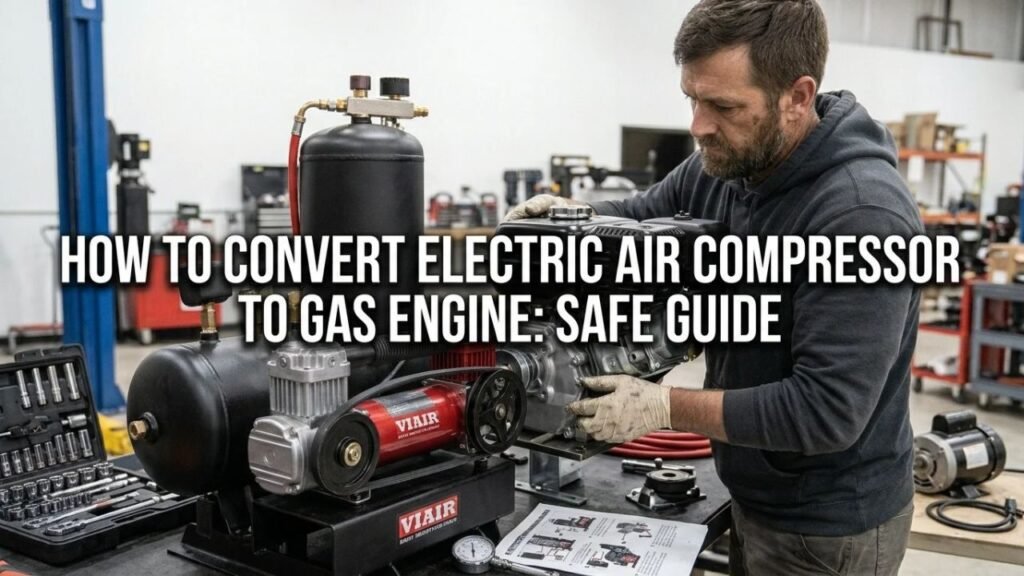
Yes, if the compressor uses a separate belt-driven pump and the pump can be matched correctly to a gasoline engine.
The conversion is much less practical on a direct-drive unit.
Belt-Driven Compressors Are the Best Candidates
A belt-driven compressor normally has:
- A separate compressor pump
- A large pump flywheel
- An electric motor with a smaller pulley
- One or more V-belts
- A separate air tank
- A tank check valve
- A pressure switch
- A safety relief valve
The electric motor can be removed while the compressor pump, tank, discharge plumbing, and much of the original air system remain in place.
The new gasoline engine drives the pump through a replacement pulley and belt arrangement.
Direct-Drive Compressors Are Poor Candidates
Many small oil-free compressors connect the electric motor shaft directly to the compressor mechanism.
The motor may also provide:
- Pump cooling
- Fan airflow
- Bearing support
- Crankshaft drive
- Housing structure
Removing the motor may leave no practical way to drive the pump independently.
For a small direct-drive compressor, buying a factory-built gas-powered unit is usually the better route.
Check the Tank Before Reusing It
Do not build a conversion around a badly rusted, dented, cracked, repaired, or questionable air receiver.
The existing tank still determines the maximum safe pressure of the finished machine.
Keep the original data plate readable and do not raise operating pressure above the tank, pump, plumbing, or safety-device ratings.
Key Takeaway: A separate belt-driven pump can often be adapted to a gas engine; an integrated direct-drive compressor usually is not a sensible conversion platform.
What Parts Are Needed for the Conversion?
The exact parts depend on the pump and engine, but a safe conversion usually needs more than an engine and pulley.
Typical components include:
- Gasoline engine
- Engine drive pulley
- Correct V-belt or belts
- Adjustable engine mounting plate
- Belt guard
- Pilot-operated unloader valve
- Engine throttle or idle-control linkage
- Tank check valve
- Pressure gauge
- Safety relief valve
- Flexible compressor discharge line
- Engine kill switch
- Fuel tank and shutoff valve
- Suitable mounting hardware
- Pump intake filter
- Compressor regulator for tool pressure
Factory gas compressors show why these parts matter. Rolair’s current 4090HK17 gas compressor uses a gasoline engine together with automatic pilot-valve operation, automatic idle control, a flexible discharge hose, pressure gauge, enclosed belt guard, and safety relief valves.
That is a much different control system from simply bolting a lawn-mower engine where the electric motor used to sit.
How to Convert Electric Air Compressor to Gas Engine Safely
The safest way to approach the project is to treat the compressor pump, engine, pressure controls, and receiver as one engineered system.
Step 1: Identify the Compressor Pump Specifications
Find the model number on the pump itself, not just the compressor tank.
You need the manufacturer’s figures for:
- Maximum pump RPM
- Recommended operating RPM
- Required drive horsepower
- Maximum pressure
- Rotation direction
- Oil type
- Oil capacity
- Flywheel diameter
Do not estimate maximum pump speed from the old motor’s nameplate alone.
The electric motor may turn around 1,725 RPM while the compressor pump runs considerably slower because of the pulley ratio.
Rolair’s gas compressor documentation gives a real example: some gas-powered models run engines around 2,775–3,150 RPM while their compressor pumps operate around 900–1,175 RPM.
Step 2: Choose an Engine Based on Pump Load
Choose the gasoline engine from the compressor pump’s required brake horsepower at the intended pressure.
Do not assume that a 2 HP electric motor should automatically be replaced by a 2 HP gasoline engine.
Electric motors and small gasoline engines deliver torque differently, and nameplate ratings are not always directly comparable.
The best reference is the compressor pump manufacturer’s engine recommendation or a factory gas-powered compressor using the same pump.
For example, Rolair pairs a 163 cc gasoline engine rated at 5.5 HP with one of its portable single-stage compressor systems delivering 9.3 CFM at 90 PSI.
Step 3: Calculate the Pulley Ratio
The engine and compressor pump do not normally turn at the same speed.
For a simple belt drive:
Pump RPM = Engine RPM × Engine Pulley Diameter ÷ Pump Flywheel Diameter
Rearranged:
Engine Pulley Diameter = Pump RPM × Pump Flywheel Diameter ÷ Engine RPM
As an example only, suppose:
- Desired pump speed = 1,000 RPM
- Pump flywheel = 12 inches
- Engine working speed = 3,000 RPM
The approximate engine pulley would be:
1,000 × 12 ÷ 3,000 = 4 inches
That calculation gives a starting ratio, not automatic approval for that pulley.
Check:
- Pump RPM limit
- Pulley bore and key size
- Belt type
- Pulley speed rating
- Belt wrap
- Engine shaft rating
- Rotation direction
Do not exceed the pump manufacturer’s rated RPM to get more CFM.
Step 4: Preserve the Correct Pump Rotation
Many compressor flywheels also act as cooling fans.
If the pump spins backward, the compressor may still move some air while receiving poor cooling or incorrect lubrication.
Look for a rotation arrow on:
- Pump housing
- Flywheel
- Belt guard
- Manufacturer documentation
Mount the engine so the pump turns in its specified direction.
Step 5: Build a Rigid Adjustable Engine Mount
The engine needs a rigid base that keeps both pulley shafts parallel.
The mounting plate should also allow belt-tension adjustment.
Poor pulley alignment can cause:
- Belt wear
- Bearing wear
- Vibration
- Belt throwing
- Shaft loading
Rolair warns that improper pulley alignment and belt tension can lead to vibration and premature belt or bearing failure.
Do not rely on thin sheet metal that flexes as the engine changes speed.
Step 6: Install a Full Belt Guard
Cover the engine pulley, compressor flywheel, and belts.
A gasoline-engine conversion often places the drive assembly in a more exposed location than the original electric motor setup.
A proper guard needs to prevent accidental contact while still allowing pump cooling.
Factory belt-driven gas compressors commonly use fully enclosed steel belt guards.
Step 7: Replace Start/Stop Control With a Gas Unloader System
This is one of the biggest differences in the conversion.
An electric compressor pressure switch typically:
- Stops electrical power to the motor at cut-out pressure.
- Unloads pressure trapped between the pump and tank check valve.
- Restarts the motor when tank pressure falls.
You cannot use those electrical contacts to control a gasoline engine in the same way.
A gas-powered compressor commonly uses a pilot-operated unloader valve.
When the tank reaches upper pressure:
- The pilot valve opens.
- The pump is unloaded.
- Pump output vents rather than filling the tank further.
- The throttle control reduces the gasoline engine to idle.
When tank pressure falls:
- The pilot valve closes.
- The compressor loads again.
- The engine returns to operating speed.
Rolair describes this same arrangement on its gas compressor systems.
Step 8: Keep an Independent Safety Relief Valve
The unloader is a control device.
It is not the emergency safety valve.
Keep a correctly rated spring-loaded safety relief valve directly connected to the receiver with no shutoff valve isolating it from the tank.
Never plug the original relief-valve opening because the pilot unloader appears to control pressure correctly.
Step 9: Inspect the Tank Check Valve and Discharge Line
The check valve lets compressed air enter the tank while preventing tank pressure from pushing backward into the compressor pump.
Confirm that it works correctly.
The discharge tube from pump to tank also sees:
- High temperature
- Pressure
- Pulsation
- Engine vibration
Use compressor-rated tubing or flexible discharge hose rated for the pressure and temperature involved.
Do not substitute fuel hose, garden hose, PVC pipe, or ordinary low-pressure tubing.
Step 10: Test the System Conservatively
Initial testing should confirm:
- Correct rotation
- Stable engine mount
- Correct belt tracking
- No unusual vibration
- Normal pump oiling
- Rising tank pressure
- Proper pilot unloading
- Engine idle-down
- Correct reload pressure
- No air leaks
- Safety relief valve remains installed and correctly rated
Do not leave the compressor unattended during initial cycling.
Stop immediately if pressure rises beyond the intended unload point.
Key Takeaway: The conversion succeeds only when pump RPM, rotation, engine load, pressure unloading, tank protection, belt alignment, and guarding all work together.
What Happens to the Original Electric Pressure Switch?
The original pressure switch usually cannot remain the main operating control for the gasoline engine.
Its electrical contacts were designed to switch an electric motor or motor starter.
Why the Electric Pressure Switch Is Different
An electric compressor can simply stop its motor every time the tank reaches cut-out pressure.
A gasoline engine does not handle rapid stop-start cycles in the same way.
Repeatedly killing and restarting the engine would make the compressor awkward to use and could create starting problems against trapped pump pressure.
Gas Compressors Usually Use Constant-Run Control
A pilot unloader lets the gasoline engine continue running.
At full tank pressure, the compressor pumps against little or no load while the engine idles.
Rolair states that its piloted unloader can vent pump output and operate an engine idle-control system once the upper pressure setting is reached.
Do Not Remove the Tank Gauge or Relief Valve
Changing the operating control does not remove the need for:
- Pressure gauge
- Safety relief valve
- Tank check valve
- Drain valve
The gas-engine control system sits alongside those safety components rather than replacing them.
Key Takeaway: Replace the electric start/stop function with a proper gas-compressor unloading and throttle-control system while retaining independent tank-pressure protection.
How to Match Engine RPM and Compressor Pump RPM
Incorrect pump speed is one of the fastest ways to shorten compressor life.
A gasoline engine may run close to 3,000–3,600 RPM under load, while many belt-driven compressor pumps are designed for much lower speeds.
Do Not Put Equal-Size Pulleys on Both Shafts
Equal pulleys create approximately a 1:1 ratio.
A 3,000 RPM engine would then attempt to spin the compressor pump at roughly 3,000 RPM.
If the pump is designed for 1,000 RPM, that would be a severe overspeed.
Use the Pump’s Rated Speed
Factory systems illustrate the difference.
Rolair lists engine speeds near 3,000 RPM on several gas-powered compressors while listing pump speeds from about 900 to 1,175 RPM.
The pulley ratio reduces engine speed to the pump’s required range.
Do Not Overspeed for More Airflow
Faster pump speed may increase air delivery, but it also raises:
- Heat
- Piston speed
- Valve stress
- Bearing load
- Oil temperature
- Flywheel speed
Run the pump at or below the manufacturer’s approved speed.
Key Takeaway: Gas-engine RPM is commonly much higher than compressor-pump RPM, so correct pulley reduction is mandatory.
Gas Engine Horsepower vs. Electric Motor Horsepower
This comparison causes many conversion mistakes.
A direct horsepower-for-horsepower swap is not always suitable.
A gasoline engine typically has different torque characteristics and may be rated under different test conditions from an electric compressor motor.
Factory compressor pairings provide a better reference.
Rolair, for example, shows:
| Compressor Type | Drive | Rated Air Delivery |
| Electric belt drive | 1.5 HP electric motor | 7.3 CFM at 90 PSI |
| Electric belt drive | 2 HP electric motor | 8.8 CFM at 90 PSI |
| Gas belt drive | 163 cc / 5.5 HP engine | 9.3 CFM at 90 PSI |
| Gas belt drive | 196 cc / 6.5 HP engine | 13.8 CFM at 90 PSI |
These are complete factory systems rather than conversion rules, but they show why simply matching the printed horsepower number can be misleading.
Use pump load data or a manufacturer-approved engine pairing whenever possible.
Can You Use the Existing Air Tank?
Often yes, if the tank is in sound condition and remains within its original pressure rating.
Do not reuse a tank with:
- Heavy rust
- Deep pitting
- Serious dents
- Cracks
- Questionable weld repairs
- Missing pressure-rating information
- Damaged mounting feet
- Severe internal corrosion
Never weld, drill, grind, or modify a pressure vessel casually.
The conversion should not increase the tank’s operating pressure.
Set the gas unloader within the compressor’s original safe operating range, and keep the safety relief valve correctly rated.
Carbon Monoxide and Gasoline Engine Safety
This is the biggest new hazard created by replacing an electric motor with a gasoline engine.
Gasoline engines produce carbon monoxide.
OSHA notes that gasoline-powered equipment can create hazardous CO concentrations in areas with limited ventilation.
Operate the compressor outdoors, away from:
- Garages
- Basements
- Workshops with closed doors
- Enclosed trailers
- Tents
- Crawlspaces
- Windows and doors where exhaust could enter a building
Keep the compressor air intake away from the engine exhaust as well.
OSHA guidance on compressor air quality specifically warns that compressor intakes should not draw combustion exhaust produced by the engine powering the compressor.
Never use ordinary shop-compressor air for breathing or respiratory protection unless the entire system is purpose-built and certified for breathing-air service.
When the Conversion Is Not Worth Doing
Buying a purpose-built gas compressor may cost more upfront but can avoid a long list of engineering problems.
Skip the conversion if:
- The compressor is direct drive
- Pump specifications are unavailable
- The tank is badly rusted
- The pump is already worn
- No suitable unloader system is available
- The frame cannot support an engine securely
- You cannot fabricate a proper belt guard
- Engine exhaust would be used near occupied indoor areas
- A factory gas compressor is available at a similar total cost
A factory gasoline compressor already has the pump, engine, pulleys, unloading system, throttle control, belt guard, tank, relief valve, and frame matched as a package.
For frequent jobsite use, that can be far simpler than rebuilding an old electric machine.
Conclusion
For how to convert electric air compressor to gas engine, start with a belt-driven compressor that has a separate pump and a sound pressure tank. Identify the pump’s rated speed, horsepower requirement, rotation direction, and maximum pressure before choosing an engine or pulley.
The engine must drive the pump through a calculated pulley reduction rather than directly at full gasoline-engine speed. A gas-powered control system also needs a pilot unloader and usually an automatic idle control because the gasoline engine continues running after the tank reaches full pressure.
Keep the pressure gauge, check valve, drain, and correctly rated safety relief valve. Add a rigid engine mount, properly aligned pulleys, suitable belts, a full belt guard, and pressure- and temperature-rated discharge plumbing.
The conversion is practical on some older belt-drive compressors, but it is rarely worthwhile on a small direct-drive unit. If the pump data is missing or the receiver condition is doubtful, a factory-built gas compressor is the safer choice.
FAQs About Converting an Electric Compressor to Gas Power
Can I Put a Gas Engine on Any Electric Air Compressor?
No. Belt-driven compressors with separate pumps are the best candidates. Small direct-drive compressors often combine the electric motor, cooling system, and pump into one unit, making a gas-engine conversion impractical.
What Size Gas Engine Do I Need for an Air Compressor?
Use the compressor pump manufacturer’s required horsepower or a factory gas-engine pairing for the same pump. Do not choose the engine solely by matching the old electric motor’s horsepower number because electric and gasoline drive characteristics differ.
Can I Use the Original Pressure Switch With a Gas Engine?
The electrical start/stop portion is normally replaced by a gas-compressor control arrangement. A pilot-operated unloader can vent pump output and activate an engine idle control when tank pressure reaches the upper setting.
How Do I Calculate the Pulley Size for a Gas Compressor Engine?
For a basic belt drive, use:
Engine pulley diameter = Desired pump RPM × Pump flywheel diameter ÷ Engine RPM
Use the pump manufacturer’s rated RPM and the engine’s actual governed working speed. Confirm that the resulting pulley, belt, and shaft arrangement are mechanically suitable before operation.
Can I Run the Compressor Pump at the Gas Engine’s Full RPM?
Usually not. Many gasoline engines operate near 3,000 RPM while belt-driven compressor pumps may run closer to 900–1,200 RPM. A pulley reduction keeps the pump within its rated speed.
Do I Need an Unloader Valve After Converting to Gas?
Yes, a constant-running gasoline compressor needs a suitable pressure-control and unloading system. The unloader allows the pump to stop building tank pressure when the upper setting is reached while the engine remains running.
Can I Reuse the Original Air Tank?
Yes if it is structurally sound and you keep operating pressure within its original rating. Do not reuse a receiver with severe rust, cracks, questionable weld repairs, serious dents, or missing pressure-rating information.
Can I Run a Gas-Powered Air Compressor Inside a Garage?
No. A gasoline engine produces carbon monoxide, which can accumulate quickly in enclosed or partly enclosed areas. Operate the converted compressor outdoors and keep engine exhaust away from doors, windows, and the compressor’s own air intake.