
Can I Put a Bigger Motor on My Air Compressor? Sizing Explained
You can sometimes replace an air-compressor motor with a higher-horsepower motor, but only if the RPM, pulley ratio, voltage, phase, frame, shaft, controls, and compressor-pump limits remain compatible. A larger motor alone normally does not increase airflow. Installing a smaller motor is riskier because the compressor pump may overload, stall, or overheat it.
A motor and compressor pump work as a matched drive system. The motor supplies torque and horsepower, while the pulley ratio determines how fast a belt-driven compressor pump turns. Changing one part without checking the others can overload the motor, overspeed the pump, or create electrical problems.
For can I put a bigger motor on my air compressor, the safest approach is to retain the pump RPM and operating pressure specified by the compressor manufacturer. Ingersoll Rand’s compressor documentation uses the relationship between motor RPM, motor-pulley diameter, compressor-pulley diameter, and compressor RPM to size belt drives.
A larger motor does not automatically turn the pump faster. If a 5 HP and a 7.5 HP motor both run at roughly 1,725 RPM and use the same pulley, the compressor pump runs at essentially the same speed. The larger motor simply has greater power capacity than the pump may require.
The electrical side also matters. ABB notes that motor nameplates identify horsepower, voltage, phase, RPM, full-load current, frame, service factor, and other characteristics. Those specifications matter when selecting a replacement, not horsepower alone.
Compressed-air systems also use substantial electricity. U.S. Department of Energy material estimates compressed-air generation accounts for about 10% of electricity use in a typical industrial facility, so improperly sizing the motor is not a harmless modification.
The sections below explain what happens with both larger and smaller motors, how pulley size changes pump RPM, and which specifications need to match.
Can I Put a Bigger Motor on My Air Compressor?
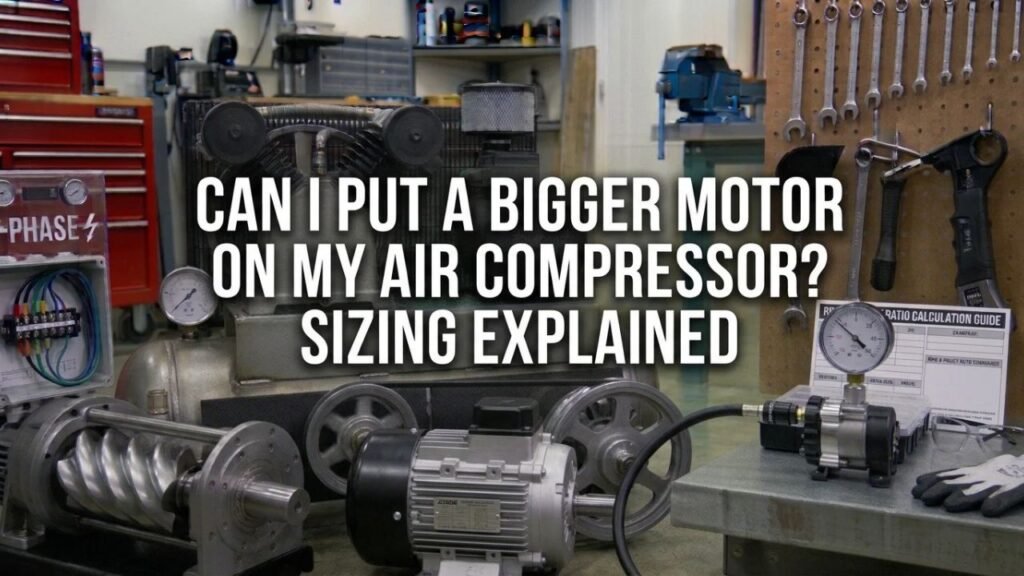
Yes, in some belt-driven compressors you can install a higher-horsepower motor without harming the pump—as long as the motor is compatible and you do not exceed the pump’s rated speed or pressure.
Bigger Horsepower Does Not Automatically Increase Pump Speed
Horsepower and RPM are different specifications.
Imagine an air compressor originally equipped with:
- 5 HP motor
- 1,725 RPM motor speed
- 5-inch motor pulley
- 15-inch compressor flywheel
If you replace the motor with a 7.5 HP unit that also runs at approximately 1,725 RPM and keep the same pulleys, the pump RPM remains essentially unchanged.
The bigger motor does not force the pump to consume all 7.5 HP.
The compressor pump determines how much mechanical load is required at its operating speed and pressure.
A Bigger Motor May Provide More Power Reserve
A higher-horsepower motor can supply more torque before reaching its rated load.
That may be useful if the manufacturer approves several motor sizes for the same pump at different approved pump speeds.
Campbell Hausfeld documentation gives a good example. One compressor pump is specified for either 4 HP or 5 HP configurations, with pump speeds of 1,150 and 1,310 RPM respectively, while listing 1,400 RPM as the pump’s maximum.
The important point is that these combinations are engineered and specified by the manufacturer.
Simply adding horsepower does not mean an unknown compressor can safely be driven faster.
Electrical Components Must Handle the New Motor
A larger motor may draw more current and have greater starting-current requirements.
The following components may need to be checked:
- Branch circuit
- Breaker or fuses
- Wire size
- Disconnect
- Magnetic starter
- Contactor
- Motor overload protection
- Pressure switch
- Supply voltage
Motor nameplate current changes with horsepower, voltage, phase, and motor design. ABB motor data illustrates why horsepower cannot be considered separately from electrical ratings.
For hardwired compressor circuits, have the electrical compatibility verified by a qualified electrician.
Key Takeaway: A bigger motor can work if RPM, pulleys, pump limits, electrical supply, starter, and physical mounting remain compatible; extra horsepower by itself does not increase compressor output.
Does a Bigger Motor Make an Air Compressor Produce More CFM?
Not by itself.
Compressor displacement is strongly related to pump speed, not merely the horsepower printed on the motor.
Same Pump RPM Means Similar Displacement
Ingersoll Rand provides a formula for belt-driven reciprocating compressors:
Compressor RPM = Motor pulley diameter × Motor RPM ÷ Compressor pulley diameter
If those three drive values stay unchanged, replacing the motor with a larger one will not materially change compressor RPM.
That means pump displacement stays essentially where it was.
Actual delivered CFM also depends on:
- Pump design
- Volumetric efficiency
- Pressure
- Valve condition
- Leakage
- Temperature
More Horsepower May Permit an Approved Higher Pump Speed
Some compressor pumps have performance charts showing different horsepower and RPM combinations.
For example, Champion documentation lists the same reciprocating pump operating at different RPM values when paired with different motor horsepower ratings, while also defining a minimum and maximum allowable pump speed.
In that situation, more horsepower can support greater pump speed and airflow—but only within the manufacturer’s performance table.
Do Not Increase Pulley Size Just to Get More CFM
Installing a larger motor pulley increases compressor RPM.
That may increase displacement, but it also increases:
- Pump load
- Piston speed
- Heat generation
- Bearing load
- Valve cycling rate
- Required motor horsepower
Once the compressor exceeds its rated RPM, reliability and safety can be compromised.
Key Takeaway: More motor horsepower does not increase CFM unless pump speed is also increased, and pump speed should only be increased within the compressor manufacturer’s approved limits.
What Happens if You Put Too Big a Motor on an Air Compressor?
A larger motor is not necessarily damaging if the pump speed stays correct.
Problems usually appear when the motor swap also changes other parts of the system.
Pump Overspeed
A common mistake is replacing a 1,725 RPM motor with a 3,450 RPM motor while retaining the original motor pulley.
That can approximately double compressor pump speed.
A pump rated for 1,000 RPM must not suddenly be driven near 2,000 RPM just because the replacement motor physically fits.
Champion documentation gives specific minimum and maximum pump RPM limits on its reciprocating compressor pumps, illustrating that pump speed is an engineered limit.
Excessive Electrical Demand
A high-horsepower motor may require more:
- Full-load current
- Starting current
- Wiring capacity
- Breaker capacity
- Starter capacity
Installing it on electrical equipment sized for a smaller motor can cause nuisance trips or unsafe overheating.
Belt and Pulley Problems
A different motor may have:
- Different shaft diameter
- Different shaft length
- Different frame height
- Different mounting pattern
That can make proper pulley alignment difficult.
Rolair warns that incorrect pulley alignment and belt tension can cause motor overload, excessive vibration, and premature belt or bearing failure.
Pressure Does Not Automatically Increase
Motor horsepower does not determine the compressor’s safe maximum tank pressure.
The compressor’s:
- Pump
- Receiver tank
- Pressure switch
- Relief valve
- Piping
all have pressure limits.
Campbell Hausfeld explicitly warns against altering control settings above the compressor’s stated maximum operating pressure.
Key Takeaway: An oversized motor is mainly dangerous when the swap leads to excessive pump RPM, incorrect electrical protection, drive misalignment, or an attempt to increase pressure beyond the compressor’s rating.
Can I Put a Smaller Motor on My Air Compressor?
Sometimes, but simply installing a lower-horsepower motor while keeping everything else unchanged is usually a poor idea.
The existing compressor pump may require more horsepower than the smaller motor can deliver.
The Motor May Overload
Suppose a compressor pump needs roughly 5 HP at its rated speed and pressure.
Replacing the original 5 HP motor with a 3 HP motor does not make the pump suddenly require only 3 HP.
The smaller motor may:
- Draw excessive current
- Slow under load
- Trip thermal protection
- Trip the breaker
- Overheat
- Fail prematurely
- Stall during compression
ABB explains that motors are intended to operate within their nameplate horsepower and service-factor limits. Running above those limits increases heating and can shorten motor life.
Starting Can Be the Biggest Problem
Reciprocating compressors need substantial starting torque.
Campbell Hausfeld notes that the unloader valve vents trapped discharge pressure so the motor can start without compressor-head pressure working against it. The manufacturer specifically describes compressor starting torque as high enough that this unloading function is needed for proper starting.
A motor with inadequate starting capability may:
- Hum
- Start slowly
- Trip overload
- Blow a fuse
- Stall when the tank is pressurized
An incorrectly functioning unloader makes that problem even worse.
A Smaller Motor Can Work if the Pump Is Properly Derated
A lower-horsepower motor may be possible if the compressor-pump manufacturer provides an approved lower-speed operating point.
That normally requires:
- Lower pump RPM
- Correct motor pulley
- Suitable minimum pump speed
- Adequate lubrication
- Verified airflow at the reduced speed
Do not assume you can slow any compressor as much as you want.
Some splash-lubricated compressor pumps have minimum speed requirements. Eaton documentation, for example, warns that specified splash-lubricated pumps require at least 550 RPM for proper lubrication.
Key Takeaway: A smaller motor usually cannot replace a larger one at the same pump speed; it may only work when the pump is deliberately slowed within the manufacturer’s approved operating range.
How Motor RPM Affects an Air Compressor
Motor RPM is just as important as horsepower.
Common induction-motor speeds include approximately:
- 1,725 RPM
- 3,450 RPM
Actual nameplate speed may vary somewhat under load.
A 3,450 RPM Motor Is Not a Direct Replacement for 1,725 RPM
If the original compressor has a 1,725 RPM motor, replacing it with a 3,450 RPM motor using the same motor pulley can drive the compressor approximately twice as fast.
That is often unsafe.
Pulley Size Can Compensate for Motor RPM
Manufacturers use different pulley sizes to maintain the desired pump RPM.
Campbell Hausfeld documentation provides an example where a compressor uses approximately:
- 10.8-inch sheave with a 1,725 RPM motor
- 5.4-inch sheave with a 3,450 RPM motor
for one specified pump operating point.
The motor speed doubles while the motor-pulley diameter is roughly halved.
That keeps compressor speed in the intended range.
Always Calculate Pump RPM
Use:
Pump RPM = Motor RPM × Motor Pulley Diameter ÷ Pump Pulley Diameter
For example:
1,725 RPM × 4 inches ÷ 12 inches = 575 pump RPM
If a 3,450 RPM motor were installed with the same pulleys:
3,450 × 4 ÷ 12 = 1,150 pump RPM
The pump would run twice as fast.
Key Takeaway: Never choose a replacement motor based only on horsepower; a change from roughly 1,725 to 3,450 RPM requires a corresponding pulley-ratio change to keep pump RPM correct.
Can You Change Pulley Size With a Bigger or Smaller Motor?
Yes, pulley changes are how many belt-driven compressor systems match different motor speeds and power levels.
Larger Motor Pulley Raises Pump RPM
Increasing the motor-pulley diameter makes the compressor pump run faster.
Example:
1,725 RPM motor
4-inch motor pulley
12-inch pump pulley
Pump speed:
575 RPM
Change only the motor pulley to 6 inches:
1,725 × 6 ÷ 12 = 862.5 RPM
That is a 50% pump-speed increase.
The pump will also require more power.
Smaller Motor Pulley Reduces Pump RPM
Reducing motor-pulley diameter slows the compressor.
This may be one way to match a lower-horsepower motor if the pump manufacturer permits operation at the resulting speed.
Pulley Diameter Has Physical Limits
Very small pulleys can create poor belt engagement and bending problems.
Pulley alignment and belt tension also remain important.
A compressor manual from Central Pneumatic specifically instructs owners to calculate the motor pulley from motor RPM and desired pump RPM, then check alignment carefully to prevent pump or motor damage.
Key Takeaway: Pulley size controls pump speed: a larger motor pulley speeds the pump up, while a smaller one slows it down, but the resulting pump RPM must stay inside approved limits.
What Motor Specifications Must Match?
Horsepower is only one line on the motor nameplate.
Horsepower
The motor needs enough rated output to drive the pump at the selected speed and pressure.
Do not rely on marketing labels such as “peak HP.”
Use the actual continuous motor rating and compressor manufacturer’s specification.
RPM
Match the original motor RPM or redesign the pulley ratio correctly.
A 1,725 RPM and 3,450 RPM motor are not interchangeable with the same pulley.
Voltage
Common compressor motors may operate on:
- 120V
- 208V
- 230V
- 460V
The motor must be connected according to its nameplate and wiring diagram.
Phase
A single-phase motor cannot simply be replaced by a three-phase motor unless three-phase power or suitable approved drive equipment is available.
Likewise, changing from three-phase to single-phase often changes current requirements substantially.
Full-Load Amps
Check the motor’s rated current.
This affects:
- Wiring
- Motor starter
- Overload setting
- Disconnect
- Circuit protection
Frame and Mounting
The replacement needs to fit the compressor base.
Check:
- Frame size
- Foot locations
- Shaft height
- Overall dimensions
Shaft Diameter
The original pulley must fit the new shaft or be replaced with the correct pulley.
Do not machine, sleeve, or improvise a poorly fitting pulley arrangement without proper engineering.
Rotation
Some compressor pumps require a specific rotation direction for cooling and lubrication.
Campbell Hausfeld tells owners to verify motor rotation before operating some two-stage compressors.
Service Factor
Service factor provides limited overload capability under specified conditions.
ABB notes that operating a motor above its rated horsepower using service factor increases temperature and can reduce life expectancy.
Key Takeaway: Match horsepower, RPM, voltage, phase, current, frame, shaft, rotation, duty rating, and service factor—not just physical motor size.
Bigger vs Smaller Air Compressor Motor: Quick Comparison
| Motor Change | Likely Result |
| Bigger HP, same RPM and pulleys | Pump speed usually unchanged |
| Bigger HP + bigger pulley | Pump runs faster; may exceed ratings |
| Bigger HP + higher motor RPM | Pump may overspeed unless pulley ratio changes |
| Smaller HP, same RPM and pulleys | Motor may overload or stall |
| Smaller HP + smaller pulley | Pump slows; may work if manufacturer permits |
| 1,725 RPM to 3,450 RPM, same pulley | Pump speed roughly doubles |
| 3,450 RPM with corrected smaller pulley | Can retain original pump RPM |
| Bigger motor with inadequate wiring/starter | Electrical overload/tripping risk |
The safest replacement is generally a motor that matches the original compressor manufacturer’s motor specification as closely as possible.
Signs a Replacement Motor Is Mismatched
Several symptoms can appear after an incorrect motor swap.
Motor Trips the Overload
Possible causes include:
- Motor too small
- Pump running too fast
- High discharge pressure
- Low voltage
- Unloader problem
Campbell Hausfeld identifies low voltage and failed unloading/check-valve components among conditions that can cause high current and motor overload.
Motor Hums but Will Not Start
Possible causes include:
- Insufficient starting torque
- Failed capacitor
- Incorrect voltage
- Compressor starting under pressure
- Undersized motor
Pump Runs Excessively Hot
Check:
- Pump RPM
- Rotation
- Lubrication
- Airflow
- Belt tension
An overspeed condition can make heat problems much worse.
Belts Slip
The new pulley may not provide correct belt engagement, alignment, or tension.
Breaker Trips at Startup
A larger replacement motor can have greater starting-current requirements than the existing circuit supports.
Do not simply install a larger breaker without verifying wiring, motor protection, and applicable electrical requirements.
Key Takeaway: Tripping, humming, excessive heat, belt problems, and difficult starting after a motor swap are warning signs that the motor, pulley, electrical system, or unloader setup is incorrect.
Conclusion
For can I put a bigger motor on my air compressor, the answer is yes in some belt-driven systems, but the replacement must be treated as a complete motor-and-drive matching job rather than a simple horsepower upgrade.
A larger motor running at the same RPM with the same pulley normally leaves pump speed and airflow almost unchanged. Trying to gain more CFM by fitting a larger pulley can overspeed the compressor unless the manufacturer’s pump data specifically permits the resulting RPM.
A smaller motor is more difficult to substitute. If it drives the original pump at the original speed and pressure, it may overload, overheat, trip its protection, or fail to start. Reducing pump speed can lower the horsepower requirement, but you must remain above any minimum pump RPM needed for proper lubrication.
Before replacing a compressor motor, identify the original horsepower, RPM, voltage, phase, full-load amps, frame, shaft size, rotation, pulley diameter, pump RPM, and motor-control requirements. When those details are unknown, the safest route is an OEM-equivalent replacement or a motor/pulley combination specified for the exact compressor pump.
FAQs About Air Compressor Motor Size
Can I Replace a 5 HP Air Compressor Motor With a 7.5 HP Motor?
Possibly.
If the 7.5 HP motor has compatible RPM, voltage, phase, frame, shaft, rotation, and electrical controls, it can drive a pump originally requiring 5 HP without automatically increasing pump speed.
Do not increase the pulley size unless the compressor pump is rated for the resulting RPM.
Can I Replace a 5 HP Motor With a 3 HP Motor?
Usually not at the same pump speed and discharge pressure.
If the compressor requires close to 5 HP, a 3 HP motor may overload or stall. A smaller motor may only be practical if the manufacturer permits a lower pump RPM and you change the drive ratio accordingly.
Will a Bigger Motor Make My Air Compressor Fill Faster?
Not if motor RPM and pulley ratio remain the same.
The pump must turn faster or have greater displacement to move more air. Increasing pump RPM beyond its rating can damage the compressor.
Can I Use a 3,450 RPM Motor Instead of a 1,725 RPM Motor?
Possibly, but you normally need a different motor pulley.
Using the same pulley can approximately double pump speed. Manufacturers often use a pulley roughly half the diameter with a 3,450 RPM motor to achieve a similar pump RPM.
What Happens if the Air Compressor Motor Is Too Small?
It can run hot, draw excessive current, slow under load, trip thermal protection, trip the breaker, or fail to start when the compressor builds pressure.
How Do I Calculate Air Compressor Pump RPM?
For a belt-driven compressor:
Pump RPM = Motor RPM × Motor pulley diameter ÷ Compressor pulley diameter
Ingersoll Rand uses this relationship in its compressor-drive calculations.
Can I Put a Larger Pulley on My Air Compressor Motor?
You can physically do so on some belt-driven machines, but a larger motor pulley makes the pump run faster.
Calculate the resulting pump RPM first and compare it with the pump manufacturer’s maximum rating.
Does a Bigger Air Compressor Motor Increase PSI?
No.
Maximum PSI is governed by the compressor pump and pressure-rated components, including the receiver, switches, valves, and piping. A larger motor does not make it safe to raise the compressor’s maximum pressure.