How Does a Cyclonic Vacuum Cleaner Work? A Simple Guide
If you have used a modern bagless vacuum in a U.S. home, you may have noticed the clear dust bin and wondered how it can collect dirt without a bag. The key is cyclonic separation. Instead of relying on a bag to hold most of the dirt, the machine uses airflow and centrifugal force to move particles out of the air stream.
So, how does a cyclonic vacuum cleaner work in real use? A motor creates airflow, dirty air enters the cyclone chamber, and the air is forced into a rapid circular path. Larger and heavier particles move toward the chamber wall, lose their airflow support, and fall into the dust bin. The remaining air then passes through one or more filters before leaving the vacuum.
The exact design varies from one vacuum to another. Some models use one large cyclone, while others use many smaller cyclones. Some also add a pre-filter and a HEPA filter. Understanding this basic process makes it easier to choose, use, and maintain a cyclonic vacuum.
What Is a Cyclonic Vacuum Cleaner?
A cyclonic vacuum cleaner is a vacuum that uses a spinning airflow to separate dirt from air. It is often a bagless design, although the word cyclonic describes the separation method rather than simply whether the vacuum has a bag.
The cyclone chamber creates a circular air path. This motion produces centrifugal force. Dirt particles move away from the center of the airflow and toward the outer wall of the chamber. Gravity then helps the particles drop into the collection bin.
To understand how does a cyclonic vacuum cleaner work, it helps to separate the job into two parts. The cyclone removes much of the larger debris, while filters capture smaller particles that remain in the airflow.
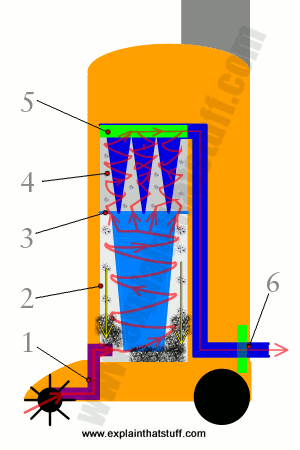
- ✦ Cyclone chamber
This chamber makes the incoming dirty air spin at high speed and helps separate particles from the airflow.
- ✦ Dust bin
The bin stores the dirt and debris removed by the cyclone.
- ✦ Filters
Filters catch fine particles that the cyclone does not remove.
- ✦ Motor and fan
The motor drives the fan, which creates the pressure difference that moves air through the vacuum.
Cyclonic Does Not Mean Filterless
A common mistake is to think that a cyclone removes every particle from the air. It does not. Very fine dust can stay suspended in the airflow, so most cyclonic vacuums still use filters.
The cyclone mainly takes care of larger and heavier particles. The filters handle finer material. This combination lets the vacuum collect dirt while protecting the motor and helping control fine dust.
How Does a Cyclonic Vacuum Cleaner Work Step by Step?
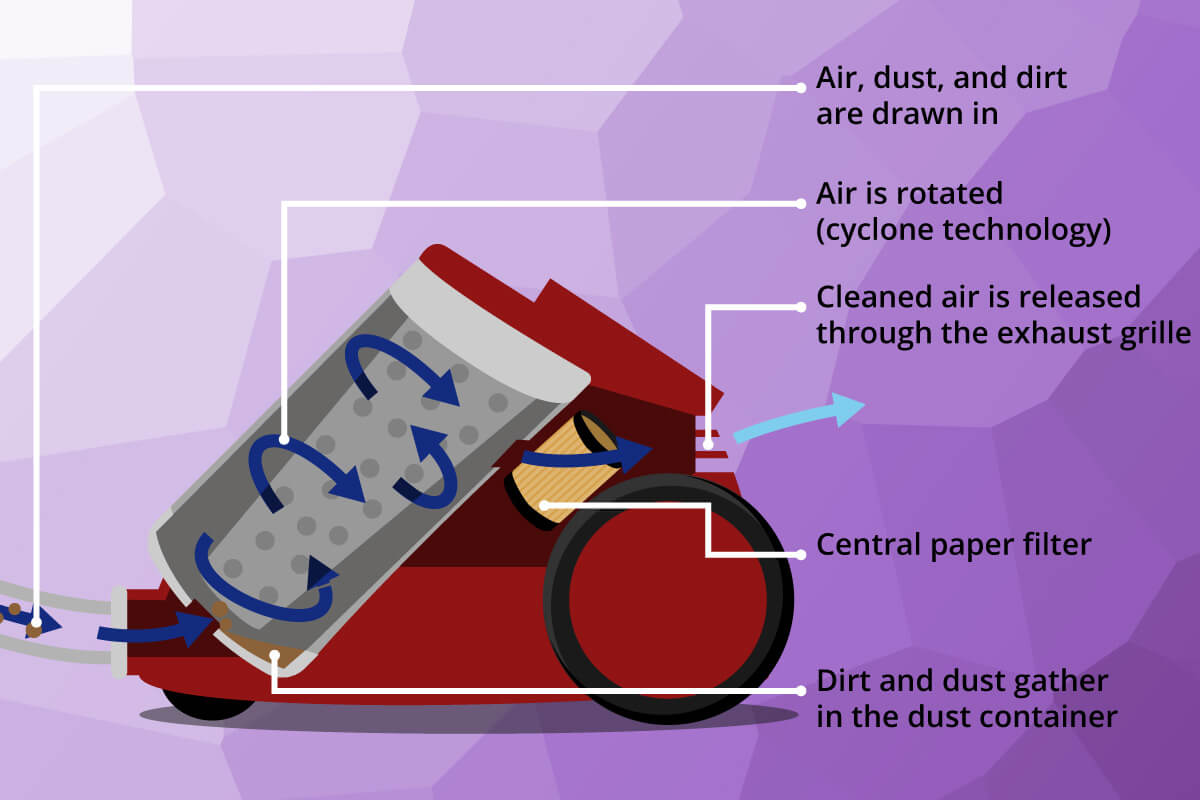
The easiest way to understand how does a cyclonic vacuum cleaner work is to follow one load of dirty air through the machine. The process starts at the floor head or cleaning tool. The vacuum pulls air, dust, hair, crumbs, and other debris into the machine.
That dirty airflow then enters the cyclone chamber. The chamber changes the direction of the airflow and makes it spin rapidly. This creates a strong swirling motion that separates many solid particles from the moving air.
After separation, the heavier dirt drops into the dust bin. The air continues through the next part of the system, where filters remove finer particles. Finally, the cleaned air passes through the motor area or exhaust path and returns to the room, depending on the vacuum design.
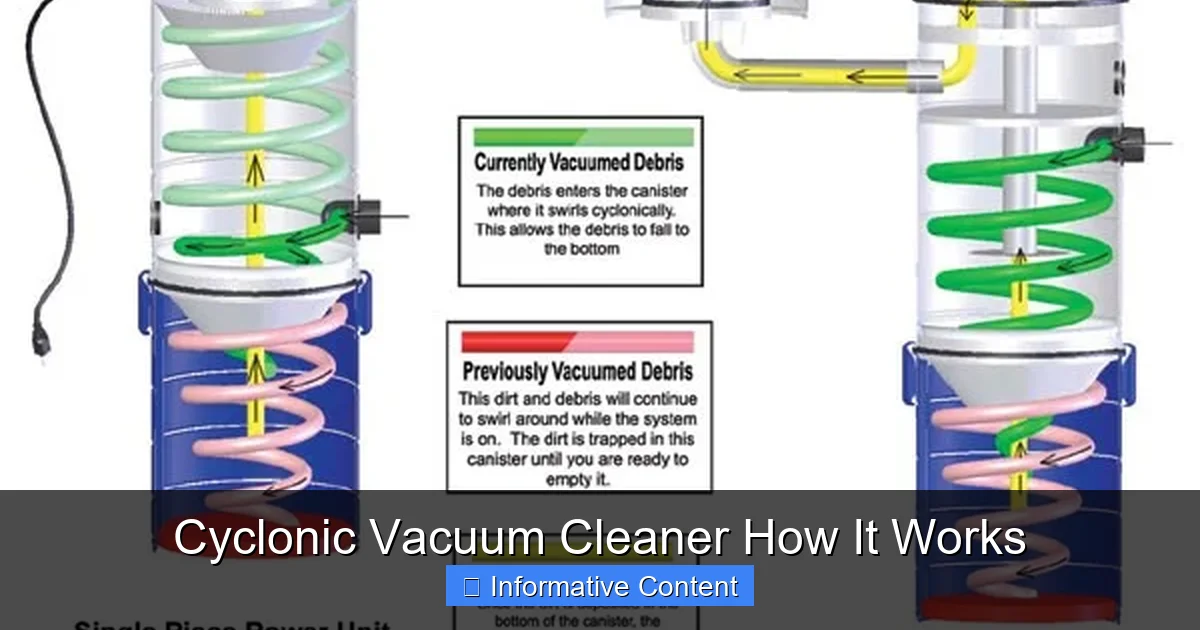
- ✦ 1. Air enters
The vacuum pulls room air and loose debris through the cleaning head and hose.
- ✦ 2. Air starts spinning
The cyclone chamber directs the dirty airflow into a fast circular path.
- ✦ 3. Dirt separates
Centrifugal force pushes many heavier particles toward the outside of the cyclone.
- ✦ 4. Dirt falls
Separated debris drops out of the moving airflow and collects in the bin.
- ✦ 5. Fine dust is filtered
The remaining air passes through filters that capture smaller particles.
- ✦ 6. Air exits
Filtered air leaves through the vacuum’s exhaust system.
Step 1: The Vacuum Creates Airflow
The electric motor turns a fan at high speed. The fan creates a pressure difference inside the vacuum. Air then moves from the higher-pressure area outside the machine toward the lower-pressure area inside it.
This airflow carries loose material from the floor. Strong suction depends on the whole airflow path, not just the motor. A blocked hose, full bin, poor seal, or dirty filter can reduce the amount of air the vacuum moves.
Step 2: Dirty Air Enters the Cyclone
The incoming air enters the cyclone chamber in a way that encourages circular motion. The chamber shape and inlet design help create the vortex.
As the air spins, particles experience forces that make them move away from the center. Larger particles respond more strongly to this motion than very small particles.
Step 3: Dirt Moves Away From the Air Core
The cyclone creates a fast-moving outer flow and a central flow. Many heavier particles move toward the outer wall because of the spinning motion. They then lose enough speed to fall into the collection area.
This is the main reason the answer to how does a cyclonic vacuum cleaner work is closely tied to centrifugal force. The vacuum uses the motion of air to separate solids without needing a traditional disposable bag for the main collection stage.
Step 4: Cleaner Air Leaves the Cyclone
Once much of the dirt has been removed, the air changes direction and travels toward the outlet. Fine dust may still remain, so the air does not simply bypass the filtration system.
The exact path depends on the model. Multi-cyclone systems may repeat the separation process several times before the air reaches the final filter.
What Role Does Centrifugal Force Play?
Centrifugal force is central to how does a cyclonic vacuum cleaner work. When air and particles move in a circle, the particles tend to move outward relative to the center of that curved path. The cyclone uses this behavior to separate solid material from air.
Think about water in a spinning bucket. The water moves around the bucket instead of staying in the middle. A cyclone uses a similar idea with air, although the airflow is much more controlled and the goal is to separate particles.
Particle size and weight matter. Large, dense particles are easier to separate than very small, light particles. That is why a cyclone works with filters rather than replacing filtration completely.

- ✦ Particle size
Larger particles are generally easier for the cyclone to separate from the airflow.
- ✦ Particle density
Heavier particles respond more strongly to the forces created by rapid circular motion.
- ✦ Air speed
The speed and shape of the airflow affect how well the cyclone can separate particles.
- ✦ Cyclone design
The chamber shape, inlet, outlet, and internal flow path all affect separation.
Why Fine Dust Is Harder to Separate
Fine dust has very little mass. It can follow the moving air instead of moving outward and dropping into the bin. This makes fine-particle filtration an important second stage.
A well-designed vacuum uses the cyclone and filters together. This layered approach helps the machine collect both visible debris and much smaller dust particles.
Single-Cyclone vs. Multi-Cyclone Vacuums
Not every cyclonic vacuum uses the same cyclone layout. A single-cyclone design uses one main separation chamber. A multi-cyclone design uses several smaller cyclones, often arranged together.
The goal of multiple smaller cyclones is to improve separation of finer particles before the air reaches the filter. The exact performance depends on the vacuum’s airflow design, seals, cyclone geometry, filters, and cleaning head.
When asking how does a cyclonic vacuum cleaner work, the basic principle stays the same in both designs. The difference is how the manufacturer manages the airflow and how many separation stages it provides.
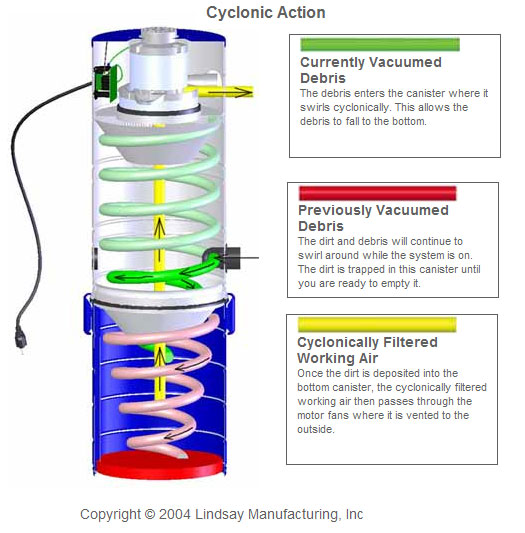
- ✦ Single cyclone
Uses one main cyclone chamber to separate dirt from the airflow.
- ✦ Multi-cyclone
Uses several smaller cyclones to provide additional particle separation.
- ✦ Filter stage
Both designs can still require filters to capture fine particles.
Why Manufacturers Use Multiple Cyclones
Smaller cyclone chambers can create different airflow conditions than one large chamber. A multi-cyclone system can therefore target smaller particles before they reach the final filter.
This does not mean every multi-cyclone vacuum will perform the same way. The entire airflow system matters, including the cleaning head, seals, bin, filters, and exhaust path.
How the Dust Bin and Filters Work Together
The dust bin is where separated debris ends up. Because the cyclone removes much of the dirt before the air reaches the filter, the filter does not have to catch all of the larger material.
Filters then provide the second line of defense. A pre-filter may protect the motor, while a final filter can capture much finer particles before the exhaust air leaves the machine.
This explains an important part of how does a cyclonic vacuum cleaner work: **separation and filtration are different jobs**. The cyclone removes many particles through airflow physics, while the filter traps particles that remain.

- ✦ Dust bin
Holds the larger debris removed by the cyclonic separation stage.
- ✦ Pre-filter
Can protect the motor and other internal parts from finer dust.
- ✦ Final filter
Captures remaining fine particles before air exits the vacuum.
- ✦ HEPA filter
Some vacuums use a HEPA filter as a final filtration stage for very small airborne particles.
Why Filter Care Matters
A dirty filter can restrict airflow. When airflow drops, the vacuum may feel weaker even though the motor still runs normally.
Filter care varies by model. Some filters can be washed, while others must stay dry or be replaced. Always follow the instructions for the specific vacuum.
What Happens When the Bin Gets Full?
A full bin can reduce the space available for separated debris and may affect airflow. Fine dust can also become harder to manage when the collection area is packed.
Emptying the bin before it becomes heavily packed is a simple way to keep the airflow path clear. It also reduces the chance of dust spilling back into the room during disposal.
Why Cyclonic Vacuums Can Maintain Airflow
One reason cyclonic designs became popular is their ability to separate much of the dirt before it reaches the main filter. In a traditional design, a collection bag or filter may handle a large share of the incoming debris. As that collection material fills, airflow can change.
A cyclonic system shifts much of the collection work into the cyclone and dust bin. This can help keep the filter from becoming loaded with larger debris. However, cyclonic separation does not guarantee constant suction.
The practical answer to how does a cyclonic vacuum cleaner work therefore includes the full airflow system. The cyclone, filters, seals, hose, brush roll, bin, and motor must all work together.
- ✦ Less large debris on the filter
The cyclone removes much of the heavier material before it reaches the filter.
- ✦ Separate collection area
Dirt collects in a bin instead of filling a conventional disposable vacuum bag.
- ✦ Airflow still matters
A blocked hose, dirty filter, or poor seal can still reduce vacuum performance.
Cyclonic Separation Does Not Create Suction by Itself
The cyclone is mainly a separator. The motor and fan create the pressure difference that drives airflow through the machine.
This distinction helps explain why a vacuum can have a sophisticated cyclone but still perform poorly when its filter is blocked or its hose is clogged. Good cleaning depends on the whole system.
Benefits of Cyclonic Vacuum Cleaners
Cyclonic vacuums offer several practical benefits for everyday cleaning. They can collect dust without a traditional disposable bag and use airflow to separate much of the debris before final filtration.
For many U.S. households, a clear or easy-to-open dust bin also makes it simple to see when the vacuum needs emptying. This can be useful when cleaning homes with pets, children, carpets, or high-traffic floors.
Still, the benefits depend on the design and maintenance of the individual machine. Understanding how does a cyclonic vacuum cleaner work helps you see both what the technology can do and where its limits begin.
- ✦ Bagless collection
Many cyclonic vacuums collect debris in a reusable dust bin instead of a disposable bag.
- ✦ Strong particle separation
The cyclone can remove many larger particles before they reach the filters.
- ✦ Visible dirt level
A clear bin lets you see how much debris the vacuum has collected.
- ✦ Reusable components
Some models use washable bins and filters, which can reduce the need for disposable collection bags.
- ✦ Useful for daily cleaning
The design works well for routine pickup of dust, crumbs, hair, and other common household debris.
Limitations and Common Problems
Cyclonic technology is not a magic solution. A vacuum can still lose performance when airflow is blocked, filters become dirty, the bin is packed, or seals allow air to leak.
Emptying a bagless bin can also release dust into the air if it is opened or handled carelessly. People who are sensitive to dust may prefer a design that allows cleaner disposal.
Another issue is maintenance. Even when the cyclone does most of the particle separation, filters still need attention. The exact cleaning and replacement schedule depends on the model.
- ✦ Filter blockage
Fine dust can build up on filters and restrict airflow.
- ✦ Clogged hose or head
Hair, fibers, and large debris can block narrow airflow paths.
- ✦ Full dust bin
A packed collection bin can interfere with normal airflow and separation.
- ✦ Dust during emptying
Opening a dry dust bin can release collected particles unless it is handled with care.
- ✦ Seal leaks
Damaged seals or poorly fitted parts can let air bypass the intended airflow path.
Why a Cyclonic Vacuum May Suddenly Lose Suction
If suction drops, start with the simple checks. Empty the bin, inspect the hose and cleaning head, and check the filters. A blocked brush roll can also affect cleaning even when the main airflow remains open.
If these checks do not solve the problem, inspect the vacuum according to its manual. Avoid opening electrical or motor components unless the manufacturer says it is safe to do so.
How to Maintain a Cyclonic Vacuum Cleaner
Good maintenance keeps the airflow path open and lets the cyclone work as designed. The most useful routine is simple: empty the bin, check for clogs, clean approved filters, and inspect the cleaning head.
Do not assume every filter can be washed. Some filters need dry cleaning or replacement. Water on a filter that should stay dry can damage the filter or create problems inside the vacuum.
If you want to get the best from a cyclonic vacuum, think about airflow from the floor all the way to the exhaust. Every part of that path matters to how does a cyclonic vacuum cleaner work.
- ✦ Empty the bin
Remove collected debris as directed by the manufacturer and avoid overfilling the container.
- ✦ Check for clogs
Inspect the floor head, hose, wand, and other accessible airflow paths.
- ✦ Clean the filters
Follow the model’s instructions for washing, brushing, drying, or replacing each filter.
- ✦ Clean the brush roll
Remove wrapped hair and fibers when the design allows safe access to the brush roll.
- ✦ Inspect seals
Check for damaged or loose parts that could allow unwanted air leaks.
A Simple Maintenance Routine
After heavy cleaning, check the bin and floor head. If you vacuum pet hair often, inspect the brush roll more frequently because long hair can wrap around moving parts.
Use the manufacturer’s instructions for filter care and service. A few minutes of routine maintenance can help prevent airflow problems and keep the vacuum ready for the next cleaning job.
Cyclonic Vacuum vs. Traditional Bagged Vacuum
Cyclonic and traditional bagged vacuums use the same basic goal: move air through the machine while collecting dirt. Their collection and separation methods differ.
A bagged vacuum stores collected debris in a bag that also plays a role in filtration. A cyclonic bagless vacuum sends dirty air through a cyclone first, then stores separated debris in a bin and uses filters for finer particles.
Neither design works in exactly the same way across every model. Motor design, airflow, cleaning head, filtration, seals, and maintenance all affect real-world performance.
- ✦ Collection
Cyclonic bagless models usually collect separated debris in a dust bin, while traditional models use a bag.
- ✦ Primary separation
Cyclonic models use spinning airflow, while bagged designs rely heavily on the bag and filter system.
- ✦ Maintenance
Cyclonic models need bin and filter care, while bagged models need timely bag replacement and filter care.
- ✦ Dust disposal
A bagged system can contain collected dust inside the bag, while an open dust bin may expose the user to more dust during emptying.
Does a Cyclonic Vacuum Work Well for Pet Hair and Fine Dust?
A cyclonic vacuum can be useful for homes with pets because the cyclone can separate larger debris such as hair and dirt before the airflow reaches the filter. However, the cleaning head also matters because brush design affects how well hair is lifted from carpets and floors.
Fine dust is a different challenge. Very small particles can stay with the airflow, so the filter system remains important. If fine dust loads the filter, airflow may fall and the vacuum can feel weaker.
When considering how does a cyclonic vacuum cleaner work for pet hair, look beyond the cyclone label. Check the brush roll, airflow path, bin design, filter system, and instructions for hair removal.
- ✦ Pet hair
The cleaning head and brush roll play a major role in lifting hair from floors and carpets.
- ✦ Fine dust
Fine particles may bypass the cyclone and require effective filtration.
- ✦ Filter loading
Heavy fine-dust pickup can increase the need for filter maintenance.
- ✦ Hair clogs
Long hair can collect around brushes and narrow passages, so regular inspection is useful.
How to Choose a Cyclonic Vacuum Cleaner
If you are shopping for a cyclonic vacuum, do not focus on the word cyclonic alone. Look at the complete cleaning system and how well it fits your floors, home size, storage needs, and cleaning habits.
For a U.S. household, useful factors may include carpet type, hard floors, stairs, pet hair, dust sensitivity, corded or cordless operation, bin size, and filter maintenance. A compact model may be convenient for a small apartment, while a larger vacuum may suit a home with several carpeted rooms.
Understanding how does a cyclonic vacuum cleaner work also helps you read product claims with more care. A cyclone can improve particle separation, but it cannot compensate for poor airflow, a weak cleaning head, clogged filters, or bad seals.
- ✦ Floor type
Choose a cleaning head that suits your mix of carpet, rugs, tile, wood, or other flooring.
- ✦ Pet hair needs
Look for a brush system designed to manage hair if you have shedding pets.
- ✦ Filtration
Check what filters the vacuum uses and how they must be maintained or replaced.
- ✦ Bin design
Consider how easy the bin is to remove, empty, and clean.
- ✦ Maintenance
Choose a design whose filter and brush care fit your normal cleaning routine.
Look at the Whole Airflow System
The cyclone is only one part of the vacuum. A useful comparison should include the cleaning head, airflow path, dust bin, filters, motor, seals, and exhaust system.
This whole-system view is more useful than judging a vacuum by a single marketing term. It also makes it easier to understand why two cyclonic vacuums can feel different during everyday cleaning.