
How to Convert Air Compressor to Vacuum Pump: Safe DIY Guide
Some air compressors can produce useful vacuum by using their intake side as the suction port, but not every compressor is suitable for this job. Small diaphragm, rocking-piston, and certain oil-free pumps are the best candidates. A standard tank-mounted shop compressor may overheat, lubricate poorly, or fight its own pressure controls when used this way.
A compressor and vacuum pump perform closely related jobs. A compressor moves air from atmospheric pressure toward higher pressure, while a vacuum pump removes air from a sealed space and discharges it to the atmosphere. In both cases, a pump is moving gas from one side to another.
The practical difference is how the machine is designed to operate. Purpose-built vacuum pumps use seals, valves, lubrication, cooling, and clearances intended to keep working as inlet pressure falls. A conventional air compressor may not tolerate the same conditions.
For how to convert air compressor to vacuum pump, the safest approach is to use a compressor or pump whose manufacturer permits vacuum operation, attach the vacuum hose to its intake port, leave the discharge side unrestricted according to its design, and monitor vacuum with a gauge. Do not modify a pressure receiver or defeat the compressor’s safety controls.
Some commercial diaphragm pumps are actually sold as combination compressor/vacuum pumps. Depending on the model, the same pump can create positive pressure from its outlet or vacuum from its inlet. Their ratings show how different the two specifications can be: a pump may produce tens of PSI of positive pressure but only around 20–28 inHg of vacuum.
A converted compressor is generally best for rough vacuum, suction fixtures, vacuum clamping, small experiments, fluid transfer systems designed for vacuum, and similar low-to-moderate vacuum jobs. It is usually a poor substitute for a dedicated HVAC evacuation pump, refrigeration pump, resin-degassing pump, or laboratory vacuum pump.
Can an Air Compressor Work as a Vacuum Pump?
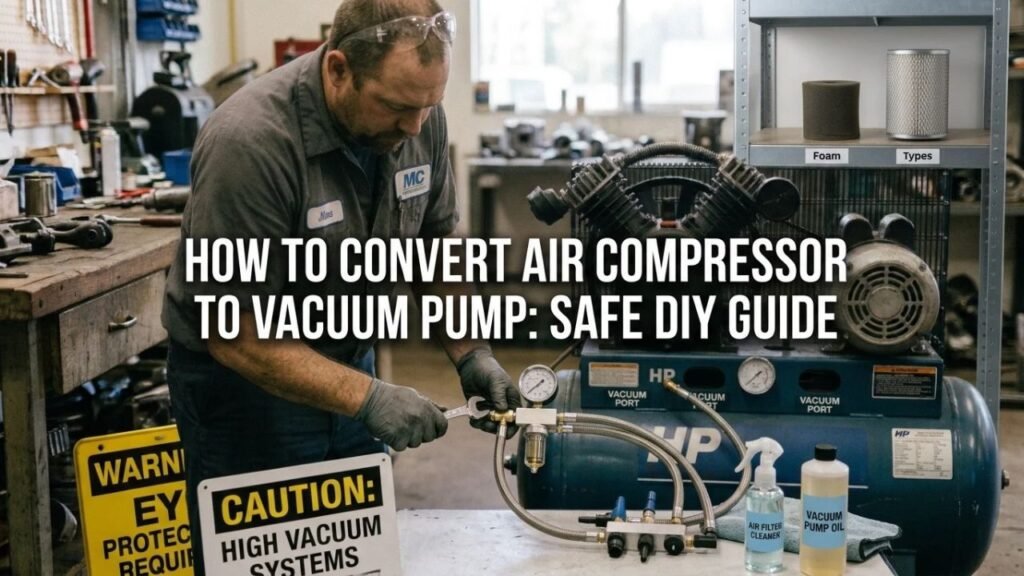
Yes, some air compressors can operate as vacuum pumps because they naturally create suction at their inlet.
The compressor draws air into its pumping chamber, compresses it, and pushes it out through the discharge port. If the intake is connected to a sealed container rather than open atmosphere, the pump begins removing air from that container.
Diaphragm Compressor/Pumps
Diaphragm pumps are among the easiest types to use for both pressure and vacuum.
A flexible diaphragm moves back and forth while check valves control airflow.
Some commercial units are specifically rated for both operations.
Depending on the model, a small diaphragm pump may reach around:
- 20 inHg vacuum
- 22 inHg vacuum
- 25 inHg vacuum
- 28 inHg vacuum
A dual-purpose unit is a much better candidate than modifying a compressor never intended to operate under vacuum.
Rocking-Piston Pumps
Rocking-piston designs can also be built for pressure, vacuum, or combined operation.
They are common in:
- Medical equipment
- Air sampling
- Laboratory equipment
- Vacuum hold-down systems
- Light industrial equipment
Check the model data sheet before using one as a vacuum source.
Conventional Reciprocating Air Compressors
A piston compressor used for a garage air system also creates suction at its intake.
That does not automatically make it a suitable continuous vacuum pump.
Possible limitations include:
- Intake port not designed for a sealed hose
- Poor lubrication under deep vacuum
- High discharge temperatures
- Tank pressure controls interfering with operation
- Long run times
- Valve leakage
- Motor duty-cycle limits
For a normal pancake, hot-dog, or 60-gallon shop compressor, converting the complete machine is rarely the best route.
Rotary Vane Pumps
Rotary-vane machines exist in both compressor and vacuum-pump forms.
Purpose-built vacuum versions use internal clearances, oil sealing, exhaust valves, and lubrication suited to low inlet pressure.
A dedicated rotary-vane vacuum pump can reach much deeper vacuum than a typical converted air compressor.
Key Takeaway: Compressors naturally create suction, but diaphragm and purpose-built combination pumps are the best candidates. A standard shop compressor may produce vacuum but may not be designed to operate that way safely or continuously.
What Vacuum Can a Converted Air Compressor Produce?
The answer depends heavily on pump type and condition.
Vacuum is commonly expressed as:
- Inches of mercury, or inHg
- Kilopascals below atmospheric pressure
- Absolute pressure
- Torr
- Microns for deeper vacuum work
At sea level, the theoretical maximum gauge vacuum is approximately 29.92 inHg.
No real pump can pull below absolute zero pressure, and ordinary converted compressors usually remain well above that limit.
Light-Duty Diaphragm Pumps
Many small dual-purpose diaphragm units reach roughly 20–28 inHg.
That can be suitable for:
- Vacuum clamping
- Suction cups
- Sample collection
- Small vacuum chambers
- Low-vacuum experimentation
It is not deep enough for every application.
Shop Compressor Conversion
A conventional compressor may pull a noticeable vacuum, but performance varies greatly.
Valve leakage, piston-ring leakage, intake seals, and crankcase design can stop vacuum from increasing beyond a modest level.
The pump may also become hotter as it runs for a long time trying to reach a vacuum it was never designed to achieve.
Dedicated HVAC Vacuum Pump
HVAC evacuation requires a much deeper vacuum than a crude compressor conversion normally produces.
Technicians measure deep HVAC vacuum in microns, not merely inHg.
A system may look close to 29 inHg on a basic gauge while still containing far too much air and moisture for proper refrigeration service.
Do not use a converted garage compressor as a substitute for an HVAC vacuum pump when evacuating an air-conditioning or refrigeration system.
Key Takeaway: A converted compressor may produce useful rough vacuum, but it normally cannot match a dedicated rotary-vane HVAC or laboratory pump for deep-vacuum work.
Which Air Compressors Are Good Candidates for Conversion?
Start by identifying the pump before buying fittings or hoses.
Best Candidates
Good candidates include units specifically described as:
- Compressor/vacuum pump
- Pressure/vacuum pump
- Reversible diaphragm pump
- Vacuum-capable rocking-piston pump
These already have vacuum specifications from the manufacturer.
You are not really redesigning the pump; you are using its intake for an intended function.
Possible Candidates
Some small oil-free piston compressors may create useful suction if their construction and manufacturer instructions permit it.
Before experimenting, confirm:
- Intake can be connected without obstructing cooling
- Pump can run continuously for the required time
- Lubrication does not depend on atmospheric intake conditions
- Discharge can remain safely open
- No control system is defeated
Poor Candidates
Avoid converting a compressor if it has:
- Unknown internal lubrication requirements
- Damaged valves
- Severe oil carryover
- Poor cooling
- Short duty cycle
- No accessible intake connection
- Integrated electronics that fault under unusual operation
- Manufacturer instructions prohibiting vacuum use
A large pressure compressor is not automatically a better vacuum pump.
Pump design matters more than horsepower or receiver size.
What You Need for a Basic Vacuum Setup
If the pump is approved or suitable for vacuum operation, the plumbing is simple.
Typical components include:
- Vacuum-capable pump
- Vacuum-rated hose
- Vacuum gauge
- Correct intake fitting
- Shutoff valve rated for vacuum
- Vacuum-rated chamber or equipment
- Intake filter if permitted
- Moisture trap when needed
Avoid ordinary containers that can collapse under atmospheric pressure.
Use Vacuum-Rated Hose
Standard soft air hose can flatten inward under vacuum.
A vacuum-rated hose has walls designed to resist collapse.
Choose a diameter large enough to avoid restricting flow.
Use a Vacuum Gauge
A gauge lets you see:
- How quickly vacuum builds
- Maximum vacuum reached
- Whether the system leaks
- Whether the pump is improving after maintenance
A general inHg gauge works for rough vacuum.
Deep-vacuum applications need a proper absolute-pressure or micron gauge.
Use a Vacuum-Rated Chamber
Vacuum creates an implosion hazard.
Atmospheric pressure pushes inward on the chamber from every direction.
Do not evacuate:
- Thin glass jars
- Unknown plastic containers
- Damaged tanks
- PVC pipe assemblies
- Pressure vessels not rated for external pressure
A tank safe for positive internal pressure is not automatically safe under external atmospheric pressure.
Key Takeaway: Use vacuum-rated hose, a gauge, and equipment designed for external pressure. Do not assume an air tank or household container is safe simply because it appears strong.
How to Convert Air Compressor to Vacuum Pump Step by Step
The procedure below applies to a small pump that is confirmed suitable for vacuum operation. It is not a recommendation to modify the receiver, safety valve, or pressure switch on a conventional shop compressor.
1. Identify the Intake and Discharge Ports
Turn the pump off and disconnect power.
Locate:
- Intake port
- Discharge port
The intake may normally have a small filter or muffler attached.
The discharge is the side where compressed air exits.
Check the manual or port markings rather than guessing from hose position.
2. Confirm Vacuum Capability
Before modifying plumbing, check the manufacturer’s technical information.
Look for a rating such as:
- Maximum vacuum: 20 inHg
- Maximum vacuum: 25 inHg
- Maximum vacuum: 28 inHg
If only pressure ratings are supplied and vacuum use is never mentioned, contact the manufacturer or choose a proper vacuum pump instead.
3. Remove the Intake Filter if the Design Allows It
Some combination pumps have a threaded intake filter that can be unscrewed and replaced with a hose fitting.
Do not remove an intake component if it also performs:
- Cooling
- Valve retention
- Noise control required for operation
- Internal sealing
Use only ports intended for accessories.
4. Install a Vacuum-Rated Fitting
Fit an adapter that matches the pump’s intake thread or hose barb.
Use a sealant approved for the fitting material and vacuum service when threaded connections require it.
Do not let sealant enter the pump.
Keep internal hose diameter reasonably large to reduce flow restriction.
5. Connect the Vacuum Hose
Attach vacuum-rated hose from the pump intake to the vacuum system.
A useful layout is:
Vacuum chamber → gauge → shutoff valve → moisture trap → pump intake
The exact order may change with the application.
A moisture trap is especially useful when there is any chance that liquid or vapor could reach the pump.
6. Keep the Pump Discharge Properly Ventilated
The air removed from the chamber has to leave somewhere.
For a dedicated combination pump used in vacuum mode, the discharge normally vents to atmosphere unless the manufacturer specifies another arrangement.
Do not cap the discharge.
Blocking both sides can overload or overheat the pump.
If the exhaust contains oil mist or hazardous vapor, the system needs the appropriate exhaust handling rather than simply venting into a workspace.
7. Start With the Vacuum Side Open to Atmosphere
Before connecting to a valuable process, run the pump briefly with the inlet arrangement installed but not yet evacuating a chamber.
Check for:
- Unusual noise
- Excessive vibration
- Loose fittings
- Overheating
- Oil leakage
Stop if the pump behaves abnormally.
8. Connect the Vacuum Load
Close the chamber and start the pump.
Watch the vacuum gauge as pressure falls.
A healthy sealed system should pull down steadily until it approaches the pump’s normal vacuum limit.
If vacuum rises slightly and then stops far below specification, check for leaks before blaming the pump.
9. Monitor Pump Temperature and Run Time
A compressor working under vacuum may run much longer than it did during intermittent pressure operation.
Check the manufacturer’s duty rating.
Stop if you notice:
- Burning odor
- Motor overload trip
- Abnormal heat
- Lubricant leakage
- Sharp increase in noise
- Smoke
Do not disable thermal protection to keep the pump operating.
10. Perform a Leak Test
Once the system reaches its best vacuum:
- Isolate the chamber with the vacuum valve.
- Switch the pump off.
- Watch the gauge.
If pressure rises quickly, the system has a leak or significant outgassing.
Check:
- Hose joints
- Chamber gasket
- Valve
- Gauge fitting
- Threaded adapters
Key Takeaway: On a vacuum-capable pump, conversion mainly means connecting the load to the intake and safely venting the discharge. Do not alter pressure safety controls or convert the compressor’s receiver into a vacuum chamber.
Why You Should Not Use the Compressor Tank as the Vacuum Chamber
The compressor receiver was designed primarily for pressure pushing outward from inside.
Vacuum reverses the load.
Atmospheric pressure pushes inward on the outside surface.
Positive Pressure and Vacuum Stress Are Different
A cylindrical air receiver can tolerate substantial internal pressure when designed and certified for that service.
Resistance to external pressure depends on:
- Wall thickness
- Diameter
- Shape
- Stiffening
- Corrosion
- Manufacturing design
A thin-walled vessel can buckle inward long before reaching a deep vacuum.
Rust Makes the Risk Worse
Air-compressor receivers collect water internally.
Over time, internal corrosion can reduce wall thickness.
Using an old pressure tank under an unapproved vacuum load adds another unknown.
Use a purpose-built vacuum vessel instead.
Why a Tank-Mounted Shop Compressor Is Awkward to Convert
A standard compressor package contains more than a pump.
Its controls are designed around building pressure in a receiver.
The Discharge Fills the Air Tank
If you connect a vacuum hose to the compressor intake but leave its normal plumbing untouched, air removed from the vacuum chamber is pumped into the receiver.
Receiver pressure rises.
Eventually the pressure switch shuts the compressor off even though the vacuum chamber may not have reached the desired vacuum.
Opening the Tank Drain Is Not a Proper Conversion
Some DIY approaches suggest leaving the receiver drain open so the pump can discharge continuously.
That can create noise, heat, contamination, and control issues and may violate the manufacturer’s operating instructions.
It also does nothing to solve lubrication and cooling limitations under vacuum.
Modifying the Pressure Switch Is Not the Answer
Do not bypass:
- Pressure switch
- Motor overload
- Safety valve
- Check valve
- Thermal protection
Those devices protect the compressor in its intended pressure operation.
If the package cannot operate as a vacuum source without defeating its safety system, choose a dedicated vacuum pump instead.
Key Takeaway: A complete shop compressor is built to fill its receiver, so its pressure switch and plumbing work against vacuum use. Modifying or bypassing those controls is not a sensible conversion.
Air Compressor vs Dedicated Vacuum Pump
A converted pump may save money for simple suction tasks, but a dedicated vacuum pump offers several advantages.
| Feature | Vacuum-Capable Compressor | Dedicated Vacuum Pump |
| Rough vacuum | Often suitable | Yes |
| Deep vacuum | Usually limited | Much better |
| HVAC evacuation | Usually unsuitable | Correct tool |
| Long vacuum run time | Model dependent | Designed for it |
| Vacuum gauge compatibility | Yes | Yes |
| Oil backstreaming | Depends on type | Depends on pump |
| Predictable vacuum rating | Only if specified | Yes |
| Simple suction applications | Good | Good |
When Conversion Makes Sense
A compatible compressor/pump can make sense for:
- Vacuum clamping
- Pick-and-place suction
- Small vacuum fixtures
- Laboratory air sampling
- Light vacuum forming
- Noncritical experiments
When to Buy a Real Vacuum Pump
Use a dedicated pump for:
- HVAC evacuation
- Refrigeration service
- Deep resin degassing
- Vacuum drying
- Vacuum distillation
- Laboratory work requiring known absolute pressure
- Long-duration vacuum processes
These jobs depend on vacuum depth, pumping speed, vapor handling, and contamination control.
Can a Refrigerator Compressor Be Used as a Vacuum Pump?
A refrigerator compressor can create vacuum on its suction side, which is why DIY projects sometimes use one.
That does not make it the best general-purpose conversion.
Refrigeration Compressors Rely on Oil and Refrigerant-System Conditions
Hermetic refrigeration compressors contain oil for lubrication.
Using one outside its intended refrigeration circuit can create:
- Oil mist
- Oil carryover
- Poor lubrication
- Overheating
- Contamination
- Electrical-starting issues
A used refrigeration compressor can also contain residual refrigerant and oil that should be handled correctly.
Do not cut open or vent a charged refrigeration system merely to obtain the compressor.
Vacuum Depth Is Not Guaranteed
Different refrigerator compressors produce different vacuum performance.
A homemade setup has no guaranteed ultimate vacuum unless you measure it.
For work where absolute pressure matters, a rated vacuum pump is a better choice.
Can You Use a Tire Inflator as a Vacuum Pump?
Most small tire inflators are poor candidates.
Their intake may not have a convenient sealed port, and they are designed for short high-pressure runs rather than sustained vacuum operation.
A purpose-built miniature diaphragm pump is usually inexpensive, quieter, and easier to connect.
Common Problems After Converting a Pump
If the setup produces little or no vacuum, check the simple causes first.
Vacuum Stops Around a Low Reading
Possible causes include:
- Hose leak
- Loose threaded fitting
- Leaking chamber seal
- Worn pump valves
- Incorrect pump direction
- Collapsing hose
- Pump not designed for deeper vacuum
Pump Gets Very Hot
Possible causes include:
- Continuous operation beyond duty rating
- Restricted discharge
- Poor ventilation
- Internal wear
- Incorrect voltage
- Pump unsuitable for vacuum service
Do not assume heat is normal just because the pump still runs.
Vacuum Drops After Shutdown
A falling vacuum may come from:
- Chamber leak
- Check-valve leakage
- Hose leakage
- Outgassing
- Pump leakage backward through valves
Use an isolation valve between the pump and chamber so you can distinguish chamber leakage from pump leakage.
Oil Appears in the Vacuum Line
Stop and determine where it is coming from.
Oil entering the vacuum side can contaminate the process and may indicate the compressor’s lubrication system is not suited to vacuum operation.
A trap can protect some applications, but it does not make an incompatible pump suitable.
Key Takeaway: Low vacuum usually comes from leaks, pump limits, collapsing hoses, or worn valves. Excessive heat or oil migration can indicate that the compressor is unsuitable for the job.
Safety Rules for a DIY Vacuum System
Vacuum equipment has different hazards from ordinary compressed-air equipment.
Protect Against Implosion
Use vessels rated for vacuum.
Wear eye protection when testing unfamiliar vacuum hardware and keep people away from questionable containers.
Keep Liquids Out of the Pump
A pump can be damaged if liquid is pulled into a mechanism designed only for air.
Use a trap if the application can draw:
- Water
- Resin
- Solvent
- Oil
- Condensate
Make sure the trap itself is vacuum rated.
Do Not Pump Flammable or Toxic Vapors
A normal air compressor motor, switch, or relay may produce sparks.
Do not use an improvised vacuum pump for flammable, explosive, corrosive, toxic, or oxygen-enriched gases unless the pump and entire system are specifically rated for that material.
Keep Cooling Airflow Clear
Do not enclose the pump in a box just to reduce noise.
Motors and pump heads depend on airflow to remove heat.
Use Electrical Protection
Keep:
- Grounding intact
- Overload protection functional
- Correct voltage
- Proper fuse or breaker
Do not bypass the motor overload if the pump trips while operating under vacuum.
Key Takeaway: The main DIY vacuum hazards are implosion, liquid ingestion, hazardous vapors, heat, and electrical faults. Use components designed for both the vacuum level and material being handled.
Conclusion
For how to convert air compressor to vacuum pump, the best method is to start with a compressor or pump that is already approved for vacuum operation. Connect a vacuum-rated hose and gauge to its intake, leave the discharge arranged as the manufacturer specifies, and operate within its rated vacuum and duty-cycle limits.
Small diaphragm and rocking-piston compressor/vacuum pumps work especially well for rough-vacuum jobs because many are designed from the start to operate in either mode.
A standard tank-mounted shop compressor is a much poorer candidate. Its receiver, check valve, unloader, pressure switch, lubrication system, and cooling are built around compressed-air service. Bypassing those systems just to obtain vacuum introduces unnecessary risk.
Use a dedicated vacuum pump when you need deep vacuum, HVAC evacuation, refrigeration work, long run times, controlled vapor handling, or a specific absolute pressure. The correct pump is usually easier to use and gives much more predictable results.
FAQs About Converting an Air Compressor to a Vacuum Pump
Can Any Air Compressor Be Used as a Vacuum Pump?
No.
Most compressors create some suction at the intake, but that does not mean they are rated for sustained vacuum operation. Check the manufacturer’s vacuum rating or technical information before connecting a sealed load.
Which Type of Air Compressor Makes the Best Vacuum Pump?
A diaphragm or rocking-piston unit specifically rated for both pressure and vacuum is one of the best choices.
These pumps often have convenient inlet and outlet fittings and published maximum-vacuum specifications.
How Much Vacuum Can an Air Compressor Pull?
It depends on pump design.
Small compressor/vacuum diaphragm pumps commonly have ratings around 20–28 inHg. A standard shop compressor may perform differently and may not have any approved vacuum rating.
Can I Use My 60-Gallon Air Compressor as a Vacuum Pump?
The pump will create suction at its intake, but converting the complete 60-gallon system is generally not a good approach.
The compressor is designed to discharge into its receiver and stop at its pressure setting. Do not bypass its pressure controls or use the receiver as an unapproved vacuum chamber.
Can I Use a Converted Air Compressor for HVAC Vacuum?
A typical conversion is not suitable for proper HVAC evacuation.
HVAC work needs deep vacuum measured in microns and a pump designed to remove air and moisture from refrigeration systems. Use a dedicated HVAC vacuum pump.
Should I Connect the Vacuum Hose to the Compressor Intake or Outlet?
Vacuum is taken from the intake side.
The outlet is where the pump discharges the air removed from the vacuum system. Never cap the discharge unless the pump manufacturer specifically calls for a closed or connected discharge arrangement.
Does a Bigger Air Compressor Pull More Vacuum?
Not necessarily.
Horsepower and CFM affect pumping speed, but maximum vacuum depends heavily on pump design, valve sealing, clearances, and leakage.
A small dedicated vacuum pump may reach a much deeper vacuum than a large shop air compressor.
Can I Use an Air Compressor Tank as a Vacuum Chamber?
Do not assume you can.
Pressure receivers are designed primarily for internal positive pressure. Vacuum creates external pressure that can buckle an unsuitable vessel inward. Use a chamber specifically rated for the vacuum level you intend to create.