DEWALT DCD985L2 20V MAX Hammerdrill/Driver Review: Complete Guide
The DEWALT DCD985L2 20V MAX Hammerdrill/Driver Kit is a heavy-duty cordless drilling system built for users who need more capability than a basic drill/driver. It combines conventional drilling, controlled screwdriving, and hammer drilling in one tool, backed by a three-speed all-metal transmission and a full-size 1/2-inch metal chuck.
DEWALT originally rated the DCD985L2 at 535 unit watts out (UWO), with no-load speed ranges of 0–575, 0–1,350, and 0–2,000 RPM. In hammer mode, it can produce up to 34,000 blows per minute (BPM). The original L2 kit included two 20V MAX 3.0Ah lithium-ion batteries, a charger, a 360-degree side handle, and a kit box.
Those specifications place the DCD985L2 well above a lightweight household drill. It was designed as a premium cordless hammerdrill capable of handling wood, metal, fasteners, and masonry-related drilling when paired with the proper accessories.
However, it is also an older generation of DEWALT cordless technology. Modern brushless hammer drills can provide more power in a smaller and lighter package, so evaluating the DCD985L2 today requires looking at more than its original specifications.
This guide examines the DEWALT DCD985L2, including its power, three-speed transmission, hammer action, chuck, clutch, battery system, drilling performance, advantages, limitations, and the types of users for whom it still makes sense.
DEWALT DCD985L2 20V MAX Hammerdrill/Driver Overview
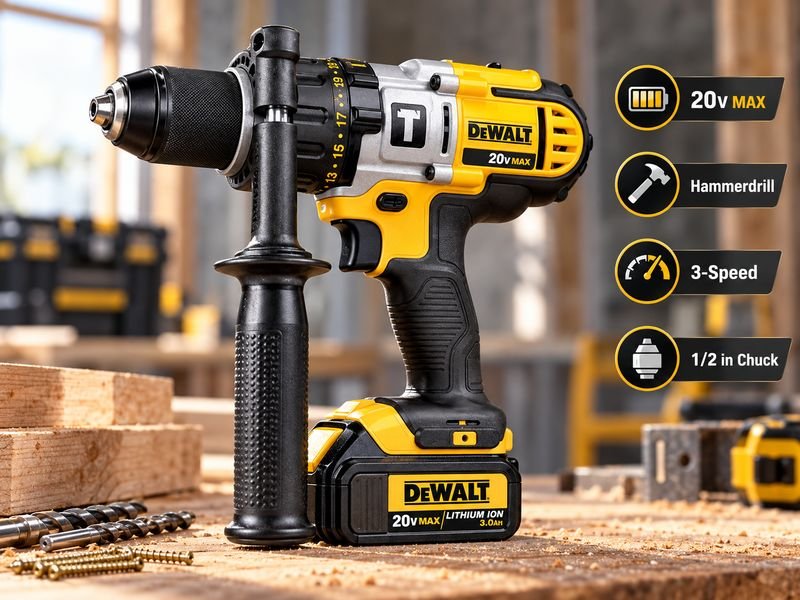
The DEWALT DCD985L2 20V MAX Hammerdrill/Driver Kit is a cordless three-mode tool.
It can operate as a:
- Drill
- Screwdriver
- Hammer drill
A separate mode collar lets the operator select the appropriate function. In screwdriving mode, the adjustable clutch controls fastening torque. In normal drilling and hammer-drilling modes, the clutch is bypassed so the tool can deliver its available drilling power continuously.
The DCD985L2 also differs from many ordinary cordless drills by using a three-speed mechanical transmission instead of two speeds.
That gives the operator greater control over the relationship between rotational speed and available torque.
Read More: BLACK+DECKER LDX220SB 20V Drill: Specs, Pros & Cons
Key Specifications
| Specification | DEWALT DCD985L2 |
| Tool Type | Cordless hammerdrill/drill/driver |
| Battery Platform | 20V MAX lithium-ion |
| Maximum Power | 535 UWO |
| Transmission | 3-speed all-metal |
| Speed 1 | 0–575 RPM |
| Speed 2 | 0–1,350 RPM |
| Speed 3 | 0–2,000 RPM |
| Hammer Rate – Gear 1 | 0–9,775 BPM |
| Hammer Rate – Gear 2 | 0–22,950 BPM |
| Hammer Rate – Gear 3 | 0–34,000 BPM |
| Chuck Size | 1/2 inch |
| Chuck Type | Metal ratcheting with carbide inserts |
| Clutch Settings | 22 |
| Variable Speed | Yes |
| Work Light | LED with 20-second delay |
| Original Battery Capacity | 3.0Ah |
| Original Batteries | 2 |
| Side Handle | 360-degree |
| Listed Weight | About 5.2 lb with battery |
| Original Charger | Fast/1-hour charger |
DEWALT’s period catalog lists the DCD985L2 as a 20V MAX Lithium-Ion Premium 3-Speed Hammerdrill Kit, confirming its 535 UWO output, three speeds, 34,000 maximum BPM, metal chuck, two 3.0Ah batteries, and 360-degree side handle.
How Powerful Is the DEWALT DCD985L2?
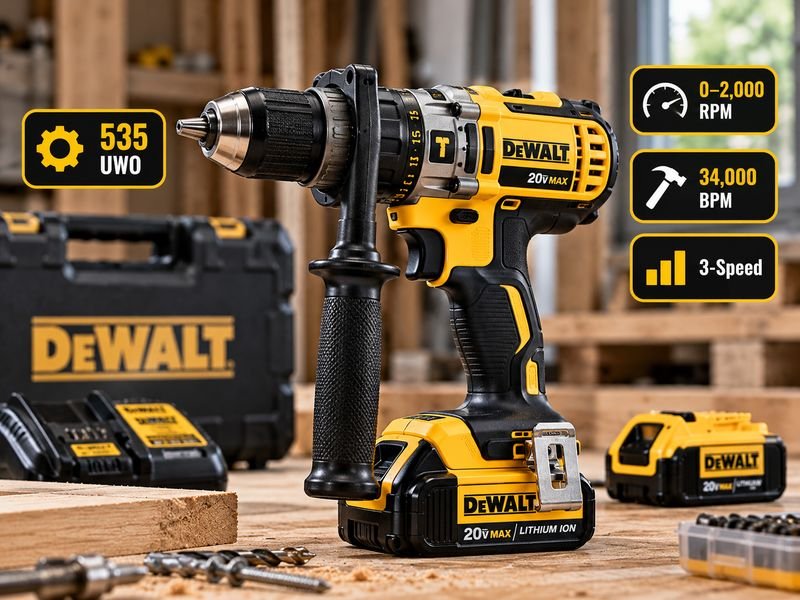
DEWALT rated the DCD985L2 at 535 unit watts out.
UWO, or unit watts out, is a DEWALT performance measurement combining rotational speed and torque at the tool’s output. It should not be treated as a direct torque specification in pound-inches, but it is useful when comparing drills from the same manufacturer’s generation.
At 535 UWO, the DCD985L2 was positioned as a high-power cordless hammerdrill rather than a compact DIY drill.
Its available power makes it appropriate for applications such as:
- Large wood-boring bits
- Hole saws
- Structural screw installation
- Metal drilling
- Spade bits
- Auger bits
- General construction drilling
- Masonry drilling with suitable carbide bits
- Heavy household repairs
- Professional installation work
Power alone does not determine performance, however.
The DCD985L2’s real advantage comes from combining its motor output with a three-speed gearbox, allowing the operator to select a more appropriate mechanical ratio for each application.
Read More: DEWALT DC720KA 18-Volt Drill: Full Specs, Pros, Cons & Value
Three-Speed All-Metal Transmission
One of the defining features of the DCD985L2 is its three-speed all-metal transmission.
The available ranges are:
Gear 1: 0–575 RPM
Gear 2: 0–1,350 RPM
Gear 3: 0–2,000 RPM
DEWALT specifically designed the three-speed transmission so the tool could be better matched to different jobs while balancing application speed and runtime.
First Gear: 0–575 RPM
The lowest gear emphasizes control and mechanical leverage.
It is generally best suited to:
- Large wood bits
- Large hole saws
- Heavy screwdriving
- High-resistance drilling
- Larger fasteners
- Applications where maximum speed is unnecessary
A lower gear lets the motor operate through a more favorable gear ratio when resistance increases.
This is particularly valuable when using larger accessories that can place substantial load on the drill.
Second Gear: 0–1,350 RPM
The middle range offers a compromise between speed and torque.
It can be useful for:
- Medium-size drill bits
- General-purpose drilling
- Smaller hole saws
- Faster fastening
- Woodworking
- Metal drilling where 2,000 RPM would be excessive
The middle gear is one reason a three-speed hammerdrill can feel more versatile than a conventional two-speed model.
Third Gear: 0–2,000 RPM
The highest range is intended for jobs where application speed matters.
Typical uses include:
- Smaller drill bits
- Pilot holes
- High-speed wood drilling
- Smaller metal-drilling applications
- Hammer drilling with suitable smaller masonry bits
A maximum of 2,000 RPM remains competitive for many drilling applications even though the DCD985L2 is now a legacy model.
Read More: Bosch DDS181-02 18-Volt Drill/Driver Review: Full Buyer Guide
Hammer-Drilling Performance
The key difference between the DCD985L2 and a standard drill/driver is its hammer-drilling mode.
When hammer mode is selected, the tool combines normal bit rotation with rapid axial impacts.
The three hammer rates correspond to the three transmission speeds:
- 0–9,775 BPM
- 0–22,950 BPM
- 0–34,000 BPM
The maximum 34,000 BPM gives the drill the rapid percussion action needed to help a carbide masonry bit break up hard material while its cutting edges rotate.
What Can the Hammer Mode Drill?
With an appropriate masonry bit, the DCD985L2 can be used for tasks involving materials such as:
- Brick
- Masonry block
- Mortar
- Certain concrete drilling applications
It can be useful for installing:
- Masonry anchors
- Wall fixtures
- Shelving brackets
- Concrete screws
- Electrical hardware
- Construction fasteners
The hammer function does not turn the DCD985L2 into a rotary hammer, however.
A rotary hammer uses a much stronger pneumatic or electromechanical impact mechanism and is generally more efficient for larger or repeated concrete drilling.
The DCD985L2 is better viewed as a powerful multipurpose drill that can also handle periodic masonry work.
Drill, Screwdriver, and Hammerdrill Modes
The DCD985 uses a dedicated mode-control collar to switch between its three major operating functions.
Drill Mode
In drill mode, the clutch does not interrupt torque delivery.
This mode is appropriate for drilling:
- Wood
- Metal
- Plastic
- Other compatible materials
Screwdriving Mode
Screwdriving mode activates the adjustable torque clutch.
The operator can then choose among 22 clutch settings to control how much force is applied to the fastener. Period product literature confirms 22 clutch positions.
Hammerdrill Mode
Hammer mode engages the percussion mechanism for masonry work.
The instruction manual notes that the torque clutch does not disengage the tool while the mode selector is in either normal drilling or hammer-drilling mode.
Having these functions on separate controls is helpful because gear selection, operating mode, and fastening torque can each be adjusted independently.
22-Position Adjustable Clutch
The 22-position clutch makes the DCD985L2 considerably more versatile as a screwdriver.
Clutch settings determine the amount of rotational resistance required before the clutch begins to slip.
A lower setting is useful when working with:
- Small screws
- Cabinet hardware
- Thin material
- Delicate assemblies
Higher settings are appropriate for:
- Larger wood screws
- Heavier hardware
- Long fasteners
- Denser materials
DEWALT’s instructions explain that increasing the number on the torque collar increases the amount of torque available and allows larger fasteners to be driven.
The advantage is control.
Instead of driving every screw with the tool’s full output, the clutch can stop further tightening once a predetermined resistance level is reached.
That helps reduce:
- Stripped screw heads
- Damaged driver bits
- Overdriven screws
- Crushed material
- Broken fasteners
Heavy-Duty 1/2-Inch Metal Ratcheting Chuck
The DCD985L2 uses a 1/2-inch metal ratcheting chuck with carbide inserts.
DEWALT promoted the carbide inserts as a way to improve bit-gripping strength, particularly under demanding loads.
This is an important feature on a high-output hammerdrill.
When a large bit encounters substantial resistance, a weak chuck can allow the bit shank to slip.
The DCD985’s metal construction and ratcheting mechanism are better suited to demanding drilling than the lighter plastic-covered chucks found on many entry-level drills.
The 1/2-inch capacity also accepts a broad range of drilling accessories, including many larger bits that would not fit a 3/8-inch chuck.
Performance in Wood
The DCD985L2 has a strong feature set for wood drilling.
The three-speed transmission allows the operator to select lower gearing for large-diameter accessories and higher speeds for smaller bits.
Potential applications include:
- Framing lumber
- Deck construction
- Cabinetry
- Remodeling
- Large pilot holes
- Spade-bit drilling
- Auger drilling
- Hole-saw work
- General woodworking
For large bits, the 360-degree auxiliary handle becomes especially important.
A large wood bit can bind suddenly. When that happens, the reaction torque can attempt to rotate the drill itself instead of the bit.
DEWALT’s manual specifically emphasizes using the side handle to maintain control if an accessory binds or the drill stalls.
Metal Drilling Capability
The DEWALT DCD985L2 hammerdrill/driver can also handle metal drilling when fitted with an appropriate bit.
Its variable-speed trigger and three transmission ranges make it easier to adjust drilling speed to suit:
- Steel
- Aluminum
- Metal brackets
- Sheet metal
- Fabrication projects
Metal drilling frequently benefits from lower rotational speeds as bit diameter increases.
This is where having a dedicated middle and low range becomes useful.
Using the correct cutting speed, a sharp bit, controlled pressure, and suitable cutting lubricant when required can make a substantial difference in both drilling speed and drill-bit life.
Screwdriving and Fastening Performance
Although it is powerful enough for demanding drilling, the DCD985L2 also functions as a conventional cordless drill/driver.
The combination of:
- Variable speed
- 22 clutch settings
- Forward and reverse
- Three gearbox ratios
allows it to handle a broad range of fasteners.
Typical jobs include:
- Deck screws
- Construction screws
- Cabinet fasteners
- Furniture assembly
- Hardware installation
- General wood screws
- Remodeling work
However, it is worth distinguishing the DCD985L2 from an impact driver.
An impact driver uses rotational impacts to drive resistant fasteners and is often faster and easier to control when repeatedly installing long construction screws.
The DCD985L2 provides smoother continuous torque and a clutch, making it more versatile for precision screwdriving and drilling.
For demanding projects, the two tools often complement each other rather than directly replacing one another.
20V MAX Lithium-Ion Battery System
The original DCD985L2 kit included two 20V MAX 3.0Ah lithium-ion batteries.
This distinction matters because later DCD985 kits, including certain DCD985M2 configurations, were supplied with larger 4.0Ah batteries. The L2 version originally used 3.0Ah packs.
Lithium-ion technology provides several advantages over the older Ni-Cd battery systems that preceded DEWALT’s 20V MAX platform:
- Lower weight for comparable stored energy
- Better energy density
- Reduced self-discharge
- No traditional Ni-Cd memory-effect concerns
- Easier battery management
It is also important to understand DEWALT’s voltage terminology.
20V MAX refers to maximum initial battery voltage without load. The nominal operating voltage is 18V. This is normal for DEWALT 20V MAX packs and does not indicate that the battery is defective or mislabeled.
Two Batteries Are a Practical Advantage
Supplying two batteries made sense for a tool intended for demanding professional work.
One battery can operate the drill while the second charges.
This reduces downtime compared with a one-battery kit, especially during repetitive drilling.
Battery runtime still depends heavily on the application.
Drilling small pilot holes places far less demand on a battery than:
- Large hole saws
- Large auger bits
- Repeated masonry drilling
- High-load fasteners
Battery age is especially relevant when buying a DCD985L2 today.
An original 3.0Ah battery may have substantially less usable capacity after years of charging cycles and storage.
LED Work Light With 20-Second Delay
The DCD985L2 includes an integrated LED work light above the trigger.
The light activates with the trigger and remains illuminated for approximately 20 seconds after the trigger is released.
That delay is useful because it keeps the work surface visible briefly after drilling stops.
Potential situations include:
- Inside cabinets
- Between framing members
- Under workbenches
- Utility rooms
- Dim construction areas
- Mechanical spaces
It is a simple feature, but one that can make positioning the drill significantly easier in poorly illuminated areas.
360-Degree Side Handle
The original kit includes a 360-degree auxiliary side handle.
This is not merely a convenience accessory.
A high-powered drill can produce substantial reaction torque when a large bit binds.
The auxiliary handle can be rotated to suit different working positions and allows the operator to control the tool with both hands.
It is particularly useful for:
- Hole saws
- Large auger bits
- Large spade bits
- Hammer drilling
- High-load drilling
- Working at unusual angles
For demanding drilling, using the side handle is a significant safety and control advantage.
Size and Weight
Period specifications list the DCD985L2 at approximately 5.2 pounds with its original battery configuration.
That weight reflects its heavy-duty construction.
It includes:
- A substantial gearbox
- Metal chuck
- Hammer mechanism
- Large 3.0Ah battery
- High-output motor system
The tradeoff is that the DCD985L2 feels heavier than modern compact drills.
For occasional demanding drilling, the added mass can provide a solid feel.
During repetitive overhead work or all-day fastening, however, a newer lightweight brushless drill may reduce fatigue.
What Comes in the DCD985L2 Kit?
The original DEWALT DCD985L2 kit included:
- DCD985 hammerdrill/driver
- Two 20V MAX 3.0Ah lithium-ion batteries
- Charger
- 360-degree side handle
- Kit box
Period product documentation consistently lists this package configuration.
Because the model is now older, secondhand packages may not include every original component.
Check the actual contents before purchasing.
DEWALT DCD985L2 Pros and Cons
Pros
- Powerful 535 UWO output
- Three-speed all-metal transmission
- Maximum 2,000 RPM
- Maximum 34,000 BPM
- Dedicated hammer-drilling mode
- Normal drilling and screwdriving modes
- 22 clutch settings
- Heavy-duty 1/2-inch metal ratcheting chuck
- Carbide chuck inserts improve bit grip
- Variable-speed trigger
- Two original 3.0Ah lithium-ion batteries
- LED work light
- 20-second LED delay
- 360-degree auxiliary handle
- Compatible with DEWALT’s widely used 20V MAX battery platform
- Capable of demanding wood, metal, and occasional masonry drilling
Cons
- Heavy compared with modern compact drills
- Older motor and electronics technology
- Original batteries may now be significantly aged
- Bulkier than newer high-output hammer drills
- Not a replacement for a rotary hammer in heavy concrete work
- Impact driver is usually more convenient for repetitive heavy fastening
- Legacy model availability is primarily through remaining stock or used equipment
Best Uses for the DCD985L2
The DCD985L2 is most appropriate where one drill needs to handle several types of work.
Good applications include:
- Remodeling
- Construction
- Woodworking
- Deck building
- Metal drilling
- Cabinet installation
- Masonry-anchor installation
- Large hole drilling
- General repair work
- Heavy DIY projects
- Professional maintenance
Its biggest strength is versatility.
Rather than specializing in only one type of drilling, the tool combines high torque, high rotational speed, adjustable fastening control, and hammer action.
Who Should Consider the DCD985L2 Today?
Existing DEWALT 20V MAX Owners
Someone who already owns compatible DEWALT batteries may find a bare or used DCD985 very practical.
Battery-platform compatibility eliminates the need to build a separate charging system.
Users Who Need Three Mechanical Speeds
Many drills use only two gears.
The DCD985’s middle 1,350 RPM range provides an additional option between maximum torque and maximum speed.
Heavy DIY Users
Home renovation, deck construction, larger woodworking projects, and occasional masonry work can justify a more substantial drill than a compact household model.
Workshop Users
A DCD985 can remain useful as a secondary heavy-duty drill even if newer cordless tools are already available.
Who May Prefer a Newer Hammer Drill?
A current-generation model may make more sense for someone who prioritizes:
- Lower tool weight
- Smaller dimensions
- Brushless motor efficiency
- Newer electronic protection systems
- Greater power-to-weight ratio
- New batteries supplied with a warranty
- Modern LED placement and controls
Cordless drill technology has advanced significantly since the DCD985L2 was introduced.
Therefore, the question is not simply whether the DCD985L2 can still drill effectively—it can.
The more important question is whether its condition and price make sense compared with current alternatives.
What to Check Before Buying a Used DCD985L2
Battery Health
Old batteries are one of the biggest concerns.
Check for:
- Rapid discharge
- Charging errors
- Excessive heating
- Physical damage
- Very short runtime
Chuck Condition
Install a straight drill bit and run the tool slowly.
Look for abnormal wobble and verify that the ratcheting chuck tightens securely.
All Three Gears
Test all three transmission settings.
Each should engage positively without abnormal grinding or jumping out of gear.
Hammer Mode
Confirm that hammer action engages when selected.
Clutch
Run the drill in screwdriving mode through several torque positions and make sure the clutch operates progressively.
Trigger and Reverse Switch
The variable-speed trigger should respond smoothly.
Forward and reverse should engage reliably.
Gearbox Noise
A heavy-duty geared drill naturally makes mechanical noise, but grinding, severe rattling, or slipping can indicate wear.
Housing and Handle
Look for cracks around:
- Gearbox
- Chuck
- Main grip
- Battery interface
- Side-handle mount
Signs of repeated drops deserve additional attention.
Frequently Asked Questions About the DEWALT DCD985L2
What is the DEWALT DCD985L2?
The DEWALT DCD985L2 is a 20V MAX cordless three-speed hammerdrill/driver designed for drilling, screwdriving, and hammer drilling.
How powerful is the DCD985L2?
DEWALT rated it at 535 unit watts out (UWO).
How many speeds does the DCD985L2 have?
It has a three-speed transmission with ranges of 0–575, 0–1,350, and 0–2,000 RPM.
What is the maximum BPM?
The maximum hammer rate is 34,000 BPM in the highest gear.
How many clutch settings does it have?
The DCD985L2 has 22 clutch settings for controlled screwdriving.
What size chuck does the DCD985L2 use?
It uses a 1/2-inch metal ratcheting chuck with carbide inserts designed for strong bit retention.
What batteries came with the DCD985L2?
The original kit included two 20V MAX 3.0Ah lithium-ion batteries.
Is 20V MAX actually 20 volts during normal use?
20V MAX represents the battery’s maximum initial voltage without load. DEWALT specifies its nominal voltage as 18V.
Does the DCD985L2 work as a regular drill?
Yes. It includes a conventional drilling mode in addition to screwdriving and hammer drilling.
Can it drill concrete?
Its hammer mode allows it to drill masonry and suitable concrete applications with the proper carbide bit. Large or repeated concrete drilling is better handled by a rotary hammer.
Is the DCD985L2 an impact driver?
No. It is a hammerdrill/drill/driver. An impact driver uses a different rotational impact mechanism designed primarily for fastening.
Does it have an LED light?
Yes. The LED activates with the trigger and remains illuminated for around 20 seconds after trigger release.
How much does the DCD985L2 weigh?
Period specifications list approximately 5.2 pounds with the original battery configuration.
Final Verdict
The DEWALT DCD985L2 20V MAX Hammerdrill/Driver Kit was built as a premium, high-output cordless drill capable of covering far more than ordinary household screwdriving.
Its 535 UWO output, three-speed all-metal transmission, 0–2,000 RPM maximum speed, 34,000 BPM hammer action, 22-position clutch, and heavy-duty 1/2-inch metal ratcheting chuck give it the versatility needed for wood, metal, fasteners, and periodic masonry work.
The original kit was also well equipped, with two 20V MAX 3.0Ah lithium-ion batteries, a charger, a 360-degree side handle, and a carrying case.
Its biggest disadvantage today is age rather than basic capability.
The DCD985L2 is heavier and bulkier than many modern premium hammer drills, while newer brushless technology can offer a better combination of efficiency, output, and weight. Original batteries may also have lost substantial capacity after years of use.
Even so, a mechanically sound DCD985 remains a capable cordless hammerdrill/driver, especially for someone already invested in the DEWALT 20V MAX platform.
For drilling large holes, installing fasteners, working in wood and metal, and occasionally drilling masonry, its three-speed transmission remains particularly useful. The low gear provides control for demanding loads, the middle range adds flexibility, and the 2,000 RPM high gear supports faster drilling.
The DEWALT DCD985L2 therefore makes the most sense when its condition, battery setup, and purchase price are considered alongside its still-substantial performance. It may no longer represent DEWALT’s newest cordless technology, but its durable metal transmission, strong chuck, hammer function, adjustable clutch, and broad operating range continue to make it a versatile heavy-duty drill.