Rolair JC10 Review: Super-Quiet Portable Air Compressor
The Rolair JC10 is a compact, low-noise portable air compressor designed primarily for finish carpentry, trim installation, pneumatic nailers, inflation, workshop cleanup, and other applications that need moderate airflow without the harsh noise associated with many conventional compressors.
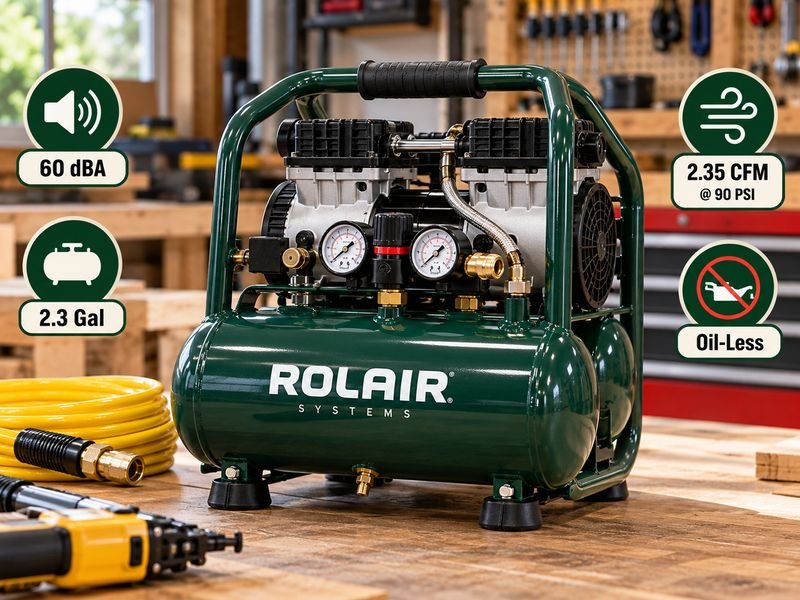
Quiet operation is the defining feature of the JC10. The original model is rated at only 60 dBA, while its twin-cylinder oil-free pump delivers approximately 3.8 CFM at 40 PSI and 2.35 CFM at 90 PSI. The original owner’s manual also lists a 1 HP motor, 120V electrical system, automatic thermal protection, 39-pound weight, and 2.3-gallon tank.
Some period product listings described the tank as approximately 2.5 gallons, so both figures appear in older material. The manufacturer manual’s 2.3-gallon figure is the more appropriate specification for the original JC10.
More importantly, this compressor was not designed to compete with large shop compressors. Its strengths are low noise, compact construction, low electrical demand, fast recovery, and enough airflow for intermittent pneumatic tools.
For finish carpenters, remodelers, woodworkers, and homeowners who frequently work indoors, those qualities can be more valuable than having a large tank or extremely high CFM output.
This Rolair JC10 review covers its motor, airflow, noise level, pump, tank, duty cycle, portability, nail-gun performance, limitations, maintenance requirements, and whether the older JC10 still makes sense today.
Rolair JC10 Specifications
| Specification | Rolair JC10 |
| Compressor Type | Portable electric air compressor |
| Motor | 1 HP |
| Voltage | 120V |
| Frequency | 60 Hz |
| Motor Speed | About 1,680–1,725 RPM |
| Delivered Air @ 40 PSI | 3.8 CFM |
| Delivered Air @ 90 PSI | 2.35 CFM |
| Pump Type | Oil-free / oil-less |
| Cylinders | 2 |
| Tank Capacity | 2.3 gal. manufacturer manual |
| Noise Level | 60 dBA |
| Running Current | About 8 amps |
| Thermal Protection | Automatic |
| Weight | Approx. 39 lb |
| Duty Cycle | 70% |
| Pump-Up Time | About 45 sec., 0–115 PSI |
| Recovery Time | About 11 sec., 85–115 PSI |
| Construction | Protective roll-cage design |
The specifications above are taken primarily from Rolair’s original JC10 documentation and period dealer material.
What Makes the Rolair JC10 Different?
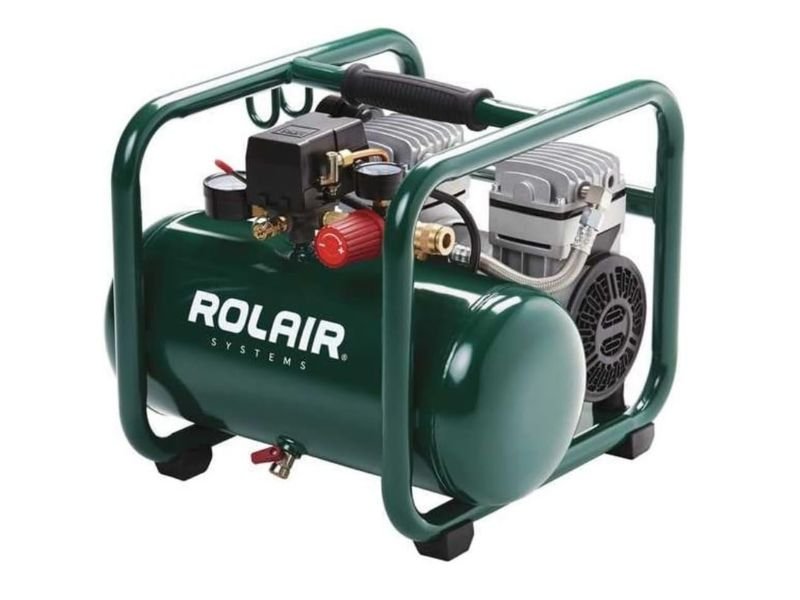
Plenty of small compressors can operate a finish nailer. The major difference with the Rolair JC10 air compressor is how quietly it does the job.
Small oil-free compressors often use relatively high-speed motors. High RPM helps keep the pump compact, but it can also generate significant mechanical noise.
The JC10 instead uses a low-speed twin-cylinder pump.
Manufacturer-era specifications place motor speed at roughly 1,680–1,725 RPM, allowing the compressor to deliver useful airflow while keeping its rated noise output around 60 dBA.
That makes the JC10 particularly useful in environments such as:
- Occupied homes
- Cabinet shops
- Interior trim projects
- Apartment renovations
- Small workshops
- Indoor remodeling
- Furniture work
A compressor does not have to be completely silent for reduced noise to matter. Lower compressor noise makes conversations, music, instructions, and communication on an indoor jobsite easier to hear.
How Quiet Is the Rolair JC10?
Rolair rates the JC10 at approximately 60 dBA.
That is unusually low for a traditional portable compressor from its era.
An independent Fine Homebuilding evaluation also described the JC10 as notably quiet during operation and reported that its compressor noise remained unobtrusive even at close range.
Noise level can vary depending on:
- The surface underneath the compressor
- Room acoustics
- Distance from the operator
- Compressor condition
- Vibrating hoses or fittings
- Nearby walls that reflect sound
Even so, 60 dBA operation remains one of the most important reasons the JC10 gained attention among trim and finish users.
The current Rolair JC10PLUS, which Rolair describes as the successor to the original JC10, retains the same 60 dBA design goal.
1 HP Low-Speed Motor
The JC10 uses a 1 HP electric motor running from standard 120V power.
Its running electrical draw is approximately 8 amps, which is relatively modest for a portable compressor.
A lower amp draw can be especially useful during remodeling and interior work.
For example, the same electrical circuit may also be supporting:
- Work lights
- Battery chargers
- Small saws
- Radios
- Other construction equipment
A compressor that demands a large amount of current can increase the likelihood of nuisance breaker trips.
The JC10’s relatively modest electrical demand makes it more practical on ordinary residential circuits, although the electrical supply must still meet the requirements in the owner’s manual.
2.35 CFM at 90 PSI
When evaluating an air compressor, CFM is one of the most important specifications.
CFM measures how much air the compressor can supply over time.
The Rolair JC10 provides:
3.8 CFM at 40 PSI
and approximately
2.35 CFM at 90 PSI.
The 90 PSI figure is particularly useful because many pneumatic tools are rated around this pressure.
A compressor’s maximum PSI alone does not tell you how well it can operate an air tool.
A small compressor might reach a high pressure but still have insufficient airflow to keep a high-demand pneumatic tool running continuously.
That is why Rolair itself recommends using delivered CFM at a specified pressure when determining whether a compressor is suitable for a particular tool.
Is 2.35 CFM Enough?
For the JC10’s intended applications, 2.35 CFM at 90 PSI is useful.
It is well suited to intermittent tools such as:
- Brad nailers
- Finish nailers
- Pin nailers
- Pneumatic staplers
- Upholstery staplers
- Tire inflators
- Blow guns used briefly
A nail gun uses a short burst of compressed air each time a fastener is fired.
Between shots, the compressor can replenish its tank.
Continuous-air tools are different.
Tools such as pneumatic sanders and grinders can consume compressed air continuously, often at rates significantly higher than 2.35 CFM.
Those tools can drain the JC10’s small tank faster than the pump can refill it.
Rolair JC10 Performance With Finish Nailers
Finish carpentry is one of the best applications for the Rolair JC10.
An independent Fine Homebuilding test operated two 15-gauge finish nailers from the compressor and reported consistent nail-driving performance. The test also found that the compressor’s quick recovery helped minimize interruption during trim work.
This matches the compressor’s specifications.
Finish nailers require relatively little air for each shot, so the combination of a small storage tank and 2.35 CFM at 90 PSI can support normal trim-installation workflows effectively.
Typical applications include:
- Baseboards
- Crown molding
- Door casing
- Window trim
- Cabinet installation
- Decorative molding
- Furniture
- Interior woodworking
The compressor’s low noise is particularly valuable in these applications because finish carpentry often takes place inside occupied buildings.
Can the Rolair JC10 Run a Framing Nailer?
The JC10 can operate some framing nailers intermittently, but continuous production framing is not its ideal job.
Fine Homebuilding’s test found that the compressor could power a framing nailer for limited work and delivered several full-size framing nails before the compressor needed to cycle.
However, that does not mean it should replace a larger framing compressor.
Framing work can involve rapid repetitive firing, especially during:
- Wall construction
- Roof framing
- Deck building
- Sheathing
- Large remodeling jobs
During sustained use, the small tank and 2.35 CFM airflow become limiting factors.
The JC10 makes more sense for occasional framing fasteners, punch-list work, and remodeling than for running a framing nailer continuously throughout the day.
Oil-Free Twin-Cylinder Pump
The Rolair JC10 uses an oil-free, two-cylinder pump.
An oil-free compressor offers several practical advantages:
- No pump-oil changes
- No routine oil-level checks
- Reduced maintenance
- No concern about oil spilling during transport
- Easier ownership for occasional users
- More convenient cold-weather startup
The twin-cylinder configuration also helps the compressor move useful amounts of air while operating at relatively low RPM.
Oil-free does not mean maintenance-free, however.
The tank still needs to be drained, the air intake kept clean, hoses inspected, and safety devices maintained.
Fast Pump-Up and Recovery
A small tank can actually provide an advantage when the compressor has enough pump output to refill it quickly.
The original JC10 manual lists approximately:
45 seconds from 0 to 115 PSI
and
11 seconds from 85 to 115 PSI.
Other later specifications and tests show slightly different pump-up and recovery figures, likely reflecting different pressure-switch settings and production revisions.
The key point is that recovery is relatively quick.
Fast recovery matters because the compressor does not remain running for long periods after normal finish-nailer use.
This contributes both to convenience and to the perception of quiet operation.
Small Tank: Advantage and Limitation
The JC10’s original manual specifies a 2.3-gallon tank, while some commercial listings rounded it to roughly 2.5 gallons.
A tank of this size keeps the compressor compact.
Benefits include:
- Smaller overall footprint
- Easier transportation
- Fast tank refill
- Easier storage
- Practical indoor use
But there is a tradeoff.
A small tank contains less stored compressed air than a 6-, 10-, or 20-gallon compressor.
That means high-consumption tools can cause pressure to drop quickly.
For nailers, this is usually not a serious disadvantage because each shot uses relatively little air.
For continuous tools, it becomes much more important.
70% Duty Cycle
One specification that distinguishes the JC10 from many basic homeowner compressors is its 70% duty-cycle rating.
Rolair’s compressor documentation specifically identifies the JC10 among its direct-drive models rated for a 70% duty cycle.
Duty cycle describes how much of a given operating period the compressor motor can safely spend running.
A 70% rating provides more operating time than many light-duty compressors built around shorter cycles.
This does not mean the motor should simply be allowed to run continuously without regard to temperature.
Rolair notes that extended operation can activate the compressor’s internal overload protection if operating limits are exceeded.
Automatic Thermal Protection
The original JC10 includes automatic thermal protection.
If the motor becomes excessively hot, overload protection can shut the compressor down.
Potential causes include:
- Excessive duty cycle
- Restricted ventilation
- Low voltage
- Undersized extension cord
- Excessive motor starting
- Mechanical problems
Thermal protection is an important safeguard, but repeated shutdowns should not be ignored.
If the overload activates frequently, the underlying operating or electrical problem should be identified.
Protective Roll Cage
The JC10 is surrounded by a substantial roll-cage frame.
The cage helps protect critical components such as:
- Motor
- Pump
- Gauges
- Regulator
- Tank fittings
- Pressure controls
This is particularly useful on jobsites where compressors are frequently transported between rooms, loaded into vehicles, and stored alongside other tools.
The downside is weight.
At approximately 39 pounds, the JC10 is heavier than some compact compressors with similar tank capacities.
Part of that additional mass comes from its robust motor and protective construction.
How Portable Is the Rolair JC10?
The JC10 is definitely a portable compressor, but it is not ultralight.
At about 39 pounds, moving it across a workshop or between nearby rooms is manageable for many users.
Carrying it repeatedly:
- Up stairs
- Across large jobsites
- Into attics
- Through several buildings
can become more tiring.
Its compact dimensions help compensate somewhat.
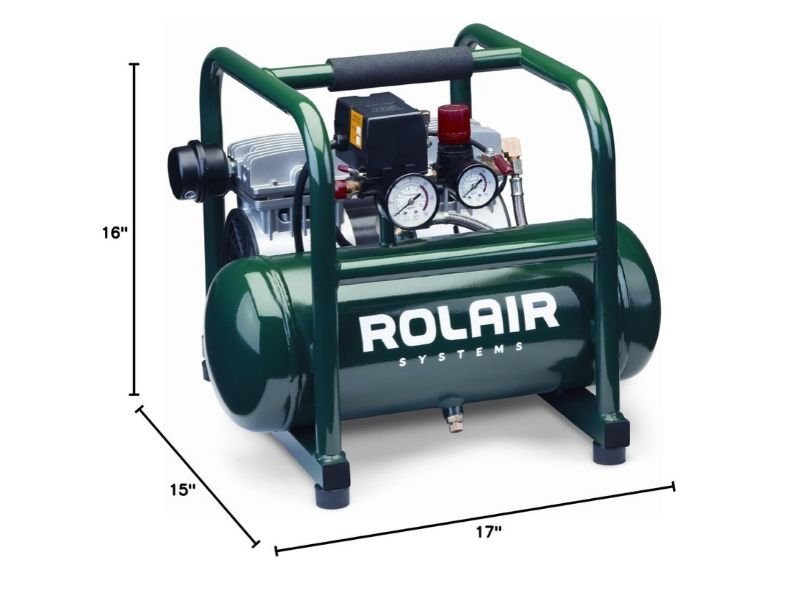
The original manual lists actual dimensions of approximately:
15-5/8 × 16-3/4 × 14-3/4 inches.
That means it can fit into relatively small storage spaces and vehicles.
For a shop where the compressor remains mostly stationary, the weight matters much less.
Regulator and Pressure Gauges
The JC10 includes the standard control components expected from a quality portable compressor:
- Tank-pressure gauge
- Regulated outlet gauge
- Pressure regulator
- Quick-connect outlet
- Safety-relief valve
The pressure regulator allows outlet pressure to be adjusted to match the pneumatic tool.
This is important because a nailer that requires 90 PSI should not simply receive maximum tank pressure.
Always set the working pressure according to the tool manufacturer’s instructions.
Ball-Valve Tank Drain
Compressed air contains moisture.
As the compressed air cools inside the receiver tank, some of that moisture condenses into liquid water.
The tank therefore needs to be drained regularly.
Period JC10 materials identify a drain system at the bottom of the tank, while the newer JC10PLUS uses a dedicated ball-valve tank drain.
Regular draining helps reduce internal corrosion.
This is especially important when evaluating an older JC10 today because years of poor drainage can cause hidden tank deterioration.
Is the Rolair JC10 Good for Tire Inflation?
Yes.
The JC10 is more than capable of ordinary tire inflation when used with a suitable tire chuck and pressure gauge.
It can be used for:
- Passenger-car tires
- Light-truck tires
- Trailer tires
- Lawn equipment
- Bicycle tires with suitable fittings
- Sports equipment
Remember that compressor tank pressure and tire pressure are completely different measurements.
Always inflate the tire according to the vehicle or tire manufacturer’s recommended cold pressure.
Can the JC10 Run an Impact Wrench?
This is not one of the JC10’s strongest applications.
Many pneumatic impact wrenches require substantially more sustained airflow than 2.35 CFM at 90 PSI.
The tank may provide enough stored air for a few short bursts, but pressure can fall rapidly.
For frequent automotive impact-wrench use, a compressor with substantially higher delivered CFM and a larger tank is generally a better choice.
Can It Run an Air Sander?
Most conventional pneumatic sanders consume air continuously.
A sander requiring 5, 8, or more CFM cannot be continuously supplied by a compressor producing 2.35 CFM at 90 PSI.
The tank might allow the tool to operate briefly, but the compressor will then struggle to restore pressure while the tool continues consuming air.
The JC10 should therefore be considered a nailer and intermittent-air-tool compressor, not a high-CFM shop compressor.
Rolair JC10 Pros and Cons
Pros
- Very quiet 60 dBA operation
- 1 HP motor
- Low-speed twin-cylinder design
- 3.8 CFM at 40 PSI
- 2.35 CFM at 90 PSI
- Oil-free pump
- 70% duty cycle
- Low 8-amp electrical draw
- Fast pump-up and recovery
- Automatic thermal protection
- Protective roll cage
- Compact footprint
- Excellent match for finish and brad nailers
- Useful for indoor renovation
- Minimal pump maintenance
Cons
- Approximately 39 pounds is relatively heavy for its tank size
- Small 2.3-gallon tank limits continuous-tool use
- Not designed for high-CFM pneumatic equipment
- Side-facing controls on the original design are less convenient than newer layouts
- Older/discontinued model
- Used-unit condition can vary significantly
- Not ideal for continuous framing or roofing production
- Larger shop tools need substantially more airflow
Rolair JC10 vs. JC10PLUS
Rolair now sells the JC10PLUS as the successor to the original JC10.
Rolair describes the JC10PLUS as the follow-up to its popular JC10 and highlights several improvements:
- Larger tank
- Stronger roll cage
- Integrated cord wrap
- Upward-facing gauges
- 7.5-amp motor
- 2.4 CFM at 90 PSI
The current JC10PLUS retains the 1 HP motor and 60 dBA noise rating while using a 2.5-gallon tank.
This is worth considering when shopping today.
A used original JC10 may offer good value if it is in excellent condition, while the newer JC10PLUS provides updated ergonomics and currently supported production.
What to Check Before Buying a Used Rolair JC10
Inspect the Air Tank
Check carefully for:
- Severe rust
- Deep pitting
- Damaged welds
- Previous tank repairs
- Moisture left inside
A compromised pressure tank is a serious safety concern.
Run the Compressor From Empty
Pump-up time should be reasonably close to the original specification.
A dramatically slower fill can indicate:
- Air leaks
- Worn valves
- Pump wear
- Intake restriction
- Internal sealing problems
Listen for Air Leaks
After pressure builds, inspect:
- Regulator
- Coupler
- Pressure switch
- Tank fittings
- Safety valve
- Drain valve
Check the Gauges
Both tank and regulated-pressure gauges should respond normally.
Test the Regulator
Outlet pressure should increase and decrease smoothly as the regulator is adjusted.
Listen to the Pump
The JC10 is known for quiet operation.
Grinding, knocking, unusual vibration, or a sudden increase in operating noise may indicate wear.
Check the Power Cord
Avoid units with exposed wiring, melted plugs, or questionable electrical repairs.
Verify Thermal Protection
Safety systems should never be bypassed.
Maintenance Tips
The oil-free pump simplifies maintenance, but several tasks remain important.
Drain moisture from the tank regularly.
Keep the air-intake area clean.
Inspect hoses and fittings for leaks.
Keep ventilation openings unobstructed.
Inspect the electrical cord.
Test safety devices according to the manual.
Store the compressor in a clean, dry area.
Rolair advises keeping compressors away from wet conditions and maintaining adequate ventilation during operation.
Who Is the Rolair JC10 Best For?
The JC10 makes the most sense for users who prioritize quiet operation and portability over large tank capacity.
It is particularly well suited to:
Finish Carpenters
Brad and finish nailers are an excellent match for its airflow and recovery characteristics.
Cabinet Installers
Low noise makes the JC10 more practical when working inside occupied buildings.
Remodelers
Its compact size, 8-amp draw, and 60 dBA noise level fit interior renovation particularly well.
Woodworkers
It can operate nailers, staplers, inflation tools, and a blow gun for short bursts without bringing a large shop compressor into the work area.
Homeowners
A homeowner needing compressed air primarily for inflation, nail guns, and general maintenance can benefit from the simple oil-free pump.
Who Should Choose a Larger Compressor?
Consider a larger compressor if the primary applications include:
- Air sanding
- Die grinding
- Continuous spray painting
- Automotive impact tools
- Sandblasting
- High-volume blow guns
- Continuous framing
- Roofing production
For those applications, higher delivered CFM and greater tank capacity are more important than ultra-low noise.
Frequently Asked Questions About the Rolair JC10
How loud is the Rolair JC10?
The original Rolair JC10 is rated at approximately 60 dBA, which is unusually quiet for a portable air compressor.
How much CFM does the Rolair JC10 produce?
It delivers approximately 3.8 CFM at 40 PSI and 2.35 CFM at 90 PSI.
How big is the JC10 tank?
The original manufacturer’s manual lists 2.3 gallons. Some period sellers rounded or described it as roughly 2.5 gallons.
Is the Rolair JC10 oil-free?
Yes. It uses an oil-less twin-cylinder pump, so routine pump-oil changes are not required.
How much does the Rolair JC10 weigh?
The original JC10 weighs approximately 39 pounds.
How many horsepower is the JC10?
It uses a 1 HP electric motor.
How many amps does it draw?
Period specifications list approximately 8 amps while running.
Can the Rolair JC10 run a finish nailer?
Yes. Finish nailers and brad nailers are among the applications that best match its 2.35 CFM airflow and quick recovery. Independent testing has also demonstrated effective finish-nailer operation.
Can the JC10 run a framing nailer?
It can operate some framing nailers intermittently, but the small tank and modest airflow make it better for occasional framing than continuous production work.
What is the JC10 duty cycle?
Rolair documentation identifies the JC10 as having a 70% duty cycle.
How quickly does the JC10 fill?
The original manual lists approximately 45 seconds from 0 to 115 PSI, with around 11 seconds recovery from 85 to 115 PSI.
Is the original Rolair JC10 still available?
The original JC10 has effectively been succeeded by the JC10PLUS. Rolair describes the JC10PLUS as the follow-up to the JC10 and currently lists that newer model in its product catalog.
Final Verdict
The Rolair JC10 stands out because it solves one of the biggest complaints associated with small portable air compressors: excessive noise.
Its 60 dBA rating, 1 HP low-speed motor, twin-cylinder oil-free pump, 2.35 CFM at 90 PSI, low 8-amp current draw, quick recovery, automatic thermal protection, and protective roll cage create a compressor particularly well suited to indoor trim and remodeling work.
The JC10 is not designed to replace a large garage compressor.
Its relatively small tank and modest delivered airflow make it a poor choice for continuous air sanders, grinders, large automotive pneumatic tools, and high-production framing. Those jobs require considerably more sustained airflow.
For finish nailers, brad nailers, staplers, inflation, cabinetry, interior remodeling, and light blow-gun work, however, its specifications are much better matched.
Its age is now the biggest consideration.
The original JC10 has been replaced by the newer JC10PLUS, so buyers considering an original model today should pay close attention to tank condition, pump-up time, air leaks, regulator operation, and overall mechanical condition.
A well-maintained JC10 can still be a highly practical quiet portable air compressor, especially when working inside homes or workshops where a conventional loud compressor would be disruptive.
The combination of quiet operation, adequate trim-tool airflow, fast recovery, an oil-free pump, and durable roll-cage construction is ultimately what made the Rolair JC10 distinctive—and those same characteristics explain why the design remains relevant even after its successor entered production.