
How Many Watt Generator to Run Air Compressor? Full Sizing Guide
An air compressor usually needs a generator with much more starting capacity than its normal running wattage suggests. A typical 1 HP compressor may use about 1,500 running watts but need around 4,500 watts for startup, while larger 2 HP and 3 HP compressors can require roughly 7,500 and 10,500 starting watts.
The reason is the electric motor. When an induction motor first starts, it can draw several times its normal running current for a brief period. If the generator cannot handle that surge, voltage may drop, the compressor may fail to start, a breaker may trip, or the generator engine may stall.
Champion’s current generator wattage chart lists a 1 HP air compressor at about 1,500 running watts and 4,500 starting watts, a 2 HP unit at 2,500 running and 7,500 starting watts, and a 3 HP compressor at 3,500 running and 10,500 starting watts.
For how many watt generator to run air compressor, a useful starting point is around a 5,000–5,500 starting-watt generator for a typical 1 HP compressor, roughly 8,000 watts of starting capacity for many 2 HP units, and around 11,000–12,000 starting watts for a typical 3 HP compressor. The compressor nameplate should still decide the final size.
Generator safety matters as much as sizing. The U.S. Consumer Product Safety Commission reports that nearly 100 people in the United States die each year from carbon monoxide poisoning associated with portable generators. Fuel-burning generators belong outdoors, well away from doors, windows, and vents.
The correct generator size depends on compressor horsepower, voltage, running amps, motor-starting current, other loads connected to the generator, and the generator’s individual outlet limits.
How Many Watt Generator to Run Air Compressor?
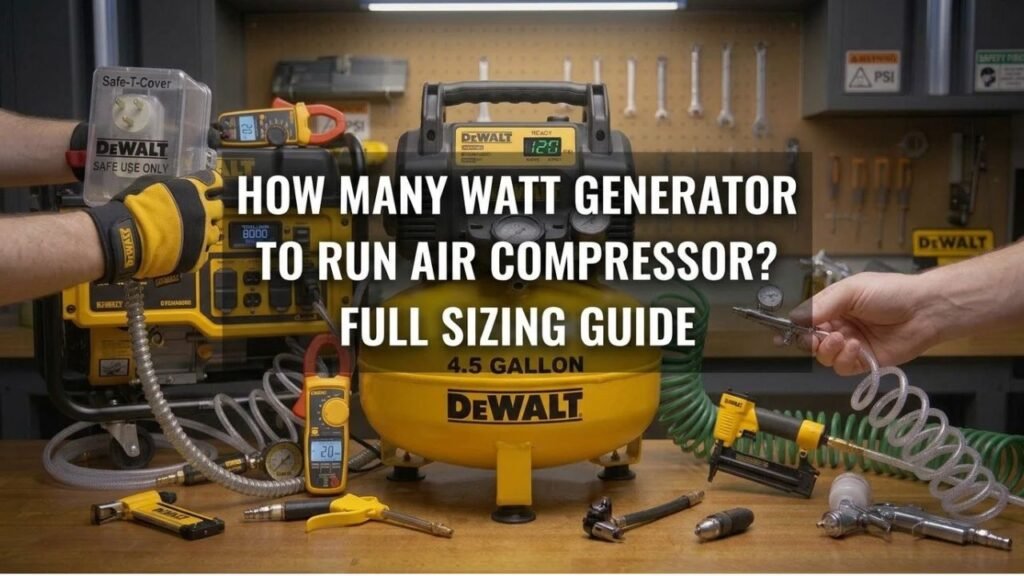
A generator must satisfy two separate electrical demands:
- The watts required while the compressor is running
- The short surge required when its motor starts
The startup requirement is often the number that determines generator size.
Generator Size for a 1 HP Air Compressor
Champion lists a typical 1 HP air compressor at:
- Running watts: about 1,500 W
- Starting watts: about 4,500 W
A generator rated for at least 4,500 starting watts is therefore the theoretical minimum for that example.
In practice, a 5,000- to 5,500-watt-class generator gives more margin for voltage drop, generator variation, and small additional loads.
Champion specifically notes that a 1 HP capacitor-start motor drawing about 1,500 running watts and 4,500 starting watts is near the upper limit of some smaller generators and recommends moving to a larger 5,500-watt model for more reliable operation.
Generator Size for a 2 HP Air Compressor
Champion’s general reference for a 2 HP air compressor is:
- Running watts: about 2,500 W
- Starting watts: about 7,500 W
A generator with roughly 7,500 starting watts or more is needed for that example.
Moving to an 8,000- to 9,000-starting-watt generator gives more headroom, assuming its continuous rating and outlet configuration also match the compressor.
Generator Size for a 3 HP Air Compressor
A typical 3 HP example in Champion’s chart uses:
- Running watts: about 3,500 W
- Starting watts: about 10,500 W
That points toward a generator with at least 10,500 starting watts.
A unit in roughly the 11,000- to 12,000-starting-watt range may be more practical if the compressor is the primary load.
Large compressors can vary considerably, so use the motor nameplate rather than horsepower alone.
Quick Generator Sizing Chart
| Air Compressor | Approx. Running Watts | Approx. Starting Watts | Practical Generator Starting Capacity |
| 1 HP | 1,500 W | 4,500 W | 5,000–5,500 W |
| 2 HP | 2,500 W | 7,500 W | 8,000–9,000 W |
| 3 HP | 3,500 W | 10,500 W | 11,000–12,000 W |
These are general planning figures based on common motor loads, not universal specifications.
Key Takeaway: A typical 1 HP compressor may need around 5,000 watts of generator starting capacity, while 2 HP and 3 HP compressors can require roughly 8,000 and 11,000 watts or more.
Why Does an Air Compressor Need So Many Starting Watts?
The compressor’s motor must overcome significant resistance when it starts.
This creates a short electrical surge.
Electric Motors Draw High Startup Current
Once an induction motor reaches normal speed, its current settles toward the rated running level.
At startup, the rotor is stationary.
The motor can draw several times its normal current before reaching operating speed.
Generac’s mobile-generator sizing guidance states that single-phase induction motors may require around three to five times their running amps or watts during startup.
This matches the common 1 HP compressor example:
1,500 running watts × 3 = about 4,500 starting watts.
Compressor Pumps Add Mechanical Load
An air compressor motor is not starting with no work attached.
It has to turn a compressor pump.
If the pump starts against residual pressure because of an unloader-valve problem, startup becomes even harder.
A healthy compressor normally releases trapped head pressure when it shuts off so the next restart requires less motor torque.
Low Generator Voltage Can Prevent Motor Starting
An undersized generator may initially attempt to supply the surge but experience a large voltage drop.
Possible results include:
- Motor humming without starting
- Generator engine bogging
- Breaker tripping
- Overload warning
- Compressor thermal protector opening
- Repeated restart attempts
Repeated stalled starts are hard on both the compressor motor and generator.
Key Takeaway: Compressor motors need a large momentary surge because the motor must accelerate from a stop while also turning the compressor pump.
Running Watts vs Starting Watts for an Air Compressor
These two ratings should not be confused.
Running Watts
Running watts are the electrical power required after the compressor motor has reached operating speed.
This is the continuous load the generator must support while the tank is filling.
If the compressor needs 2,500 running watts, a generator capable of only 2,000 continuous watts is not large enough even if its short surge rating is higher.
Starting Watts
Starting watts are available only briefly.
Portable generator manufacturers may call them:
- Starting watts
- Surge watts
- Peak watts
- Maximum watts
Generac defines starting wattage as the temporary extra output available to start motor-driven equipment.
A generator could be rated:
- 6,500 starting watts
- 5,000 running watts
That means it cannot continuously supply 6,500 watts.
Both Ratings Must Pass
A suitable generator must meet both conditions:
- Its continuous output must exceed the compressor’s running demand plus other continuous loads.
- Its surge output must handle the compressor startup plus any loads already operating.
Passing only one test is not enough.
Key Takeaway: Running watts cover normal compressor operation, while starting watts cover the brief motor surge; the generator must satisfy both ratings.
How to Calculate Generator Size From Air Compressor Amps
The compressor nameplate is usually more useful than a generic horsepower chart.
Look for voltage and amperage.
Basic Wattage Calculation
For a simple single-phase estimate:
Watts ≈ Volts × Amps
For example, a 120V compressor drawing 15 amps has an apparent electrical demand around:
120 × 15 = 1,800
That gives roughly 1,800 VA and serves as a basic planning estimate.
Motor power factor means actual real watts can differ, so generator sizing should use manufacturer data when available.
Example: 120V, 15-Amp Compressor
Suppose the nameplate says:
- 120 volts
- 15 running amps
Approximate running load:
120 × 15 = 1,800
If startup demand is about three times the normal running current, the brief requirement could approach 5,400 VA.
A generator with only 2,000 or 3,000 starting watts would likely struggle.
Example: 240V, 15-Amp Compressor
A 240V compressor drawing 15 amps represents about:
240 × 15 = 3,600 VA
A generator would need:
- 240V output
- An outlet and breaker rated for the load
- Enough continuous wattage
- Enough motor-starting capacity
Do not assume a generator can power a 240V compressor merely because its total watt rating looks high.
Use Locked-Rotor Data When Available
A motor nameplate may list:
- FLA — Full Load Amps
- RLA — Rated Load Amps
- LRA — Locked Rotor Amps
- NEMA code letter
Locked-rotor information gives a better indication of the starting demand than a generic multiplier.
Generac’s commercial generator guidance recommends collecting motor horsepower, voltage, phase, amperage, and NEMA locked-rotor data when sizing generators for motor loads.
Key Takeaway: Use the compressor nameplate whenever possible; voltage and running amps estimate continuous demand, while LRA or motor-start information gives a better picture of generator surge needs.
What Size Generator for a 120V Air Compressor?
Many small portable compressors run from standard 120V power.
Common examples include:
- Pancake compressors
- 6-gallon compressors
- Small hot-dog compressors
- Many 10- to 20-gallon portable models
Check the Running Amps
A 120V compressor may draw 10, 12, 15, or more amps depending on its motor.
A 15-amp unit can approach 1,800 VA during normal operation.
Starting demand can be several times higher for a capacitor-start induction motor.
Check Generator Outlet Capacity
A generator’s total watt rating is not the only limit.
Each receptacle may have its own breaker.
For example:
- 120V × 20A = 2,400 VA
- 120V × 30A = 3,600 VA
A compressor cannot draw more through an individual outlet than that circuit safely permits.
Generac warns that an individual receptacle’s breaker can limit usable output even when the generator’s total rating is higher.
Extension Cord Size Matters
A long, undersized extension cord adds voltage drop.
A compressor motor already places a high demand on the power source during startup, so low voltage can make starting worse.
Use a heavy-duty grounded cord rated for the compressor’s current and cord length.
Plugging the compressor directly into the generator with the shortest practical connection is generally preferable.
Key Takeaway: For a 120V compressor, check motor amps, generator surge rating, the specific 120V outlet breaker, and extension-cord size—not just the large watt number printed on the generator.
What Size Generator for a 240V Air Compressor?
Larger shop compressors often use 240V single-phase power.
These compressors need a generator that actually provides the correct 240V supply.
The Generator Must Have 240V Output
A 7,500-watt generator with only the wrong receptacle arrangement cannot automatically operate every 240V compressor.
Check:
- Generator voltage
- Receptacle type
- Breaker size
- Compressor plug or wiring
- Running amps
- Starting amps
Check the Generator’s 240V Current Rating
Suppose a generator can continuously produce 7,200 watts at 240V.
Approximate maximum current:
7,200 ÷ 240 = 30 amps.
A compressor with a 22-amp running motor may fit from a continuous-load standpoint, but the generator must also survive the startup surge.
Hard-Wired Compressors Need Proper Connections
Many 60- and 80-gallon compressors are hard-wired rather than fitted with a portable cord.
Do not improvise temporary connections to generator receptacles.
A qualified electrician may be needed to provide correct overcurrent protection, grounding, disconnects, conductors, and plug/receptacle hardware.
Key Takeaway: A 240V compressor requires a generator with the correct 240V supply, enough amperage on that circuit, and enough surge capability to start the motor.
What Generator Size for Common Air Compressor Tank Sizes?
Tank gallons do not directly determine generator wattage.
The motor does.
Two 20-gallon compressors can have completely different electrical requirements.
6-Gallon Air Compressor
Many 6-gallon pancake compressors use 120V motors.
Some fall into the range where a 2,500- to 4,000-watt generator can operate them, while others need substantially more surge capacity.
Check the compressor’s running amps and manufacturer specifications before choosing a generator.
20-Gallon Air Compressor
A 20-gallon model may use a motor ranging from roughly 1 HP to 2 HP or more.
Generator requirements can therefore vary from around the 1 HP example to well above 7,000 starting watts.
Tank size alone cannot provide the answer.
30-Gallon Air Compressor
Some 30-gallon compressors remain 120V, while others use 240V.
The motor plate is the deciding factor.
A 2 HP motor may place the generator into the 7,500-plus starting-watt class.
60-Gallon Air Compressor
Many 60-gallon stationary shop compressors use 240V motors around 3 HP to 5 HP.
These are much harder to start from a portable generator.
A 3 HP reference load may need around 10,500 starting watts, and a larger 5 HP induction motor can demand far more.
Professional generator sizing is sensible for large hard-wired compressors.
80-Gallon Air Compressor
An 80-gallon receiver often accompanies a large stationary pump and motor.
A large tank does not itself require more electrical power, but 80-gallon compressors are commonly paired with higher-horsepower motors.
These systems may need a large portable generator, towable generator, or permanent generator sized from the exact motor-starting data.
Key Takeaway: Tank capacity does not determine generator watts; 6-, 20-, 60-, and 80-gallon compressors must be sized from the motor’s voltage, amperage, horsepower, and startup requirement.
Does Air Compressor Horsepower Tell You the Generator Size?
Horsepower is useful for a rough estimate, but it should not be the only specification used.
Motor HP Does Not Equal Electrical Input Exactly
One mechanical horsepower equals approximately 746 watts of mechanical output.
That does not mean a 1 HP compressor consumes only 746 electrical watts.
Electric motors are not 100% efficient, and compressors also have starting surge and other losses.
A common 1 HP compressor may use around 1,500 running watts according to generator sizing charts.
Advertised Compressor HP Can Be Misleading
Some portable compressors have historically been marketed using peak or maximum horsepower numbers rather than continuous motor output.
The nameplate amperage and voltage are more useful for electrical sizing.
Start With the Electrical Label
Prioritize:
- Voltage
- Phase
- Running amps
- Starting or locked-rotor amps
- Manufacturer generator recommendation
Horsepower can then serve as a cross-check.
Key Takeaway: Horsepower gives a rough generator range, but voltage, amperage, and starting-current data provide a better basis for generator sizing.
Should You Oversize the Generator for an Air Compressor?
A moderate margin is usually sensible.
A generator operating right at its absolute limit can struggle during compressor restarts.
Allow for Other Loads
If the generator also powers:
- Lights
- Battery chargers
- Refrigerator
- Power tools
- Fans
- Pumps
their running wattage needs to be included.
Generac recommends adding the running watts of loads that operate at the same time and then accounting for the largest motor-starting surge.
Do Not Add Every Starting Surge Together Automatically
If only one large motor starts at a time, you normally size for the highest single starting event plus other loads already running.
For example:
- Compressor running: 1,500 W
- Lights running: 500 W
- Refrigerator running: 700 W
- Compressor extra startup surge: 3,000 W
Peak need would be around 5,700 watts in that simplified example.
Leave Some Operating Margin
Running a generator constantly at its absolute rating leaves little space for transient loads or changing conditions.
Generac’s mobile sizing guidance notes that leaving capacity above the planned load provides flexibility and helps avoid overload conditions.
Key Takeaway: Size for the compressor’s startup surge plus other active loads and leave reasonable capacity rather than planning to operate at the generator’s maximum limit continuously.
Why Won’t My Generator Start My Air Compressor?
A generator can appear large enough on paper yet still struggle.
Generator Surge Rating Is Too Low
This is one of the most common causes.
The generator may easily handle the compressor after it starts but fail during the first fraction of a second.
Compressor Unloader Valve Is Not Working
The unloader valve releases pressure trapped between the compressor pump and check valve after shutdown.
If pressure remains in the pump head, the motor has to start against a heavy mechanical load.
Symptoms may include:
- Motor humming
- Generator bogging
- Breaker tripping
- Compressor starts easily with an empty tank but not after cycling
Extension Cord Is Too Small or Too Long
Voltage drop can prevent the motor from developing enough starting torque.
Use the correct conductor size and keep the cord as short as practical.
Generator Eco Mode Is Responding Too Slowly
Some inverter generators reduce engine speed under low load.
A compressor can apply a very sudden starting load.
If the generator manufacturer recommends disabling economy mode for high-starting-current equipment, follow that instruction.
Generator Output Is Reduced
Generator capability can be affected by operating conditions and maintenance.
Possible issues include:
- High elevation
- Poor engine condition
- Dirty air filter
- Old fuel
- Incorrect engine speed
- Overheated generator
- Other loads already connected
Compressor Motor Has a Problem
A weak start capacitor, damaged motor winding, failing pressure switch, pump problem, or mechanical binding can raise startup current.
Do not automatically buy a larger generator if the compressor suddenly becomes hard to start after previously working normally.
Key Takeaway: Low generator surge capacity, a failed compressor unloader, voltage drop, generator settings, or compressor motor faults can all cause startup failure.
Portable Generator Safety When Running an Air Compressor
A generator and compressor together create electrical, exhaust, pressure, and noise hazards.
Run Fuel-Burning Generators Outdoors
Never operate a gasoline, diesel, or propane generator inside:
- Garage
- Workshop
- Basement
- Shed
- Trailer
- Enclosed porch
OSHA states that portable generators should be operated outdoors and at least 20 feet from doors, windows, and vents to reduce carbon monoxide risk.
Keep the Generator Dry
Do not operate electrical equipment in standing water or expose the generator to rain without an approved weather-protection arrangement that maintains ventilation.
OSHA also advises keeping generators dry and following manufacturer grounding instructions.
Use Proper Extension Cords
Use grounded cords rated for:
- Generator voltage
- Compressor amperage
- Cord length
- Outdoor environment when applicable
A light household extension cord is a poor choice for a high-current compressor motor.
Do Not Backfeed a Building
Never connect a portable generator to building wiring through a homemade male-to-male cord or similar setup.
A properly installed transfer device is required when connecting a generator to building electrical systems.
OSHA warns that improper generator connection can energize utility lines and expose workers and others to electrocution.
Key Takeaway: Operate generators outdoors, keep them dry, use properly rated electrical connections, and never backfeed a building electrical system.
Conclusion
For how many watt generator to run air compressor, a typical 1 HP compressor may need around 1,500 running watts and 4,500 starting watts, making a 5,000- to 5,500-starting-watt generator a practical range for many units.
A typical 2 HP compressor may need around 7,500 starting watts, while a 3 HP unit may approach 10,500 starting watts. These are reference numbers rather than universal specifications.
The compressor’s tank size is not the main factor. Look at the motor’s voltage, running amperage, phase, horsepower, and locked-rotor or startup data. A generator must also provide the correct 120V or 240V outlet and sufficient current through that outlet.
When choosing between two generators, pay close attention to both running watts and starting watts. A generator that can run the compressor but cannot survive its startup surge is still undersized.
FAQs About Generator Size for an Air Compressor
Will a 2,000-Watt Generator Run an Air Compressor?
It may run some small portable compressors, but it is usually too small for a typical 1 HP capacitor-start compressor requiring around 4,500 starting watts.
Check the exact compressor nameplate and startup requirement before connecting it.
Will a 3,500-Watt Generator Run an Air Compressor?
It can operate certain small compressors with lower startup demand.
A typical 1 HP compressor may require about 4,500 starting watts, so a 3,500-watt generator may not have enough surge capacity for that example.
Will a 5,000-Watt Generator Run a 1 HP Air Compressor?
Often, yes, if the generator’s starting rating is at least around 4,500 watts, its continuous rating exceeds the compressor’s running demand, and no large additional loads are operating.
Verify the compressor’s actual electrical label because motor designs differ.
What Size Generator Do I Need for a 2 HP Air Compressor?
A general Champion reference lists a 2 HP compressor at about 2,500 running watts and 7,500 starting watts.
A generator in roughly the 8,000- to 9,000-starting-watt class provides more margin for a compressor matching that example.
What Size Generator Do I Need for a 3 HP Air Compressor?
A general reference places a 3 HP air compressor around 3,500 running watts and 10,500 starting watts.
That points toward roughly an 11,000- to 12,000-starting-watt generator, subject to the exact motor specifications.
Can a 6,500-Watt Generator Run an Air Compressor?
Yes, it can run many smaller compressors.
For a typical 1 HP compressor requiring around 4,500 starting watts, 6,500 starting watts can provide adequate headroom. A 2 HP compressor with a 7,500-watt startup requirement may exceed that generator’s capability.
Does a 60-Gallon Air Compressor Need a Bigger Generator?
Often, but not because the tank holds 60 gallons.
Many 60-gallon compressors use larger 240V motors, commonly around 3–5 HP. The motor’s electrical specifications determine generator size.
Can an Inverter Generator Run an Air Compressor?
Yes, if its continuous output, surge output, voltage, receptacle capacity, and current rating meet the compressor’s requirements.
Motor startup is the main challenge. A small inverter generator may overload even though it could theoretically handle the compressor’s normal running watts.