
How Many Watts Does a 3 Gallon Air Compressor Use? Wattage Guide
Most 3-gallon air compressors use roughly 300 to 1,300 watts while the motor is running. Small 1/3 HP models commonly fall near 300–450 watts based on their 120-volt amp ratings, while stronger 1 HP units may draw around 1,100–1,300 watts. Starting demand can be much higher for a short moment.
Tank size does not determine electrical consumption. Two compressors can both have 3-gallon tanks yet use very different motors, pumps, pressures, and amp ratings.
Current 120-volt 3-gallon compressors show how wide the range can be. Compact models may carry ratings around 2.5–3.5 amps, while higher-output units may be rated around 9.5–11 amps. At 120 volts, those figures translate to roughly 300–420 volt-amps at the low end and about 1,140–1,320 volt-amps at the high end.
This means the best answer to how many watts does a 3 gallon air compressor use comes from the electrical nameplate on the exact compressor, not from the 3-gallon tank label.
You also need to separate running watts from startup demand. Compressor motors draw a brief surge when they start against electrical and mechanical load. A generator, inverter, or portable power station that can handle the running load may still trip when the compressor motor starts.
The sections below show typical wattage ranges, real 120-volt examples, the formula for converting amps to watts, generator sizing, electricity cost, and the factors that change how much power a small compressor actually uses.
How Many Watts Does a 3 Gallon Air Compressor Use?
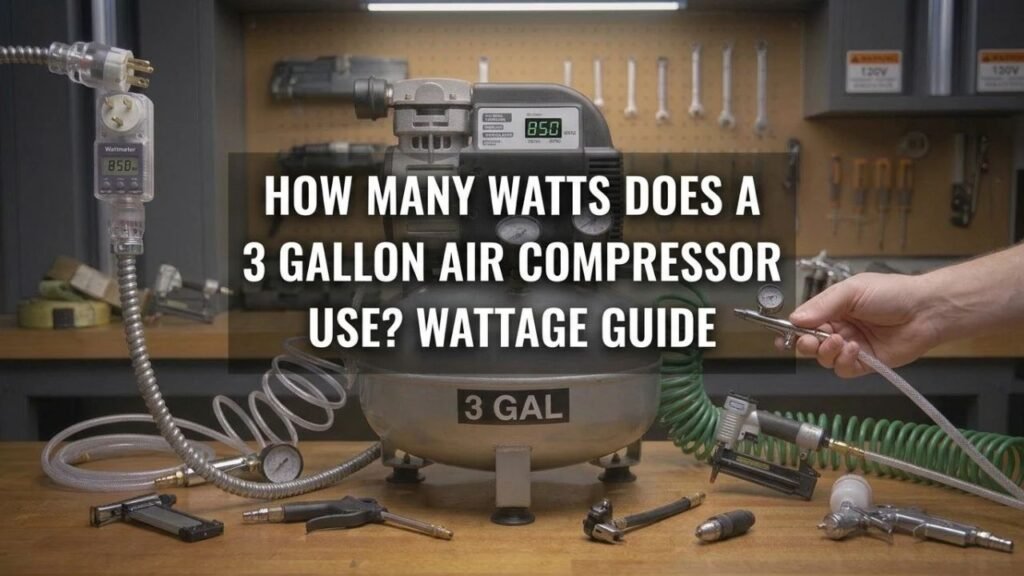
A 3-gallon compressor can use anywhere from about 300 watts to more than 1,300 watts while running, based on the motor and pump fitted to the machine.
The range is wide because “3 gallon” describes only the amount of compressed air stored in the tank.
Small 1/3 HP 3-Gallon Compressors
Light-duty 3-gallon units often use a small oil-free motor.
Real nameplate examples include ratings such as:
- 120 V, 2.5 A
- 120 V, 3.0 A
- 120 V, 3.2 A
- 120 V, 3.5 A
Using volts × amps as a quick electrical-load estimate gives:
| Voltage | Amps | Approx. Electrical Load |
| 120 V | 2.5 A | 300 VA |
| 120 V | 3.0 A | 360 VA |
| 120 V | 3.2 A | 384 VA |
| 120 V | 3.5 A | 420 VA |
These compact compressors are often rated around 1/3 HP and deliver roughly 0.5–1.0 SCFM at common working pressures.
They are mainly suited to inflation, blowing light debris, airbrushing, and other low-air-demand jobs.
Stronger 3-Gallon Compressors
Some 3-gallon models use much larger motors.
Examples include 120-volt units rated around:
- 9.5 amps
- 11 amps
The same calculation gives:
| Voltage | Amps | Approx. Electrical Load |
| 120 V | 9.5 A | 1,140 VA |
| 120 V | 11 A | 1,320 VA |
These units may deliver two to four times as much air as a basic 1/3 HP compressor even though the storage tank remains the same size.
Key Takeaway: Most 3-gallon compressors fall somewhere around 300–1,300 watts of running electrical load, with small 1/3 HP units near the low end and higher-output motors near the upper end.
Why Tank Size Does Not Tell You Wattage
A common mistake is assuming every 3-gallon compressor consumes about the same amount of electricity.
The tank is only a storage vessel.
A 3-gallon tank can be paired with:
- 1/3 HP motor
- 1 HP motor
- Oil-free pump
- Oil-lubricated pump
- Low-SCFM pump
- High-SCFM pump
- 100 PSI system
- 155 PSI system
Motor size has a much stronger relationship with electrical demand than tank capacity.
A 3-gallon compressor rated at 0.6 SCFM at 90 PSI may draw only around 3 amps, while another 3-gallon model producing roughly 2.5 SCFM at 90 PSI may require close to 10 or 11 amps.
The larger motor fills the same-size tank faster and can keep up with higher air demand, but it also pulls more electrical current.
That is why gallon size should never be used by itself when selecting a generator, extension cord, inverter, or portable power station.
How to Calculate Air Compressor Watts From Amps
The compressor data plate usually gives you voltage and amperage.
For a quick load estimate:
Volts × Amps = Volt-Amps
For simple planning, people often use this result as an approximate watt figure.
Example: 3-Amp Compressor
A compressor rated:
120 V × 3 A = 360
So the nameplate electrical load is roughly 360 VA.
Example: 3.5-Amp Compressor
120 V × 3.5 A = 420
That gives about 420 VA.
Example: 9.5-Amp Compressor
120 V × 9.5 A = 1,140
That gives about 1,140 VA.
Example: 11-Amp Compressor
120 V × 11 A = 1,320
That gives about 1,320 VA.
Watts and Volt-Amps Are Not Always Identical
A compressor uses an AC induction or universal motor, and AC motors can have a power factor below 1.0.
That means volts × amps does not always equal the exact real watt consumption measured by a wattmeter.
For generator and inverter sizing, the nameplate amp rating is still useful because the electrical source must handle the current drawn by the motor.
For exact household energy consumption, a plug-in power meter provides a better number.
Key Takeaway: Multiply 120 volts by the compressor’s nameplate amps for a quick load estimate, but remember that actual real watts may differ because of motor power factor and changing load.
Running Watts vs Starting Watts
The biggest electrical issue with an air compressor is often startup, not normal running.
Electric motors draw extra current for a short time when they begin turning.
Running Watts
Running watts describe the electrical load after the compressor motor has reached normal speed.
A compact 3-gallon unit might run around the equivalent of 300–450 watts of electrical load.
A larger model may be around 1,000–1,300 watts.
Starting Surge
At startup, the motor may briefly demand several times its normal running current.
The exact surge depends on:
- Motor design
- Compressor pump
- Tank pressure
- Unloader valve
- Ambient temperature
- Extension cord
- Supply voltage
- Motor condition
This surge may last only a fraction of a second, but a generator or inverter must still survive it.
Why Compressors Are Hard on Small Generators
An air compressor automatically cycles.
The motor stops when tank pressure reaches cut-out pressure, then starts again when pressure falls to the cut-in point.
Each restart creates another startup surge.
A generator that barely handles the compressor’s normal running load may:
- Stall
- Trip overload protection
- Drop voltage
- Make the compressor motor hum
- Cause the compressor overload protector to trip
Give the compressor enough starting headroom rather than matching the generator rating to running watts alone.
Key Takeaway: Running consumption may be modest, but the brief motor-starting surge can be much higher and is often the main limit when using a generator, inverter, or battery power station.
What Size Generator for a 3-Gallon Air Compressor?
There is no single generator size that fits every 3-gallon compressor.
Start with the compressor nameplate.
For a Small 3-Amp Compressor
A 120-volt, 3-amp unit has a nameplate load around 360 VA.
A generator rated well above the running requirement and capable of handling motor surge may operate it comfortably.
A generator in the 1,000- to 1,500-watt class may be enough for many very small compressors if its surge rating is suitable and no other heavy load is connected.
Do not treat that as a universal minimum.
For a 10- to 11-Amp Compressor
A 120-volt compressor drawing 10–11 amps approaches roughly 1,200–1,320 VA during normal operation.
Startup can go far above that.
For this type of unit, a 2,500- to 3,500-watt generator class is a more sensible starting point for evaluation, but you should check the generator’s motor-start capability and the compressor’s actual startup current.
Some inverter generators can supply a short overload surge; others shut down quickly once the limit is reached.
Include Other Loads
If the generator also powers:
- Lights
- Battery charger
- Saw
- Refrigerator
- Fan
- Shop vacuum
their loads must be added to the compressor demand.
Avoid starting another motor-driven tool at the same moment the compressor restarts.
Can a Portable Power Station Run a 3-Gallon Compressor?
It can, but the inverter must handle both the running load and the motor surge.
Battery capacity alone is not enough.
A power station may have a large battery but an inverter that shuts down when the compressor starts.
Check three specifications:
- Continuous AC output
- Surge output
- Battery capacity in watt-hours
Example With a Small Compressor
Suppose a compact compressor averages around 350 watts while its motor runs.
A 1,000 Wh power station does not automatically give 1,000 ÷ 350 = 2.86 hours of actual compressor motor run time.
Inverter losses, battery management, temperature, and motor power factor reduce usable output.
The compressor also cycles rather than running continuously.
Compressor Duty Cycle Changes Runtime
If the compressor motor runs 50% of the time, average energy use across an hour can be far lower than its instantaneous running draw.
A compressor drawing about 400 watts for 30 minutes in an hour would consume roughly:
400 W × 0.5 hour = 200 Wh
That is a simplified estimate. Actual cycle time changes with air-tool demand.
How Much Electricity Does a 3-Gallon Air Compressor Use?
Energy use depends on wattage and how long the motor actually runs.
The tank can stay pressurized with the motor off, so a compressor does not consume its full running wattage every minute it is switched on.
Example: 400-Watt Compressor
If the motor runs for 30 minutes:
400 watts × 0.5 hour = 200 watt-hours
That equals:
0.20 kWh
If it runs for a full hour:
400 watts × 1 hour = 400 watt-hours
That equals:
0.40 kWh
Example: 1,200-Watt Compressor
If the motor runs for 30 minutes:
1,200 × 0.5 = 600 Wh
That equals:
0.60 kWh
If the motor actually runs for a full hour:
1,200 Wh = 1.20 kWh
Calculate Your Electricity Cost
Use:
kWh × electricity rate = operating cost
If the compressor uses 0.60 kWh during a job and electricity costs $0.20 per kWh:
0.60 × $0.20 = $0.12
The exact price depends on your utility rate.
For most home users, small compressors cost relatively little to run because the motor cycles on and off rather than operating continuously all day.
Does Horsepower Tell You How Many Watts the Compressor Uses?
Horsepower gives some information about motor output, but it should not be used as the only electrical calculation.
One mechanical horsepower equals about 746 watts.
That does not mean a 1 HP compressor pulls exactly 746 watts from the outlet.
Electric motors are not 100% efficient, and compressor labels may use horsepower ratings differently.
A motor delivering one true mechanical horsepower must draw more than 746 watts of electrical input because some energy becomes heat and other losses.
The nameplate voltage and amp rating are more useful for planning an electrical circuit.
Why One 3-Gallon Compressor Uses More Power Than Another
Several design choices change motor demand.
Air Delivery
SCFM is one of the biggest differences.
A compressor rated around 0.6 SCFM at 90 PSI can use a much smaller pump and motor than one rated around 2.5 SCFM at 90 PSI.
Higher airflow usually requires more motor power.
Maximum Pressure
A compressor rated for 155 PSI must compress air to a higher pressure than a 100 PSI model.
Pressure alone does not determine wattage, but higher-pressure systems may use larger motors or run longer during tank filling.
Pump Type
Oil-free and oil-lubricated designs have different friction, cooling, pump speed, and motor arrangements.
You cannot assume one type always consumes less electricity.
Fill Time
A larger motor may draw more power but fill the tank faster.
A lower-powered compressor may use fewer watts at any moment yet run much longer.
Total energy used for a given job is therefore not determined by running wattage alone.
Key Takeaway: SCFM, motor size, pressure, pump design, and fill time explain why two 3-gallon compressors can have very different electrical loads even with identical tank capacity.
Can You Run a 3-Gallon Compressor on a 15-Amp Circuit?
Many portable 3-gallon compressors are designed for a standard 120-volt household circuit.
A 15-amp, 120-volt circuit has a theoretical rating of:
120 × 15 = 1,800 VA
That does not mean you should load the circuit with 1,800 watts of compressor plus other tools.
The compressor motor needs startup current, and other devices on the same branch circuit reduce the available capacity.
A 3-amp compact compressor is generally much easier on a 15-amp circuit than an 11-amp model.
If the breaker trips during startup, check for:
- Other loads on the circuit
- Long extension cord
- Undersized extension cord
- Low supply voltage
- Compressor starting under pressure
- Faulty unloader valve
- Motor or pump problem
Do not replace a breaker with a larger one unless the wiring and entire circuit are designed for that rating.
Does an Extension Cord Increase Compressor Power Use?
An extension cord can create voltage drop, especially if it is too long or too small in wire gauge.
Low voltage may cause the motor to draw more current, start slowly, overheat, or trip its overload protection.
Many compressor manuals recommend using a longer air hose instead of a long electrical extension cord.
If an extension cord is permitted, follow the compressor manual for:
- Maximum cord length
- Minimum wire gauge
- Outdoor rating
- Grounding requirement
A heavy 10- or 11-amp compressor needs more attention to cord size than a 3-amp model.
How to Find the Exact Wattage of Your 3-Gallon Compressor
The most accurate answer starts with the label attached to the machine.
Look for:
- Voltage
- Amps
- Watts
- Horsepower
- Frequency
- Phase
If watts are listed directly, use that number.
If only volts and amps are shown, multiply them for a quick load estimate.
For example:
120 V × 3.2 A = 384 VA
A plug-in electrical meter can show actual running watts on models that are within the meter’s current rating.
For generator planning, also account for startup surge rather than relying only on the meter’s normal running reading.
Conclusion
How many watts does a 3 gallon air compressor use depends much more on its motor than its tank. Small 1/3 HP models commonly have nameplate loads around 300–450 VA, while stronger 3-gallon compressors can reach roughly 1,100–1,300 VA during normal running.
Check the data plate instead of estimating from tank capacity. Multiply 120 volts by the amp rating for a quick load figure, then remember that real AC watts can differ because of motor power factor.
Startup demand is equally important. A compressor motor can pull far more current for a brief moment when it starts, so generators, inverters, and portable power stations need enough surge capacity.
For household use, also pay attention to the branch circuit and extension cord. A small 3-amp model is easy to supply from most normal 120-volt circuits, while an 11-amp unit leaves much less room for other loads and may expose voltage-drop problems.
FAQs About 3-Gallon Air Compressor Wattage
How Many Watts Does a 3-Gallon 120V Air Compressor Use?
A 120-volt 3-gallon compressor may use roughly 300–1,300 watts or volt-amps of running electrical load, based on its motor.
A 3-amp model is about 360 VA, while an 11-amp model is about 1,320 VA.
How Many Watts Does a 3-Amp Air Compressor Use?
At 120 volts:
120 × 3 = 360
That gives an approximate electrical load of 360 VA.
Actual real watt consumption can be somewhat different because AC motors have a power factor.
How Many Watts Does an 11-Amp Air Compressor Use?
At 120 volts:
120 × 11 = 1,320
That equals about 1,320 VA of nameplate electrical load.
Startup demand can briefly exceed the normal running requirement by a large amount.
Will a 1,000-Watt Generator Run a 3-Gallon Air Compressor?
It may run a very small low-amp compressor if the generator’s surge output is high enough.
It is unlikely to be a safe general recommendation for higher-powered 3-gallon compressors. Check the compressor amp rating and generator startup capacity before connecting them.
Will a 2,000-Watt Generator Run a 3-Gallon Compressor?
Many compact 3-gallon compressors can run from a 2,000-watt generator, but high-amp models may still cause trouble during startup.
Check the generator’s surge rating and the compressor’s nameplate current.
Does a 3-Gallon Compressor Use More Electricity Than a 6-Gallon Compressor?
Not necessarily.
Tank size measures stored air, not motor wattage. A 3-gallon compressor with a large motor may draw more power than a 6-gallon model with a smaller motor.
Compare volts, amps, horsepower, and SCFM instead.
How Many Amps Does a 3-Gallon Air Compressor Use?
Current examples range from roughly 2.5 amps to 11 amps at 120 volts.
Small 1/3 HP units often draw around 2.5–3.5 amps, while stronger 1 HP-class compressors may approach 9.5–11 amps.