
How to Measure Drill Press Size: A Simple Guide for Beginners
A drill press may be labeled as an 8-inch, 10-inch, 12-inch, 15-inch, or even larger machine, but that number does not describe its height or the size of drill bit it can use. Understanding how to measure drill press size is mainly about measuring the machine’s swing, which tells you how wide a workpiece can be drilled at its center.
This measurement is useful when buying a drill press, comparing models, identifying an older machine, or deciding whether your drill press can handle a particular project.
The basic calculation is simple: measure the distance from the center of the spindle to the nearest edge of the column, then multiply that distance by two. That result is the drill press’s advertised swing size.
This guide explains exactly how to take that measurement, what other drill press dimensions matter, and how to choose a useful size for your work.
How to Measure Drill Press Size Correctly
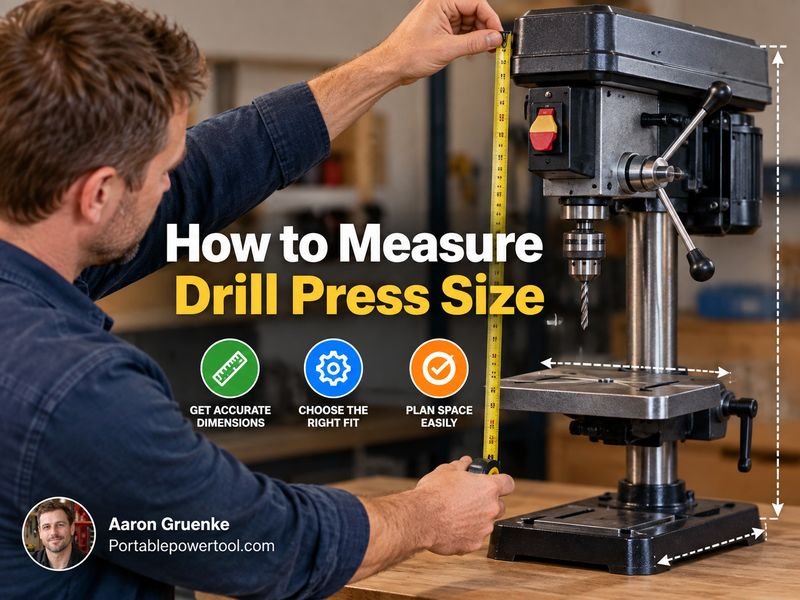
The standard way to measure drill press size is to determine its swing.
Measure horizontally from the centerline of the spindle to the closest side of the vertical column. Then multiply that measurement by two.
For example:
If the distance from the spindle center to the column is 6 inches:
6 inches × 2 = 12 inches
That machine is considered a 12-inch drill press.
This measurement represents the largest theoretical diameter of a circular workpiece whose center can be positioned directly beneath the drill bit without the workpiece hitting the column.
What Does Drill Press Swing Mean?
Swing is the distance from the drill press spindle to the column, multiplied by two.
It is one of the most important measurements manufacturers use to classify drill presses.
A drill press with a 10-inch swing has approximately 5 inches of clearance between the spindle center and the column.
A 15-inch drill press has approximately 7.5 inches of clearance.
The larger the swing, the farther you can drill from the edge of a workpiece.
Drill Press Size Formula
You can calculate drill press size with this simple formula:
Drill press size = spindle-to-column distance × 2
Here are several examples:
| Spindle-to-Column Distance | Drill Press Swing Size |
| 4 inches | 8-inch drill press |
| 5 inches | 10-inch drill press |
| 6 inches | 12-inch drill press |
| 7.5 inches | 15-inch drill press |
| 8.5 inches | 17-inch drill press |
| 10 inches | 20-inch drill press |
Actual usable clearance can vary slightly because of the column shape, chuck size, workpiece shape, and machine design.
What Part of the Drill Press Should You Measure?
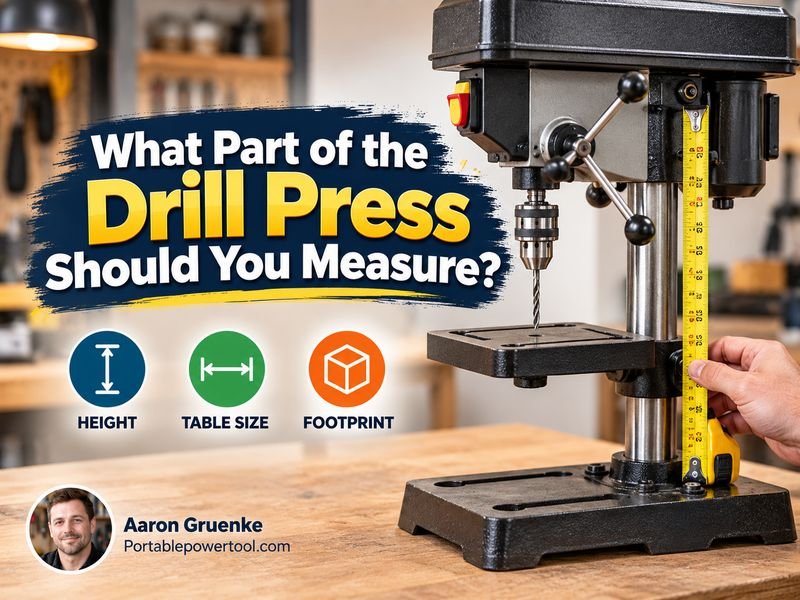
To measure accurately, identify two parts of the machine:
Spindle: The rotating shaft that holds or drives the drill chuck.
Column: The vertical support post connecting the base, table, and drill press head.
The measurement runs horizontally from the center of the spindle to the surface of the column facing the spindle.
Do not measure from the outer edge of the chuck. The centerline of the spindle is the reference point used for swing.
Step-by-Step Measurement
If the drill press does not have a readable model label or specification plate, you can determine its approximate swing yourself.
- Turn off and unplug the drill press.
- Locate the center of the spindle or drill chuck.
- Hold a tape measure horizontally from the spindle center toward the column.
- Measure to the nearest surface of the column.
- Multiply the measurement by two.
For example, a measurement of approximately 6.5 inches indicates a drill press with roughly a 13-inch swing.
Manufacturers may round specifications slightly, so your measurement may not perfectly match the advertised number.
Why Is Drill Press Size Measured This Way?
The swing measurement describes the maximum width of workpiece that can theoretically be drilled through its center.
Imagine placing a 12-inch-wide circular board on a 12-inch drill press.
The center of that board would be 6 inches from its outer edge. Because a 12-inch drill press has roughly 6 inches between the spindle center and the column, the center of the board can be positioned beneath the drill bit.
This makes swing more useful than simply describing the physical width or height of the machine.
It tells you something important about the drill press’s workpiece capacity.
Does Drill Press Size Mean Drill Bit Size?
No. Drill press size and drill bit capacity are different specifications.
A 12-inch drill press does not use a 12-inch drill bit.
The 12-inch measurement normally refers to the machine’s swing.
Drill bit capacity depends on other specifications, including:
- Chuck capacity
- Spindle taper
- Motor power
- Available torque
- Material being drilled
- Recommended tooling limits
A common drill press chuck might accept drill bits up to 1/2 inch or 5/8 inch in shank diameter, although specifications vary considerably by model.
Always check the manufacturer’s recommendations before using unusually large drill bits, hole saws, or Forstner bits.
Other Important Drill Press Measurements
Swing is the traditional measurement used to describe drill press size, but it is not the only dimension that matters.
Two drill presses with the same swing can have very different drilling capabilities.
Spindle Travel
Spindle travel, sometimes called quill travel, tells you how far the spindle can move vertically during drilling.
For example, a drill press might have:
- 2-inch spindle travel
- 3-inch spindle travel
- 3-1/4-inch spindle travel
- 4-inch or greater spindle travel
More spindle travel allows you to drill deeper holes without repositioning the table or workpiece.
This is particularly useful when drilling thick lumber or deep holes.
Chuck Capacity
The chuck capacity describes the range of drill-bit shank sizes that the chuck can hold.
A chuck marked 1/16 to 1/2 inch, for example, is designed to grip drill-bit shanks within approximately that range.
Chuck capacity does not tell you the largest hole the machine can drill. Large-diameter cutting tools can sometimes have smaller shanks.
Distance Between Chuck and Table
Another practical measurement is the maximum distance between the drill chuck and the table.
This determines how tall a workpiece can be while still fitting under the drilling tool.
Remember that a long drill bit reduces the available working height.
Distance Between Spindle and Base
If the drill press table can swing out of the way, the distance between the spindle and base may allow you to work with taller objects.
This can matter when drilling long assemblies, large blocks, or awkwardly shaped pieces.
Table Size
A larger drill press table gives you more support for bigger workpieces.
Measure the table’s width and depth if you plan to work with larger boards, metal plates, jigs, or fixtures.
A machine can have good swing capacity but still feel restrictive if its table is very small.
Overall Height
Overall height is especially important when choosing between a benchtop drill press and a floor drill press.
A benchtop model normally sits on a workbench or stand.
A floor model has a taller column and stands directly on the floor.
Overall height does not determine the nominal drill press size, but it affects installation and usable workspace.
Swing vs. Throat Depth
You may see another term called throat depth.
Throat depth is essentially the direct distance from the spindle centerline to the column.
Therefore:
Swing = throat depth × 2
A machine with a 6-inch throat depth has approximately a 12-inch swing.
These terms sometimes cause confusion because manufacturers may highlight one measurement while users discuss the other.
Knowing the relationship makes comparison easier.
How Drill Press Size Affects What You Can Drill
A larger swing allows you to drill farther from the edge of a workpiece.
Suppose you need to drill a hole 6 inches from the edge of a wide board.
A drill press with only 5 inches of spindle-to-column clearance may not allow the board to move far enough beneath the spindle.
A machine with 7 or 8 inches of clearance would give you more room.
This makes swing particularly important for:
- Furniture making
- Cabinet components
- Large wooden panels
- Metal plates
- Circular workpieces
- Jigs and fixtures
- Large fabrication projects
For small brackets, craft projects, hardware, and narrow boards, a compact drill press may provide plenty of capacity.
Common Drill Press Sizes
Drill presses are available in many sizes, but several swing ranges are common.
8- to 10-Inch Drill Presses
These compact machines are typically intended for lighter work and smaller workpieces.
They can be useful for:
- Hobby projects
- Small woodworking tasks
- Craft work
- Light metal drilling
- Shops with limited bench space
Their main limitation is the short distance between the spindle and column.
12- to 14-Inch Drill Presses
This range provides more workpiece clearance while still being reasonably manageable for many home workshops.
These machines can handle a wide variety of woodworking and general shop jobs.
For many DIY users, this range offers a practical balance between capacity and physical size.
15- to 17-Inch Drill Presses
Larger machines give you more room for wide workpieces and often come with heavier components, larger tables, greater spindle travel, or more powerful motors.
Specifications vary, so do not assume every larger-swing machine automatically has more power.
18-Inch and Larger Drill Presses
Large drill presses are typically chosen when workpiece capacity is a major concern.
They may be useful in professional woodworking, fabrication, maintenance, and machine shops.
The larger size usually requires more floor space and careful planning for moving and installation.
Benchtop vs. Floor Drill Press Size
The terms benchtop and floor describe the machine’s physical configuration rather than its swing measurement.
A benchtop drill press usually has a shorter column and is mounted on a bench.
A floor drill press stands on its own base and generally provides more vertical working space.
Both designs can still be described by swing.
For example, you might find both a benchtop 12-inch drill press and a floor-standing drill press with a similar swing.
The floor model may provide substantially more room between the chuck, table, and base.
How to Measure a Drill Press Before Buying Used
Used drill presses sometimes have missing labels, unreadable model numbers, or incomplete listings.
Measuring the machine yourself can reveal much more than relying on the seller’s description.
Start by measuring the swing, but also check:
- Spindle-to-column distance
- Spindle travel
- Table dimensions
- Maximum table-to-chuck clearance
- Base dimensions
- Overall height
- Chuck capacity
- Column diameter
You should also inspect mechanical condition.
With the machine unplugged, check whether the spindle has obvious side-to-side movement. Examine the table adjustment mechanism, belts, pulleys, chuck, power cord, and safety guards.
A larger drill press is not necessarily a better purchase if important parts are badly worn or missing.
Choosing the Right Drill Press Size
The best drill press size depends mainly on where your holes need to be located and how large your workpieces are.
Think about the distance between the intended hole and the nearest edge of the material.
If most of your holes are within 3 or 4 inches of an edge, a compact drill press may work well.
If you regularly drill near the middle of wide boards or metal plates, additional swing becomes much more valuable.
You should also consider:
- Available workshop space
- Workpiece thickness
- Required drilling depth
- Table size
- Speed range
- Motor capacity
- Chuck capacity
- Type of materials being drilled
Do not choose a drill press based on swing alone.
Common Mistakes When Measuring Drill Press Size
One common mistake is measuring the total width of the machine.
The width of the drill press head does not determine its nominal size.
Another mistake is measuring from the column to the outer edge of the chuck. Because chucks come in different diameters, this does not give the correct swing measurement.
Measure to the spindle centerline instead.
Some people also confuse spindle travel with drill press size. Spindle travel tells you how far downward the drill bit can move, not how wide a workpiece can fit between the spindle and column.
Finally, remember that advertised swing represents a geometric capacity. An irregularly shaped workpiece, large clamp, fence, vise, or fixture can reduce the usable space.
Safety When Measuring or Inspecting a Drill Press
Unplug the drill press before placing your hands near the chuck, spindle, belts, or pulleys.
If you are inspecting a used machine, do not assume that turning off the switch makes every moving component safe. Disconnecting power prevents accidental startup while you measure or inspect the machine.
When operating the drill press later, secure workpieces properly with a clamp or vise when appropriate. A drill bit can grab an unsecured workpiece and cause it to rotate.
Remove the chuck key before starting the machine, and follow the manufacturer’s recommended speed for the drill bit and material.
FAQs About How to Measure Drill Press Size
Where is drill press size measured from?
Drill press size is normally determined by measuring horizontally from the center of the spindle to the closest side of the column and multiplying that distance by two.
The resulting number is the drill press’s swing.
What does a 12-inch drill press mean?
A 12-inch drill press normally has approximately 6 inches of horizontal distance between the spindle center and the column.
That gives it a nominal swing of 12 inches.
It does not mean the machine accepts a 12-inch drill bit.
What does a 10-inch drill press mean?
A 10-inch drill press generally has about 5 inches between the spindle centerline and the column.
This means a circular workpiece approximately 10 inches in diameter could theoretically have its center positioned beneath the spindle.
Is drill press swing the same as throat depth?
Not exactly, but the measurements are directly related.
Throat depth is the distance from the spindle center to the column.
Swing is twice the throat depth.
A 5-inch throat depth therefore corresponds to approximately a 10-inch swing.
Does a larger drill press drill deeper holes?
Not necessarily.
Drilling depth depends primarily on spindle travel, drill-bit length, workpiece positioning, and other machine dimensions.
A drill press can have a large swing but relatively short spindle travel.
How do I know what size drill press I need?
Consider how far your typical holes are located from the edge of your workpieces.
The spindle-to-column clearance must be at least as large as that distance.
Also consider spindle travel, vertical clearance, table size, speed range, motor capability, and available shop space.
Can I measure drill press size with the chuck installed?
Yes.
You can usually estimate the spindle center by identifying the centerline running through the chuck.
Measure horizontally from that centerline to the nearest surface of the column, then double the result.
For greater accuracy, measure carefully at a height where the tape or ruler stays level.
Why doesn’t my measurement exactly match the advertised size?
Small differences are normal.
Manufacturers may round nominal swing measurements, and measuring from the wrong point on a rounded column can also change the result slightly.
Use the center of the spindle and the closest point of the column for the best estimate.
Conclusion
Learning how to measure drill press size is straightforward once you understand that the advertised size normally refers to swing. Measure from the spindle centerline to the nearest side of the column and multiply that distance by two.
A 6-inch spindle-to-column distance, for example, corresponds to approximately a 12-inch drill press.
Swing is useful because it tells you how far the machine can reach toward the center of a workpiece, but it should not be the only specification you consider. Spindle travel, chuck capacity, table size, vertical clearance, speed range, and motor capability also affect what a drill press can realistically handle.
Knowing these measurements makes it much easier to identify an existing drill press, compare models, or choose the right machine for your workshop.