What Is a 3 Gallon Air Compressor Good For? Uses and Tool Limits
A 3-gallon air compressor is best for tire inflation, brad and pin nailers, pneumatic staplers, small inflation jobs, short blow-gun use, airbrushing, and other tools that consume air in brief bursts. It is portable and easy to store, but most 3-gallon models lack the sustained airflow needed for sanders, grinders, large spray guns, and other continuous-use air tools.
Three gallons refers only to the air receiver capacity. It does not tell you how much air the pump can produce. Two compressors with the same 3-gallon tank can perform very differently if one delivers 0.6 SCFM at 90 PSI and another produces more than 2 SCFM at the same pressure.
That distinction explains why some small compressors are sold mainly for inflation and cleaning, while stronger 3-gallon units can operate finish nailers and other intermittent pneumatic tools with fewer pauses.
For what is a 3 gallon air compressor good for, focus first on the tool’s SCFM requirement and working PSI. Maximum tank pressure, horsepower, and gallons matter too, but SCFM at the required pressure tells you far more about tool compatibility.
Compressed-air safety matters even with a small machine. OSHA requires compressed air used for cleaning in covered U.S. workplaces to be reduced below 30 PSI under the applicable rule, along with required chip guarding and personal protective equipment. Never direct compressed air at your skin or clothing.
A 3-gallon compressor is a strong choice for homeowners, DIY work, trim projects, garage inflation, and mobile jobs where low weight matters. It becomes frustrating when a tool consumes air continuously because the small tank empties quickly and the pump may not refill it fast enough.
What Is a 3 Gallon Air Compressor Good For?
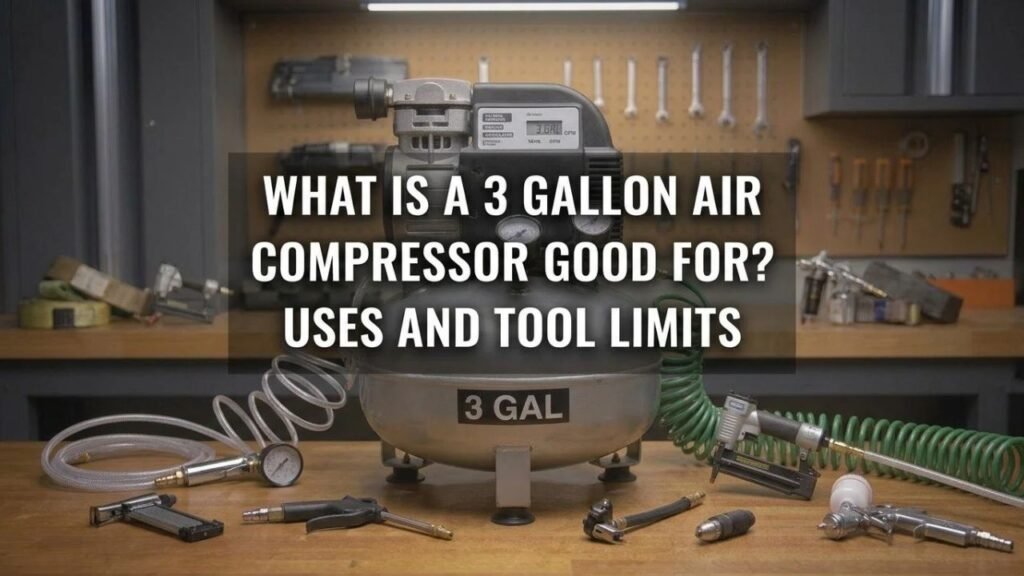
A 3-gallon compressor is at its best with tools that use a small burst of air and then pause.
Good matches include:
- Tire inflation
- Brad nailers
- Pin nailers
- Narrow-crown staplers
- Some finish nailers
- Airbrushes
- Blow guns used briefly
- Sports-ball inflation
- Bicycle and lawn-equipment tires
- Small pneumatic cleaning tasks
The exact list depends on compressor output.
Tire Inflation
Inflating vehicle tires is one of the strongest uses for a 3-gallon compressor.
The tank stores enough compressed air to add several PSI quickly to many passenger-car tires.
A basic setup includes:
Compressor → air hose → tire inflator or tire chuck
Use an accurate pressure gauge and inflate to the cold tire pressure listed on the vehicle placard.
Do not use the maximum pressure printed on the tire sidewall as the routine inflation target unless the vehicle application calls for it.
A 3-gallon compressor is especially handy for:
- Cars
- Motorcycles
- Bicycles
- Lawn tractors
- Wheelbarrows
- Utility carts
- Small trailers
Large truck and off-road tires contain much more air, so the compressor will run longer and may need recovery time.
Brad Nailers
An 18-gauge brad nailer is one of the best pneumatic tools for a small compressor.
The nailer consumes air only when you fire a fastener.
That gives the compressor time to recover between shots.
Common projects include:
- Baseboard
- Small molding
- Cabinet trim
- Furniture
- Decorative woodworking
- Craft projects
Even a lower-output 3-gallon compressor can often run a brad nailer at a normal DIY pace because the tank supplies short bursts of stored air.
Pin Nailers
Pin nailers use very little air per shot.
A 3-gallon compressor has more than enough tank capacity for many pin-nailing jobs when its output matches the tool specifications.
These nailers are commonly used for:
- Small trim
- Delicate molding
- Cabinet work
- Glue-up support
- Furniture details
The compressor may cycle occasionally, but air demand is generally low.
Pneumatic Staplers
Many narrow-crown and upholstery staplers are also good matches.
They work in short cycles rather than demanding a continuous stream of air.
Useful jobs include:
- Furniture backing
- Upholstery
- Light trim
- Cabinet work
- Small woodworking projects
Always set the regulator within the stapler manufacturer’s pressure range.
Key Takeaway: A 3-gallon compressor is strongest with inflation equipment, nailers, staplers, and other tools that consume air for only a moment at a time.
Is a 3 Gallon Air Compressor Enough?
A 3-gallon air compressor is enough if your jobs use low airflow or short bursts.
It is not enough simply because a tool requires less than the compressor’s maximum PSI.
Look at SCFM at 90 PSI
SCFM tells you how much air the pump can deliver continuously under specified conditions.
Current 3-gallon compressor designs vary widely.
Some light-duty models deliver around:
- 0.5–0.6 SCFM at 90 PSI
Stronger 3-gallon models may deliver roughly:
- 2.0–2.8 SCFM at 90 PSI
That is a huge performance difference from machines with the same tank capacity.
Tank Capacity Is Stored Air
The 3-gallon tank acts as a buffer.
A tool can temporarily use air faster than the pump produces because the tank supplies the difference.
Once tank pressure falls, the compressor starts refilling it.
This works well for a nail gun.
It works poorly for a sander that consumes air continuously.
Enough for Homeowners?
For common homeowner jobs such as tires, trim nailing, stapling, blowing small amounts of debris, and inflation, yes.
For a garage built around pneumatic automotive tools, a 3-gallon unit will probably feel undersized.
Enough for Contractors?
It depends on the trade.
A trim carpenter using one small nailer may find a lightweight 3-gallon model convenient.
A framing crew, auto technician, painter, or metal fabricator will usually need much more airflow.
Key Takeaway: Three gallons is enough for intermittent low-air jobs, but SCFM determines if the compressor can keep pace with the exact tool.
What Can a 3 Gallon Air Compressor Do With Nail Guns?
Nail guns are one of the main reasons small compressors remain useful.
The tank provides reserve air for each shot, then the pump replaces that air between fasteners.
Brad Nailer
Good match.
An 18-gauge brad nailer normally uses air intermittently and works well with many 3-gallon compressors.
Pin Nailer
Excellent match.
Pin nailers generally need very little air per cycle.
Finish Nailer
Often a good match for intermittent use.
A stronger 3-gallon compressor may operate a 15- or 16-gauge finish nailer comfortably at a moderate pace.
Low-output models may cycle frequently.
Framing Nailer
Possible in short bursts, but model-dependent.
A framing nailer consumes more air per shot than a brad nailer.
A high-output 3-gallon compressor may fire individual framing nails, but rapid production work can drain the tank faster than the pump refills it.
For extended framing, a larger compressor with stronger SCFM output is a better setup.
Roofing Nailer
A roofing nailer can cycle quickly when used professionally.
A small tank may struggle to support rapid firing for long periods.
Short repair work may be possible if the compressor output matches the nailer.
Key Takeaway: A 3-gallon compressor is very well suited to pin and brad nailers, often works with finish nailers, and becomes more limited with rapid framing or roofing work.
Can a 3 Gallon Air Compressor Run an Impact Wrench?
It can run some impact wrenches for short bursts, but this is not an ideal pairing for many 3-gallon compressors.
An impact wrench may require several SCFM at around 90 PSI while operating.
A small compressor may initially feel strong because the tank is full.
Then:
- You pull the trigger.
- The wrench consumes stored air.
- Tank pressure drops.
- The compressor starts.
- Pump output cannot match wrench demand.
- Tool performance falls.
- You wait for the tank to recover.
For removing a few lightly stuck fasteners, this may be acceptable.
For automotive work involving many lug nuts, suspension fasteners, or long trigger time, use a compressor with higher sustained SCFM.
Do not raise tool pressure beyond its rated limit to make up for low airflow.
Can a 3 Gallon Air Compressor Run an Air Ratchet?
Possibly for short jobs.
An air ratchet consumes air continuously while its motor turns.
That makes it harder for a small compressor to support than a nailer.
You may get enough runtime to remove or install a few fasteners, followed by recovery pauses.
For regular automotive use, a larger compressor is much more convenient.
A cordless electric ratchet is often a better fit for a garage that does not have a high-CFM air system.
Can a 3 Gallon Air Compressor Run an Air Sander?
Most 3-gallon compressors are poor matches for pneumatic sanders.
Air sanders can consume large volumes of air continuously.
Examples include:
- Random orbital air sanders
- Dual-action sanders
- Straight-line sanders
A sander may require 6, 10, 12 SCFM or more depending on design.
A small 3-gallon compressor can fill the tool with enough air to start, but pressure may fall within seconds.
You may experience:
- Sander slowing down
- Constant compressor operation
- Frequent waiting
- Excess heat in the compressor
- Thermal overload trips
An electric or cordless sander is a better choice unless you already have a much larger air system.
Can a 3 Gallon Air Compressor Run a Die Grinder?
A die grinder is another poor match for most small compressors.
It consumes air continuously while spinning.
The tool might run strongly for several seconds from a full tank, then lose speed.
The compressor cannot make up the air fast enough if its SCFM output is far below the grinder requirement.
For regular grinding, move to a compressor sized around the tool’s stated continuous air demand.
Can a 3 Gallon Air Compressor Run a Paint Sprayer?
Small spray equipment may work, but a full-size spray gun commonly needs more air.
Airbrush
Good match.
Airbrushes use relatively low airflow and operate at modest pressure.
A 3-gallon tank can also reduce the rapid pressure cycling associated with tiny airbrush compressors.
Add good moisture control for painting.
Small Detail Spray Gun
Model-dependent.
A low-consumption touch-up gun may work with a stronger 3-gallon compressor for short jobs.
Compare its CFM requirement directly with compressor output.
Full-Size HVLP Spray Gun
Usually a poor match.
Many automotive and woodworking HVLP guns require steady airflow far beyond the output of a small compressor.
The gun may spray normally for a moment and then lose pressure.
Poor air supply can affect:
- Spray pattern
- Atomization
- Coating consistency
For large painting projects, choose a compressor based on the gun’s stated CFM demand.
Key Takeaway: A 3-gallon compressor works well with airbrushes and may support selected low-air detail guns, but full-size spray equipment usually needs much more sustained airflow.
Is a 3 Gallon Air Compressor Good for Blowing Dust?
Yes, for short bursts.
A blow gun can remove:
- Sawdust from selected equipment
- Loose debris from a workbench
- Dust from non-sensitive parts
- Water from some components
The limitation is airflow duration.
Holding a blow gun open continuously can drain a 3-gallon tank rapidly.
Use short bursts and let the compressor recover.
For workplace cleaning, follow OSHA requirements that apply to compressed-air cleaning, including the pressure limitation and protective measures.
Never use compressed air to clean your body or clothes.
Is a 3 Gallon Air Compressor Good for Bike Tires?
Yes.
A 3-gallon compressor is more than capable of inflating most bicycle tires from an airflow standpoint.
Use the correct valve adapter for:
- Schrader
- Presta
The main concern is pressure control.
Some bicycle tires operate at much higher pressures than passenger-car tires but contain much less air, so pressure can rise quickly.
Use an accurate gauge and add air in short bursts.
Do not rely only on the compressor’s outlet gauge for final tire pressure.
Is a 3 Gallon Air Compressor Good for Car Tires?
Yes. Routine car-tire inflation is one of its strongest uses.
A small compressor is easy to carry around the garage and provides enough stored air for normal top-offs.
It works especially well when a tire needs only a few PSI.
Completely filling a large flat tire takes longer because the pump must supply far more total air.
For everyday pressure maintenance, a 3-gallon model is plenty for most passenger vehicles.
Is a 3 Gallon Air Compressor Good for Inflatable Equipment?
Yes, but high-volume inflatables may not be the fastest application.
It can fill:
- Sports balls
- Small pool toys
- Air cushions
- Bicycle tires
- Small pneumatic tires
Large air mattresses, pools, and inflatable boats need lots of air at very low pressure.
A high-volume electric inflator may fill those items faster than an air compressor designed to build high pressure.
Always use a suitable regulator or inflation nozzle because a compressor can easily exceed the safe pressure of a low-pressure inflatable.
How Much Air Does a 3 Gallon Compressor Store?
Three U.S. gallons equals roughly 0.4 cubic foot of physical tank volume.
The usable amount of compressed air is greater than that volume when expressed as free air because the air is stored under pressure.
Higher tank pressure packs more air into the same physical tank.
That means a 150-PSI 3-gallon compressor stores more usable compressed air than a 100-PSI 3-gallon compressor, all else being equal.
Still, stored air eventually runs out.
Pump output determines how fast the compressor replaces it.
That is why a small high-pressure tank does not automatically make the compressor suited to high-CFM tools.
Does Maximum PSI Tell You How Good a 3 Gallon Compressor Is?
No.
Maximum PSI is useful, but it is only one specification.
You may see 3-gallon compressors rated for:
- 100 PSI
- 110 PSI
- 125 PSI
- 135 PSI
- Higher pressure on selected models
Higher pressure gives you more stored-air reserve in the same tank.
It does not guarantee high airflow.
A 135-PSI compressor producing 0.6 SCFM at 90 PSI may still struggle badly with a tool needing 5 SCFM.
For tool compatibility, compare:
Tool required SCFM at stated PSI vs compressor delivered SCFM at the same pressure
That comparison tells you much more than maximum PSI alone.
Is a 3 Gallon Air Compressor Good for a Home Garage?
Yes, if your garage work is mostly inflation and light pneumatic tasks.
It takes up little space and can be carried around easily.
Good garage jobs include:
- Checking and filling tires
- Operating a blow gun briefly
- Running a brad nailer
- Running a stapler
- Small airbrush work
- Inflating sports equipment
- Light pneumatic repairs
It is less suited to a garage centered around:
- Impact wrenches
- Air ratchets
- Die grinders
- DA sanders
- Pneumatic cut-off tools
- Large spray guns
Those tools make much more sense with a compressor that delivers substantially higher SCFM.
Is a 3 Gallon Compressor Better Than a 6 Gallon Compressor?
Neither tank size is always better.
The 3-gallon model wins in portability.
The 6-gallon model provides more air reserve.
| Feature | 3-Gallon Compressor | 6-Gallon Compressor |
| Portability | Better | Heavier |
| Storage space | Smaller | Larger |
| Tire inflation | Good | Good |
| Brad nailing | Good | Good |
| Finish nailing | Good with suitable output | Better reserve |
| Framing | Limited | Better |
| Motor cycling | More frequent | Less frequent |
| High-CFM tools | Usually poor | Still depends heavily on pump |
| Home storage | Easy | Requires more room |
Pump output still matters.
A strong 3-gallon compressor can outperform a weak 6-gallon model in sustained airflow.
The larger tank mainly gives you more stored reserve between compressor cycles.
Key Takeaway: A 3-gallon unit favors low weight and easy storage, while a 6-gallon tank gives you longer bursts of air and less frequent cycling.
Advantages of a 3 Gallon Air Compressor
Small compressors remain popular because their limits come with several practical benefits.
Easy to Carry
Many 3-gallon compressors are compact enough to move with one hand.
Some light-duty models weigh around 15–25 pounds.
This suits:
- Home repairs
- Jobsite trim work
- Vehicle storage
- Garage use
- Moving between rooms
Small Storage Footprint
A 3-gallon tank fits into spaces where a large vertical compressor would be impractical.
It can be stored against a garage wall or under selected shelving when not operating, provided the operating position meets the manufacturer’s ventilation requirements.
Lower Purchase Cost
Small light-duty compressors are generally less expensive than large shop units.
They make sense for users who do not need high-flow pneumatic tools.
Many Are Oil-Free
Oil-free pumps reduce routine pump maintenance.
You still need to inspect the air filter, drain tank condensation, maintain fittings, and follow the service schedule.
Fast Enough for Common Small Jobs
For tires, nailers, and staplers, carrying around a 20- or 60-gallon compressor is unnecessary.
A 3-gallon unit supplies the air without taking up much space.
Limitations of a 3 Gallon Air Compressor
The small size also creates clear restrictions.
Small Air Reserve
The tank empties quickly with high-flow tools.
This causes more frequent motor cycling.
Many Models Have Low Pump Output
Some compact 3-gallon compressors deliver only around 0.5–0.6 SCFM at 90 PSI.
That is enough for inflation and intermittent nailers but far below the needs of many rotary air tools.
Continuous Tools Are Difficult
Sanders, grinders, and spray guns may need several times the compressor’s output.
A full tank only delays the pressure drop.
More Noise Cycles
A small tank refills more often when you use substantial amounts of air.
If the compressor is loud, frequent cycling becomes noticeable in a garage or indoor workspace.
Limited Expansion
If you expect to build a full pneumatic shop later, buying a larger high-output compressor from the start may save you from replacing the small machine.
Key Takeaway: A 3-gallon compressor saves space and weight, but limited stored air and pump output restrict its usefulness with continuous pneumatic tools.
How to Tell if a 3 Gallon Compressor Will Run Your Tool
Do not guess from tank size.
Use the specifications.
Find the Tool’s Working PSI
Look at the tool manual or label.
A pneumatic tool may specify a range such as 70–90 PSI or a maximum operating pressure.
Find the Tool’s Air Consumption
Look for:
- CFM
- SCFM
- Average CFM
- Continuous air consumption
Be careful with “average” ratings on tools that may be used continuously.
Find Compressor SCFM at the Same Pressure
A compressor commonly lists:
- SCFM at 40 PSI
- SCFM at 90 PSI
Compare the 90-PSI figures if the tool operates near 90 PSI.
Allow Some Airflow Margin
A compressor that exactly matches the tool’s published consumption may have to run almost continuously during extended work.
Some reserve output reduces recovery problems.
Think About Tool Duty
A nailer needing a large burst for a fraction of a second behaves differently from a grinder using air every second the trigger is held.
Tank reserve matters more for intermittent tools.
Pump SCFM dominates continuous tools.
Key Takeaway: Match SCFM at the same operating pressure and consider how long the tool consumes air, not just its PSI number.
Who Should Buy a 3 Gallon Air Compressor?
A 3-gallon compressor makes sense for someone who wants a small portable air source rather than a full pneumatic shop.
It is a good choice for:
- Homeowners
- DIY users
- Hobby woodworkers
- Trim installers
- Furniture builders using nailers
- People maintaining car tires
- Airbrush users
- Users with limited garage storage
A larger compressor is a better purchase if your planned tools include several continuous high-air-demand machines.
For automotive or fabrication work, prioritize SCFM and duty cycle over compact tank size.
Conclusion
What is a 3 gallon air compressor good for? It is best for tire inflation, pin and brad nailers, pneumatic staplers, selected finish nailers, airbrushes, short blow-gun use, sports equipment, and other intermittent low-air-demand jobs.
If you are asking is 3 gallon air compressor enough, the answer depends on pump output rather than gallons alone. Light-duty models may produce only around 0.5–0.6 SCFM at 90 PSI, while stronger 3-gallon compressors can deliver several times that amount.
For home garages, trim work, and inflation, a 3 gallon air compressor is good because it is compact, portable, and easy to store. It becomes a poor match for continuous pneumatic sanders, grinders, large spray guns, and similar high-CFM equipment.
Before buying or connecting a tool, compare its SCFM requirement with the compressor’s output at the same PSI. That simple check gives you the clearest answer about what the compressor can actually run.
FAQs About 3 Gallon Air Compressor Uses
What Can a 3 Gallon Air Compressor Do?
A 3-gallon compressor can inflate car and bicycle tires, run brad and pin nailers, operate many staplers, power an airbrush, and supply a blow gun for short periods.
Stronger models can also handle selected finish nailers and other intermittent pneumatic tools.
Is a 3 Gallon Air Compressor Good?
Yes, for light and intermittent jobs.
It is a good size for homeowners who prioritize portability and do not need continuous high airflow. It is less suited to sanders, grinders, large spray equipment, and heavy pneumatic automotive work.
Is 3 Gallon Air Compressor Enough for Car Tires?
Yes. A 3-gallon unit is well suited to maintaining passenger-car tire pressure.
Completely filling a large truck or off-road tire takes longer, but routine top-offs are easy for most small compressors.
Will a 3 Gallon Air Compressor Run a Nail Gun?
Yes, many 3-gallon compressors work very well with brad, pin, and staple guns.
Finish nailer performance depends on pump output and firing pace. Framing and roofing nailers may require frequent recovery pauses.
Will a 3 Gallon Air Compressor Run an Impact Wrench?
It may run an impact wrench for brief bursts, but most small 3-gallon compressors cannot supply enough continuous airflow for repeated automotive work.
Compare the wrench SCFM rating with the compressor output at its operating pressure.
Can a 3 Gallon Air Compressor Run a Paint Gun?
It can run an airbrush and some low-air-consumption detail guns.
A full-size HVLP spray gun generally requires more sustained airflow than a typical 3-gallon compressor supplies.
Can a 3 Gallon Air Compressor Run a Sander?
Most cannot run a pneumatic sander well for more than a short period.
Air sanders consume large amounts of air continuously, so pressure falls rapidly once the small tank starts emptying. An electric sander or larger high-SCFM compressor is a better match.