
How Deep Does a 7/8 Inch Cap Staple Penetrate Into Wood?
A 7/8-inch cap staple has legs that are approximately 7/8 inch long, but that does not automatically mean the staple will penetrate a full 7/8 inch into the wood underneath. The actual penetration depth depends on the thickness of the material being fastened, how deeply the stapler drives the staple, and the density of the substrate.
For example, if you install a thin layer of roofing felt or housewrap over wood sheathing, most of the 7/8-inch staple leg can enter the sheathing. In practical terms, penetration may be close to 3/4 inch or slightly more because a small portion of the staple length is occupied by the material above the wood and by how the staple sits under the cap.
Cap staples are commonly used to temporarily or permanently secure roofing underlayment, synthetic underlayment, housewrap, foam board, and similar sheet materials, depending on manufacturer requirements and local building codes.
This guide explains how deep does a 7 8 inch cap staple penetrate, how staple length differs from penetration depth, and how to determine whether 7/8-inch cap staples are suitable for your project.
How Deep Does a 7 8 Inch Cap Staple Penetrate?
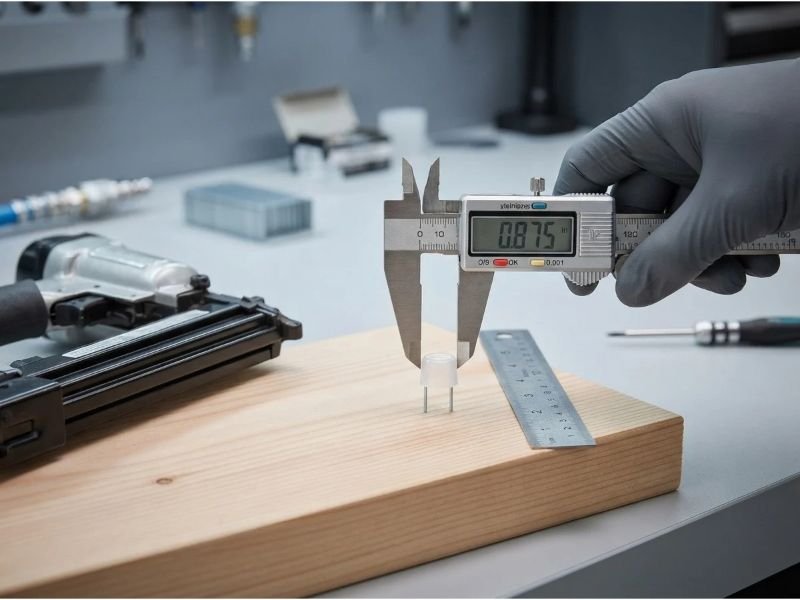
A 7/8-inch cap staple can theoretically penetrate up to about 7/8 inch, but its actual penetration into the underlying wood will normally be slightly less.
The basic relationship is:
Staple penetration = staple leg length − thickness of material being fastened
For example, if the membrane being fastened is approximately 1/16 inch thick:
7/8 inch − 1/16 inch = about 13/16 inch
That means roughly 13/16 inch of staple could enter the substrate under ideal conditions.
In real-world installations, the actual embedment may be somewhat less because of:
- Stapler depth setting
- Wood density
- Surface irregularities
- Staple design
- Cap thickness and shape
- Multiple layers of material
- Whether the staple is driven completely flush
For thin roofing felt or housewrap over plywood or OSB, a properly driven 7/8-inch cap staple will usually provide substantial penetration into the sheathing.
Is 7/8 Inch the Staple Length or Penetration Depth?
The 7/8-inch measurement normally refers to the staple leg length, not guaranteed penetration depth.
This distinction is important.
A staple has:
- A crown, which connects the two legs
- Two staple legs, which penetrate the material
- A plastic or metal cap, depending on the fastener system
With a 7/8-inch staple, the legs are approximately 7/8 inch long from the crown to the tips.
However, some of that length passes through the material you are fastening before entering the wood underneath.
For example:
| Material Above Wood | Approximate Maximum Wood Penetration |
| Very thin housewrap | Nearly 7/8 in. |
| 1/16-in. material | About 13/16 in. |
| 1/8-in. material | About 3/4 in. |
| 1/4-in. material | About 5/8 in. |
| 1/2-in. material | About 3/8 in. |
These figures are simple length calculations, not guaranteed installed depths.
Actual penetration can vary.
What Is a 7/8-Inch Cap Staple?
A cap staple combines a staple with a relatively wide cap that spreads pressure across a larger surface area.
The cap is especially useful with thin materials that could tear around an ordinary narrow staple.
Common applications include:
- Roofing felt
- Synthetic roofing underlayment
- Housewrap
- Building wrap
- Vapor-retarder materials
- Foam insulation
- Temporary weather barriers
Instead of the narrow staple crown pressing directly against the material, the cap distributes the holding force over a wider area.
This can reduce tearing and help prevent wind from pulling the membrane away from the substrate.
Why Doesn’t a 7/8-Inch Staple Always Penetrate 7/8 Inch?
Several factors reduce actual penetration.
Material Thickness
Anything between the cap and the wood consumes part of the staple’s usable leg length.
If you staple through a very thin membrane, this difference is small.
If you fasten through foam board or several layers of material, the amount of staple entering the wood can decrease considerably.
Stapler Depth Adjustment
Many pneumatic and cordless cap staplers include depth-of-drive adjustment.
If the tool is set too shallow, the staple may not enter completely.
If it is set too deep, the cap can crush or tear the membrane.
The ideal setting usually leaves the cap snug against the material without cutting through it.
Air Pressure
With pneumatic staplers, insufficient air pressure can leave staples partially raised.
Excessive pressure can drive the cap too deeply.
Always stay within the tool manufacturer’s specified operating-pressure range and use the depth adjustment whenever possible.
Wood Density
Staples generally penetrate softwood more easily than dense lumber.
Plywood, OSB, framing lumber, and engineered wood can all produce slightly different driving results.
Stapler Angle
Cap staples should normally be driven as close to perpendicular to the work surface as practical.
Driving at an angle reduces effective embedment and can cause one staple leg to penetrate differently from the other.
How Deep Should a Cap Staple Penetrate Into Wood?
There is no single penetration depth that is correct for every cap-staple application.
The required embedment depends on:
- Material manufacturer instructions
- Fastener specifications
- Substrate
- Wind exposure
- Whether the installation is temporary or permanent
- Local building-code requirements
For roofing underlayment and housewrap, the objective is generally to achieve enough penetration for the staple to hold securely without damaging the membrane.
A longer staple does not automatically create a better installation.
The fastener must be compatible with both the material and substrate.
Is a 7/8-Inch Cap Staple Long Enough for Roofing Felt?
A 7/8-inch cap staple can be suitable for some roofing-felt installations, especially when the felt is being attached directly to wood roof decking.
Because traditional roofing felt is thin, most of the staple length can enter the plywood or OSB underneath.
However, whether cap staples are permitted as the final fastener depends on:
- Roofing-material manufacturer’s instructions
- Underlayment requirements
- Roof slope
- Wind conditions
- Local building requirements
Some roofing systems or jurisdictions may require cap nails rather than cap staples in certain situations.
Always follow the underlayment manufacturer’s fastening schedule.
How Much Does a 7/8-Inch Cap Staple Enter Roof Sheathing?
If a thin underlayment is directly over plywood or OSB, most of a 7/8-inch staple leg can enter the sheathing.
For example, suppose the underlayment is only around 1/16 inch thick.
The simple theoretical penetration would be:
7/8 − 1/16 = 13/16 inch
Actual penetration might be somewhat lower depending on the cap stapler and surface.
This means a 7/8-inch staple generally provides much more than surface-level attachment when used over thin membranes.
Is a 7/8-Inch Cap Staple Too Long for 1/2-Inch Sheathing?
If you drive a 7/8-inch staple through a thin membrane into 1/2-inch plywood or OSB, the staple legs may extend through the back of the sheathing.
For example, nearly 3/4 inch or more of penetration into a 1/2-inch panel means part of the staple can protrude through the underside.
Whether this matters depends on the application.
On a roof deck, protruding staple points beneath the decking may be common with some approved fasteners, but you still need to follow the required fastener specification.
For walls, exposed points can become a concern if the back side of the sheathing is accessible.
Will a 7/8-Inch Staple Go Through 1/2-Inch Plywood?
Yes, it can.
A 7/8-inch staple driven through a very thin surface material can easily pass through 1/2-inch plywood.
The amount extending beyond the plywood depends on:
- Actual staple length
- Thickness of the membrane
- Driving depth
- Plywood’s actual thickness
If avoiding penetration through the rear surface is important, select staple length based on the total thickness of the materials.
How Deep Should the Cap Be Driven?
The cap should generally sit flat and snug against the surface, not float above it and not cut deeply into the membrane.
A properly installed cap usually:
- Holds the membrane securely
- Lies relatively flat
- Does not tear the material
- Does not noticeably crush the substrate
- Keeps the staple crown properly seated
If the cap remains loose, the staple may be underdriven.
If the cap cuts into or through the material, the staple may be overdriven.
What Happens If a Cap Staple Is Underdriven?
An underdriven staple does not fully seat the cap against the surface.
This can cause:
- Loose underlayment
- Poor wind resistance
- Raised fasteners
- Problems installing roofing material over the fastener
- Reduced holding strength
If many staples are underdriven, adjust the stapler rather than manually correcting every fastener.
What Happens If a Cap Staple Is Overdriven?
Driving the staple too deeply can be equally problematic.
An overdriven cap may:
- Tear roofing felt
- Cut synthetic underlayment
- Damage housewrap
- Crush foam insulation
- Reduce the cap’s ability to distribute load
The goal is secure contact, not maximum possible depth.
How to Check Cap Staple Penetration
If you are unsure whether the staple length is appropriate, make a test installation before starting the full project.
Step 1: Use a Scrap Piece
Use the same membrane and substrate that will be used in the actual installation.
Step 2: Drive Several Staples
Hold the tool square to the surface and drive a few staples.
Step 3: Inspect the Caps
The caps should be seated firmly without tearing the material.
Step 4: Inspect the Back of the Substrate
If accessible, check whether the staple legs extend through the material.
This is particularly useful when working with thin plywood.
Step 5: Measure Actual Embedment
If precise penetration matters, remove or cut a sample section and physically measure the embedded staple length.
A real test is more reliable than estimating penetration from the labeled staple size alone.
7/8-Inch vs. Shorter Cap Staples
Choosing between staple lengths depends primarily on material thickness.
| Staple Length | General Characteristic |
| Short staple | Less penetration and less rear-side protrusion |
| Medium staple | Useful for many thin-sheet applications |
| 7/8-in. staple | Provides relatively deep penetration |
| Longer staple | Useful when fastening through thicker materials |
Do not choose staple length based only on the assumption that longer means stronger.
Too much length can create unwanted protrusion, while too little length may provide inadequate holding power.
7/8-Inch Cap Staples vs. Cap Nails
Cap staples and cap nails serve similar purposes but use different fastener designs.
A cap staple uses two narrow legs connected by a crown.
A cap nail uses a single nail shank underneath a wide cap.
Cap nails can offer stronger withdrawal resistance in some applications, while cap staples can be very fast to install with a pneumatic or cordless cap stapler.
Which fastener should be used depends on the specific building material and its installation instructions.
For roofing work, never assume the two fasteners are interchangeable simply because both have plastic caps.
Can a Regular Staple Gun Shoot 7/8-Inch Cap Staples?
Usually not.
A 7/8-inch cap staple often requires a dedicated cap stapler designed for that particular staple and cap system.
Many ordinary hand staple guns accept much shorter staples and do not have a mechanism for feeding plastic caps.
Some specialized tools automatically feed both the cap and staple during each trigger cycle.
Check the stapler’s specifications before purchasing fasteners.
Using an incompatible staple can cause:
- Jamming
- Misfires
- Tool damage
- Poor fastening
- Unsafe operation
Safety When Using 7/8-Inch Cap Staples
A 7/8-inch staple is long enough to penetrate many common sheet materials completely.
Before stapling, make sure there are no:
- Electrical wires
- Plumbing lines
- Hands
- Fingers
- Finished surfaces
directly behind the material.
Wear eye protection while using a pneumatic, cordless, or powered cap stapler.
Never hold thin material with your hand directly behind the point where the fastener will be driven.
Treat a cap stapler as a power fastening tool rather than an ordinary office stapler.
FAQs About How Deep Does a 7 8 Inch Cap Staple Penetrate
Does a 7/8-inch staple penetrate a full 7/8 inch?
Not necessarily. 7/8 inch is generally the staple leg length. The actual penetration into the substrate is reduced by the thickness of the material being fastened and may also vary with the tool’s depth setting.
How deep will a 7/8-inch staple go into plywood?
Through a very thin membrane, it can penetrate close to the full staple length. For example, through approximately 1/8 inch of material, theoretical plywood penetration is about 3/4 inch.
Will a 7/8-inch staple go through 1/2-inch plywood?
Yes. If there is only a thin membrane above the plywood, the staple points can extend through the rear side of 1/2-inch plywood.
Are 7/8-inch cap staples good for roofing felt?
They can be suitable for certain roofing-felt installations, but the underlayment manufacturer and applicable building requirements should determine the required fastener type, length, and spacing.
Are 7/8-inch cap staples good for housewrap?
They may be appropriate for some housewrap systems because the cap spreads the load and reduces tearing. Always follow the housewrap manufacturer’s fastening specifications.
Should a cap staple be flush?
The cap should normally sit snug and relatively flat against the material without cutting or tearing it.
Does thicker material reduce staple penetration?
Yes. Every layer between the cap and substrate uses part of the staple’s leg length, leaving less length available to penetrate the substrate.
Is deeper staple penetration always better?
No. The staple needs enough embedment to provide the required holding power, but excessive length can result in unnecessary penetration or exposed staple points behind thin sheathing.
Conclusion
So, how deep does a 7 8 inch cap staple penetrate? The staple itself has legs approximately 7/8 inch long, but the actual penetration into wood is slightly less because part of the staple must pass through the roofing felt, housewrap, underlayment, or other material above the substrate.
With very thin material, penetration can approach 7/8 inch. Through approximately 1/8 inch of material, the theoretical penetration is about 3/4 inch.
The best staple length depends on the material thickness, substrate, stapler settings, and manufacturer requirements. For roofing or exterior building applications, use the specified fastener rather than choosing a staple only by its maximum penetration depth.