Can You Use Caps With a Regular Staple Gun? Installation Guide
The short answer to can you use caps with a regular staple gun is generally no, not in the normal automatic way. A regular staple gun is designed to feed and drive staples only; it does not have the mechanism needed to feed, position, and fasten plastic caps with each staple.
You may be able to manually place certain loose plastic caps and drive a compatible staple through them, but this is slow, awkward, and may not produce consistent fastening. For housewrap, roofing felt, foam board, and similar building materials, a cap stapler or another approved cap-fastening tool is usually the better choice.
Can You Use Caps With a Regular Staple Gun?
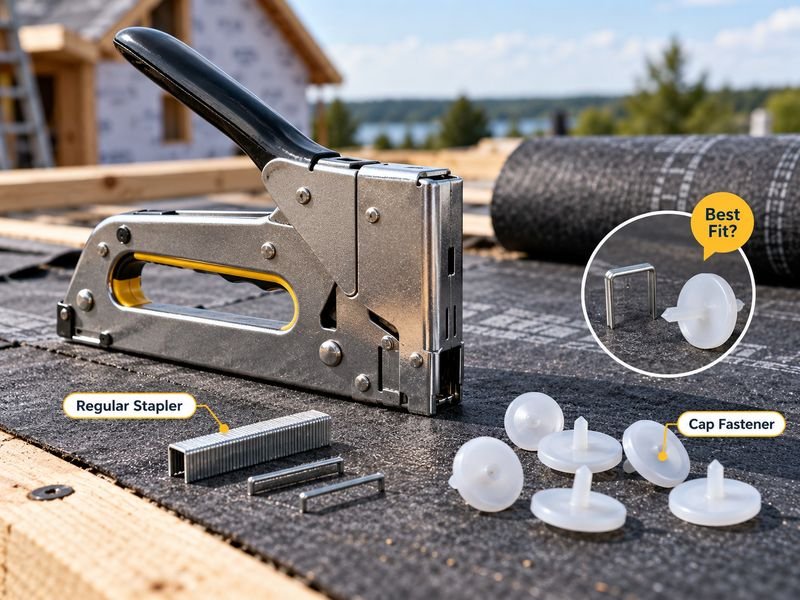
A standard staple gun generally cannot automatically use cap staples because cap fasteners require both a staple and a plastic cap to be positioned together.
A dedicated cap stapler feeds the cap into position and then drives the staple through its center. A regular staple gun feeds only staples.
However, there is an important distinction.
Some loose plastic fastening caps are designed so that you can manually position the cap over the material and then drive a staple through it. Whether this works properly depends on:
- The type of cap
- Staple size
- Staple gun design
- Material being fastened
- Installation requirements
So while manual use may sometimes be physically possible, a regular staple gun is not a direct replacement for a cap stapler.
What Are Staple Caps?
Staple caps are small, usually round plastic discs installed underneath staples.
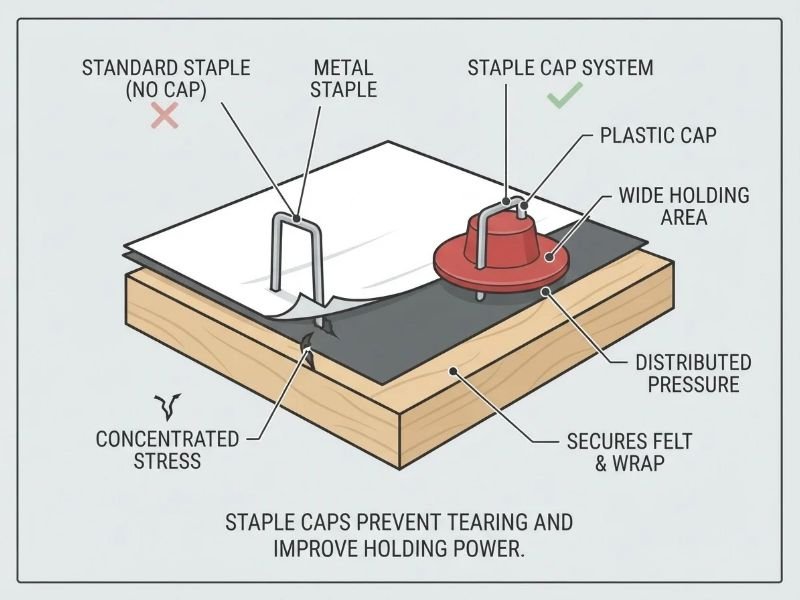
Instead of the narrow crown of the staple pressing directly against housewrap, roofing felt, or foam, the cap spreads the holding pressure across a larger surface.
This helps prevent thin materials from:
- Tearing around the staple
- Pulling away in wind
- Sliding around the fastener
- Being punctured excessively
- Pulling over the staple crown
The larger bearing surface is the main advantage of a cap fastener.
What Is a Cap Stapler?
A cap stapler is a fastening tool designed to install plastic caps and staples together.
Depending on the model, it may be:
- Manual
- Hammer-style
- Pneumatic
- Battery powered
The tool normally carries a supply of staples along with a separate strip, roll, or stack of caps.
When you operate the tool, it positions a cap against the work surface and drives a staple through it in one action.
This makes installation much faster than manually placing every cap.
Why Doesn’t a Regular Staple Gun Work Like a Cap Stapler?
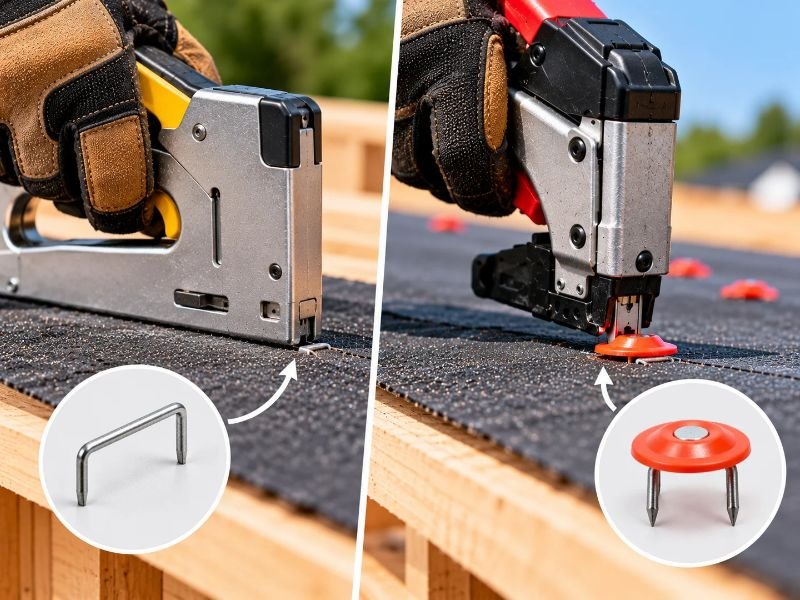
The difference is in the feeding system.
A standard staple gun contains a magazine for staples. Each time the trigger or handle is operated, the gun advances another staple into position.
There is nowhere for a plastic cap to go.
A cap stapler has an additional mechanism that:
- Feeds a cap.
- Places it under the nose of the tool.
- Positions the staple over the cap.
- Drives the staple through the cap.
- Advances the next cap.
A regular staple gun cannot perform those additional steps.
Can You Place the Caps by Hand?
With some types of loose fastening caps, yes.
You can potentially:
- Position the material.
- Place the plastic cap by hand.
- Put the staple gun over the center of the cap.
- Drive an appropriately sized staple through it.
This method may work for a very small project or occasional repair.
However, it has several disadvantages.
It Is Much Slower
Every cap must be positioned individually.
On a large housewrap or roofing project, you may need hundreds or thousands of fasteners. Manual placement quickly becomes inefficient.
Staple Placement Can Be Inconsistent
The staple needs to land correctly on the cap.
If it is too close to the edge, the cap may:
- Split
- Bend
- Pull loose
- Fail to distribute pressure properly
A dedicated cap stapler positions the staple much more consistently.
Caps Can Move Before Fastening
Loose plastic caps are small and lightweight.
Wind, gloves, uneven surfaces, or working overhead can make them difficult to hold in position.
You Need Compatible Caps and Staples
Not every plastic cap is designed to have a standard staple driven through it.
Some cap systems are made specifically for proprietary tools or particular fastener sizes.
Check the cap manufacturer’s instructions before trying to use a regular stapler.
What Is the Difference Between Regular Staples and Cap Staples?
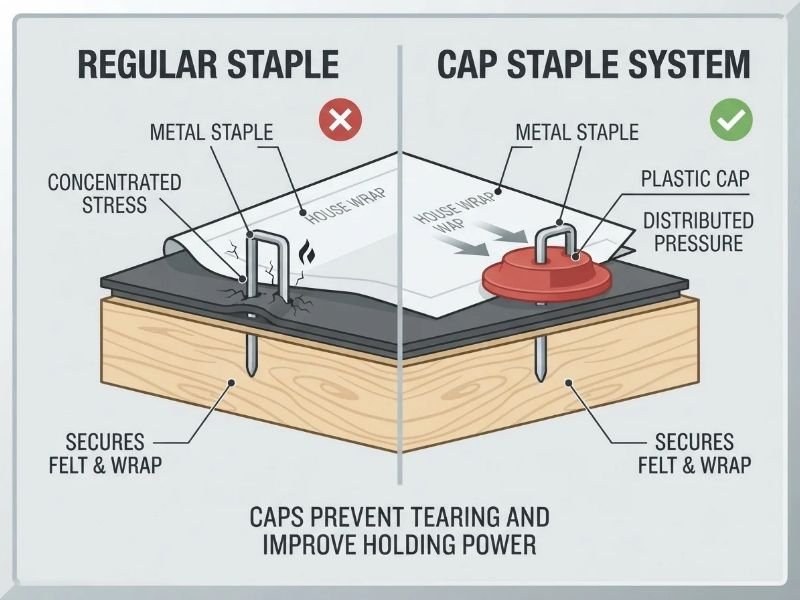
The main difference is the size of the area holding the material.
A normal staple contacts the material primarily through its narrow crown.
A cap staple uses a larger plastic disc.
| Feature | Regular Staple | Cap Staple |
| Plastic cap | No | Yes |
| Holding surface | Small | Larger |
| Tear resistance | Lower | Higher |
| Housewrap use | Depends on requirements | Common |
| Wind resistance | Generally lower | Generally higher |
| Special tool | Standard stapler | Usually cap stapler |
| Installation speed | Fast | Fast with proper tool |
Neither fastener is universally better for every job.
The correct fastener depends on what you are installing.
Why Are Caps Used With Housewrap?
Housewrap is relatively thin and lightweight.
If a plain staple is driven directly through housewrap, the narrow staple crown creates a concentrated load.
Wind can pull against the wrap and gradually tear the material around the staple.
A plastic cap spreads that force over a larger area.
This gives the fastener more resistance to pull-through.
Cap fasteners are therefore commonly used when installing:
- Housewrap
- Weather-resistant barriers
- Building wrap
- Foam insulation
- Roofing underlayment
- Roofing felt
- Synthetic underlayment
The exact fastening requirements should always come from the product manufacturer and applicable building requirements.
Can You Use Regular Staples for Housewrap?
Sometimes plain staples may be permitted for temporary positioning, but you should not automatically assume they are acceptable for final installation.
Different housewrap manufacturers specify different fastening methods.
Instructions may call for:
- Cap staples
- Cap nails
- Plastic-cap fasteners
- Specific staple dimensions
- Particular fastening spacing
If the manufacturer’s instructions require cap fasteners, installing only ordinary staples may not meet the intended installation method.
Always check the instructions for the exact housewrap you are using.
Can You Use Caps With an Electric Staple Gun?
An ordinary electric staple gun generally has the same limitation as a manual staple gun: it feeds staples but does not automatically feed plastic caps.
If the caps are specifically designed for manual placement, it may be possible to place each cap yourself and then drive a compatible staple through it.
But an electric staple gun does not become a true cap stapler simply because the driving force is electric.
A purpose-built cap tool remains faster and more consistent.
Can You Use Caps With a Pneumatic Staple Gun?
The same basic rule applies.
A normal pneumatic staple gun can drive staples quickly, but unless it is specifically designed as a cap stapler, it will not automatically feed caps.
Loose caps might be manually positioned if they are compatible with the staples and application.
For large jobs, using a pneumatic cap stapler is much more practical.
Can You Use Roofing Caps With a Staple Gun?
It depends on the specific roofing caps.
Some plastic roofing caps are designed for cap nails, while others can accept staples.
You should never assume that a cap designed for a nail will work correctly with an ordinary staple.
Check:
- Hole or fastening area
- Recommended fastener type
- Staple crown width
- Staple leg length
- Installation instructions
Roofing and underlayment installations can also have specific fastening requirements, especially in high-wind areas.
What Size Staples Do Cap Staplers Use?
There is no universal cap-staple size.
Different tools use different:
- Crown widths
- Staple gauges
- Leg lengths
- Cap diameters
Common cap systems often use approximately 1-inch plastic caps, but the staple itself may vary considerably depending on the tool and material.
Use the exact staple type listed for your cap stapler.
Trying to substitute a similar-looking staple can cause:
- Jamming
- Poor fastening
- Incomplete driving
- Tool damage
- Misaligned caps
When Should You Buy a Cap Stapler?
A dedicated cap stapler makes sense when you are installing a significant amount of material.
For example, consider one if you are working with:
- An entire house of housewrap
- Large amounts of roofing felt
- Synthetic roof underlayment
- Exterior foam board
- Large weather-barrier installations
The time saved can be substantial.
For only a few replacement caps or a small repair, manually placed compatible caps may be sufficient.
Cap Stapler vs Cap Nailer
Both tools increase the fastener’s bearing area by using a plastic cap, but they use different fasteners.
Cap Stapler
A cap stapler drives a staple through a plastic cap.
It can be fast and convenient for lightweight sheet materials.
Cap Nailer
A cap nailer drives a nail through a plastic cap.
Cap nails may provide greater withdrawal resistance in applications where nails are specified.
Which one is appropriate depends on the material and installation instructions.
Do not substitute staples for nails where the manufacturer specifically calls for cap nails.
Can You Make a Regular Staple Gun Into a Cap Stapler?
Usually, no.
A cap stapler has a purpose-built cap feeding and positioning system.
Adding loose caps to a conventional staple gun does not give it:
- Automatic cap feeding
- Cap alignment
- Correct indexing
- One-action installation
Some manufacturers may sell accessories designed for specific tools, but only use accessories specifically approved for your staple gun.
Do not modify the nose, magazine, or safety mechanism of a staple gun to make it accept caps.
Problems With Manually Installing Caps
Hand-installing caps may look simple, but a few problems are common.
Staple Misses the Center
An off-center staple may crack or distort the cap.
Staple Is Driven Too Deep
Excessive driving can crush the cap or damage the material beneath it.
The cap should secure the material without cutting through it.
Staple Is Too Shallow
A high staple leaves the cap loose and may allow the material to move.
Incorrect Staple Length
A staple needs enough penetration into the substrate to hold properly.
The correct length depends on the material, substrate, and manufacturer’s requirements.
Wrong Type of Cap
Some caps are designed for nails rather than staples.
Using incompatible components can create a weak fastening point.
How to Install Loose Caps With a Regular Staple Gun
If the cap manufacturer permits installation with ordinary staples, the basic process is simple.
Step 1: Verify Compatibility
Confirm that the cap can be installed using the type and size of staple your gun accepts.
Step 2: Position the Material
Keep the housewrap, felt, or other sheet material flat against the substrate.
Avoid wrinkles around the fastening point.
Step 3: Position the Cap
Place the cap flat against the material.
Step 4: Center the Staple Gun
Place the staple gun nose so that the staple will cross the intended fastening area of the cap.
Step 5: Drive the Staple
Drive the staple firmly without crushing the cap excessively.
Step 6: Inspect the Fastener
Make sure:
- The cap sits flat.
- The staple is centered.
- The material is secure.
- The staple is not excessively recessed.
If the cap cracks or bends repeatedly, the caps, staples, or gun may not be compatible.
Is Buying a Cap Stapler Worth It?
For a large project, usually yes.
The biggest benefit is productivity.
Instead of repeatedly:
- Picking up a cap
- Positioning it
- Holding it
- Aligning the staple gun
- Firing the staple
you can usually install a cap and staple in one motion.
A dedicated tool also produces more consistent placement.
For a homeowner making a very small repair, purchasing a specialized tool may not be necessary. Renting, borrowing, or manually installing approved loose caps may make more sense.
Safety When Using Staple and Cap Tools
Staple guns can easily penetrate skin.
Keep your hands away from the firing area and never hold a cap directly underneath the nose of a powered stapler while firing.
Other basic precautions include:
- Wear eye protection.
- Disconnect pneumatic air before clearing jams.
- Remove the battery before servicing cordless tools.
- Never point a staple gun toward yourself or another person.
- Use only approved fasteners.
- Follow the tool manufacturer’s instructions.
If you are manually placing caps, position your fingers away from the path of the staple gun before firing.
FAQs About Can You Use Caps With a Regular Staple Gun
Can you manually use cap staples with a regular stapler?
Sometimes. Certain loose plastic caps can be positioned manually and fastened with a compatible staple.
However, the cap and staple must be intended to work together.
Do I need a special stapler for cap staples?
For automatic installation, yes.
A cap stapler has a separate mechanism that feeds and positions each plastic cap before driving the staple.
Can I use a regular staple gun for housewrap?
A regular staple gun can physically attach housewrap, but whether plain staples are acceptable depends on the housewrap manufacturer’s installation instructions and applicable requirements.
Cap fasteners are often specified because they provide a larger holding surface.
Are cap staples stronger than regular staples?
The staple itself is not necessarily stronger.
The advantage comes from the plastic cap, which distributes the load over a wider area and reduces the chance of thin sheet material tearing around the fastener.
Can I put a plastic cap under a normal staple?
Some loose caps are designed for this method.
Check the cap’s specifications and make sure the staple crown and length are compatible.
Can I use cap nails instead of cap staples?
Possibly, and in some applications cap nails may be specifically required or preferred.
Follow the installation instructions for the housewrap, underlayment, or other material being installed.
Do cap staples hold housewrap better?
Generally, cap fasteners provide better resistance to pull-through because the plastic cap spreads the load over a larger section of housewrap.
The exact performance depends on the fastener, substrate, installation, and product requirements.
Are regular staples okay for roofing felt?
Do not assume they are. Roofing felt and underlayment manufacturers may specify cap nails, cap staples, or other approved fasteners.
Follow the instructions for the particular roofing product and local requirements.
Conclusion
So, can you use caps with a regular staple gun? A normal staple gun cannot automatically feed and install caps like a dedicated cap stapler. Some loose plastic caps can be manually positioned and fastened using a compatible regular staple, but this method is slower and requires careful alignment.
For a small repair, manually installed approved caps may be practical. For large housewrap, roofing underlayment, or exterior weather-barrier projects, a cap stapler or cap nailer is generally the more efficient and consistent tool. Most importantly, use the fastening method specified by the material manufacturer rather than assuming ordinary staples are an acceptable substitute.