
Are Staples or Cap Nails Better for Installing Roofing Felt?
If you are wondering are staples or cap nails better for installing roofing felt, cap nails are generally the better choice for a permanent roofing-felt installation. Their wide plastic or metal caps spread pressure over a larger area, helping prevent the felt from tearing or pulling away from the roof deck.
Plain staples are faster and inexpensive, but their narrow crowns concentrate pressure in a small area. During wind exposure or while workers move across the roof, staples can more easily tear through felt, especially if the underlayment remains uncovered for a while.
There are situations where staples may still be acceptable, and cap staples provide better holding performance than ordinary staples. However, the correct fastener ultimately depends on the roofing-felt manufacturer, roofing material, local building requirements, roof slope, and how quickly the final roof covering will be installed.
Are Staples or Cap Nails Better for Installing Roofing Felt?
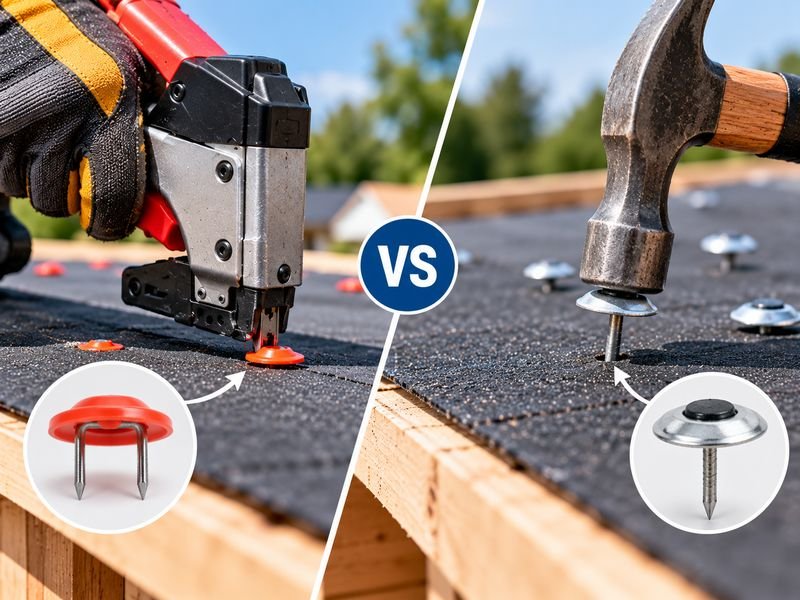
For most permanent installations, cap nails are better for installing roofing felt than plain staples. A cap nail combines a roofing nail with a wide plastic or metal washer-like cap that presses the felt firmly against the roof decking.
The larger contact area provides three important advantages:
- Better resistance to wind uplift
- Less chance of tearing through the felt
- More secure attachment while the roof covering is installed
Plain staples can hold roofing felt temporarily, but their narrow metal crown does not distribute pressure nearly as well.
If the felt will remain exposed to wind or weather before shingles are installed, the advantage of cap nails becomes even more important.
What Are Cap Nails?
Cap nails are roofing fasteners that combine a nail with a wide plastic or metal cap.
The nail penetrates the roof decking while the cap sits on top of the roofing felt or underlayment.
Instead of concentrating the holding force around a small nail head, the cap distributes it over a much larger surface.
This helps protect relatively thin roofing materials from ripping.
Cap nails are commonly used with:
- Asphalt roofing felt
- Synthetic roof underlayment
- Housewrap
- Roofing membranes approved for mechanical fastening
For roofing applications, use corrosion-resistant fasteners that are suitable for exterior exposure and compatible with the roofing system.
What Are Roofing Staples?
Roofing staples are usually installed with a hammer stapler, pneumatic stapler, or cap stapler.
A standard staple has two legs connected by a narrow crown. Both legs penetrate the roof deck while the crown presses the roofing felt down.
Staples are popular because installation can be extremely fast.
A roofer can secure large sections of felt much faster with a stapler than by individually hammering nails.
The main disadvantage is the small contact area.
When wind pulls upward on the roofing felt, the narrow staple crown can act almost like a cutting edge and eventually pull through the material.
Why Cap Nails Usually Hold Roofing Felt Better
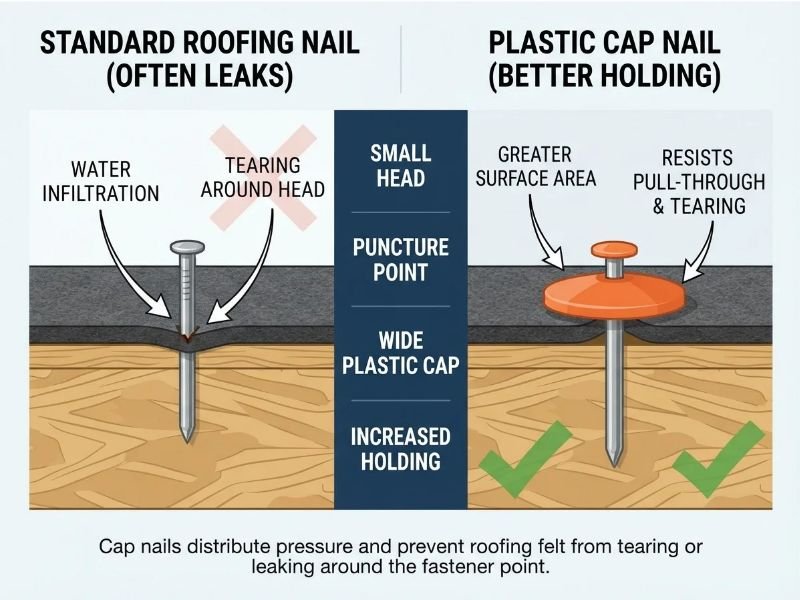
Roofing felt does not need enormous downward force. The bigger challenge is preventing the material from lifting, shifting, or tearing around each fastener.
Cap nails handle this particularly well.
Larger Holding Surface
The biggest difference is the size of the fastener head.
A standard staple presses against only a narrow strip of roofing felt.
A cap nail spreads the load across a much larger area.
When wind gets underneath exposed felt and pulls upward, the larger cap makes it more difficult for the fastener to tear through the material.
Better Tear Resistance
Roofing felt can tear relatively easily around small fasteners.
This is especially true when:
- Wind is strong
- Felt becomes wrinkled
- Fasteners are driven too deeply
- Workers walk across the underlayment
- The felt remains exposed before shingles are installed
Cap nails reduce stress around each fastening point.
They do not make roofing felt tear-proof, but they generally provide better resistance than plain staples.
Better for Temporary Weather Exposure
Ideally, roofing felt should be covered with the final roofing material relatively quickly.
Construction schedules do not always cooperate.
Rain, wind, inspections, material delays, or labor schedules may leave the underlayment exposed longer than expected.
Cap nails provide more secure attachment during that period.
However, roofing felt should not automatically be treated as a long-term exposed roof covering. Follow the manufacturer’s exposure limitations.
Are Staples Ever Acceptable for Roofing Felt?
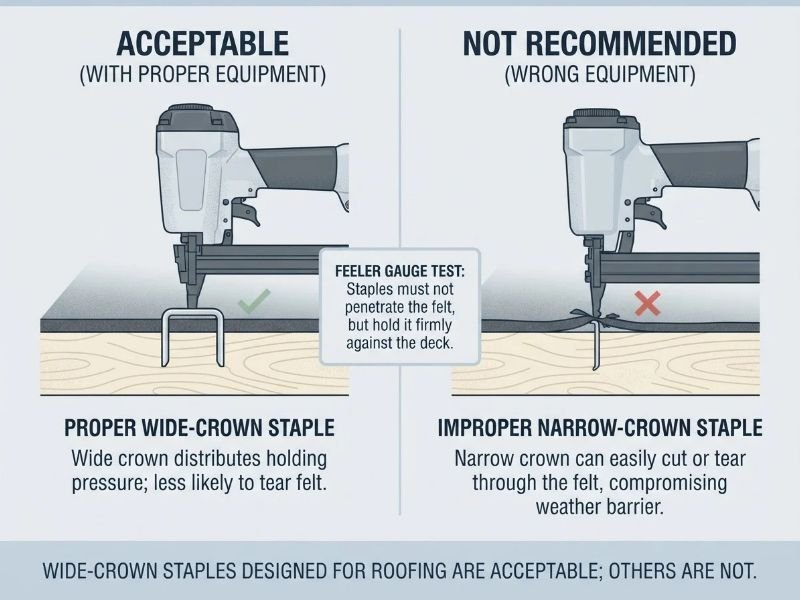
Yes, staples can be acceptable in some roofing systems, but that does not mean they are always the preferred fastener.
The answer depends on:
- Underlayment manufacturer instructions
- Roofing material installed above it
- Local building requirements
- Wind conditions
- Fastener type
- Roof deck material
- How long the underlayment will remain exposed
Plain staples are sometimes used to temporarily position traditional asphalt felt before shingles are installed.
Once shingles are properly fastened through the felt into the roof deck, the completed roofing system provides much more secure attachment.
However, a manufacturer or local code may require capped fasteners rather than ordinary staples.
Always follow whichever requirement is more restrictive.
Cap Nails vs Plain Staples for Roofing Felt
| Feature | Cap Nails | Plain Staples |
| Holding surface | Large | Small |
| Tear resistance | Better | Lower |
| Wind resistance | Better | Lower |
| Installation speed | Moderate | Very fast |
| Temporary positioning | Good | Good |
| Extended exposure | Better | Less suitable |
| Risk of pulling through felt | Lower | Higher |
| Common professional use | Very common | Depends on system |
For a typical homeowner installation, cap nails provide more margin for error.
What About Cap Staples?
There is an important third option: cap staples.
Cap staples combine the installation speed of a stapler with a plastic cap that distributes pressure over the underlayment.
Instead of driving only a thin metal staple into the felt, a cap stapler installs a wide cap over each fastener.
This gives cap staples many of the same advantages as cap nails.
Cap Staples vs Cap Nails
Both can provide excellent holding strength when approved for the particular roofing system.
Cap staples can be faster because they can be installed with a specialized pneumatic or manual cap stapler.
Cap nails have the advantage of simplicity and do not require a specialized cap-stapling tool.
If a manufacturer permits both, the better choice often depends on the tools available and the installer’s preference.
The important distinction is usually not nail versus staple by itself. It is often capped fastener versus uncapped fastener.
Why Plain Staples Can Tear Roofing Felt
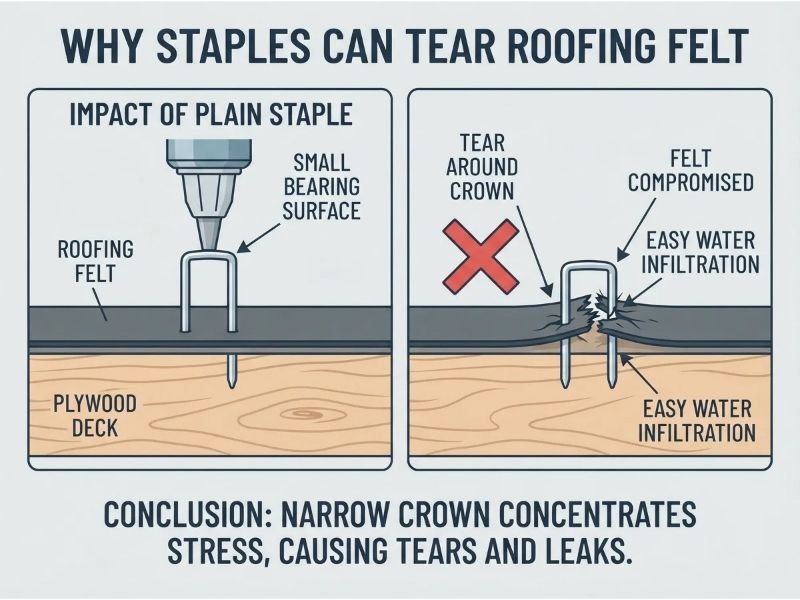
Imagine pulling upward on a sheet of paper held down by a thin piece of wire.
The force becomes concentrated along that narrow edge.
Roofing felt behaves similarly.
When wind creates uplift, the roofing felt pulls upward while the staple stays anchored in the plywood or OSB roof deck.
The narrow staple crown concentrates that load into a very small section of felt.
Eventually, the material may rip around the staple.
A wide cap spreads the same force over a larger area, reducing stress on the underlayment.
Can You Use a Hammer Tacker for Roofing Felt?
A hammer tacker can quickly secure roofing felt with staples, and it has traditionally been used for this type of work.
However, whether it is appropriate for your roof depends on the installation requirements.
A hammer tacker is particularly useful for temporarily positioning felt while additional roofing work proceeds.
It is less suitable when the underlayment manufacturer specifically calls for capped fasteners.
Before using a hammer tacker across an entire roof, check the printed installation instructions for the felt or synthetic underlayment.
How Long Will the Roofing Felt Be Exposed?
Exposure time should influence your fastener choice.
If shingles will be installed almost immediately and the manufacturer permits staples, ordinary staples may be adequate for temporary positioning.
If the felt may remain exposed for several days, cap nails or approved cap staples provide a more secure attachment.
Weather conditions also matter.
A calm day can quickly turn into a windy one. Once wind gets underneath an edge of loosely attached felt, it can pull a surprisingly large section away from the roof.
Secure edges, overlaps, and field areas according to the manufacturer’s fastening pattern.
Does Fastener Spacing Matter?
Yes.
Using cap nails does not compensate for widely spaced or incorrectly positioned fasteners.
Roofing underlayment manufacturers normally specify a particular fastening pattern.
Spacing may differ around:
- Roof edges
- Overlaps
- Valleys
- Ridges
- Field areas
Wind requirements can also affect fastening patterns.
Do not simply place a few cap nails around the perimeter and assume the felt is secure.
Follow the specific instructions supplied with the underlayment.
How Deep Should Cap Nails Be Driven?
Cap nails should sit flat against the roofing felt without cutting through or severely deforming it.
Driving them too deeply defeats much of the benefit of the cap.
An overdriven fastener may:
- Damage the felt
- Reduce holding strength
- Create a tear point
- Break the plastic cap
- Pull through during wind exposure
An underdriven nail can also cause problems because the raised fastener may interfere with shingles or other roofing materials installed above it.
The goal is a secure, flat fastener, not one crushed deeply into the underlayment.
Should You Use Cap Nails With Synthetic Underlayment?
Many synthetic roofing underlayments are designed to be installed with cap nails or approved cap staples, particularly when the underlayment will be exposed before the finished roofing is installed.
Synthetic underlayment is not the same product as traditional asphalt-saturated felt.
Its fastening requirements can therefore differ.
Do not assume a fastening method that worked with older roofing felt is automatically acceptable for a modern synthetic product.
Read the manufacturer instructions printed on the roll or provided with the product.
Does Roof Deck Material Matter?
Yes.
Most residential roofing underlayments are installed over roof decking such as:
- Plywood
- OSB
- Wood plank decking
The fastener must penetrate sufficiently into the approved roof deck to remain secure.
A nail or staple that barely enters the decking may pull out regardless of how good the cap is.
Old, deteriorated, damaged, or excessively thin decking can also reduce fastener holding strength.
If the deck feels soft or damaged, repair the decking rather than trying to compensate with more fasteners.
What Type of Cap Nails Should You Use?
Use roofing cap nails specifically approved for the underlayment and roof deck.
Important characteristics include:
Corrosion resistance: Roofing fasteners can be exposed to moisture during construction.
Correct length: The nail must provide adequate penetration into the roof decking.
Proper cap size: The cap should meet the underlayment manufacturer’s requirements.
Compatible material: Fasteners should be appropriate for the roofing system and environmental conditions.
Avoid choosing fasteners solely because they happen to be available in the garage.
Which Is Faster to Install?
Plain staples are generally faster.
A pneumatic or hammer stapler can place fasteners rapidly while the installer moves across the roof.
Cap nails take longer when installed manually.
However, pneumatic cap nailers and cap staplers can significantly increase installation speed while still providing a wider holding surface.
For a professional crew covering large roof areas, powered capped-fastener systems can provide both speed and secure attachment.
Which Option Is Better in Windy Areas?
Cap nails or approved cap staples are generally the stronger choice when wind exposure is a concern.
The wide cap helps resist the underlayment tearing around the fastener.
However, fastening is only one part of wind resistance.
Proper installation also requires:
- Correct overlaps
- Secure roof edges
- Proper fastener spacing
- Flat installation without large wrinkles
- Prompt installation of the final roof covering
A poorly installed sheet of felt can still fail even when cap nails are used.
Common Mistakes When Fastening Roofing Felt
One common mistake is overdriving the fasteners.
The cap should hold the felt firmly without cutting through it.
Another problem is stretching roofing felt excessively tight. Underlayment should lie properly against the deck, but forcing it under excessive tension can make tearing more likely.
Poor overlap is another concern. Even securely fastened roofing felt may allow water intrusion if courses are installed with inadequate overlap.
Finally, do not ignore weather forecasts. Leaving partially fastened felt exposed before a windstorm can result in large sections being damaged or removed.
Should DIY Roofers Use Cap Nails?
For many DIY roofing projects, cap nails are the safer general choice because they provide a large holding surface and are relatively easy to install correctly.
They are particularly useful when the homeowner does not know exactly how long the roof will remain uncovered.
That said, the product instructions should always take priority.
If the roofing felt or underlayment specifies another approved fastening method, follow those requirements.
Roof work also involves significant fall risk. Use proper roof access, fall protection, footwear, and safe working practices. Steep, high, wet, icy, or otherwise hazardous roofs are better handled by qualified roofing professionals.
FAQs About Are Staples or Cap Nails Better for Installing Roofing Felt
Can You Staple Roofing Felt Down?
Yes, staples may be permitted for some roofing felt installations.
However, plain staples provide a smaller holding area than capped fasteners and can more easily tear through the felt. Check the underlayment manufacturer’s requirements before using them.
Are Cap Nails Better Than Staples for Roofing Felt?
Generally, yes. Cap nails provide better tear and wind resistance because the wide cap spreads the holding force over a larger area.
Plain staples are faster but have a higher chance of pulling through the felt.
Are Cap Staples as Good as Cap Nails?
They can be when the underlayment manufacturer approves them.
Cap staples provide a large holding surface while allowing fast installation with a cap stapler.
Can I Use Regular Roofing Nails Instead of Cap Nails?
That depends on the roofing underlayment and applicable installation requirements.
A regular roofing nail has a larger head than many ordinary nails, but a cap nail provides an even larger contact area. Follow the manufacturer’s specified fastener type.
How Far Apart Should Fasteners Be on Roofing Felt?
Fastener spacing varies by underlayment, roof location, and installation conditions.
Rather than using one universal spacing, follow the fastening pattern provided by the roofing-felt manufacturer and any applicable local requirements.
Can Roofing Felt Be Left Exposed With Staples?
Even when staples are permitted, long exposure increases the chance of wind and weather damage.
Capped fasteners generally provide better security if the underlayment must remain exposed. Always observe the manufacturer’s maximum exposure recommendations.
Do Cap Nails Damage Roofing Felt?
Not when installed correctly.
The cap should sit flat against the material. Overdriving the nail can crush the cap or damage the felt.
Should I Use Cap Nails for 15-Pound and 30-Pound Roofing Felt?
Cap nails can be used with many traditional asphalt roofing felts and provide excellent holding strength. However, always verify the installation instructions for the particular product being installed.
Conclusion
If your question is are staples or cap nails better for installing roofing felt, cap nails are generally the better permanent fastening choice because their wide caps provide stronger holding power and reduce the chance of the felt tearing around the fastener.
Plain staples offer faster installation and may be acceptable for certain roofing-felt systems, particularly for temporary positioning. Cap staples can provide a useful middle ground by combining fast installation with a larger holding surface.
Regardless of the fastener you choose, follow the underlayment manufacturer’s instructions and applicable local roofing requirements. Proper fastener type, spacing, penetration, overlaps, and installation technique all work together to keep roofing felt secure until the finished roof covering is installed.