
What Is a Finish Nail Gun? Uses, Types, Sizes, and Full Guide
A finish nail gun is a power tool designed to drive relatively thin finishing nails into wood quickly and neatly. It is mainly used for projects where the fastener needs to provide more holding strength than a brad nail while leaving a much smaller hole than a framing nail.
If you are wondering what is a finish nail gun, think of it as the nailer commonly used for baseboards, door and window casing, crown molding, cabinets, stair trim, and other finish carpentry. Most finish nailers use 15-gauge or 16-gauge finish nails, although the exact nail length and style depend on the tool.
You may also hear the tool called a finish nailer, finishing nail gun, or finishing nailer. These names usually refer to the same general type of tool.
Finish nailers are available in pneumatic, cordless battery-powered, and other powered designs. Some have straight magazines, while others use angled magazines to make it easier to reach corners and tight spaces.
This pillar guide covers what a finish nail gun is, what a finish nailer gun is used for, what a finishing nail gun is called, how it works, nail sizes, gauge differences, types, applications, advantages, limitations, safety, maintenance, and how it compares with other common nail guns.
What Is a Finish Nail Gun?
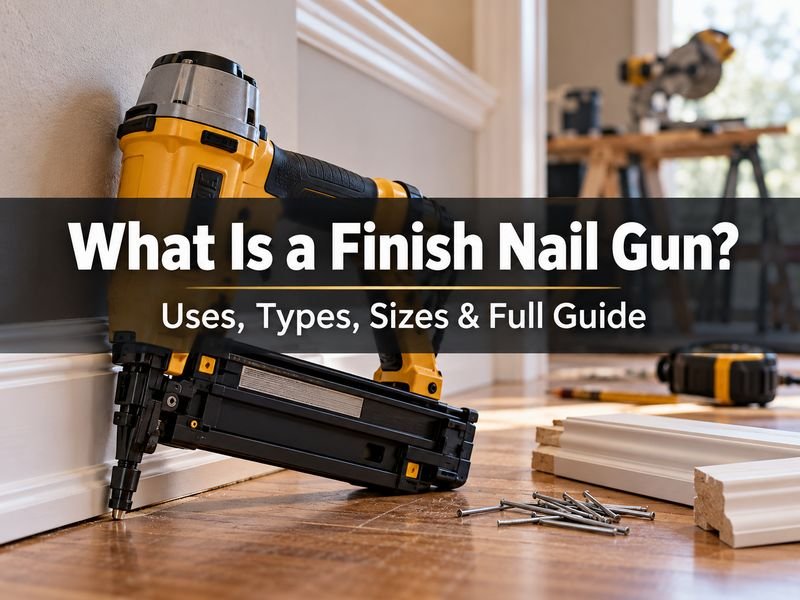
A finish nail gun is a powered fastening tool that drives finish nails into wood and similar materials. It is commonly used during the final stages of woodworking and construction, especially when installing decorative trim and other visible woodwork.
Unlike a hammer, a finish nail gun drives a nail with a quick trigger action. This makes repetitive fastening considerably faster and can reduce hammer marks on finished wood.
Most finish nail guns are designed around either 15-gauge or 16-gauge nails.
The gauge number refers to the thickness of the nail. A lower gauge number means a thicker nail, so a 15-gauge finish nail is thicker than a 16-gauge nail.
Both sizes provide considerably more holding strength than the thinner 18-gauge brads commonly used in brad nailers.
A finish nail gun sits between a brad nailer and a framing nailer in terms of fastener size and typical application. It is strong enough for substantial trim work but generally too light for structural framing.
What Is a Finish Nailer Gun Used For?
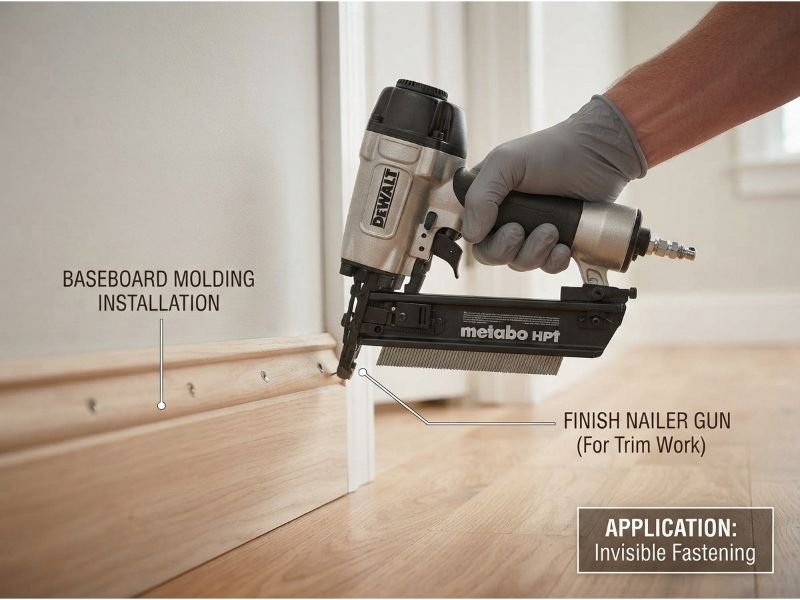
A finish nailer gun is used for attaching medium-weight finish carpentry materials, particularly trim that needs stronger fastening than an 18-gauge brad can provide.
Typical uses include installing:
- Baseboards
- Crown molding
- Door casing
- Window casing
- Chair rail
- Interior trim
- Cabinet components
- Stair trim
- Decorative molding
- Wood paneling
- Some furniture components
The exact applications depend on the material thickness, nail length, wood species, and whether you are using a 15- or 16-gauge finish nailer.
Installing Baseboards
Baseboards are one of the most common finish-nailer applications.
A finish nail can pass through the baseboard and drywall and reach the wall framing behind them when an appropriate nail length is used.
The relatively small nail head is easy to conceal with wood filler before painting.
For thicker or heavier baseboards, a finish nailer often provides better holding power than a brad nailer.
Installing Door and Window Casing
Finish nail guns are widely used for door and window trim.
A finish nailer’s combination of holding strength and small fastener holes works well for attaching casing around openings.
A 15- or 16-gauge nailer may be used depending on the trim dimensions, wood type, and desired holding strength.
Installing Crown Molding
Crown molding can be relatively large and needs to remain securely attached where the wall meets the ceiling.
A finish nailer makes it possible to fasten crown molding quickly without repeatedly swinging a hammer close to finished walls or decorative molding.
Choosing the correct nail length is important so the nail penetrates the molding and reaches solid framing or suitable backing.
Installing Chair Rail and Decorative Trim
Chair rail, picture molding, and similar decorative pieces are also suitable applications.
A finish nail provides enough holding power for many medium-weight moldings while leaving a hole that can normally be filled easily.
Cabinet Work
Finish nailers are sometimes used during cabinet installation and construction.
They can help secure:
- Cabinet trim
- Face-frame components
- Decorative molding
- Toe-kick trim
- Certain cabinet assembly components
However, a finish nail should not automatically be treated as a replacement for screws or proper joinery where structural strength is required.
Stair Trim
Finish nailers can be useful when installing stair skirt boards, riser trim, decorative molding, and similar components.
Because stair assemblies experience significant loads, structural stair components should still use the fasteners and construction methods specified for the application.
What Is a Finishing Nail Gun Called?
A finishing nail gun is most commonly called a finish nailer or finish nail gun.
You may encounter several names:
Finish nailer: The most common professional term.
Finish nail gun: A common general term used by homeowners, retailers, and tool users.
Finishing nailer: Another commonly understood name.
15-gauge finish nailer: A finish nailer designed specifically for 15-gauge nails.
16-gauge finish nailer: A finish nailer designed specifically for 16-gauge nails.
These terms should not be confused with a brad nailer, which normally fires thinner 18-gauge fasteners, or a pin nailer, which commonly uses even thinner 23-gauge pins.
How Does a Finish Nail Gun Work?
A finish nail gun stores a strip of collated nails inside a magazine. A spring-loaded follower moves the nails toward the firing area.
When the tool is correctly positioned and activated, a driver blade forces one nail out of the nose and into the workpiece.
How that driver gets its energy depends on the type of finish nailer.
A pneumatic finish nailer uses compressed air.
A cordless finish nailer typically uses a rechargeable battery and an internal mechanical or pneumatic-style driving mechanism.
Different manufacturers use different drive systems, but the basic result is the same: the nail is driven into the workpiece without requiring a hammer strike.
Main Parts of a Finish Nail Gun
Although designs vary, most finish nailers contain several common components.
Magazine
The magazine holds the strip of finish nails and guides them toward the firing mechanism.
Magazine capacity varies between nailers.
Some magazines are straight, while others are angled.
Nose
The nose is the front of the nailer where each nail exits.
Many tools have a removable or replaceable no-mar tip that protects finished wood from scratches and dents.
Trigger
The trigger activates the firing system.
However, modern nailers generally include another safety mechanism that also has to be engaged before the tool fires.
Work-Contact Element
The work-contact element is located at the tool’s nose.
It must normally be pressed against the workpiece before the nailer can fire.
Never disable or modify this safety mechanism.
Depth Adjustment
Many modern finish nailers have tool-free depth adjustment.
It allows you to control how deeply the nail is driven without dramatically changing your technique.
The ideal setting normally leaves the nail head slightly below the wood surface without creating a large dent.
Jam-Release Mechanism
Finish nails can occasionally jam inside the nose.
Many modern nailers provide a tool-free or easy-access jam release so the bent fastener can be removed.
Always disconnect the air supply, remove the battery, or otherwise disable the tool according to its instructions before clearing a jam.
Belt Hook
Cordless and pneumatic nailers may have a belt or rafter hook.
It allows the tool to be temporarily secured while you move between working positions.
What Size Nails Does a Finish Nail Gun Use?
Most traditional finish nailers use either 15-gauge or 16-gauge finish nails.
Exact nail lengths vary by model, but finish nails commonly cover lengths suitable for trim and woodworking applications, often extending to around 2 1/2 inches on many tools.
Never assume that every nail of the correct gauge will fit your nailer.
Check:
- Gauge
- Nail length
- Collation angle
- Nail style
- Manufacturer compatibility
The tool’s manual or magazine markings should identify the approved fasteners.
15-Gauge vs 16-Gauge Finish Nailer
Choosing between 15 and 16 gauge is one of the biggest decisions when buying a finish nailer.
Both are legitimate finish-carpentry tools, but they are slightly different.
| Feature | 15-Gauge Finish Nailer | 16-Gauge Finish Nailer |
| Nail thickness | Thicker | Slightly thinner |
| Holding strength | Higher | Strong |
| Nail hole | Slightly larger | Smaller |
| Typical magazine | Often angled | Straight or angled |
| Heavy trim | Excellent | Very good |
| General trim | Excellent | Excellent |
| Delicate trim | Less ideal | Slightly better |
| Tight spaces | Angled models excel | Depends on design |
What Is a 15-Gauge Finish Nailer Used For?
A 15-gauge finish nailer is often chosen for heavier finish carpentry.
Typical applications include:
- Thick baseboards
- Large crown molding
- Door casing
- Window casing
- Stair trim
- Heavy decorative molding
- Some cabinet work
The thicker nail provides strong holding power.
The tradeoff is a slightly larger hole in the wood.
What Is a 16-Gauge Finish Nailer Used For?
A 16-gauge finish nailer is often considered an excellent general-purpose finish carpentry tool.
It works well for:
- Baseboards
- Casing
- Crown molding
- Chair rail
- Interior trim
- Paneling
- Cabinet trim
The nail is slightly thinner than a 15-gauge nail, so the hole is generally easier to conceal while still providing substantial holding strength.
Straight vs Angled Finish Nail Gun
Finish nailers can also be divided into straight and angled nailers.
The terms describe the position of the nail magazine relative to the tool.
Straight Finish Nailer
A straight nailer holds the magazine roughly perpendicular to the direction the nail travels.
Straight designs are common among 16-gauge finish nailers.
They are simple and effective for many general trim applications.
Angled Finish Nailer
An angled nailer positions the magazine at an angle.
This can make the nose easier to position in:
- Tight corners
- Inside edges
- Confined spaces
- Crown molding areas
- Awkward trim locations
Many 15-gauge finish nailers use angled magazines, although angled 16-gauge models also exist.
The magazine angle and nail collation must match the tool. Nails for one angled system are not automatically compatible with another.
Pneumatic vs Cordless Finish Nail Gun
Another important choice is how the nailer is powered.
Pneumatic Finish Nailer
A pneumatic finish nailer runs from compressed air supplied by an air compressor through a hose.
Pneumatic tools are popular because the nailer itself can be relatively compact and lightweight.
Advantages include:
- Fast firing
- Consistent performance
- Lower tool weight in many cases
- Good for continuous professional work
- Simple drive mechanism
The biggest disadvantage is the air system.
You need:
- Air compressor
- Air hose
- Suitable fittings
- Electrical power for the compressor in many situations
The hose can also become inconvenient while moving between rooms or working on ladders.
Cordless Finish Nailer
A cordless finish nailer operates without an external compressor hose.
Modern battery-powered nailers are popular with remodelers, carpenters, and homeowners because they are convenient for small and medium jobs.
Advantages include:
- No air compressor
- No hose
- Easy transportation
- Fast setup
- Convenient for service work
Potential drawbacks include:
- Greater tool weight
- Higher purchase price in some cases
- Battery charging
- Different firing feel compared with pneumatic tools
For occasional household trim work, cordless convenience can be especially attractive.
For high-volume shop or jobsite work, pneumatic tools remain useful.
Finish Nailer vs Brad Nailer
Finish nailers and brad nailers look similar, but they are not the same.
A traditional brad nailer generally uses 18-gauge brads.
A finish nailer normally uses thicker 15- or 16-gauge nails.
| Feature | Finish Nailer | Brad Nailer |
| Typical fastener | 15 or 16 gauge | 18 gauge |
| Holding strength | Higher | Lower |
| Hole size | Larger | Smaller |
| Heavy trim | Better | Less suitable |
| Thin delicate trim | Greater splitting risk | Better |
| Baseboards | Excellent | Possible for lighter material |
| Cabinet trim | Good | Excellent for lighter trim |
A finish nailer is usually preferable when strength is more important.
A brad nailer is preferable for thinner, more delicate pieces where a finish nail might split the wood.
Finish Nailer vs Pin Nailer
A pin nailer typically uses extremely thin headless or nearly headless pins, commonly around 23 gauge.
Pin nails leave very small holes but provide limited holding strength.
They are useful for:
- Tiny molding
- Decorative pieces
- Holding glued joints temporarily
- Delicate woodworking
A finish nailer is much stronger and better suited to substantial trim.
A pin nailer should not be considered a substitute for a finish nailer when significant mechanical holding power is necessary.
Finish Nailer vs Framing Nailer
A framing nailer and finish nailer serve very different purposes.
A framing nailer drives large nails intended for structural construction such as framing walls and assembling wood structures.
A finish nailer uses much smaller nails intended for visible trim and woodworking.
A framing nailer is typically used for:
- Wall framing
- Floor framing
- Roof framing
- Sheathing applications where approved
- Large construction projects
A finish nailer is commonly used after much of this structural construction has already been completed.
You should not use finish nails as substitutes for approved structural fasteners.
Finish Nailer vs Roofing Nailer
A roofing nailer is designed to drive roofing nails, typically for asphalt shingles and other approved roofing applications.
Roofing nails have large heads that are completely different from finish nails.
A roofing nailer is therefore not suitable for normal finish carpentry, while a finish nailer should not be used in place of a roofing nailer for installing shingles.
Each tool is designed around a specific fastener and application.
Can You Use a Finish Nail Gun for Framing?
No. A finish nail gun is not intended for structural framing.
Finish nails do not provide the same diameter, head size, or structural fastening characteristics as framing nails or approved screws.
Do not use a finish nailer as the primary fastener for:
- Wall studs
- Floor joists
- Roof rafters
- Structural headers
- Deck framing
- Load-bearing assemblies
Use the fastener specified for the construction method and applicable building requirements.
Can You Use a Finish Nailer for Baseboards?
Yes. Baseboard installation is one of the best-known uses for a finish nailer.
Both 15- and 16-gauge nailers can work well.
The correct nail length must account for the thickness of the baseboard, drywall, and the amount of penetration needed into solid backing.
Avoid relying on nails driven only into drywall when secure attachment to framing or suitable backing is needed.
Can You Use a Finish Nailer for Crown Molding?
Yes.
Finish nailers are commonly used for crown molding because crown can be relatively thick and benefits from stronger holding power.
An angled finish nailer can be especially convenient because crown molding creates tight working angles near the wall and ceiling.
Can You Use a Finish Nailer for Cabinets?
Yes, for many cabinet-related tasks.
A finish nailer can be useful for attaching cabinet trim, molding, face-frame components, and other appropriate pieces.
However, cabinet construction often combines:
- Glue
- Screws
- Dowels
- Biscuits
- Pocket-hole joinery
- Other woodworking joints
Finish nails should only provide the type of fastening appropriate for the particular joint.
Can You Use a Finish Nail Gun on Hardwood?
Yes, but hardwood can require more care.
Dense species may increase the risk of:
- Nail deflection
- Surface damage
- Splitting near edges
- Incomplete nail setting
Test the nailer on a scrap piece first.
Adjust depth gradually and keep nails away from extremely thin edges.
The thicker nails used by finish nailers can split narrow hardwood trim more easily than smaller brads.
Can a Finish Nail Gun Be Used Outdoors?
It can be used for appropriate outdoor trim work, but the fastener material matters.
Ordinary steel nails can corrode when exposed to moisture.
Exterior applications may require properly rated galvanized or stainless-steel finish nails, depending on exposure, wood treatment, and project requirements.
Pressure-treated lumber can also require fasteners with suitable corrosion resistance.
Confirm that both the nailer and the selected fasteners are appropriate for the application.
What Is a Finish Nail Gun Not Used For?
A finish nailer is versatile, but it is not an all-purpose nail gun.
It is generally not intended for:
- Structural framing
- Roof shingles
- Hardwood flooring installation requiring flooring fasteners
- Heavy deck framing
- Concrete fastening
- Metal framing
- Extremely delicate molding
- Upholstery fastening
Choosing the right nailer for the material improves both safety and finished appearance.
Advantages of a Finish Nail Gun
The biggest advantage is speed.
Installing a room full of trim with a hammer requires repeatedly positioning and driving individual nails. A finish nailer can accomplish the same basic fastening action in a fraction of the motions.
Finish nailers also provide consistent nail depth when adjusted properly.
Other advantages include reduced hammer marks, good holding strength, relatively small fastener holes, and convenient one-handed positioning of trim in many situations.
For anyone installing substantial quantities of molding, the productivity difference can be significant.
Disadvantages of a Finish Nail Gun
Finish nailers also have limitations.
Their nails leave larger holes than brad or pin nails.
Thicker finish nails can split very thin trim, especially near edges.
Pneumatic models require a compressor and hose, while cordless models can be heavier.
A nail can also follow the wood grain and deflect sideways rather than traveling perfectly straight. This is one reason hand placement around the fastening area is extremely important.
How to Choose the Right Finish Nailer
Start by deciding whether 15 or 16 gauge better matches your work.
For heavier trim and greater holding power, a 15-gauge finish nailer is an excellent option.
For general-purpose interior trim and slightly smaller fastener holes, a 16-gauge finish nailer is highly versatile.
Next, consider where you will use the tool.
An angled magazine may be helpful if you frequently work in tight corners.
Then decide between pneumatic and cordless power.
A pneumatic nailer makes sense if you already own a compressor or perform high-volume work.
A cordless model makes sense if portability and fast setup are priorities.
Also look for practical features such as:
- Tool-free depth adjustment
- Easy jam clearing
- No-mar tip
- Adjustable exhaust on pneumatic models
- Dry-fire lockout where available
- Comfortable grip
- Good visibility around the nose
- Sequential firing mode
How Deep Should Finish Nails Be Driven?
The nail head normally needs to sit slightly below the finished wood surface so the small hole can be filled.
It should not be driven so deeply that the tool creates a large crater.
Start with a shallow depth setting and test the nailer on scrap material of similar thickness.
Gradually increase the depth until the nail sits correctly.
Wood density can significantly affect driving depth, so a setting that works on soft pine may behave differently on hardwood.
How to Use a Finish Nail Gun
Before loading the tool, read its instructions and confirm that the nails are compatible.
Load the correct fasteners into the magazine.
Set the depth conservatively and test on scrap material.
Position the nose firmly against the workpiece and keep your free hand well away from the expected nail path.
Activate the nailer according to its firing system.
Check the first few nails before continuing across the project.
If they are too deep or too proud of the surface, adjust the tool rather than simply changing how hard you press.
Sequential vs Contact Firing
Some nail guns provide different trigger or actuation modes.
Sequential Firing
With sequential actuation, the tool normally requires the work-contact element to be positioned and the trigger operated in a particular sequence for each fastener.
This provides deliberate nail placement and is generally a sensible choice for finish carpentry.
Contact Firing
Some tools support faster contact-style firing.
The exact operation varies by nailer.
Fast firing is rarely necessary for precision finish work, and it increases the importance of understanding the tool’s safety system.
Never modify the trigger or work-contact mechanism to make a nailer fire more easily.
Finish Nail Gun Safety
A finish nailer can drive a fastener deeply enough to cause serious injury.
Wear eye protection whenever operating the tool. Hearing protection may also be appropriate, particularly with compressors and repeated fastening.
Keep your hands away from the area where the nail will travel.
Nails do not always travel perfectly straight. They can hit knots, follow grain, or deflect out the side of a workpiece.
Never point a nail gun toward yourself or another person, even when you believe it is unloaded.
Before clearing a jam, performing maintenance, or inspecting the nose, disconnect the air hose or battery and follow the manufacturer’s procedure for disabling the tool.
Never bypass the safety contact.
Why Do Finish Nails Bend or Come Out the Side?
Finish nails are slender.
When a nail encounters hard grain, a knot, another fastener, or an angled surface inside the wood, its path can change.
The nail may curl or exit unexpectedly through the side of the material.
To reduce the risk:
Use the correct fastener.
Keep hands away from the likely nail path.
Avoid unnecessarily long nails.
Position the nailer correctly.
Be particularly cautious near thin edges and corners.
Why Does a Finish Nailer Leave Nails Sticking Out?
A nail that does not fully sink can result from several problems.
For pneumatic tools, possible causes include insufficient air pressure, air-system restrictions, or tool issues.
For cordless nailers, a low battery or drive-system problem may contribute.
Other causes include very dense wood, incorrect nail length, improper depth adjustment, or a dirty tool.
Do not automatically increase pressure beyond the nailer’s rated limits. Follow the manufacturer’s operating range.
Why Does a Finish Nail Gun Jam?
Common causes of jams include:
- Incorrect nails
- Damaged nail strips
- Wrong collation style
- Debris in the magazine
- Worn components
- Improper loading
- Bent fasteners
If the nailer jams, stop using it.
Disconnect its power source before opening the nose or attempting to remove the fastener.
After clearing the jam, inspect the magazine and nail strip before returning the tool to service.
How to Maintain a Finish Nail Gun
Maintenance requirements depend on the tool.
Some pneumatic nailers require periodic pneumatic tool oil, while others are designed as oil-free nailers.
Do not add oil unless the manufacturer calls for it.
Keep the magazine and nose free from excessive dust and debris.
Check the:
- Safety contact
- Magazine
- Driver area
- Air fittings
- Battery contacts
- No-mar tip
- Fasteners
Replace damaged parts rather than continuing to use a malfunctioning nailer.
Store the tool dry and protected from extreme moisture.
Finish Nailer, Brad Nailer, or Pin Nailer: Which Should You Use?
Choosing among these tools mainly depends on material size and required holding strength.
| Project | Typical Better Choice |
| Heavy baseboard | Finish nailer |
| Large crown molding | Finish nailer |
| Door casing | Finish nailer |
| Window casing | Finish nailer |
| Light decorative trim | Brad nailer |
| Thin molding | Brad nailer |
| Tiny decorative pieces | Pin nailer |
| Temporary holding while glue dries | Brad or pin nailer |
| Heavy structural framing | Framing nailer |
These are general guidelines rather than absolute rules. Material thickness, wood species, fastener length, and project design all matter.
Is a Finish Nailer Worth Buying?
A finish nailer is one of the most useful fastening tools for anyone who regularly installs trim.
It becomes particularly valuable for projects involving:
- Multiple rooms of baseboard
- Crown molding
- Door replacement
- Window trim
- Cabinet installation
- Remodeling
- Furniture building
For a homeowner doing a single tiny repair, hand nailing may be sufficient.
For repeated finish carpentry, the speed, consistency, and convenience of a finish nailer can make it much more practical.
FAQs About What Is a Finish Nail Gun
What Is Another Name for a Finish Nail Gun?
A finish nail gun is commonly called a finish nailer. You may also hear the term finishing nailer or finishing nail gun.
Gauge-specific names such as 15-gauge finish nailer and 16-gauge finish nailer are also common.
What Is the Main Purpose of a Finish Nail Gun?
The main purpose is to attach trim and other finish-carpentry materials securely while leaving relatively small nail holes.
Baseboards, crown molding, door casing, window casing, and decorative trim are common applications.
Is a Finish Nailer the Same as a Brad Nailer?
No.
A finish nailer normally uses thicker 15- or 16-gauge fasteners, while a brad nailer commonly uses thinner 18-gauge brads.
A finish nailer provides greater holding power, while a brad nailer leaves a smaller hole and is better suited to lighter trim.
Which Is Better, a 15- or 16-Gauge Finish Nailer?
Neither is universally better.
A 15-gauge nailer provides stronger fastening and works particularly well for heavier trim.
A 16-gauge nailer provides excellent general-purpose holding strength while creating a somewhat smaller hole.
The best choice depends on the work you plan to do.
Can You Use a Finish Nail Gun for Baseboards?
Yes. Baseboards are one of the most common applications for finish nailers.
Choose a nail long enough to pass through the trim and reach suitable solid backing without using an unnecessarily long fastener.
Can a Finish Nail Gun Replace a Framing Nailer?
No.
Finish nails are not intended to replace structural framing nails. Use a framing nailer or other approved structural fastener for framing applications.
Can You Hammer Finish Nailer Nails by Hand?
Some individual finish nails can be installed manually, but collated nails made specifically for nail guns are intended for compatible nailers.
For traditional hand nailing, use finish nails designed and packaged for manual installation.
What Gauge Finish Nailer Is Most Common?
Both 15-gauge and 16-gauge finish nailers are widely used.
The 16-gauge size is highly versatile for general trim, while 15-gauge tools are popular when heavier holding strength is needed.
What Is the Difference Between a Finish Nail and a Regular Nail?
Finish nails are relatively slender and have small heads designed to sit below the wood surface so the hole can be filled.
General construction nails may have much larger heads and thicker shanks because appearance is less important and greater structural holding strength may be required.
How Long Should Finish Nails Be?
The correct length depends on the trim thickness and the material behind it.
The nail needs enough penetration to hold securely without being so long that it creates unnecessary risk of hitting hidden utilities or exiting the workpiece.
Always choose a fastener compatible with the nailer and appropriate for the project.
Conclusion
If you are asking what is a finish nail gun, it is a powered nailer designed primarily for medium-duty finish carpentry such as baseboards, crown molding, door and window casing, cabinets, stair trim, and decorative woodwork.
If you are wondering what is a finish nailer gun used for, its main advantage is combining substantial holding strength with a relatively small nail hole. Most finish nailers use 15-gauge or 16-gauge finish nails, placing them between lighter brad nailers and much heavier framing nailers.
And if you are asking what is a finishing nail gun called, the standard name is simply a finish nailer or finish nail gun.
Choosing between 15 and 16 gauge, straight and angled magazines, and pneumatic and cordless models depends on the type of trim work you plan to tackle. Whichever style you use, correct fastener selection, depth adjustment, careful hand placement, and proper tool safety are essential for clean and reliable finish carpentry.