
Why Use Plastic Cap Staples on Roofing Paper? Benefits Explained
Roofing paper is thin, flexible, and easy to tear around a small fastener head. That is the main reason roofers often use plastic cap staples instead of ordinary bare staples when fastening roofing underlayment to a wood roof deck.
If you are wondering why use plastic cap staples on roofing paper, the answer is simple: the wide plastic cap spreads the holding force over a larger area. This reduces the chance that wind, foot traffic, or movement will pull the staple through the roofing paper.
Plastic cap staples are especially useful with roofing felt and synthetic roof underlayment that may remain exposed before shingles or another roof covering are installed. Some underlayment manufacturers specifically require capped fasteners, and applicable building codes can also require cap nails or cap staples under certain conditions, particularly higher-wind installations.
This guide explains what plastic cap staples are, why the plastic cap matters, how they compare with regular staples and cap nails, where they are commonly used, and what homeowners and DIY installers should know before fastening roofing paper.
Why Use Plastic Cap Staples on Roofing Paper?
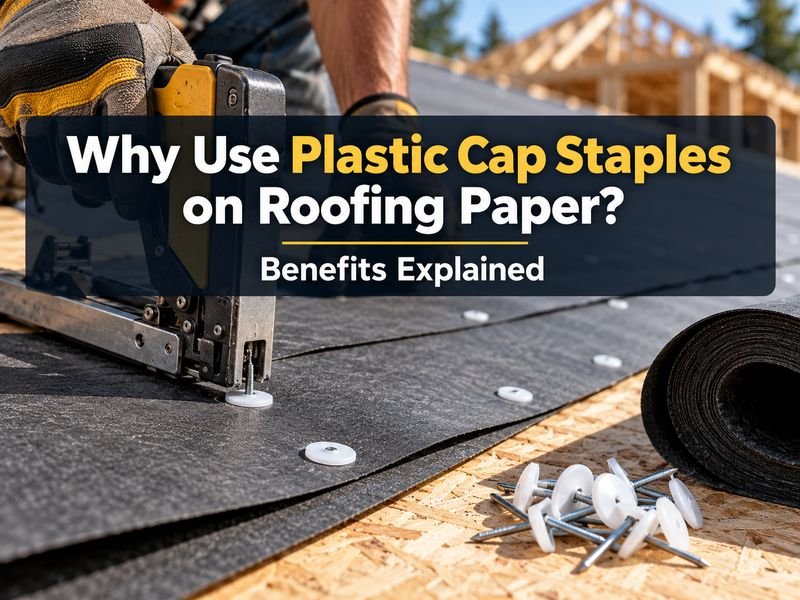
You use plastic cap staples on roofing paper because the plastic cap creates a much larger bearing surface than a bare staple. This helps hold the underlayment flat against the roof deck without allowing the fastener to tear through the material as easily.
A standard staple has a narrow metal crown. When wind pulls upward on roofing paper, all that force is concentrated around a very small area.
A plastic cap changes that.
The cap sits between the staple and the roofing paper, distributing pressure across a wider circular area. Standardized cap staples commonly use approximately a 1-inch plastic cap, creating substantially more contact area than the staple crown alone.
That wider surface provides several practical benefits:
- Better resistance to tearing
- Better resistance to wind uplift
- More secure underlayment installation
- Less chance of the fastener pulling through
- Better performance while the underlayment is temporarily exposed
- More consistent pressure against the roof sheathing
The staple still provides the penetration into the roof deck. The plastic cap provides the larger holding surface.
What Are Plastic Cap Staples?
A plastic cap staple combines two components:
- A metal staple
- A round plastic cap
The staple passes through the center of the cap and then through the roofing material into the wood sheathing.
The plastic cap remains on top of the underlayment.
Unlike a standard staple, which presses only its narrow crown against the material, a capped staple distributes the load across the plastic disc.
Cap staples are commonly installed with a cap stapler, which automatically positions the plastic cap and drives the staple through it in one action.
This is much faster than manually positioning individual caps.
What Is Roofing Paper?
The term roofing paper is commonly used for roofing underlayment installed between the roof deck and the final roof covering.
Traditionally, this meant asphalt-saturated felt such as:
- No. 15 felt
- No. 30 felt
Today, many roofs use synthetic underlayment instead.
Both types provide a secondary protective layer underneath materials such as:
- Asphalt shingles
- Metal roofing
- Wood shingles
- Some tile systems
Underlayment can help protect the roof deck from moisture that gets underneath the finished roofing.
However, roofing underlayment is relatively thin. That makes proper fastening important.
The Plastic Cap Spreads the Load
Load distribution is the biggest reason for using capped fasteners.
Imagine trying to hold down a sheet of paper with the tip of a pencil.
Now imagine holding it with the flat bottom of a drinking glass.
The larger surface spreads pressure across more material.
A plastic cap works in a similar way.
With a Bare Staple
A bare staple places most of its holding force along its narrow crown.
If the roofing paper moves upward, that small metal edge can begin cutting through the material.
Once a small tear develops, wind can enlarge it.
With a Plastic Cap Staple
The cap distributes that upward force across a much wider area.
Instead of the underlayment pulling against only a thin piece of metal, it pulls against the broad plastic disc.
This greatly reduces concentrated stress around the fastener.
Plastic Cap Staples Help Prevent Roofing Paper From Tearing
Roof underlayment can experience considerable movement during installation.
Workers walk across it.
Wind catches exposed edges.
Temperature changes cause materials to expand and contract.
The underlayment can also shift slightly as roofing materials are installed over it.
Bare staples may hold the material initially but can create weak points where tearing begins.
A plastic cap protects the area surrounding the staple penetration.
That is especially valuable with synthetic underlayment because some synthetic sheets are light and can experience substantial wind forces if left exposed.
GAF, for example, specifies plastic cap nails or plastic cap staples for its FeltBuster synthetic roofing underlayment and warns against using uncapped nails or staples for normal installation.
Plastic Cap Staples Improve Wind Resistance
Wind does not simply blow across a roof.
It can create uplift forces that attempt to lift roofing materials away from the deck.
Before shingles are installed, exposed underlayment can behave somewhat like a large sheet.
Wind entering underneath a loose edge can pull upward on the entire section.
If the underlayment is held with bare staples, each small staple crown becomes a concentrated stress point.
The material can tear around one fastener and then begin tearing around nearby fasteners.
Plastic caps help resist this process.
The larger cap distributes the force and makes it harder for the underlayment to pull over the fastener.
This is one reason capped fasteners are particularly important in higher-wind applications. Some International Residential Code provisions for high design-wind conditions specify metal or plastic cap nails or cap staples with caps at least 1 inch in diameter for underlayment attachment.
Always follow the building code adopted in your location because requirements vary by jurisdiction and code edition.
Why Bare Staples Can Pull Through Roofing Paper
A staple may appear secure immediately after installation.
Problems can develop later.
Suppose a bare staple is driven tightly into roofing felt.
The staple crown creates two small contact points or a narrow line across the surface.
If wind lifts the felt repeatedly, those points can begin cutting into the material.
Eventually, the staple may remain firmly embedded in the plywood while the roofing paper tears completely around it.
At that point, the fastener is still in the roof deck—but it is no longer holding the underlayment.
Plastic caps help prevent this type of failure.
Plastic Cap Staples Keep Underlayment Flatter
Underlayment should lie reasonably flat against the roof deck.
Wrinkles and loose sections can make subsequent roofing installation more difficult.
Cap staples provide a broader clamping area.
This can help keep the material:
- Flat against the roof deck
- Properly positioned at overlaps
- Secure around edges
- Less likely to flap in the wind
A flat underlayment surface also makes it easier to install shingles consistently.
They Are Useful When Roofing Paper Will Be Exposed Temporarily
Sometimes the final roofing cannot be installed immediately after the underlayment.
For example:
- Work may stop overnight.
- Rain may delay installation.
- A large roof may require several days.
- Shingle delivery may be delayed.
- A crew may complete drying-in before returning for roofing.
During that period, the underlayment is exposed to wind and weather.
Plastic cap staples generally provide much better holding ability than bare staples during temporary exposure.
However, underlayment should not automatically be treated as a finished temporary roof.
Manufacturers specify exposure limits and conditions, and some products are water-resistant rather than completely waterproof.
Follow the specific underlayment manufacturer’s instructions.
Plastic Caps Reduce Damage From Foot Traffic
Roofers often walk across the underlayment while installing the finished roof.
Foot traffic can cause the material to pull and shift around fasteners.
A wider cap helps stabilize the sheet.
It also reduces the chance that movement around a narrow fastener crown will begin tearing the material.
This does not mean capped underlayment cannot be damaged.
Installers still need to avoid:
- Dragging heavy materials
- Walking on wrinkled sections
- Stepping on unsupported areas
- Working carelessly on wet or steep roofs
The cap simply provides a stronger fastening point.
Plastic Cap Staples vs. Regular Staples
The biggest difference is the size of the area holding the underlayment.
| Feature | Plastic Cap Staples | Regular Staples |
| Holding surface | Large plastic cap | Narrow staple crown |
| Tear resistance | Better | Lower |
| Wind resistance | Better | Lower |
| Underlayment holding | More secure | Suitable only where permitted |
| Temporary exposure | Better suited | More vulnerable |
| Installation tool | Cap stapler | Standard stapler |
| Manufacturer approval | Common for underlayment | Depends on product |
Regular staples are not automatically wrong in every roofing application.
What matters is the specific underlayment, local code, roof conditions, and manufacturer instructions.
Some installations may permit ordinary staples when roofing is immediately covered.
Other products specifically require capped fasteners.
Never assume a regular staple is acceptable simply because it physically holds the material down.
Plastic Cap Staples vs. Cap Nails
Both fasteners use a broad cap to distribute pressure.
The difference is what goes into the roof deck.
Plastic Cap Staple
A cap staple uses two staple legs.
Advantages can include:
- Fast installation
- Lightweight tools
- High installation speed
- Good underlayment holding
Plastic Cap Nail
A cap nail uses a nail shank through a plastic cap.
Cap nails are often preferred or required for particular underlayments, roof systems, or code conditions.
They can provide strong pullout resistance and are widely specified for synthetic roofing underlayment.
Which Is Better?
Neither is universally better.
The correct choice depends on:
- Underlayment manufacturer
- Roof deck material
- Roof slope
- Wind conditions
- Local building code
- Whether the underlayment will remain exposed
If the manufacturer’s instructions require cap nails, do not substitute cap staples simply because they are faster.
Are Plastic Cap Staples Required for Roofing Felt?
Not always.
Traditional asphalt roofing felt has historically been installed using several types of approved roofing fasteners.
Requirements can change based on:
- Roofing material
- Wind speed
- Roof slope
- Local code
- Manufacturer
In some lower-wind installations, the applicable code may simply require underlayment to be fastened sufficiently to hold it in place.
Under higher design-wind conditions, more specific capped-fastener requirements can apply.
That is why installers should check both:
- Local building-code requirements
- Underlayment manufacturer’s installation instructions
The stricter applicable requirement should be followed.
Are Plastic Cap Staples Required for Synthetic Underlayment?
They are very commonly required or recommended.
Synthetic underlayment can be lightweight compared with traditional asphalt felt, making secure fastening particularly important when exposed.
Many synthetic underlayment manufacturers specify:
- Plastic cap nails
- Plastic cap staples
- Specific cap diameters
- Specific fastener spacing
For example, GAF specifically directs installers to use plastic cap nails or plastic cap staples with its FeltBuster synthetic underlayment under normal installation requirements.
Do not assume instructions for one synthetic underlayment apply to another product.
Read the installation instructions printed on the roll or supplied by the manufacturer.
How Large Are Plastic Roofing Caps?
A common roofing cap is approximately 1 inch in diameter.
ASTM standards identify cap staples using a 1-inch plastic cap, and certain building-code underlayment provisions also specify caps with a nominal diameter of at least 1 inch.
That may not sound large, but it provides dramatically more contact area than a narrow staple crown.
The result is better load distribution across the underlayment.
How Far Apart Should Plastic Cap Staples Be?
There is no single spacing that is correct for every roofing paper installation.
Spacing depends on:
- Underlayment type
- Manufacturer
- Roof covering
- Wind design
- Roof slope
- Location of the fastener
- Local building code
Fasteners are often installed more closely around laps and edges because those areas are more vulnerable to wind lifting the material.
For example, some high-wind code provisions specify closer fastening at side and end laps than within the main field of the sheet.
Always follow the spacing printed in the installation instructions for the underlayment you are using.
Do not rely on a universal spacing rule.
How Deep Should Cap Staples Go?
The staple must penetrate deeply enough into the roof sheathing to hold securely.
However, driving it too deeply can crush the plastic cap or damage the roofing paper.
The goal is for the cap to sit flat and snug against the underlayment without cutting through it.
A properly driven cap should:
- Lie flat
- Hold the underlayment securely
- Not cut into the material
- Not stand noticeably above the surface
Fastener length should meet the manufacturer’s instructions and applicable code requirements.
Some building-code provisions require cap staple legs to penetrate through the roof sheathing or at least a specified depth into the sheathing under certain high-wind conditions.
Can You Drive Plastic Cap Staples Too Deep?
Yes.
An overdriven staple can reduce the benefit of the plastic cap.
If the tool drives the fastener too hard, the cap may:
- Cup inward
- Crack
- Cut into the underlayment
- Become partially embedded
- Tear the roofing paper
Instead of distributing the load, an overdriven cap may create another weak point.
Adjust the cap stapler’s depth or air pressure as appropriate for the tool.
Test several fasteners before installing an entire roll.
Can Cap Staples Be Too Loose?
Yes.
An underdriven cap may stand above the underlayment.
That can create problems when shingles are installed over it.
A high fastener may:
- Interfere with shingles
- Catch shoes or equipment
- Allow the underlayment to move
- Fail to clamp the sheet properly
The ideal installation keeps the cap flat against the roofing paper without crushing it.
Where Should Plastic Cap Staples Be Installed?
Follow the fastening marks or instructions provided with the underlayment.
Generally, fasteners are placed:
- Along horizontal laps
- Along vertical/end laps
- Around perimeter edges
- Across the field of the sheet
Do not randomly place fasteners wherever convenient.
Proper spacing helps distribute wind loads evenly across the underlayment.
Many synthetic products print fastening guides directly onto the material.
Do Plastic Caps Create Holes in the Underlayment?
Yes.
Both nails and staples penetrate the underlayment.
The cap does not eliminate the penetration.
Instead, it improves how the fastener holds the material around that penetration.
The finished roof covering provides the primary weather-resistant roof surface, while the underlayment acts as a secondary protective layer.
Fastener type and placement should therefore follow the roof-system design.
Can You Use a Regular Staple Gun With Plastic Caps?
Normally, a standard staple gun does not automatically feed roofing caps.
A cap stapler is specifically designed to feed a plastic cap into position and then drive a staple through its center.
This makes installation much faster.
Separate caps can sometimes be manually positioned and fastened, but doing this across a large roof would be inefficient.
For professional or large DIY projects, the correct cap-stapling tool is usually much easier.
What Is a Cap Stapler Used For?
A cap stapler is designed for fastening thin sheet materials that benefit from a wide holding surface.
Roofing applications are among the most common.
Depending on the fastener and manufacturer’s approval, cap staplers may be used for:
- Roofing underlayment
- Asphalt felt
- Synthetic underlayment
- Housewrap
- Foam board
- Certain weather barriers
Always verify the material manufacturer’s fastening requirements.
Do Plastic Cap Staples Make Roofing Paper Waterproof?
No.
The plastic cap should not be confused with waterproof flashing or sealant.
Its primary job is mechanical: holding the roofing paper securely without tearing it.
The cap may help shield the immediate fastener area, but it does not make the entire roofing underlayment waterproof.
Water resistance comes from the underlayment system, overlaps, flashing, roof covering, and proper installation.
Common Mistakes When Using Plastic Cap Staples
Overdriving the Staples
Driving the cap too deeply can damage the underlayment.
Underdriving Them
A loose cap does not clamp the roofing paper properly.
Using the Wrong Fastener Length
A staple that is too short may not achieve adequate holding strength.
Ignoring Manufacturer Spacing
Using fewer fasteners than specified can reduce wind resistance.
Using Cap Staples When Cap Nails Are Required
Some products or conditions require nails instead.
Check the instructions.
Leaving Loose Wrinkles
Do not use extra staples as a substitute for laying the underlayment correctly.
Straighten the sheet before fastening.
Are Plastic Cap Staples Worth Using?
When the roof system permits them, yes.
Plastic cap staples combine the speed of a stapler with the improved holding surface of a capped fastener.
Their biggest advantage is not the staple itself.
It is the wide plastic cap, which prevents the narrow staple from concentrating all of the load into a small section of roofing paper.
For underlayment exposed to wind or job-site movement, that difference can be significant.
Safety When Installing Roofing Paper
Roof work presents a serious fall hazard.
Roofing underlayment can also be slippery, particularly when:
- Wet
- Dusty
- Installed on steep slopes
- Walked on before being securely fastened
Use appropriate fall protection and follow OSHA requirements and applicable job-site safety practices.
Do not work on a roof during high winds, rain, ice, or other unsafe conditions.
If you are not comfortable working at height, roofing underlayment installation is better handled by a qualified roofing contractor.
FAQs About Why Use Plastic Cap Staples on Roofing Paper
Why Are Plastic Caps Better Than Regular Staples for Roofing Paper?
Plastic caps spread the holding force across a larger area. This makes it harder for roofing paper to tear around the fastener, especially during wind or foot traffic.
Can I Use Regular Staples on Roofing Paper?
Sometimes, but only when the underlayment manufacturer and applicable building code allow them. Many synthetic underlayments require capped fasteners instead.
Do Cap Staples Hold Better in Wind?
The plastic cap improves the underlayment’s resistance to pulling over the fastener because the load is distributed across a larger surface. This can improve performance when wind creates uplift on exposed underlayment.
Are Cap Staples Good for Roofing Felt?
Yes, cap staples can be used for many roofing-felt applications when permitted by the manufacturer and code. The cap reduces the chance of the staple tearing through the felt.
Can You Use Plastic Cap Staples for Synthetic Underlayment?
Yes, many synthetic underlayment products permit or require plastic cap staples. Check the specific product instructions because some applications require cap nails instead.
What Size Are Plastic Caps for Roofing?
A common standard cap is approximately 1 inch in diameter, although the exact required size should come from the product instructions and applicable code.
Should Plastic Cap Staples Be Flush?
Yes. The cap should generally sit flat and snug against the underlayment without crushing, cutting, or noticeably deforming it.
Are Cap Nails Stronger Than Cap Staples?
Cap nails can provide different pullout characteristics because they use a nail shank rather than two staple legs. Which fastener is appropriate depends on the underlayment instructions, roof conditions, and building code rather than one type always being better.
Conclusion
The main reason why use plastic cap staples on roofing paper is to prevent a narrow staple from tearing through the underlayment. The wide plastic cap spreads pressure across a larger area, helping the roofing paper remain flat and securely attached to the roof deck.
Plastic cap staples can improve tear resistance, wind resistance, and temporary holding strength, which is especially valuable when underlayment remains exposed before the finished roofing is installed.
They are not the correct fastener for every roof, however. Always check the roofing-paper or synthetic-underlayment manufacturer’s instructions along with your local building code. If cap staples are approved, proper fastener spacing, penetration, and driving depth are just as important as using the cap itself.