Which Is Better a Cap Nailer or a Cap Stapler? Full Comparison
If you are fastening roofing felt, synthetic underlayment, housewrap, foam board, or similar sheet materials, you may be deciding between a cap nailer and a cap stapler. Both tools drive a fastener through a plastic cap, which spreads the holding force over a wider area and helps prevent thin material from tearing around the fastener.
So, which is better a cap nailer or a cap stapler? Neither is automatically better for every job. A cap nailer generally provides stronger, more durable holding power and is often better for roofing underlayment and jobs where the material will stay exposed longer. A cap stapler is typically faster, lighter, and well suited to housewrap and other lightweight building membranes.
The right choice depends on the material you are fastening, local building requirements, expected exposure to wind and weather, and whether the installation is temporary or long-term.
This guide compares cap nailers and cap staplers in simple terms so you can choose the right fastening system for your project.
Which Is Better a Cap Nailer or a Cap Stapler?
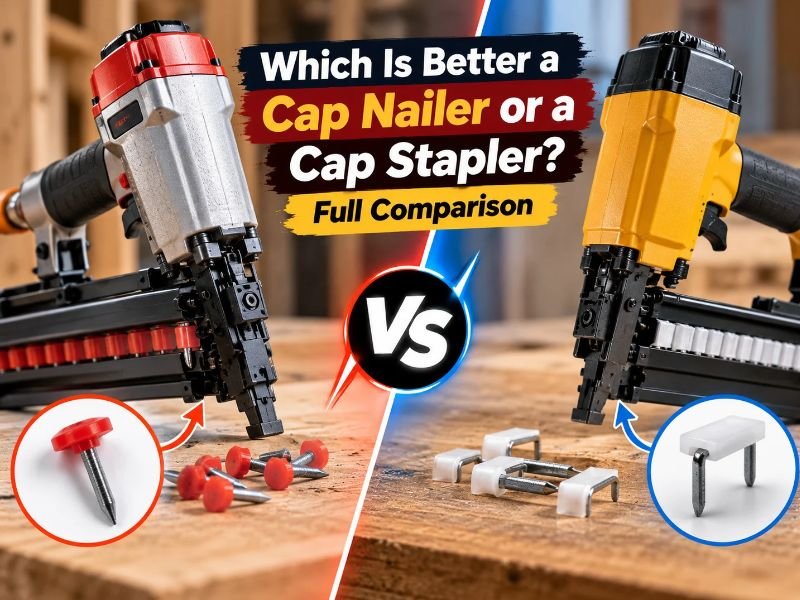
A cap nailer is usually better when maximum holding strength is the priority, while a cap stapler is often better when speed and lightweight fastening matter more.
For example, roofing underlayment exposed to wind before shingles are installed often benefits from cap nails because the nail shank usually provides stronger resistance to pullout.
For housewrap, a cap stapler can be very convenient because it installs fast, reduces tearing around the fastener, and usually provides enough holding strength until siding or another exterior finish is installed.
A simple comparison looks like this:
| Feature | Cap Nailer | Cap Stapler |
| Holding strength | Higher | Moderate |
| Installation speed | Fast | Very fast |
| Pullout resistance | Better | Lower |
| Best for roofing underlayment | Often preferred | Sometimes suitable |
| Best for housewrap | Good | Excellent |
| Tool weight | Usually heavier | Usually lighter |
| Fastener cost | Can be higher | Often lower |
| Temporary fastening | Good | Excellent |
| Long exposure to weather | Better | Less ideal |
| Tear resistance | Excellent | Excellent |
The material manufacturer’s fastening instructions should always take priority over general recommendations.
What Is a Cap Nailer?
A cap nailer is a fastening tool that drives a nail through a plastic cap.
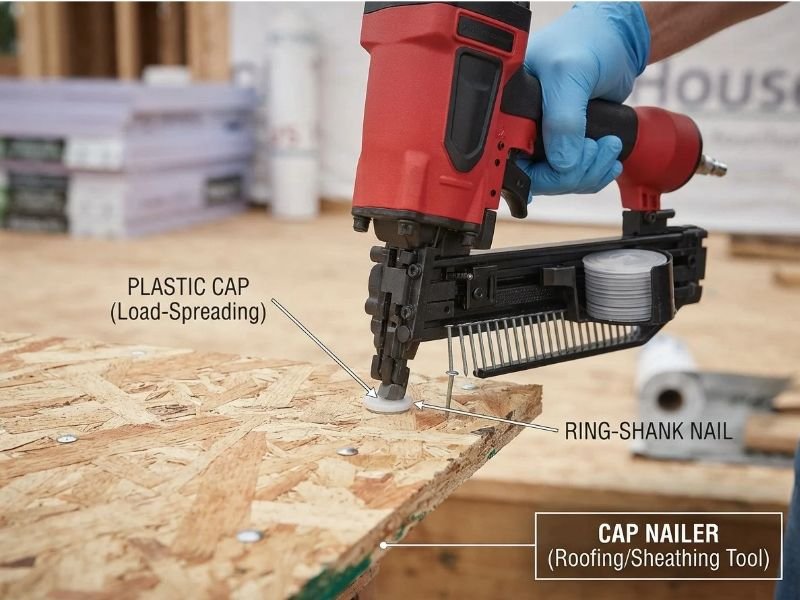
The cap is usually round and sits between the nail head and the material being installed.
Instead of concentrating pressure onto a tiny nail head, the plastic cap spreads the load over a much larger surface.
This is particularly useful with thin sheet materials that can tear easily.
Common applications include:
- Roofing felt
- Synthetic roofing underlayment
- Housewrap
- Foam board
- Building paper
- Weather-resistant barriers
The nail provides the main attachment strength, while the cap prevents the material from pulling over the nail head.
What Is a Cap Stapler?
A cap stapler works on the same basic principle but uses a staple instead of a nail.
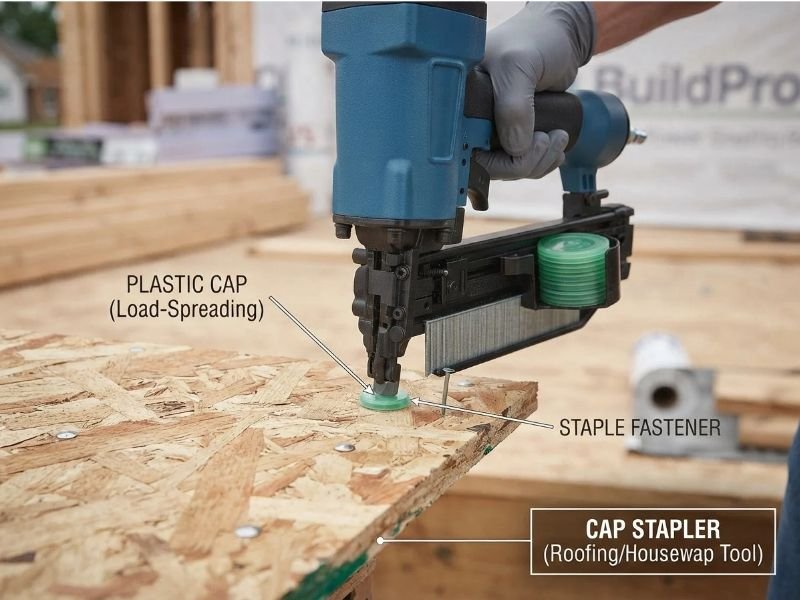
The tool places a plastic cap over the material and drives a staple through the cap.
A staple has two legs that penetrate the substrate.
Cap staplers are popular because they are quick and efficient for covering large walls or surfaces.
They are commonly used for:
- Housewrap
- Building wrap
- Roofing felt in approved applications
- Foam insulation board
- Sheathing membranes
- Temporary weather barriers
Many contractors prefer cap staplers for wall applications because they can cover large areas quickly.
Why Use Caps Instead of Regular Nails or Staples?
The main benefit is load distribution.
Imagine fastening housewrap with an ordinary narrow staple. Wind pulls against the wrap, and all that force becomes concentrated around a very small section of material.
The wrap may tear around the staple.
A plastic cap creates a much wider contact area.
That helps reduce:
- Tearing
- Pull-through
- Wind damage
- Material movement
- Loose sections of membrane
Cap fasteners are especially valuable when the material remains exposed before the final roofing or siding material is installed.
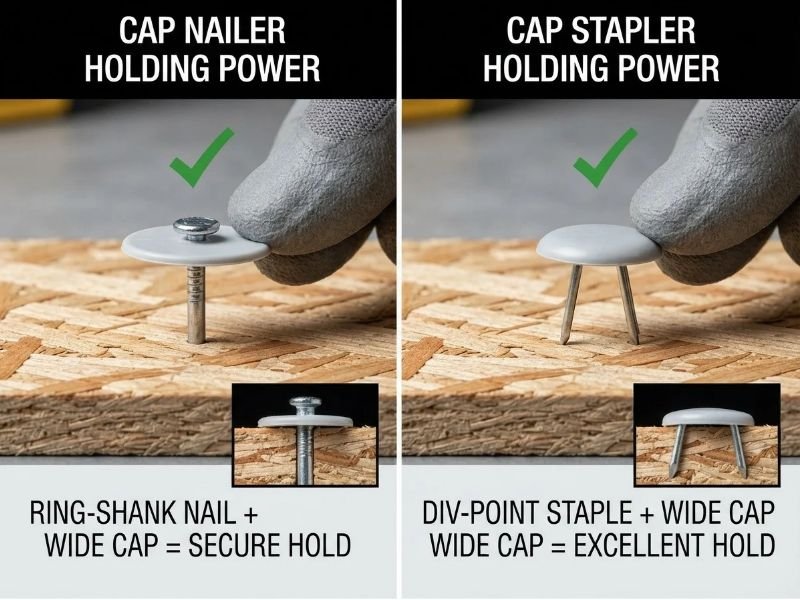
Cap Nailer vs Cap Stapler Holding Power
Holding power is one of the biggest differences between the two systems.
Cap Nailer Holding Strength
A nail has a single shank that penetrates relatively deeply into wood sheathing.
Depending on the nail design, the shank may also have rings or other features that improve withdrawal resistance.
This usually gives cap nails strong pullout resistance.
That can be particularly valuable on roofs because roofing underlayment may experience significant wind uplift before the finished roof covering is installed.
Cap Stapler Holding Strength
A staple has two thinner legs.
This provides good surface attachment, but staples can generally be easier to pull out than properly installed nails in demanding applications.
That does not mean cap staples are weak.
They can be highly effective when used for the correct material and installation.
The difference becomes more important in high-wind conditions or when the membrane may remain exposed for an extended period.
Which Is Better for Roofing Felt?
For many roofing applications, a cap nailer is the stronger choice.
Roofing felt or underlayment sits on a roof deck where it may be exposed to substantial wind before shingles or other roofing materials are installed.
Cap nails provide both:
- A broad plastic cap
- Strong nail penetration into the roof deck
This combination helps prevent the underlayment from lifting or tearing.
However, approved fastening methods vary by underlayment manufacturer.
Some roofing felt products may allow cap staples under certain installation conditions.
Others may specifically call for cap nails.
Always follow the underlayment manufacturer’s fastening requirements and applicable building codes.
Which Is Better for Synthetic Roof Underlayment?
Synthetic roof underlayment is usually stronger than traditional asphalt felt, but it still needs proper fastening.
Cap nails are commonly favored when:
- The underlayment will remain exposed
- Strong winds are possible
- The manufacturer specifies cap nails
- The roof has a steep pitch
- Long-term attachment before roofing installation is important
A cap stapler can still be useful when explicitly permitted by the underlayment manufacturer.
The key issue is not simply whether a staple can hold the material. It is whether that specific fastener meets the product’s installation requirements.
Which Is Better for Housewrap?
For housewrap, a cap stapler is often an excellent choice.
Housewrap is installed vertically over exterior wall sheathing and is eventually covered by siding or another exterior finish.
Cap staples can hold the wrap securely while allowing installers to move quickly across large walls.
Compared with ordinary staples, capped staples provide much better resistance to tearing.
A cap nailer can also be used for housewrap when approved.
However, its extra holding strength may not always be necessary for normal wall applications.
Which Tool Is Faster?
A cap stapler is often slightly faster and easier to use for large wall areas.
Staples are compact, and the tools designed to drive them can be relatively lightweight.
This makes them useful for repetitive fastening.
A cap nailer is also fast, especially compared with manually installing cap nails.
However, the tool and fasteners may be somewhat larger.
For a large housewrap installation, the lower weight of a cap stapler can become noticeable after hundreds or thousands of fasteners.
Which Tool Is Easier for Beginners?
Both are relatively straightforward once properly set up.
A cap stapler may feel easier because:
- Tools can be lighter
- Recoil may feel lower
- Fast placement is simple
- Staple magazines can be easy to reload
However, beginners still need to learn proper depth adjustment.
Driving either a nail or staple too deeply can crush the plastic cap or damage the material.
The fastener should hold the membrane securely without cutting through it.
Cap Nailer vs Cap Stapler for Wind Resistance
Cap nails generally have an advantage where wind resistance is especially important.
Wind does not simply push on roofing or housewrap. It can create suction that tries to lift material away from the sheathing.
If the fastener begins pulling out of the wood, the entire attachment can fail even if the plastic cap remains intact.
A nail’s deeper and stronger shank usually performs better under withdrawal forces.
For that reason, cap nails are commonly chosen for exposed roofing applications.
Which Has Better Tear Resistance?
Both systems provide good tear resistance because both use plastic caps.
The cap itself is the important part for spreading pressure across the membrane.
The difference is less about the cap and more about what happens underneath it.
A cap staple can resist the material pulling over the fastener very well, but the staple itself may withdraw sooner from the substrate under severe loads.
A cap nail combines cap protection with stronger substrate attachment.
Nail Penetration vs Staple Penetration
Nails and staples penetrate materials differently.
A cap nail uses one larger-diameter shank.
A cap staple uses two smaller legs.
The actual penetration depth depends on the fastener and tool.
Longer fasteners are not automatically better.
They should provide enough penetration into the sheathing or framing material to meet the manufacturer’s requirements without creating unnecessary problems on the opposite side.
Do Cap Nails Damage Underlayment Less?
When adjusted correctly, both cap nails and cap staples are designed to minimize underlayment damage.
Problems usually occur when the tool is set too deep.
An overdriven fastener may:
- Crush the cap
- Cut the membrane
- Tear the underlayment
- Reduce holding ability
An underdriven fastener creates another problem because the cap may stick up and interfere with the roofing material installed above it.
Correct depth adjustment matters regardless of which tool you choose.
Cap Nailer vs Cap Stapler Cost
A cap stapler can sometimes be less expensive to operate, but total cost depends on the tool and fastener system.
Consider:
- Tool purchase price
- Cap fastener price
- Compressor requirements
- Fastener availability
- Number of fasteners needed
- How often you will use the tool
For a homeowner completing one small project, purchasing a dedicated pneumatic cap nailer may not always make financial sense.
Tool rental may be worth considering if available locally.
For a contractor using capped fasteners frequently, productivity often matters more than the initial tool price.
Pneumatic vs Manual Cap Fasteners
Not every project requires a powered tool.
Cap nails and cap staples can sometimes be installed manually.
However, manual installation becomes tiring on large jobs.
A powered cap tool provides:
- Faster installation
- More consistent depth
- Less hand fatigue
- Better productivity
- More consistent cap positioning
For installing hundreds or thousands of fasteners, a dedicated cap nailer or stapler can make a substantial difference.
Can You Use Regular Staples Instead of Cap Staples?
Ordinary staples may be permitted in limited situations, but they do not provide the same protection against tearing.
A regular staple concentrates force along its narrow crown.
A cap staple spreads that force across a wider plastic disc.
For materials exposed to wind before they are covered, this difference can be significant.
Always check the membrane manufacturer’s instructions rather than automatically substituting one fastener for another.
Can You Use Regular Roofing Nails Instead of Cap Nails?
Sometimes a roofing product may allow other fastening methods, but ordinary roofing nails and capped nails are not identical.
A cap nail has a larger effective bearing area because of the plastic cap.
This can reduce the chance of the underlayment pulling over the nail head.
Modern synthetic underlayment manufacturers often provide specific fastener requirements based on exposure time and installation conditions.
Follow those instructions rather than assuming any roofing nail is acceptable.
How Far Apart Should Cap Nails or Cap Staples Be?
Fastener spacing varies considerably by material and application.
There is no universal spacing that applies to every:
- Housewrap
- Roofing felt
- Synthetic underlayment
- Foam board
- Weather barrier
Fastener spacing may also change around:
- Edges
- Seams
- Corners
- High-wind areas
- Roof perimeters
Use the fastening pattern specified by the product manufacturer.
Local building requirements can also affect spacing.
When a Cap Nailer Is the Better Choice
A cap nailer generally makes more sense when strong attachment is the main priority.
It is particularly useful for:
- Roofing underlayment
- Long exposure periods
- Wind-prone jobsites
- Steep roofs
- Applications requiring stronger pullout resistance
If the product instructions specifically require cap nails, the decision is simple: use the approved nail system.
When a Cap Stapler Is the Better Choice
A cap stapler is especially useful for lightweight membrane installation where speed matters.
Good examples include:
- Housewrap
- Weather barriers
- Certain foam insulation installations
- Temporary protection
- Approved underlayment applications
For siding crews covering large exterior walls, a cap stapler can provide a good balance between speed and holding ability.
Can One Tool Replace the Other?
Not completely.
Although both perform similar tasks, their fasteners behave differently.
A cap stapler cannot automatically replace cap nails where nails are specifically required.
Likewise, using a cap nailer for every housewrap project may provide more holding strength than needed while increasing tool weight and potentially cost.
Think of them as related tools designed for overlapping but not identical jobs.
Which One Should a Homeowner Buy?
For a homeowner, the decision should be based on the project rather than which tool seems more versatile.
If you are installing roofing underlayment, check the underlayment instructions first. If cap nails are required or recommended, buy or rent a cap nailer.
If you are wrapping walls before siding, a cap stapler may be more convenient.
If you only have a very small amount of material to fasten, manual capped fasteners may be more economical than buying a specialized powered tool.
Which One Should a Roofing Contractor Use?
Roofing contractors often benefit more from a cap nailer because roofing underlayment is one of the main applications where strong pullout resistance matters.
A powered cap nailer also allows fast installation without manually placing individual plastic caps.
However, the exact fastening system should always match the roofing underlayment being installed.
A contractor working with multiple manufacturers may need more than one fastening method.
Common Mistakes When Using Cap Fasteners
A powerful fastening tool does not compensate for incorrect installation.
Common mistakes include:
- Driving caps too deeply
- Leaving fasteners too high
- Using incorrect spacing
- Using fasteners not approved by the membrane manufacturer
- Installing into weak or damaged sheathing
- Using regular staples where capped fasteners are required
- Ignoring special fastening requirements at edges and seams
Before beginning a large installation, test several fasteners on a small area and adjust the tool depth.
The cap should sit securely against the material without cutting through it.
Safety When Using a Cap Nailer or Cap Stapler
Both are powered fastening tools and should be treated carefully.
Wear eye protection and follow the tool manufacturer’s safety instructions.
Keep your free hand away from the firing area.
Never point the tool toward yourself or another person, even when it is disconnected from the air hose.
For pneumatic tools, disconnect the air supply before:
- Clearing jams
- Servicing the tool
- Making certain adjustments
- Leaving the tool unattended
On a roof, tool safety also includes proper fall protection and careful handling of air hoses.
FAQs About Which Is Better a Cap Nailer or a Cap Stapler
Is a cap nailer stronger than a cap stapler?
Generally, yes. A cap nail typically provides better pullout resistance from wood sheathing than a staple, making cap nailers useful for applications requiring stronger attachment.
Are cap staples good for roofing felt?
They may be suitable for some roofing felt or underlayment products, but not all manufacturers permit them.
Check the specific underlayment installation instructions before choosing cap staples.
Are cap nails better for synthetic roof underlayment?
Cap nails are commonly preferred for synthetic roofing underlayment, especially when the material may remain exposed to wind or weather. The manufacturer’s requirements should determine the final fastener choice.
Are cap staples better than regular staples for housewrap?
Yes, cap staples generally provide better resistance to tearing because the plastic cap distributes pressure across a wider section of housewrap.
Can I use a cap stapler for housewrap?
Yes, cap staplers are commonly used for housewrap when compatible with the wrap manufacturer’s installation instructions.
Why do cap nails have plastic caps?
The plastic cap increases the fastener’s contact area. This helps keep thin materials such as underlayment or housewrap from tearing or pulling over the fastener head.
Do cap nails hold better in high winds?
Cap nails generally provide stronger withdrawal resistance than cap staples, which can make them advantageous when a membrane is exposed to significant wind.
Can I use the same tool for cap nails and cap staples?
Usually not. Cap nailers and cap staplers are designed around different fastener sizes and feeding mechanisms. Use only the fasteners specified for your particular tool.
Conclusion
So, which is better a cap nailer or a cap stapler depends primarily on what you are fastening. A cap nailer is generally the better choice when strong pullout resistance, roofing underlayment attachment, and resistance to wind exposure are priorities.
A cap stapler is often the more convenient option for housewrap, weather barriers, and other lightweight materials where fast installation matters.
Both systems protect thin building materials better than narrow uncapped fasteners because their plastic caps distribute pressure over a larger area. Before choosing either one, check the installation requirements for the specific underlayment, housewrap, or building membrane you are using.