
How Often to Drain Air Compressor: Best Schedule and Tips
Water collecting inside an air compressor tank is normal. Atmospheric air always contains some moisture, and compressing that air eventually causes part of the water vapor to condense into liquid. Over time, that condensate settles at the bottom of the receiver tank.
If you are wondering how often to drain air compressor tanks, the right schedule depends on how often the compressor runs, local humidity, tank size, and whether the machine has a manual or automatic drain.
For most home and shop compressors, drain accumulated moisture after each substantial use or at least once a day when the compressor is used daily. In humid conditions or during heavy continuous operation, the tank may need to be drained more frequently.
An occasionally used compressor may not collect enough water to require draining every few minutes of operation, but leaving condensate sitting inside the tank for weeks or months is not a good practice. Moisture can encourage internal corrosion and can eventually travel into air lines, pneumatic tools, and spray equipment.
This guide explains how often different compressors should be drained, why water accumulates, what happens if you neglect the drain valve, and how to build a practical maintenance routine without unnecessarily draining the tank every few minutes.
How Often to Drain Air Compressor Tanks
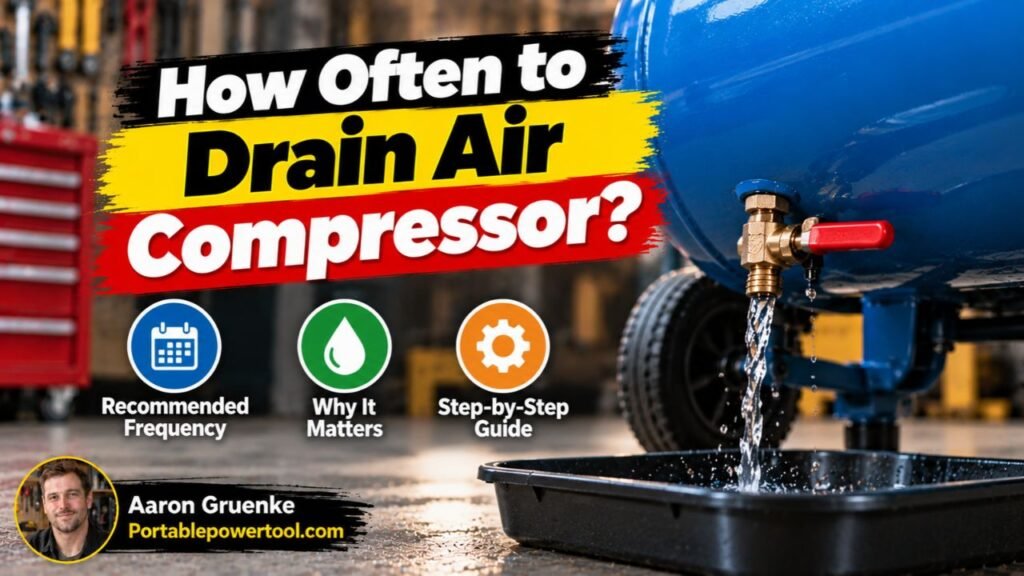
For a typical homeowner or small-shop compressor, how often to drain air compressor tanks can be summarized like this:
- Drain after a substantial work session.
- Drain at the end of each day if the compressor is used daily.
- Check more frequently during humid weather or heavy continuous use.
- Drain before long-term storage.
- Inspect automatic drains regularly even if manual draining is not normally required.
The exact schedule should follow the compressor manufacturer’s instructions.
A compressor used for five minutes once a month does not accumulate moisture at the same rate as a compressor running several hours every day.
The best maintenance schedule therefore depends on actual operating conditions rather than tank size alone.
Why Does Water Build Up in an Air Compressor Tank?
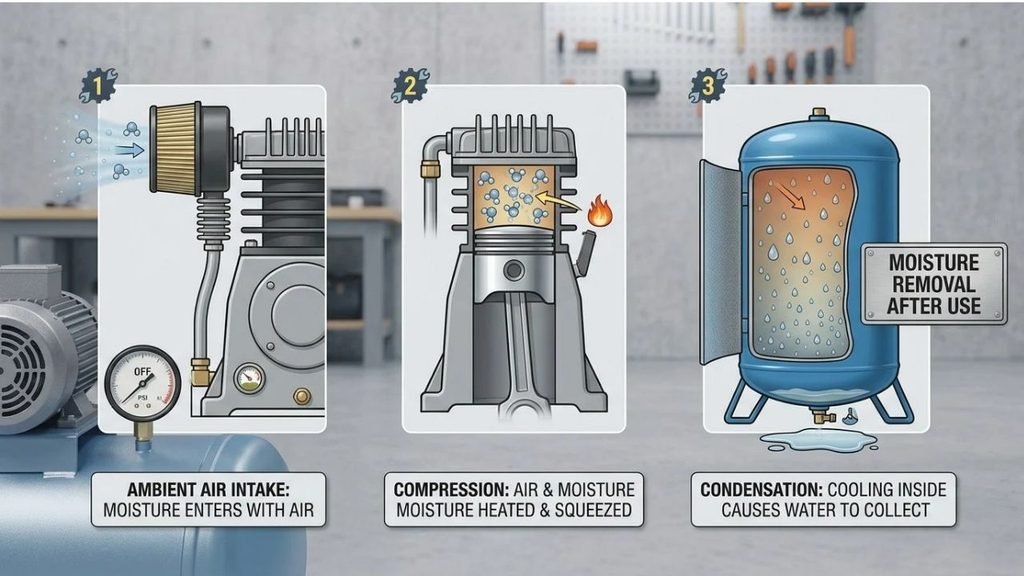
Atmospheric air contains water vapor.
When the compressor draws in that air, it also draws in moisture.
Compression raises air temperature. The compressed air then moves into the receiver tank and begins cooling.
As the air cools, its ability to hold water vapor decreases.
Some of that moisture condenses into liquid droplets and settles at the lowest point of the tank.
This happens with both:
- Oil-free compressors
- Oil-lubricated compressors
The amount of water produced depends heavily on temperature, humidity, and how much air the compressor processes.
Why Humidity Changes How Often You Need to Drain
A compressor operating in a humid environment can collect substantially more condensate than the same compressor working in dry air.
During warm, humid summer weather, you may notice significantly more water coming from the drain valve.
In a dry climate or during cool, low-humidity weather, the amount may be much smaller.
That is why a fixed rule such as “once every seven days” does not work well for every compressor.
If significant water comes out every time you drain the tank, your compressor probably needs to be drained at least that frequently.
Should You Drain an Air Compressor After Every Use?

For many portable home compressors, draining after each meaningful work session is a good habit.
This is particularly useful when the compressor has been running long enough to cycle repeatedly.
Examples include:
- Running nail guns for a project
- Inflating multiple tires
- Using an impact wrench repeatedly
- Blowing out equipment
- Performing workshop tasks for several hours
If you turn the compressor on for a very short task and barely run the pump, there may be little condensate to remove.
However, regularly checking the drain valve helps you learn how quickly your particular compressor accumulates water.
Should You Drain an Air Compressor Every Day?
If the compressor operates every day, daily draining is generally a sensible maintenance routine unless it has a properly functioning automatic drainage system.
Daily draining is especially useful in:
- Auto repair shops
- Woodworking shops
- Construction environments
- Fabrication shops
- Humid garages
- Commercial workspaces
A heavily used compressor may need condensate removed more than once during a workday.
Large commercial systems often use automatic drains for this reason.
How Often to Drain a Small Air Compressor

Small portable compressors commonly have tanks ranging from about 1 to 10 gallons.
These compressors may cycle frequently because their tanks have limited storage capacity.
For a small compressor used for DIY work, a practical approach is:
Drain it after each extended work session and before putting it away for an extended period.
Examples include:
- 1-gallon compressors
- 3-gallon compressors
- 6-gallon pancake compressors
- Small hot-dog compressors
Because these units are easy to move and access, routine manual draining usually takes only a short time.
How Often to Drain a 6-Gallon Air Compressor
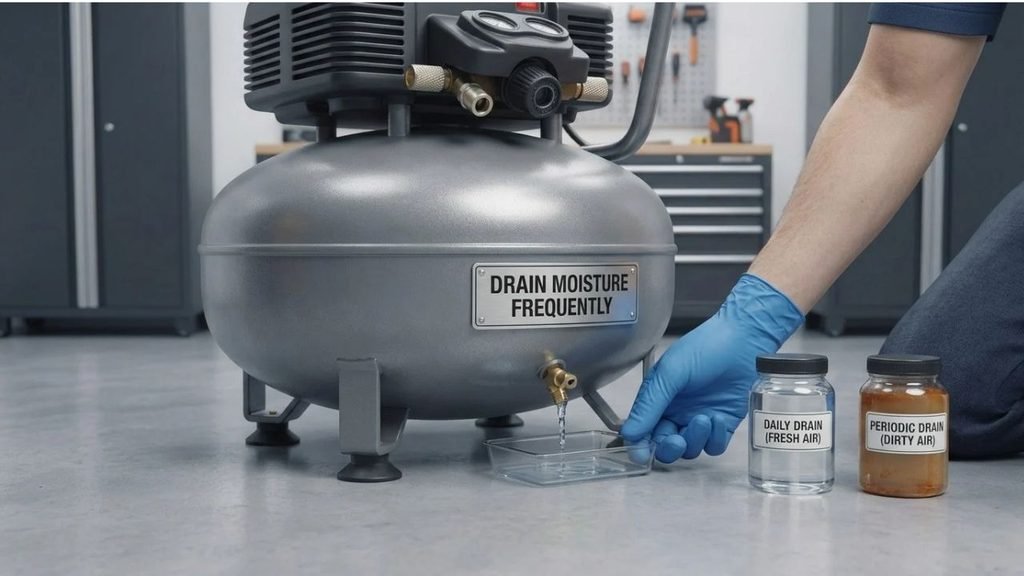
A 6-gallon pancake compressor is commonly used with:
- Brad nailers
- Finish nailers
- Staplers
- Tire inflators
- Blow guns
If you use the compressor regularly throughout the day, drain it at the end of the work session.
If it runs heavily in humid conditions, checking for water more often is worthwhile.
If you use it only occasionally, drain any accumulated condensate before storing it for a long period.
How Often to Drain a 20-Gallon Air Compressor
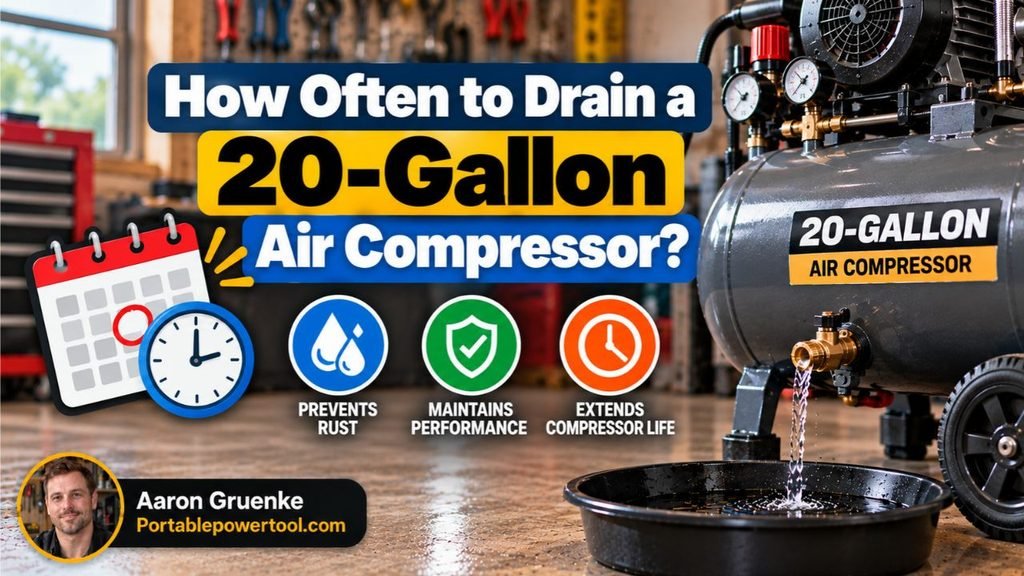
A 20-gallon compressor may run less frequently than a very small compressor for the same short task because its tank stores more compressed air.
However, it can still collect substantial moisture.
For regular workshop use, checking and draining at the end of the day is a good general practice.
More frequent draining may be appropriate if:
- Compressor runs continuously
- Humidity is high
- Large amounts of water appear
- Air tools are receiving moisture
Installing an automatic drain can make maintenance easier on a frequently used stationary unit.
How Often to Drain a 60- or 80-Gallon Compressor

Large stationary compressors often serve shops where compressed air is used throughout the day.
These systems can process a large amount of atmospheric air, meaning they can also produce substantial condensate.
A large shop compressor may require:
- Daily manual draining
- Multiple drain cycles per day
- Automatic timed drain
- Zero-loss drain system
The appropriate setup depends on compressor usage and the entire compressed-air system.
For heavy commercial operation, relying on someone to remember a small manual drain valve every day may be less reliable than an automatic system.
What Happens If You Don’t Drain an Air Compressor?
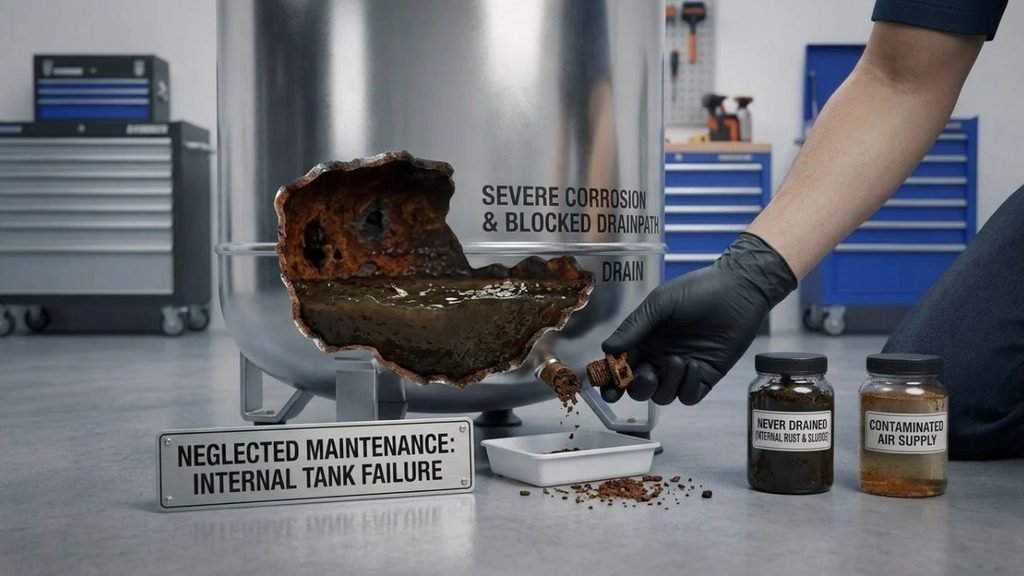
Leaving water inside a receiver tank can cause several problems.
Internal Tank Corrosion
One of the biggest concerns is rust inside the air receiver.
Steel exposed to water and oxygen can corrode.
Because corrosion occurs inside the tank, it may not be immediately visible from the outside.
Pressure vessels should never be ignored when significant rust or damage is suspected.
Water Enters the Air Lines
As condensate builds up, moisture can travel with the compressed air into downstream plumbing.
This can cause problems with:
- Pneumatic tools
- Spray guns
- Air hoses
- Regulators
- Filters
Pneumatic Tool Problems
Excess moisture can promote corrosion inside certain air tools.
Tools may also require proper tool lubrication independent of compressor tank drainage.
Poor Paint Finish
Water entering a spray gun can cause defects during painting.
Possible problems include:
- Water spots
- Finish contamination
- Uneven coating
- Adhesion problems
For painting, a moisture separator or dryer is usually needed in addition to regular tank draining.
Can Water in the Tank Make an Air Compressor Explode?
A properly maintained air receiver is designed to withstand its rated pressure.
However, severe internal corrosion can weaken a pressure vessel over time.
That is one reason routine moisture removal and tank inspection matter.
Never:
- Weld a damaged compressor tank without an approved repair procedure
- Drill into a pressure vessel
- Operate a severely rusted tank
- Bypass the pressure relief valve
- Exceed rated tank pressure
If a tank shows significant corrosion, bulging, cracking, or damage, stop using it and have it evaluated or replaced.
How Much Water Is Normal?
There is no universal normal amount.
You might see:
- A few drops
- Several tablespoons
- Much more after prolonged operation
The amount depends on:
- Humidity
- Operating hours
- Compressor capacity
- Air temperature
- Cooling conditions
Finding water during draining does not necessarily mean anything is wrong with the compressor.
Condensation is a normal result of compressing humid air.
How Do You Know the Tank Needs Draining?

The simplest method is to open the drain according to the manufacturer’s procedure and observe what comes out.
Warning signs that moisture is accumulating include:
- Water spraying from the drain
- Water coming from air tools
- Moisture in air hoses
- Rust-colored condensate
- Water collecting in filters
- Problems during spray painting
Rust-colored water can indicate corrosion inside the receiver and deserves closer attention.
Should You Completely Empty the Air Tank Every Time?
Draining condensate and completely depressurizing the receiver are related but not always exactly the same maintenance procedure.
Some compressors are designed to have condensate drained while a small amount of tank pressure helps push water out.
Other manufacturers specify a particular depressurization process.
Follow your compressor manual.
Do not remove a threaded drain fitting or perform repairs while the tank is pressurized.
A drain valve should be operated only according to its intended design.
How to Drain an Air Compressor Safely
The exact procedure varies by model, but the general process is straightforward.
- Turn off the compressor.
- Disconnect electrical power when required by the maintenance instructions.
- Allow hot components to cool if necessary.
- Reduce tank pressure as directed by the manufacturer.
- Position the tank so the drain is at its lowest point if the design requires it.
- Slowly open the drain valve.
- Allow water and air to escape.
- Close the drain after condensate has been removed.
- Check the valve for leakage.
Wear eye protection because condensate can spray outward with considerable force.
Never put your face directly in front of the drain opening.
Read the Complete Guide: How to Drain Water From Air Compressor
Should There Be Pressure in the Tank When Draining?
Some tank pressure can help force water through a manual drain.
However, the safe pressure and procedure depend on the compressor and drain design.
Do not assume that fully pressurized draining is appropriate for every machine.
Check the manufacturer’s instructions and reduce pressure accordingly.
Never remove an entire drain plug from a pressurized tank.
Why Does Rusty Water Come Out of My Compressor?
Brown or orange water usually contains rust particles.
A small amount of discoloration can occur as steel receiver tanks age, but repeated heavy rust contamination should not be ignored.
Inspect the tank for:
- External corrosion
- Pitting
- Damage
- Leaks
- Unusual swelling
Internal condition is harder to assess without proper inspection.
If you are concerned about pressure-vessel integrity, stop using the compressor and have it evaluated by a qualified service provider.
Can You Leave Water in the Compressor Overnight?
Occasionally leaving a small amount of condensation overnight will not automatically destroy the tank.
However, routinely leaving water sitting inside a steel receiver encourages corrosion over time.
If you use the compressor daily, draining it at the end of the work period is a simple habit that minimizes prolonged moisture exposure.
Should You Drain a Compressor Before Storage?
Yes, removing condensate before long-term storage is a good idea.
Before storing the compressor:
- Drain accumulated moisture
- Follow manufacturer instructions for tank pressure
- Keep the compressor in a dry location
- Protect electrical components from moisture
If the compressor is oil-lubricated, storage may involve additional maintenance specified by the manufacturer.
Do Oil-Free Air Compressors Need to Be Drained?
Yes.
The term oil-free describes the compressor’s lubrication system.
It does not mean the compressor produces moisture-free air.
Oil-free compressors draw the same atmospheric humidity into the pump as other compressors.
Therefore, an oil-free compressor with an air receiver still needs proper condensate drainage.
Do Oil-Lubricated Compressors Need Draining?
Yes.
Pump oil does not prevent water vapor in incoming air from condensing inside the receiver.
Oil-lubricated compressors still require tank moisture management.
In some systems, the drained condensate may contain small amounts of oil, especially in industrial installations.
Local disposal requirements may apply to oily condensate.
Does an Automatic Drain Mean You Never Need to Check the Tank?
No.
An automatic drain valve reduces manual maintenance but can fail or become clogged.
It should still be inspected periodically.
Check that:
- Drain actually operates
- Discharge path is clear
- Valve is not leaking continuously
- Condensate is leaving the system
A failed automatic drain can allow substantial water buildup even though the compressor appears to be maintained automatically.
Types of Automatic Compressor Drains
Several systems are used.
Timed Drain
A timer opens the valve at preset intervals.
These are relatively simple but may release some compressed air each time they operate.
Float Drain
A float responds to the amount of condensate collected and opens when needed.
Zero-Loss Drain
These systems are designed to discharge condensate while minimizing loss of compressed air.
They are more common in commercial compressed-air systems.
Does a Moisture Separator Replace Tank Draining?
No.
A moisture separator removes some water from compressed air downstream.
It does not necessarily remove water already collected in the air receiver.
A complete moisture-control system may include:
- Tank drain
- Aftercooler
- Moisture separator
- Air dryer
- Filters
- Line drains
Tank drainage remains an important part of the system.
Does an Air Dryer Mean You Don’t Need to Drain the Tank?
Usually, no.
An air dryer treats compressed air at a particular point in the system.
Condensation can still form elsewhere depending on system design.
Receiver and line drains should continue to operate according to the system’s maintenance requirements.
Why Water Keeps Coming From Air Tools
If significant water reaches your pneumatic tools even though you drain the tank regularly, the system may need better moisture control.
Possible solutions include:
- Aftercooler
- Moisture separator
- Refrigerated dryer
- Desiccant dryer
- Properly designed air piping
- Additional line drains
The right choice depends on your application.
For ordinary home tools, a moisture separator may be enough.
Painting and other sensitive applications may require more extensive drying.
Does Tank Orientation Affect Draining?
Yes.
The drain is usually located at or near the lowest point of the receiver so gravity can carry condensate toward it.
Portable compressors may need to be positioned slightly according to manufacturer instructions to remove water completely.
Do not turn or tilt a compressor in a way that could damage it or cause oil problems in an oil-lubricated pump.
Follow the manual.
What If the Drain Valve Is Stuck?
Do not apply excessive force to a pressurized fitting.
First:
- Shut the compressor off.
- Completely depressurize the tank according to the manufacturer’s instructions.
- Disconnect power.
- Inspect the valve.
A blocked or damaged drain valve can sometimes be cleaned or replaced.
Replacement valves must have the proper pressure rating and thread specification.
Do not substitute an unapproved low-pressure plumbing fitting on an air receiver.
Can You Replace a Manual Drain With an Automatic Drain?
Often, yes, if a suitable drain is available for your compressor and installation.
The replacement must match:
- Thread size
- Pressure rating
- Electrical requirements, if applicable
- Condensate handling needs
Stationary compressors that operate daily can benefit significantly from automatic drainage.
For a small portable compressor, a simple manual valve may remain easier and less expensive.
How to Reduce Moisture Inside the Compressor System
You cannot prevent atmospheric moisture from entering completely, but you can manage it.
Helpful practices include:
- Drain the receiver regularly.
- Keep the compressor in a relatively dry environment.
- Use an aftercooler where appropriate.
- Install a moisture separator.
- Use an air dryer for moisture-sensitive work.
- Drain downstream filters and piping.
- Maintain automatic drains.
The goal is not only to protect the tank but also to deliver cleaner, drier compressed air to your equipment.
Common Air Compressor Draining Mistakes
Never Draining the Tank
This allows condensate to remain against the tank interior for long periods.
Waiting Until Water Comes From the Hose
By that point, moisture may already be accumulating throughout the air system.
Opening the Drain While Standing Directly in Front of It
Water and debris can be discharged forcefully.
Stand clear and wear eye protection.
Removing the Drain Plug Under Pressure
A threaded component can become dangerous if removed while the receiver is pressurized.
Assuming Oil-Free Means Water-Free
Oil lubrication and moisture condensation are two separate issues.
Ignoring a Broken Automatic Drain
Automatic equipment still requires inspection.
Never Checking for Tank Corrosion
Drain maintenance is important, but the receiver should also be checked for visible damage and corrosion.
A Practical Drain Schedule for Most Users
A simple maintenance schedule can make the decision easier.
| Compressor Use | Practical Drain Schedule |
| Occasional homeowner use | After substantial use and before extended storage |
| Regular home garage use | At the end of each work session |
| Daily workshop use | At least daily |
| Heavy humid-weather use | Daily or more often as needed |
| Continuous commercial use | Automatic drain or frequent scheduled draining |
| Long-term storage | Drain before storage |
These are general guidelines.
Your compressor manufacturer’s schedule should take priority.
FAQs About How Often to Drain Air Compressor
How often should I drain my air compressor?
For regular use, draining at the end of each workday or substantial operating session is a good general practice.
Heavy operation or high humidity may require more frequent draining.
Should I drain my air compressor after every use?
If the compressor has run enough to collect condensate, draining after use is a useful habit.
A very short inflation job may produce little water, but regular checking is still beneficial.
What happens if you don’t drain an air compressor?
Water can accumulate inside the tank, increasing the potential for corrosion and allowing moisture to enter hoses and pneumatic equipment.
Do small air compressors need to be drained?
Yes.
Small compressors still collect moisture because they compress humid atmospheric air.
How often should I drain a 6-gallon air compressor?
For regular DIY or contractor use, drain it at the end of the work session.
Check more frequently if it runs heavily in humid conditions.
Do oil-free compressors need draining?
Yes.
Oil-free describes lubrication, not moisture removal. Water vapor still condenses inside the receiver.
Is it normal for water to come out of an air compressor?
Yes.
Some condensate is normal because atmospheric moisture turns into liquid as compressed air cools.
Large amounts simply mean the compressor has processed a lot of humid air or has not been drained recently.
Should I leave the air compressor drain valve open during storage?
Some manufacturers recommend opening the drain after depressurizing for storage, while others have different procedures.
Follow the manual for your compressor rather than using one rule for every model.
Conclusion
The practical answer to how often to drain air compressor tanks is to base the schedule on usage and moisture production rather than waiting for water to become a problem. For most homeowners and small shops, draining the tank after a substantial work session—or at least once a day when the compressor is used daily—is a sensible routine. Heavy use and humid conditions may require more frequent draining.
Regular drainage matters because condensate left inside a steel receiver can contribute to internal corrosion and can eventually contaminate air lines, tools, and spray equipment. An oil-free compressor still needs draining, and having a moisture separator does not eliminate the need to remove water from the receiver.
For occasional use, you do not need to obsessively drain the tank after every few minutes of runtime. Instead, check it regularly, learn how quickly your compressor collects water, drain it before long-term storage, and follow the manufacturer’s maintenance procedure. That combination provides the best balance between convenient maintenance, dry compressed air, and long-term tank safety.