
How to Drain Air From Air Compressor: Safe Step-by-Step Guide
To learn how to drain air from air compressor equipment safely, turn the compressor off, disconnect its power source, reduce tank pressure, then slowly open the tank drain valve until the compressed air and accumulated moisture are released. Once the tank is empty, close the drain valve before using the compressor again.
Draining an air compressor is more important than simply letting air out of the tank. As compressed air cools inside the receiver tank, moisture condenses and collects at the bottom. If this water is left inside for long periods, it can contribute to internal corrosion, contaminate air lines, and eventually shorten the life of the tank.
The process is simple, but it should be done correctly. Opening a drain valve too quickly can blow water, rust particles, or debris out with considerable force. Leaving the compressor powered while draining can also cause the motor to start unexpectedly as tank pressure falls.
In this guide, I’ll explain how to drain air from an air compressor safely, how to remove water from the tank, when you should drain it, what to do if the drain valve is stuck, and whether you should leave the tank empty between uses.
How to Drain Air From Air Compressor Safely

The safest way to drain an air compressor is to shut it down completely before opening the tank drain.
For most portable and shop compressors, the basic process is straightforward.
- Turn the air compressor off.
Move the power switch to the OFF position so the compressor cannot intentionally run while you are working around the tank. - Disconnect the power source.
Unplug an electric compressor from the outlet. If you have a gasoline-powered unit, shut the engine down according to the manufacturer’s instructions. - Allow hot components to cool if necessary.
Compressors can become hot during operation. If the pump, discharge tube, or surrounding components are very hot, allow them to cool before reaching near the bottom of the tank. - Reduce tank pressure.
You can release some air through a connected air tool, blow gun, hose, or another normal outlet. You do not always have to reduce the tank to zero before opening the drain, but lowering the pressure makes the process quieter and easier to control. - Locate the drain valve.
The drain is normally installed at the lowest point of the receiver tank because water settles at the bottom. - Open the drain valve slowly.
Turn or pull the valve according to its design. Open it gradually so air and water escape in a controlled manner. - Allow the tank to drain completely.
Keep the valve open until water stops coming out and the remaining compressed air has been released if you intend to fully depressurize the compressor. - Close the drain valve.
Once drainage is complete, close it securely, but do not overtighten a small manual drain valve.
Before powering the compressor again, make sure the drain is completely closed. An open drain valve will prevent the compressor from building normal tank pressure.
Key Takeaways:
- Turn the compressor off and disconnect power before draining.
- Open the drain valve gradually rather than releasing full pressure suddenly.
- Drain both trapped moisture and compressed air when storing or servicing the unit.
- Close the valve securely before restarting the compressor.
Why You Need to Drain an Air Compressor Tank
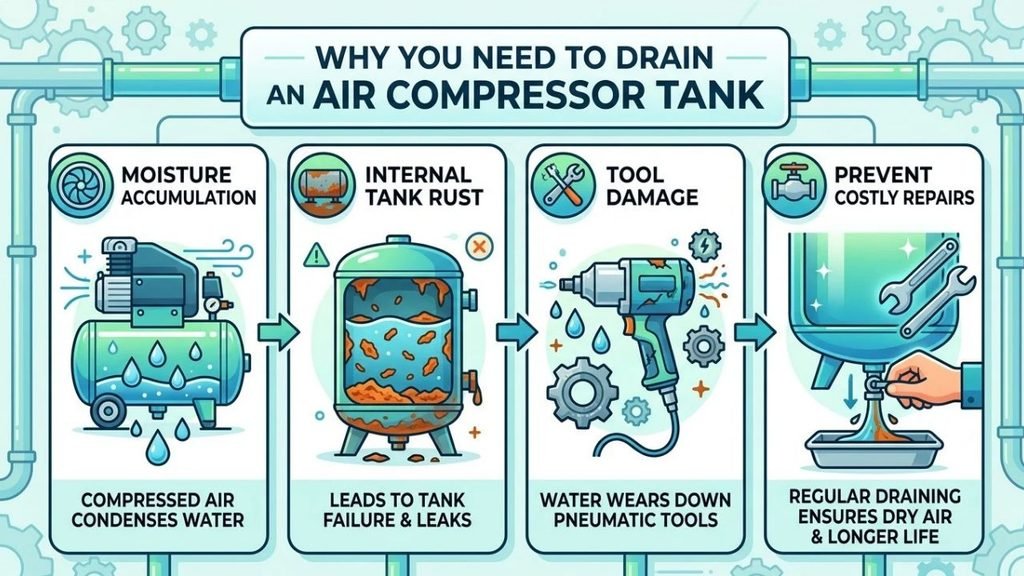
Every air compressor pulls atmospheric air into its pump. That air naturally contains water vapor.
Compression heats the air. When the compressed air enters the receiver tank and begins cooling, some of the water vapor condenses into liquid water.
That liquid settles at the bottom of the tank.
The amount of water produced depends on several factors, including humidity, ambient temperature, compressor runtime, tank size, and how much air the compressor processes.
A compressor operating for hours on a humid summer day can accumulate much more condensate than a small compressor used briefly in a dry environment.
Internal Tank Corrosion
The most important reason to drain the compressor is corrosion prevention.
Air receiver tanks are made to safely contain compressed air, but persistent moisture inside the tank can encourage rust. Because the corrosion occurs internally, you generally cannot see its progression from the outside.
Regular drainage is therefore one of the simplest maintenance practices you can perform.
If a tank shows severe external rust, unusual bulging, leaks, or other structural damage, stop using it. A pressure vessel should not be patched, welded, or modified casually.
Water Can Reach Your Air Tools
Condensation does not always stay inside the tank.
Moist air can travel through the outlet and into hoses, regulators, pneumatic tools, or spray equipment.
For tools such as nailers and impact wrenches, excess moisture can contribute to internal corrosion and poor lubrication.
For spray painting, moisture is especially troublesome because water reaching a paint gun can contaminate the finish.
Compressor Performance and Maintenance
A small amount of water at the bottom of a large tank does not dramatically reduce compressor capacity, but allowing condensate to accumulate indefinitely is unnecessary and undesirable.
Regular draining also gives you an opportunity to notice unusual contamination.
For example, a small amount of rusty-looking water can occur as moisture interacts with the inside of a steel tank. Heavy rust flakes or unusual contamination deserve closer inspection.
Draining Air vs. Draining Water From an Air Compressor
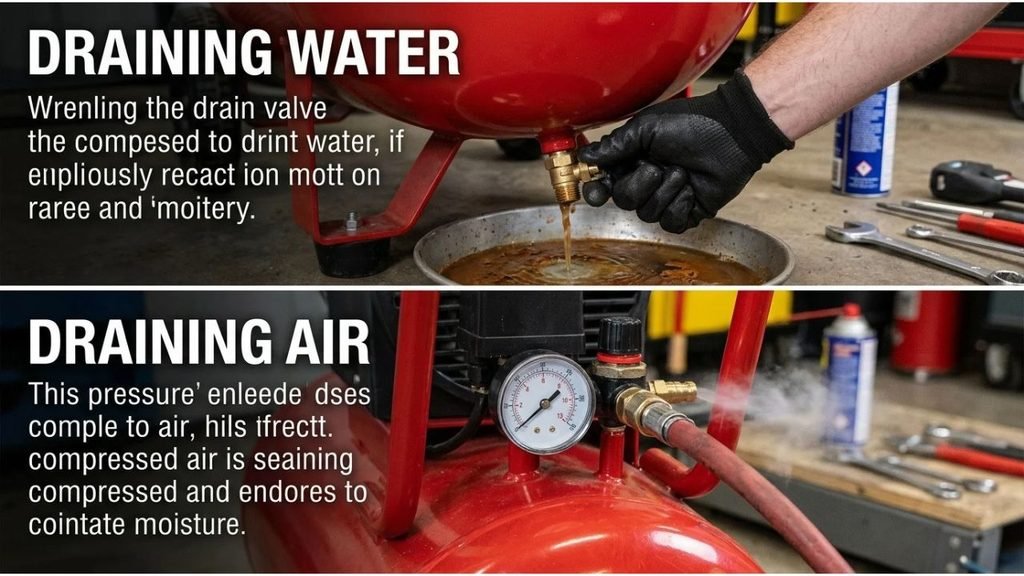
People often use these terms interchangeably, but they refer to slightly different things.
Draining air means releasing compressed air so the receiver tank becomes depressurized.
Draining water means removing condensation collected at the lowest point of the tank.
Opening the tank drain valve commonly accomplishes both.
When you first open the valve, pressurized air forces the accumulated water outward. As drainage continues, pressure decreases until the tank is empty.
You do not necessarily need to empty every bit of compressed air after each short period of use. The important maintenance task is removing accumulated water regularly.
However, fully depressurizing the compressor may be appropriate before certain maintenance procedures, long-term storage, transportation, or whenever the manufacturer’s instructions call for it.
Where Is the Air Compressor Drain Valve?
On most compressors, the tank drain valve is located at or near the lowest point of the receiver tank.
That placement is intentional because condensation flows downward.
On a horizontal portable compressor, you will commonly find the drain underneath the tank.
On a vertical compressor, the valve is generally located at the bottom of the tank.
Some compressors use a simple manual valve, while others have alternative designs.
Common Drain Valve Types
A screw-style or petcock drain uses a small threaded mechanism that you loosen to release air and water.
A quarter-turn valve uses a small lever or handle and can often be opened more easily.
Some compressors use pull-ring or spring-loaded drain designs.
Larger shop systems may use automatic condensate drains that open periodically without manual intervention.
Regardless of design, use the valve according to the compressor manufacturer’s instructions. Do not remove an entire threaded drain assembly from a pressurized tank.
How to Drain Water From an Air Compressor
If your goal is specifically to remove condensation rather than fully empty the tank, you can usually leave a modest amount of tank pressure to help push the water out.
Shut the compressor off and disconnect power first.
Then position the compressor as instructed by the manufacturer. On many portable units, the tank is already shaped so water moves toward the drain valve.
Slowly open the drain.
You may first hear a strong rush of air followed by mist or liquid water. Keep the opening controlled.
Allow the water to discharge until you see mostly air coming through the valve.
For small portable compressors, tilting the unit slightly may sometimes help move remaining water toward the drain, but only do this if the compressor’s design and manual allow it. Large stationary compressors should not be moved or tilted simply to drain them.
A shallow container or absorbent material underneath the drain can keep condensate from spreading across the floor.
Important Tip: Compressor condensate may contain traces of oil, rust, or other contaminants depending on the compressor design and operating environment. Dispose of contaminated condensate appropriately rather than automatically pouring it into a storm drain or onto the ground.
Read The Complete Guide: how to drain water from air compressor
Should You Drain an Air Compressor After Every Use?
For many portable compressors, draining accumulated moisture after each significant use is a good practice, especially if the compressor has been operating long enough to produce condensation.
You do not necessarily need to completely depressurize the tank after every few minutes of light operation.
The real objective is to prevent water from sitting inside the tank for extended periods.
If you use your compressor:
- In a humid climate
- For long periods
- Several times per day
- For painting
- With moisture-sensitive air tools
you may need to drain condensate more frequently.
For a compressor that runs heavily throughout a workday, draining only once every several weeks would generally be inadequate.
Follow the Compressor Manual
Different manufacturers specify different maintenance intervals.
The owner’s manual should always take priority because compressor designs, drain systems, working environments, and duty cycles differ.
Some compressors are specifically designed with automatic drainage equipment, while small pancake compressors generally rely on a manual valve.
Key Takeaways:
- Moisture accumulation depends heavily on humidity and compressor usage.
- Frequently used compressors may require daily condensate draining.
- Lightly used home compressors should still be checked regularly.
- Follow the manufacturer’s stated maintenance schedule whenever available.
Do You Need to Empty the Air Compressor Tank After Every Use?
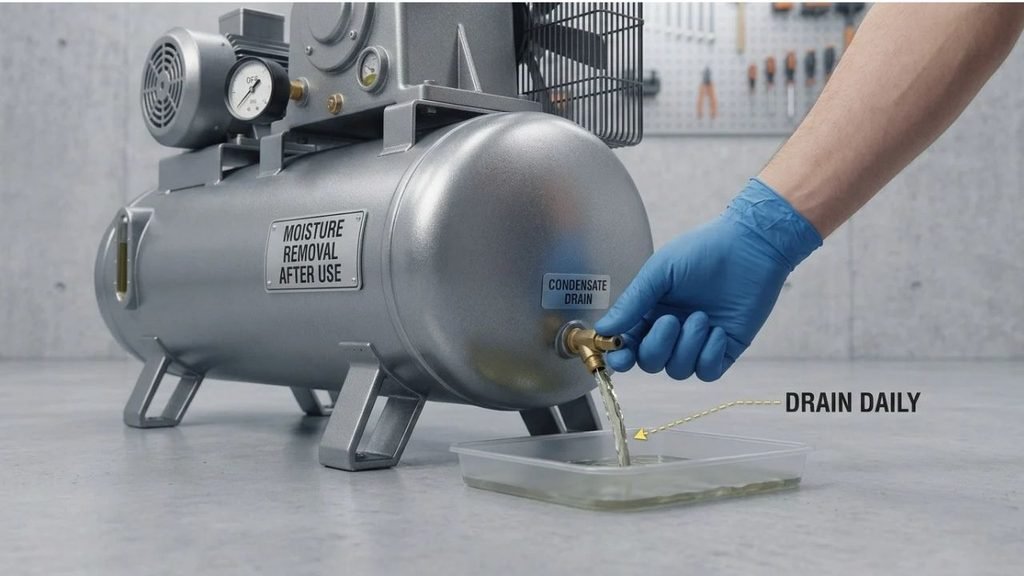
Not necessarily.
Leaving compressed air in a healthy receiver tank for a short period is not automatically harmful. The greater concern is leaving liquid water sitting inside the tank.
Some owners prefer to fully depressurize portable compressors after finishing a job, especially when the compressor will be stored for a long time.
Others drain condensate while retaining a small amount of tank pressure.
Either approach can be reasonable when it follows the manufacturer’s instructions.
For long-term storage, I generally prefer leaving the tank drained and depressurized. That reduces stored energy and ensures water is not sitting unnoticed inside the receiver.
Should You Leave the Drain Valve Open During Storage?
For extended storage, some compressor instructions recommend leaving the drain valve open after the tank is fully depressurized so remaining moisture can escape.
However, this is not universal.
Leaving the valve open in a dusty or dirty environment can allow contamination to enter the tank opening.
The best practice is to follow the specific storage instructions provided for your compressor.
If you do leave the drain open during storage, remember to close it before starting the compressor again.
Otherwise, the pump will run while air escapes through the bottom of the tank.
How Much Pressure Should Be in the Tank When Draining Water?
You do not need maximum tank pressure to drain condensate.
In fact, opening a tiny drain valve while the tank is at its maximum working pressure can cause water and debris to spray aggressively.
A modest amount of pressure is generally enough to push water from the tank.
If the compressor is at full pressure, I prefer reducing pressure first through a normal outlet before opening the drain valve.
This makes drainage easier to control and reduces the chance of condensate spraying across the surrounding area.
If you need the tank completely depressurized for maintenance, leave the drain open until the pressure gauge reaches zero and no further air escapes.
Can You Use the Safety Relief Valve to Drain an Air Compressor?
A compressor normally has a pressure-relief or safety valve, often recognizable by a pull ring.
This valve is an important safety device designed to relieve excessive pressure if necessary.
Although manually pulling the ring may release air, I would not use the safety valve as the normal method for draining tank condensate.
It is usually located above the bottom of the tank, so it cannot effectively remove water that has settled underneath.
Use the dedicated tank drain valve for normal condensate removal.
The relief valve should remain functional and unobstructed, but it should not substitute for routine tank drainage.
What If the Air Compressor Drain Valve Is Stuck?
A stuck drain valve needs careful handling because it is attached directly to a pressure vessel.
First, turn the compressor off, disconnect its power supply, and verify that the tank is completely depressurized before attempting any repair.
Do not apply tools to a stuck drain fitting while the tank remains pressurized.
Once pressure is confirmed at zero, inspect the valve for corrosion, dirt, or physical damage.
A valve that is badly corroded or leaking may need replacement.
Use only a replacement suitable for your compressor’s tank pressure and fitting size.
If the fitting itself is heavily rusted or you suspect significant tank corrosion around the threaded opening, I would stop using the compressor until it has been properly evaluated.
Do Not Force a Corroded Valve on a Pressurized Tank
This is particularly important.
Applying significant torque to a damaged drain assembly while the tank contains compressed air can create unnecessary risk.
Completely remove stored pressure before servicing any pressure-containing component.
Why Is No Water Coming Out of My Air Compressor?
If you open the drain valve and only air comes out, that does not necessarily indicate a problem.
The tank may simply contain very little condensation.
This can happen when:
- The compressor was used only briefly.
- Ambient humidity is low.
- The compressor was recently drained.
- An upstream system removes much of the moisture.
However, if you know the compressor has operated heavily in humid conditions and you never see moisture, check whether the drain is actually positioned at the lowest point and whether its passage is obstructed.
Never probe a blocked drain on a pressurized receiver.
Depressurize the tank completely before inspecting the opening.
Why Does So Much Water Come Out of My Compressor?
A surprising amount of water can be completely normal after extensive compressor use in humid conditions.
Compressors process large volumes of atmospheric air. The moisture contained in that air eventually has to go somewhere.
As hot compressed air cools, condensation collects inside the receiver tank and downstream air system.
High water accumulation can result from warm humid weather, long compressor cycles, large volumes of air consumption, or rapid cooling of compressed air.
If moisture causes problems downstream, such as during painting, draining the tank alone may not be enough.
You may need suitable equipment such as a moisture separator, aftercooler, filter, or air dryer depending on the application.
Can You Drain an Air Compressor While It Is Running?
For a conventional manual tank drain, I recommend shutting the compressor off before draining.
If you open the drain while the compressor is powered, falling pressure may cause the motor to start automatically.
That creates unnecessary noise, airflow, heat, and moving machinery while you are working near the tank.
Automatic drain systems are different. They are specifically designed to discharge condensate while a compressed-air system remains in service.
If your compressor includes an automatic drain, follow the manufacturer’s operating and maintenance instructions for that system.
What Happens If You Never Drain an Air Compressor?
Ignoring compressor drainage may not cause an immediate failure, which is why the task is easy to overlook.
Over time, however, moisture can contribute to internal corrosion of a steel receiver tank.
Water can also migrate into air hoses and pneumatic equipment.
For painting, moisture may cause finish-quality problems. For pneumatic tools, contaminated air can encourage internal corrosion and interfere with lubrication.
The compressor tank is also a pressure vessel, so maintaining its condition is more important than merely protecting tool performance.
Regular drainage requires only a short amount of time and is one of the most worthwhile maintenance habits for an air compressor.
Key Takeaways:
- Condensation left inside the tank can contribute to corrosion.
- Water can travel downstream into tools and paint equipment.
- Regular drainage is simple preventive maintenance.
- Never continue using a tank that appears structurally damaged or severely corroded.
How to Reduce Water Inside an Air Compressor System
You cannot completely prevent atmospheric moisture from entering a normal compressor, but you can manage it.
Regular tank drainage is the first step.
For general home and workshop use, a moisture separator installed in the air system can help capture liquid water traveling downstream.
For spray painting and other moisture-sensitive applications, more advanced moisture control may be necessary.
Air dryers, aftercoolers, properly routed air lines, and filtration systems can reduce moisture more effectively than relying solely on the tank drain.
Keep the Compressor in a Suitable Environment
If possible, avoid storing a compressor in an extremely damp environment.
Temperature swings can also encourage condensation.
Keeping the compressor protected from weather and following proper storage practices can help reduce unnecessary moisture exposure.
Drain Downstream Components Too
Your compressor tank is not the only place water can collect.
Moisture can accumulate in:
- Filter bowls
- Moisture separators
- Air-line low points
- Auxiliary tanks
- Dryers
These components may also require regular drainage according to their design.
How to Drain Different Types of Air Compressors
The general principle remains the same, but access to the drain varies with compressor design.
Pancake Air Compressor
A pancake compressor normally has a small drain valve underneath the round tank.
Turn the compressor off, unplug it, reduce pressure, and slowly open the bottom drain.
Because pancake compressors sit close to the floor, accessing the valve can sometimes be awkward.
Do not tip or position the compressor unsafely simply to reach the valve.
Hot Dog Air Compressor
Hot dog compressors use a horizontal cylindrical tank.
The drain is generally located underneath or near the lowest point of the cylinder.
Drain the unit on a stable surface and allow collected water to move toward the valve.
Twin-Stack Air Compressor
Twin-stack compressors have two receiver tanks.
Depending on the design, there may be a drain arrangement for each tank or a common system.
Follow the manufacturer’s instructions so both tanks are properly drained.
Vertical Shop Compressor
Large vertical compressors generally have a drain at the very bottom of the receiver.
Because these tanks hold much more air, discharge can be powerful if the valve is opened at high pressure.
Reducing pressure beforehand makes manual draining more controlled.
Automatic drains are particularly useful on frequently operated stationary shop compressors.
Manual Drain Valve vs. Automatic Drain Valve
A manual drain is inexpensive and simple, but it depends entirely on the operator remembering to use it.
An automatic drain periodically releases collected condensate without requiring manual opening each time.
Automatic drains can be useful for:
- Busy workshops
- Commercial garages
- High-humidity environments
- Compressors that run daily
- Installations where the drain is difficult to reach
They still require inspection and maintenance.
An automatic drain should not be treated as something you install and then ignore indefinitely.
For an occasional-use home compressor, the original manual drain is usually perfectly adequate as long as you actually use it.
Common Mistakes When Draining an Air Compressor
One common mistake is opening the drain valve suddenly while the tank is at full pressure. This can spray dirty water and debris forcefully.
Another is forgetting to turn off the compressor. As pressure falls, the pressure switch may command the motor to restart.
Some users also drain all the air but fail to remove the moisture because they release pressure through the hose instead of using the valve at the bottom of the tank.
Another mistake is leaving the drain partially open when restarting the compressor. The pump may then run continuously while trying to build pressure that is escaping through the valve.
Finally, never assume a tank is depressurized simply because the compressor is switched off. Verify pressure using the gauge and confirm that no air remains before performing maintenance on valves, fittings, or other pressure-containing components.
FAQs about How to Drain Air From Air Compressor
How do I drain air from an air compressor?
Turn the compressor off, disconnect the power, reduce tank pressure, and slowly open the drain valve located near the lowest point of the tank. Leave it open until the desired amount of pressure and moisture has been released.
Do I need to drain my air compressor after every use?
You should remove accumulated condensation regularly, and draining after substantial use is a good practice for many portable compressors. The exact interval depends on humidity, operating time, and the manufacturer’s maintenance recommendations.
Should I drain all the air out of my compressor?
Not always. Removing condensate is more important during routine use. Fully depressurizing the tank is useful for certain maintenance procedures, transportation, or long-term storage when recommended by the manufacturer.
Should an air compressor be stored with air in the tank?
For long-term storage, I generally prefer a depressurized and properly drained tank, assuming this agrees with the compressor’s instructions. This avoids storing unnecessary compressed energy and helps ensure moisture is not left inside.
Where is the drain valve on an air compressor?
It is normally installed at the lowest point of the receiver tank so gravity can move condensation toward the opening.
Why does water come out when I drain my compressor?
Atmospheric air contains water vapor. Compression heats the air, and when it cools inside the receiver tank, some of that moisture condenses into liquid water.
Can I drain the compressor at full pressure?
You can encounter compressors that allow condensate to be discharged under pressure, but opening a manual drain at maximum tank pressure can produce a forceful spray. I prefer reducing pressure first unless the manufacturer’s procedure specifies otherwise.
Can I use the pressure relief valve to empty the tank?
It can release pressure, but it is not the proper method for draining moisture because the relief valve is normally not located at the bottom of the tank. Use the dedicated drain valve for condensate.
Why is my compressor drain valve leaking after I close it?
Debris, rust, damaged threads, or a worn valve can prevent it from sealing completely. Depressurize the tank before inspecting or replacing the valve.
What happens if I forget to close the drain valve?
The compressor may be unable to build normal tank pressure because air continuously escapes through the open drain. Turn the compressor off before correcting the problem.
How often should I drain water from a compressor tank?
Frequency depends on runtime and humidity. A heavily used compressor may require daily or even more frequent condensate management, while an occasionally used home compressor may accumulate water much more slowly. Follow the manufacturer’s stated interval whenever one is provided.
Is rusty water from an air compressor normal?
Some discoloration can occur, but substantial rust, flakes, structural corrosion, or unusual leakage deserves attention. If you suspect significant tank deterioration, stop using the compressor until its condition is properly evaluated.
Conclusion
Knowing how to drain air from air compressor equipment is simple, but doing it regularly can make an important difference in compressor maintenance and safety.
Turn the compressor off, disconnect its power source, reduce tank pressure, and slowly open the drain valve at the lowest point of the tank. Allow accumulated moisture to escape, and completely depressurize the receiver when required for maintenance or storage. Close the valve securely before restarting the compressor.
The most important reason for drainage is not simply removing stored air. It is removing condensation before water remains inside the steel receiver tank long enough to contribute to corrosion.
For a compressor used frequently or in humid conditions, I recommend making tank drainage a routine part of your shutdown procedure. A lightly used compressor may not produce much water, but it should still be checked regularly.
Never loosen or remove pressure-containing fittings while the tank is pressurized, and do not rely on the safety relief valve as a substitute for the dedicated condensate drain. If a drain valve is badly corroded, the tank leaks, or the receiver shows signs of significant structural damage, stop using the compressor rather than attempting an unsafe repair.
The practical rule is straightforward: keep the tank drained of moisture, follow the manufacturer’s maintenance schedule, and never service the pressure system until you have confirmed that stored air pressure is gone.