
Is Air Compressor Oil the Same as Hydraulic Oil? Key Differences
No, air compressor oil is generally not the same as hydraulic oil. They can sometimes share the same ISO viscosity grade, but they are formulated for different jobs and should not be considered interchangeable unless the compressor manufacturer specifically approves the hydraulic oil.
If you are wondering is air compressor oil the same as hydraulic oil, the confusion is understandable. A bottle of compressor oil and a bottle of hydraulic oil may both be labeled ISO VG 32, 46, or 68, and both are designed to lubricate machinery. That does not mean they contain the same base oils, additive packages, or performance characteristics.
Air compressor oil is formulated for the heat, oxidation, moisture, and deposits associated with compressing air. Hydraulic oil is primarily designed to transfer power through hydraulic pumps, valves, cylinders, and other components while also controlling wear and protecting the hydraulic system.
In some specific compressors, a manufacturer may permit a particular hydraulic oil specification. In many others—especially rotary screw compressors—using an unapproved substitute can reduce lubrication quality, increase deposits, damage seals, shorten oil life, or create expensive compressor problems.
This guide explains the differences between compressor and hydraulic oil, whether hydraulic oil can ever be used in an air compressor, how viscosity grades compare, and how to choose the correct lubricant for your compressor.
Is Air Compressor Oil the Same as Hydraulic Oil?
No, is air compressor oil the same as hydraulic oil has a generally straightforward answer: the two lubricants are designed for different operating environments.
Air compressor oil is expected to deal with:
- High compression temperatures
- Continuous exposure to hot air
- Oxidation
- Condensed moisture
- Carbon and varnish formation
- Foaming
- Compressor-specific bearings and moving components
Hydraulic oil is primarily designed for:
- Hydraulic pumps
- Valves
- Cylinders
- Hydraulic motors
- Power transmission
- Anti-wear protection
- System cleanliness and filterability
The oils may look similar and even have the same viscosity rating, but matching viscosity does not make two lubricants equivalent.
| Feature | Air Compressor Oil | Hydraulic Oil |
| Main purpose | Lubricate compressor components | Transfer hydraulic power and lubricate system |
| High-temperature oxidation control | Very important | Important, but operating requirements differ |
| Deposit/carbon control | Critical in compressors | Formulated differently |
| Moisture handling | Important | Important |
| Anti-wear additives | Depends on compressor formulation | Common, especially AW hydraulic oils |
| Foam control | Important | Very important |
| Common ISO grades | 32, 46, 68 and others | 32, 46, 68 and others |
| Automatically interchangeable | No | No |
What Is Air Compressor Oil?
Air compressor oil is a lubricant formulated for the operating conditions inside an oil-lubricated air compressor.
Depending on compressor type, the oil may perform several jobs.
Reduce Friction
Oil creates a lubricating film between moving components such as:
- Bearings
- Crankshafts
- Connecting rods
- Pistons and cylinders
- Rotary screw components
This helps reduce metal-to-metal contact and wear.
Remove Heat
Compression creates considerable heat.
In some compressor designs, particularly oil-injected rotary screw compressors, oil carries heat away from the compression chamber.
Help Seal Internal Clearances
Oil can help seal small clearances between moving compressor components.
In a rotary screw compressor, this can improve compression efficiency by reducing internal air leakage.
Control Deposits
High temperatures can cause ordinary lubricants to oxidize and form:
- Varnish
- Sludge
- Carbon deposits
A suitable compressor oil is designed to resist these problems under compressor operating conditions.
Protect Against Corrosion
Air compressors continually handle atmospheric air, which contains moisture.
As compressed air cools, some of that moisture can condense.
Compressor oil needs suitable corrosion and rust protection.
What Is Hydraulic Oil?
Hydraulic oil is a fluid designed primarily to transmit power through a hydraulic system.
Hydraulic systems use pressurized liquid to operate equipment such as:
- Hydraulic cylinders
- Excavator arms
- Vehicle lifts
- Industrial presses
- Forklifts
- Hydraulic motors
- Power equipment
The fluid must move efficiently through:
- Pumps
- Control valves
- Filters
- Hoses
- Actuators
while protecting the components from wear.
Many hydraulic oils also contain additives for:
- Anti-wear protection
- Oxidation resistance
- Rust prevention
- Corrosion protection
- Foam control
- Water separation
These characteristics sound similar to compressor-oil requirements, but the additives are balanced for a different operating system.
Why Air Compressor Oil and Hydraulic Oil Look Similar
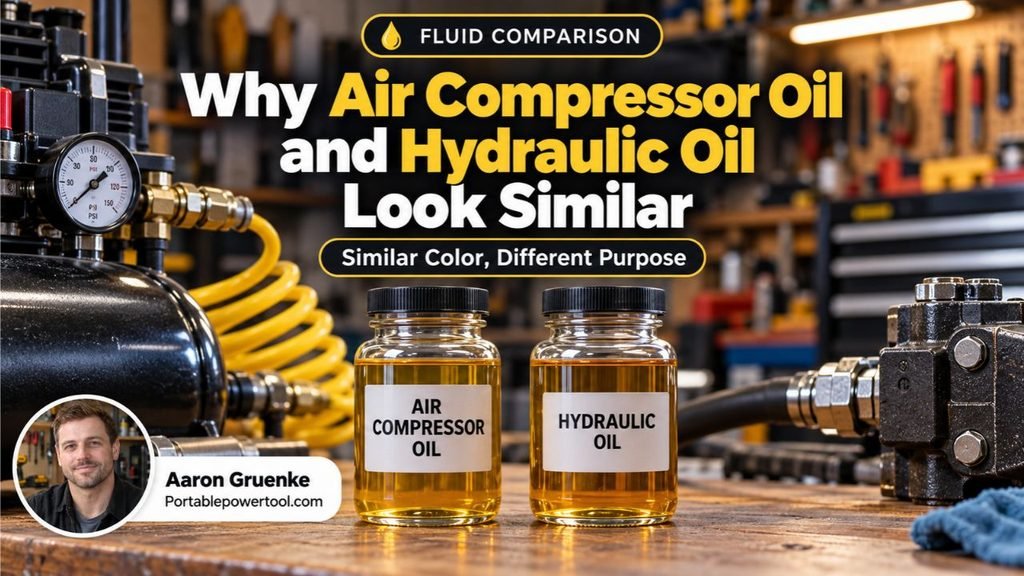
The two oils can appear almost identical.
Both may be:
- Clear
- Amber
- Light yellow
- Similar in thickness
They can also carry identical ISO VG viscosity numbers.
For example, you may find:
- ISO VG 32 compressor oil
- ISO VG 32 hydraulic oil
- ISO VG 46 compressor oil
- ISO VG 46 hydraulic oil
- ISO VG 68 compressor oil
- ISO VG 68 hydraulic oil
This is one of the main reasons people assume the fluids are interchangeable.
They are not necessarily the same.
What Does ISO VG Mean?
ISO VG stands for ISO viscosity grade.
It describes the approximate kinematic viscosity of an industrial lubricant at 40°C.
Common grades include:
- ISO VG 32
- ISO VG 46
- ISO VG 68
- ISO VG 100
A higher number indicates a thicker lubricant at the specified test temperature.
For example:
ISO VG 68 is thicker than ISO VG 32.
However, viscosity is only one characteristic of an oil.
Two oils can both be ISO VG 46 while having very different:
- Additives
- Base stocks
- Oxidation resistance
- Seal compatibility
- Deposit control
- Operating-temperature capability
Therefore:
ISO VG 46 compressor oil is not automatically interchangeable with ISO VG 46 hydraulic oil.
Can You Use Hydraulic Oil in an Air Compressor?
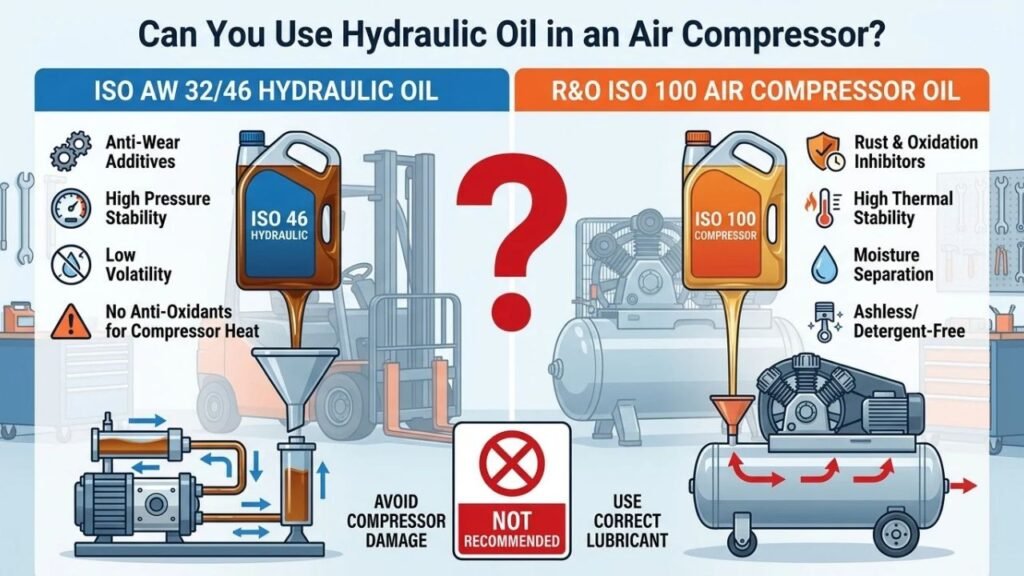
Sometimes—but only when the compressor manufacturer specifically allows it.
Certain reciprocating compressors, industrial compressors, or older equipment may specify an oil that can be met by an appropriate non-detergent industrial or hydraulic lubricant.
However, you should not assume hydraulic oil is safe simply because the viscosity matches.
Check the compressor manual for an oil specification such as:
- ISO VG grade
- DIN specification
- OEM part number
- Synthetic or mineral requirements
- Additive restrictions
If the manual says to use a specific compressor oil, use that oil or a lubricant explicitly approved as an equivalent.
Can You Use AW-32 Hydraulic Oil in an Air Compressor?
Not automatically.
AW-32 is a common anti-wear hydraulic oil with an ISO VG 32 viscosity grade.
AW means anti-wear.
Some compressor applications may tolerate or even specify a similar industrial lubricant, but many do not.
Using AW-32 purely because your compressor calls for “ISO 32” can be a mistake.
The compressor may require an oil with different:
- Oxidation characteristics
- Additive chemistry
- Flash point
- Deposit control
- Air-release characteristics
Check the manufacturer’s specifications first.
Can You Use AW-46 Hydraulic Oil in an Air Compressor?
The same rule applies.
AW-46 hydraulic oil and ISO VG 46 compressor oil may have similar viscosity, but they are not necessarily formulated the same way.
Use AW-46 only if the compressor manufacturer approves a hydraulic oil meeting that specification.
Do not substitute based solely on the number 46.
Can You Use AW-68 Hydraulic Oil in an Air Compressor?
Again, not unless the compressor’s specifications permit it.
An ISO VG 68 hydraulic oil may be the correct viscosity but still have the wrong additive package for the compressor.
Some large reciprocating compressor applications use relatively heavy lubricants, but the correct choice depends on:
- Pump design
- Ambient temperature
- Compressor speed
- Operating pressure
- Manufacturer requirements
Why Compressor Oil Needs Strong Oxidation Resistance
A compressor creates heat every time it raises air pressure.
The lubricant can therefore be exposed to:
- Elevated temperature
- Oxygen
- Moisture
- Metal surfaces
Heat and oxygen accelerate oil oxidation.
As oil oxidizes, it can eventually produce:
- Acids
- Sludge
- Varnish
- Deposits
These contaminants can interfere with lubrication and heat transfer.
High-quality compressor oils are formulated specifically to perform in this environment.
Carbon Deposits Matter in Air Compressors
Deposit formation is particularly important in compressor lubrication.
In reciprocating compressors, overheated or unsuitable lubricant may contribute to carbon accumulation around:
- Discharge valves
- Valve plates
- Piping
- Cylinder components
Excessive deposits can interfere with normal compressor operation.
This is one reason compressor manufacturers specify particular lubricants rather than simply recommending any oil of approximately the same thickness.
How Hydraulic Oil Additives Differ
Many hydraulic oils are formulated heavily around anti-wear performance.
A common anti-wear additive family used in hydraulic fluids includes zinc-containing compounds, although zinc-free hydraulic oils also exist.
Hydraulic fluid formulations may prioritize:
- Pump protection
- Filterability
- Water separation
- Foam control
- Seal compatibility
- Hydraulic stability
Those characteristics are excellent for hydraulic systems but do not automatically make the fluid suitable for an air compressor’s hotter compression environment.
Mineral vs Synthetic Compressor Oil
Air compressor oils can use different base stocks.
Mineral Compressor Oil
Mineral oil is petroleum-based.
It is widely used in many conventional reciprocating compressors.
Advantages can include:
- Reasonable price
- Wide availability
- Good performance for normal applications
Its service interval may be shorter than some premium synthetic compressor oils.
Synthetic Compressor Oil
Synthetic oils may use base stocks such as:
- PAO
- PAG
- Esters
- Other specialized synthetic formulations
Depending on the compressor and oil formulation, synthetic lubricants can provide:
- Better oxidation resistance
- Longer service intervals
- Better high-temperature stability
- Improved low-temperature performance
However, synthetic oils are not universally interchangeable.
For example, some synthetic chemistries can have compatibility issues with other oils, seals, or compressor materials.
Use the lubricant type specified for the machine.
Mineral vs Synthetic Hydraulic Oil
Hydraulic fluids are also available in mineral and synthetic formulations.
Synthetic hydraulic fluid may be selected for:
- Extreme temperatures
- Fire resistance
- Long service intervals
- Specialized industrial environments
This still does not make synthetic hydraulic fluid an acceptable replacement for synthetic compressor oil.
The application-specific formulation remains important.
What About Non-Detergent Oil?
Some reciprocating air compressors traditionally specify non-detergent compressor oil.
Non-detergent oil does not contain the same detergent and dispersant package commonly found in automotive engine oils.
This matters because compressor lubrication requirements differ from combustion-engine lubrication.
If your compressor manual calls for non-detergent oil, use an oil meeting that specification.
Do not assume any non-detergent hydraulic or industrial oil is automatically suitable.
Is Hydraulic Oil Non-Detergent?
Many hydraulic fluids do not contain the detergent packages used in automotive engine oils, but calling all hydraulic oil “non-detergent compressor oil” would still be misleading.
Hydraulic fluid has its own additive chemistry designed for hydraulic equipment.
The absence of automotive detergents does not prove compressor compatibility.
Compressor Oil vs Hydraulic Oil Additives
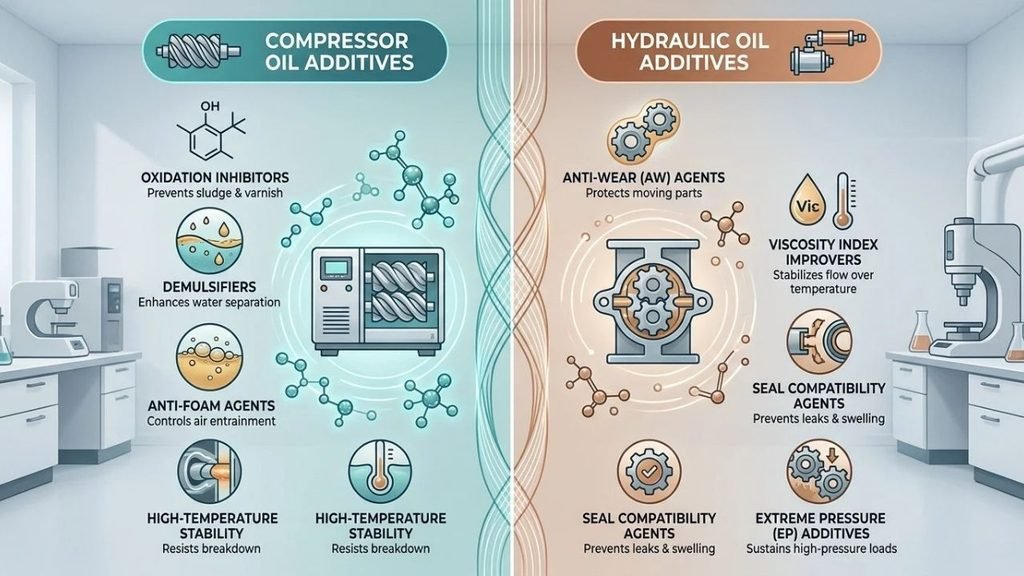
A simplified comparison helps illustrate why the products differ.
Compressor Oil May Prioritize:
- Oxidation resistance
- Thermal stability
- Deposit control
- Rust protection
- Water separation
- Low foaming
- Air release
- Compressor-specific wear protection
Hydraulic Oil May Prioritize:
- Anti-wear protection
- Pump lubrication
- Oxidation resistance
- Foam control
- Air release
- Filterability
- Rust protection
- Hydraulic seal compatibility
There is overlap, but formulation priorities are not identical.
Does Compressor Oil Have Detergent?
Many dedicated air compressor oils are non-detergent or use additive systems different from conventional automotive engine oils.
However, there are numerous compressor designs, and you should not assume every compressor lubricant has identical chemistry.
Always follow the compressor manufacturer’s oil specification.
Can You Mix Compressor Oil and Hydraulic Oil?
It is generally best not to.
Even when both products use similar base oils, additive packages may interact unpredictably.
Mixing can potentially affect:
- Viscosity
- Foam control
- Oxidation resistance
- Water separation
- Seal compatibility
- Deposit formation
If the wrong oil was added, consult the compressor manufacturer’s recommendations before operating the machine extensively.
A complete drain, cleaning procedure, filter replacement, or flushing may be necessary depending on the compressor and lubricant involved.
What Happens if You Put Hydraulic Oil in an Air Compressor?
The result depends on the compressor design, hydraulic oil formulation, and operating conditions.
If the lubricant does not meet the required specification, possible problems include:
- Increased operating temperature
- Faster oxidation
- Sludge
- Varnish
- Carbon deposits
- Foaming
- Increased wear
- Reduced lubrication
- Seal compatibility issues
- Shorter service intervals
A small reciprocating compressor may continue running and appear normal initially, which can create the false impression that the substitute is acceptable.
Lubrication problems often develop gradually.
What if You Accidentally Added Hydraulic Oil?
Do not panic, but do not assume everything is fine either.
First:
- Stop using the compressor if practical.
- Check the compressor manual.
- Identify exactly which hydraulic oil was added.
- Compare the oil specification with the manufacturer’s required lubricant.
- Contact the compressor manufacturer or qualified service provider if compatibility is unclear.
If the fluid is not approved, it may be appropriate to drain it before prolonged operation.
For expensive rotary screw compressors, professional guidance is particularly worthwhile because oil compatibility can affect separators, filters, seals, and the compressor element.
Rotary Screw Compressors Need Extra Caution
Oil selection is especially important in oil-injected rotary screw compressors.
Their lubricant performs several jobs simultaneously:
- Lubrication
- Cooling
- Sealing
- Heat transfer
Manufacturers often specify their own compressor fluids with carefully selected:
- Base oil
- Additives
- Viscosity
- Compatibility properties
Using ordinary hydraulic oil as a cheap substitute can be a false economy.
A compressor-fluid problem can potentially affect:
- Oil separator
- Thermostatic valve
- Cooler
- Bearings
- Screw element
- Hoses
- Seals
Use the specified compressor lubricant or a proven equivalent that explicitly meets the OEM requirements.
Are Compressor Oils Interchangeable With Each Other?
Not always.
Even two products labeled “air compressor oil” can be different.
For example, one may be:
- Mineral ISO VG 68
while another may be:
- Synthetic ISO VG 46
And a rotary screw compressor may require a completely different synthetic chemistry from a reciprocating piston compressor.
Always match:
- Compressor type
- Viscosity
- Base oil
- Specification
- Manufacturer approval
rather than buying oil based solely on the words “compressor oil.”
Can You Use Engine Oil Instead of Compressor Oil?
Usually, you should not substitute automotive engine oil unless the compressor manufacturer specifically permits it.
Engine oil is formulated for internal combustion engines and may contain:
- Detergents
- Dispersants
- Anti-wear additives
- Other engine-specific chemistry
Some older compressor manuals may specify a certain automotive-style oil, but modern users should follow the exact current specification for their compressor.
The same principle applies to hydraulic oil: manufacturer approval matters more than general similarity.
How Do You Know Which Oil Your Air Compressor Needs?
Start with the owner’s manual.
Look for information about:
- Viscosity grade
- Oil type
- Mineral vs synthetic
- OEM lubricant
- Environmental temperature range
- Change interval
Common compressor oil viscosities may include:
- ISO VG 32
- ISO VG 46
- ISO VG 68
- ISO VG 100
But these numbers should never be treated as universal recommendations.
Does Ambient Temperature Affect Compressor Oil Choice?
Yes.
Oil viscosity changes with temperature.
Cold Conditions
Oil becomes thicker.
If the lubricant is too heavy, the compressor may:
- Start slowly
- Draw more electrical current
- Lubricate poorly during startup
Hot Conditions
Oil becomes thinner.
If it becomes too thin, the lubricating film may not protect components adequately.
Manufacturers may specify different viscosity grades for different ambient-temperature ranges.
Follow their chart when available.
How Often Should Air Compressor Oil Be Changed?
There is no single oil-change interval for every compressor.
Intervals vary based on:
- Mineral vs synthetic oil
- Compressor design
- Operating hours
- Temperature
- Dust
- Humidity
- Load
- Manufacturer recommendations
Some small reciprocating compressors may require relatively frequent oil changes, while high-quality synthetic fluids in industrial compressors can have much longer scheduled service intervals.
Use operating hours and manufacturer recommendations rather than guessing based only on calendar time.
How to Check Compressor Oil
Oil-lubricated piston compressors commonly use one of several systems.
Sight Glass
A small window on the pump shows the oil level.
The oil level generally needs to remain within the marked range.
Dipstick
Some compressors use a dipstick similar to an engine.
Fill Plug Level
Certain designs use an oil plug or level indicator.
Check oil with the compressor positioned according to manufacturer instructions, normally on a level surface.
Do not overfill.
Too much oil can be almost as problematic as too little.
Signs Your Compressor Oil May Need Attention
Inspect the lubricant if you notice:
- Oil level dropping repeatedly
- Dark or burned-smelling oil
- Milky oil
- Excessive oil carryover
- Increased compressor temperature
- Unusual mechanical noise
- Sludge
- Foaming
Milky oil can indicate moisture contamination.
Rapid darkening can indicate high temperature, oxidation, or contamination, although appearance alone cannot provide a complete oil diagnosis.
Is Hydraulic Oil Cheaper Than Compressor Oil?
Sometimes.
General-purpose hydraulic oils are produced in very large quantities and may cost less than specialty compressor lubricants.
However, substituting cheaper oil can become expensive if it causes:
- Shorter oil life
- Deposits
- Increased wear
- Separator problems
- Compressor failure
Lubricant cost is usually small compared with the cost of repairing a compressor pump or rotary screw element.
Can Hydraulic Oil Damage Compressor Seals?
Potentially.
Seal compatibility depends on:
- Oil chemistry
- Seal material
- Operating temperature
- Additive package
An unapproved lubricant can cause certain elastomers to:
- Swell
- Harden
- Shrink
- Degrade
This risk is especially important when switching between different synthetic lubricant chemistries.
Never assume two oils are compatible simply because their viscosity matches.
Can Hydraulic Oil Cause Foaming in a Compressor?
A suitable hydraulic oil is normally designed to control foam in hydraulic systems, but foam behavior in a compressor can differ because the oil is exposed to different:
- Air contact
- Temperature
- Pressure
- Separation conditions
A compressor lubricant needs good air-release and foam-control properties for its specific application.
Incorrect oil can interfere with normal oil-air separation.
Which Oil Is Better for High Temperature?
You cannot answer this simply by choosing “compressor oil” or “hydraulic oil.”
The correct lubricant depends on:
- Base oil
- Viscosity index
- Oxidation stability
- Additives
- Compressor design
For a compressor operating at high temperature, a manufacturer-approved synthetic compressor oil may provide substantially better service life than a basic mineral product.
Do not choose hydraulic oil solely because its label mentions high-temperature operation.
Is Compressor Oil the Same as Pneumatic Tool Oil?
No.
Compressor oil lubricates the compressor pump.
Pneumatic tool oil, also called air-tool oil, lubricates tools such as:
- Impact wrenches
- Air ratchets
- Nailers
- Pneumatic drills
The two products serve different equipment.
Never assume compressor crankcase oil should be poured into the air inlet of a pneumatic tool.
Follow the tool manufacturer’s lubrication instructions.
Is Compressor Oil the Same as Vacuum Pump Oil?
No.
Vacuum pump oil is designed for vacuum systems and often requires very specific:
- Vapor pressure
- Purity
- Oxidation characteristics
Using compressor oil in a vacuum pump—or vacuum pump oil in an air compressor—without approval can result in poor performance or damage.
Common Mistakes When Choosing Air Compressor Oil
Matching Only the Viscosity Number
ISO VG 46 does not tell you the complete formulation.
Assuming All Industrial Oils Are Interchangeable
Hydraulic, compressor, turbine, gear, and circulating oils can have different additive systems.
Buying Oil Based Only on Price
Lubricant is relatively inexpensive compared with compressor repairs.
Mixing Different Synthetic Oils
Different synthetic chemistries may be incompatible.
Ignoring the Compressor Manual
The manufacturer’s specification should be the starting point.
Overfilling the Compressor
Adding extra oil does not improve lubrication.
Use the specified level.
Running With Too Little Oil
Low oil can lead to excessive heat, bearing damage, scoring, and pump failure.
When Is Hydraulic Oil Actually Acceptable?
Hydraulic oil is acceptable when the compressor manufacturer explicitly identifies a hydraulic-fluid specification that meets the compressor’s requirements.
For example, a manual may permit an industrial oil that happens to be marketed as hydraulic fluid and meets:
- Required ISO viscosity
- Correct additive requirements
- Correct oxidation specification
- Other OEM requirements
In that situation, the oil is acceptable because it meets the compressor specification, not simply because all hydraulic oil is interchangeable with compressor oil.
FAQs About Is Air Compressor Oil the Same as Hydraulic Oil
Can hydraulic oil be used in an air compressor?
Only if the compressor manufacturer approves that hydraulic oil specification.
Do not use hydraulic oil simply because it has the same viscosity grade as the recommended compressor oil.
Is ISO 46 compressor oil the same as ISO 46 hydraulic oil?
No.
Both oils have approximately the same viscosity grade, but their base oils and additive packages may differ.
ISO VG 46 describes viscosity—not the complete lubricant formulation.
Can I use AW-32 hydraulic oil instead of compressor oil?
Only if AW-32 meets the compressor manufacturer’s specified lubricant requirements.
Otherwise, use the correct compressor oil.
What happens if I use hydraulic oil in my air compressor?
An incompatible oil can potentially cause increased wear, oxidation, deposits, foaming, seal problems, overheating, or shortened oil life.
The exact result depends on the compressor and fluid.
What oil should I put in my air compressor?
Use the oil type and viscosity specified in the compressor owner’s manual.
Common compressor oil grades include ISO VG 32, 46, 68, and others, but the correct grade depends on the compressor.
Is compressor oil hydraulic fluid?
Normally no.
Compressor oil is formulated for compressor lubrication, while hydraulic fluid is designed primarily for power transmission and lubrication in hydraulic systems.
Can I mix hydraulic oil with compressor oil?
It is generally best not to mix them unless compatibility has been specifically confirmed.
Different additives and base oils can affect lubricant performance.
Can I use hydraulic oil temporarily in an air compressor?
A temporary substitution is still a substitution.
If the manufacturer does not approve it, avoid using the compressor until the correct lubricant is available. This is especially important with expensive rotary screw compressors.
Conclusion
So, is air compressor oil the same as hydraulic oil? In most cases, no. Although the two lubricants may look similar and can even share the same ISO VG viscosity grade, they are formulated around different operating requirements.
Air compressor oil must perform reliably in an environment involving compressed hot air, oxidation, moisture, deposit formation, friction, and—in many designs—significant heat removal. Hydraulic oil is primarily designed to transmit power through pumps, valves, cylinders, and hydraulic motors while providing anti-wear protection and maintaining hydraulic-system cleanliness.
The practical verdict is simple: do not substitute hydraulic oil for compressor oil based only on matching viscosity. If your compressor calls for ISO VG 46 compressor oil, an ISO VG 46 hydraulic fluid is not automatically equivalent. Use the compressor manufacturer’s specified lubricant or a replacement that explicitly meets the same requirements.
There are exceptions because some compressor manufacturers approve certain industrial or hydraulic oils for specific models. In those cases, using hydraulic oil is acceptable because the manufacturer has confirmed the required specifications—not because compressor oil and hydraulic oil are fundamentally the same product.
For the best compressor life, reliable lubrication, controlled operating temperature, and fewer deposit or compatibility problems, follow the oil specification in your owner’s manual rather than choosing a substitute based on price, appearance, or viscosity alone.