
Can I Use Air Compressor Oil in Air Tools? What You Should Know
Air compressors and pneumatic tools both use lubricants, so it is easy to assume that the oil used in the compressor pump can also be poured into an impact wrench, air ratchet, nailer, or other air-powered tool. The oils may even look similar. However, they are designed for different jobs inside very different types of equipment.
In most cases, you should not use air compressor oil as a substitute for air tool oil. Air tools should receive the lubricant specified by the tool manufacturer, which is usually a light pneumatic tool oil.
So, can I use air compressor oil in air tools? Generally, no. Compressor oil is formulated to lubricate the internal pump or crankcase of an oil-lubricated air compressor, while air tool oil is formulated to travel through a pneumatic tool’s air passages and lubricate moving parts such as vanes, bearings, seals, and impact mechanisms.
The reverse substitution is also usually a bad idea. Air tool oil should not automatically be used in an air compressor crankcase because it may have the wrong viscosity, additive package, oxidation resistance, and thermal characteristics for the compressor pump.
This guide explains the difference between air compressor oil and air tool oil, whether either can substitute for the other, what happens if you use the wrong lubricant, and how to choose the right oil for both your compressor and pneumatic tools.
Can I Use Air Compressor Oil in Air Tools?
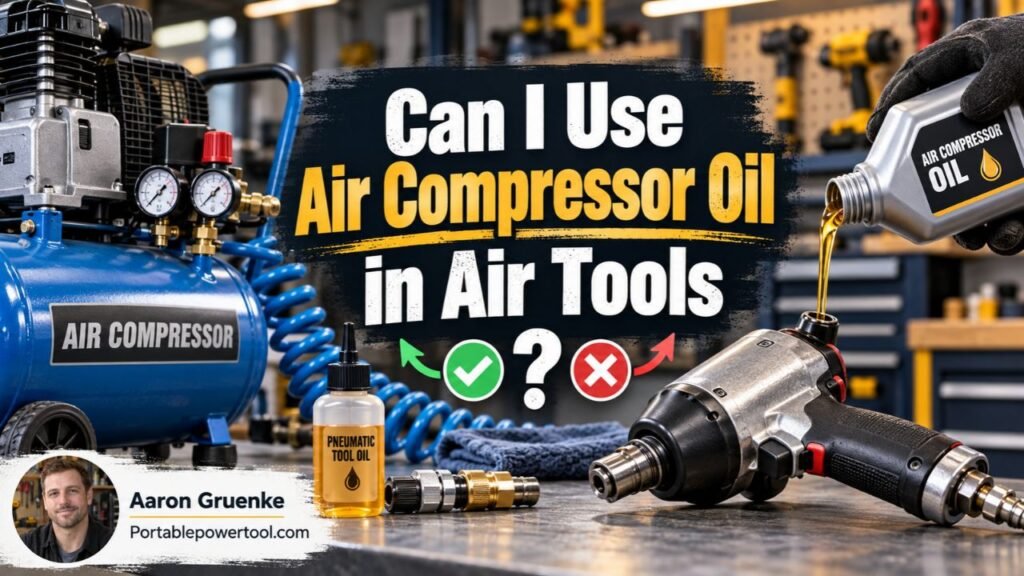
Generally, air compressor oil should not be used in air tools unless the tool manufacturer specifically approves it.
Most air tools are designed for a light, low-viscosity pneumatic tool oil that can move easily through narrow air passages and coat fast-moving internal components.
Air compressor oil is intended for a different environment.
It is commonly designed for:
- Compressor crankcases
- Bearings
- Connecting rods
- Pistons
- Rotary compressor elements
- High-temperature compressor operation
Air tool oil is commonly designed for:
- Air motors
- Rotor vanes
- Air passages
- O-rings
- Internal seals
- Small bearings
- Pneumatic mechanisms
Using the correct oil helps the tool operate smoothly without excessive drag or residue.
Is Air Compressor Oil the Same as Air Tool Oil?
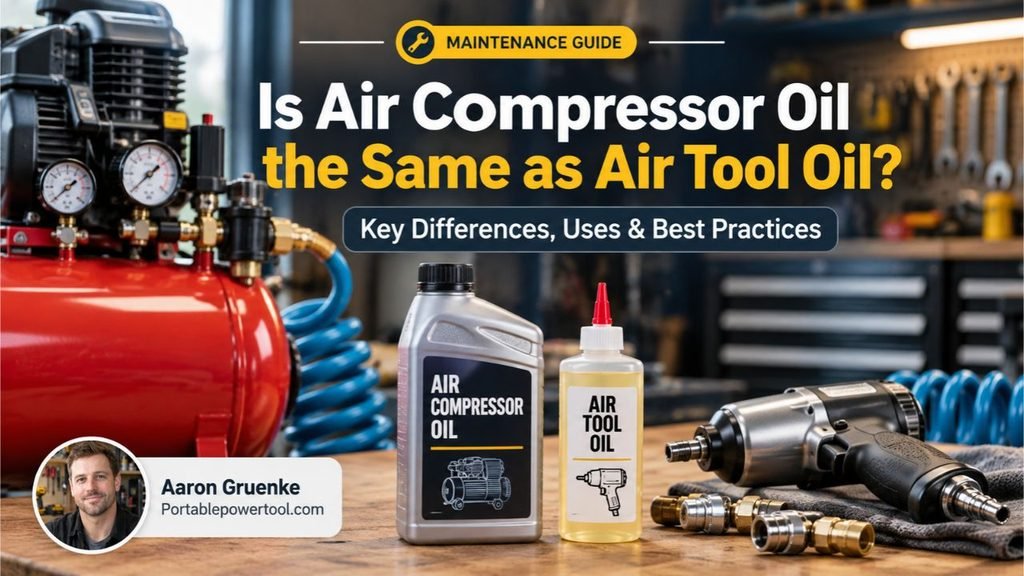
No. Air compressor oil and air tool oil are not necessarily the same lubricant.
They may share some characteristics, but their intended applications are different.
A basic comparison is:
| Feature | Air Compressor Oil | Air Tool Oil |
| Main use | Compressor pump/crankcase | Pneumatic tools |
| Typical viscosity | Often heavier | Usually lighter |
| Operating environment | Heat, pressure, crankcase operation | Fast-moving air motor and passages |
| Application method | Filled into compressor sump | Drops added to tool inlet or inline lubricator |
| Primary goal | Protect compressor pump | Lubricate tool internals |
| Interchangeable? | Usually no | Usually no |
The safest rule is simple: use compressor oil in the compressor and air tool oil in the air tool unless the manufacturer says otherwise.
Why Air Tools Need Special Oil
Pneumatic tools depend on compressed air flowing rapidly through small internal passages.
The oil needs to:
- Spread quickly
- Coat internal surfaces
- Reach moving parts
- Lubricate without creating excessive resistance
- Remain compatible with seals
A heavy oil can reduce how freely small components move.
For example, an air impact wrench contains an air motor that spins at high speed. If a lubricant is too thick, it can increase drag and reduce performance, especially in cold conditions.
Air tool oil is normally formulated to work well in this environment.
Why Air Compressors Need Different Oil
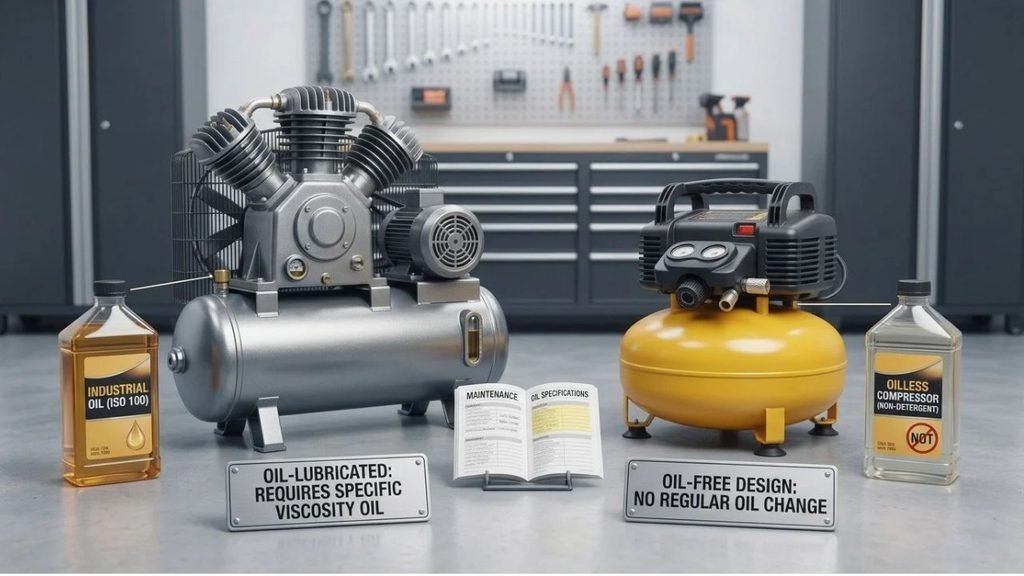
An oil-lubricated compressor pump operates under a different set of conditions.
The oil may need to handle:
- High operating temperatures
- Longer operating periods
- Bearing loads
- Compression-related heat
- Oxidation
- Moisture contamination
The compressor manufacturer chooses a lubricant viscosity and formulation based on the pump design.
Using a lighter oil that was intended for pneumatic tools may not provide the film strength or thermal protection the compressor needs.
Can I Use Compressor Oil in My Air Tools?
This question has the same basic answer: usually, no.
If you are asking, “can I use compressor oil in my air tools,” check the tool manual before making a substitution.
Some light compressor oils may appear similar to pneumatic tool oil, but viscosity alone is not enough to determine compatibility.
A lubricant can differ in:
- Base oil
- Additives
- Anti-wear properties
- Rust protection
- Oxidation resistance
- Seal compatibility
- Foaming behavior
If the tool specifies pneumatic oil, use pneumatic oil.
Can I Use Air Tool Oil in My Compressor?
Usually not.
Air tool oil is generally too light to be treated as a universal replacement for compressor oil.
An oil-lubricated compressor requires the lubricant grade specified by its manufacturer.
Using air tool oil in the crankcase can potentially lead to:
- Inadequate lubrication
- Increased wear
- Higher temperatures
- Reduced oil film strength
- Premature pump damage
A small amount of air tool oil accidentally entering the compressor’s air intake is different from filling the compressor crankcase with it.
The crankcase should always contain the correct compressor lubricant.
What Happens If You Put Compressor Oil in an Air Tool?
The result depends on the oil and the tool.
A small amount may not immediately destroy the tool, but problems can occur.
The Tool May Run Slower
Heavier oil can increase internal drag.
High-speed pneumatic motors depend on free movement, so thick lubricant can reduce RPM.
Oil May Collect Inside the Tool
Some oils do not move through the air passages as easily.
That can leave excessive residue.
Dirt May Stick to the Oil
Thicker oil can trap:
- Dust
- Metal particles
- Shop debris
This may accelerate wear over time.
Seals May Not Like the Formulation
Some lubricants contain additives that are not ideal for the tool’s rubber seals or O-rings.
This is another reason manufacturer-approved oil matters.
What Happens If You Put Air Tool Oil in an Air Compressor?
A small accidental amount may not immediately cause failure, but using it as the main crankcase lubricant can be risky.
Possible problems include:
- Insufficient viscosity
- Reduced bearing protection
- Increased wear
- Excessive heat
- Shortened pump life
Drain and refill the compressor with the correct oil if a significant amount of incorrect lubricant was added.
Follow the manufacturer’s procedure rather than continuing to operate it with an unknown oil mixture.
What Kind of Oil Do Air Tools Use?
Many pneumatic tools use a dedicated air tool oil, sometimes called:
- Pneumatic tool oil
- Air motor oil
- Pneumatic lubricant
This oil is typically thin enough to travel through the tool easily.
However, not every pneumatic tool uses the exact same lubricant.
Some tools may require:
- Standard air tool oil
- Special impact mechanism grease
- Turbine oil
- Manufacturer-specific lubricant
- No added oil at all
Always check the manual.
Which Air Tools Commonly Need Oil?
Many traditional pneumatic tools require regular lubrication.
Examples include:
- Impact wrenches
- Air ratchets
- Pneumatic drills
- Die grinders
- Air hammers
- Pneumatic sanders
- Some nailers
- Some staplers
The oil is often added through the air inlet.
The exact quantity varies by tool.
Some manufacturers specify only a few drops before use, while tools connected to a centralized air system may use an inline lubricator.
Do All Air Tools Need Oil?
No.
Some modern pneumatic tools are designed as oil-free or require very limited lubrication.
Certain nailers and specialty tools may specifically warn against adding oil because oil can:
- Contaminate work surfaces
- Damage internal components
- Affect seals
- Cause staining
Never assume every pneumatic tool should receive oil.
Check the tool’s lubrication instructions.
How Much Air Tool Oil Should You Use?
More is not necessarily better.
Too much oil may blow out through the exhaust and create a mess.
For many small pneumatic tools, only a few drops in the air inlet are needed before operation.
However, there is no universal amount.
The correct quantity depends on:
- Tool type
- Tool size
- Usage frequency
- Manufacturer design
- Whether an inline lubricator is used
Follow the tool manufacturer’s maintenance schedule.
Where Do You Put Air Tool Oil?
For tools requiring manual lubrication, oil is commonly added through the air inlet fitting.
A typical procedure is:
- Disconnect the air hose.
- Hold the tool with the air inlet facing upward.
- Add the specified number of drops.
- Reconnect the hose.
- Run the tool briefly at low load.
- Wipe away excess oil from the exhaust area.
Do not pour large amounts of oil into the tool.
What Is an Inline Air Lubricator?
An inline lubricator is installed in a compressed air line and introduces a controlled mist of oil into the airflow.
It can be useful when several pneumatic tools operate frequently.
An FRL system may combine:
- Filter
- Regulator
- Lubricator
The filter removes contaminants.
The regulator controls pressure.
The lubricator delivers oil mist.
However, an inline lubricator should not be used on equipment that requires oil-free air unless the air system is separated appropriately.
Can Compressor Oil Travel Into Air Tools Automatically?
Some oil-lubricated compressors can produce small amounts of oil carryover in the compressed air.
This is not the same as properly lubricating an air tool.
The amount is:
- Uncontrolled
- Usually inconsistent
- Not necessarily the correct lubricant
- Often filtered out by the air system
Do not rely on compressor oil carryover to lubricate pneumatic tools.
Use the lubrication system recommended for the tool.
What About Oil-Free Air Compressors?
An oil-free compressor does not supply lubricating oil to air tools.
If your pneumatic tool requires lubrication, you still need to provide it separately.
That may mean:
- Adding drops to the tool inlet
- Using an inline lubricator
- Following another manufacturer-approved lubrication method
The compressor and tool lubrication systems are separate issues.
Is Synthetic Compressor Oil Safe for Air Tools?
Do not assume that synthetic compressor oil is suitable simply because it is high quality.
Synthetic refers primarily to the lubricant’s base stock, not its intended application.
A synthetic compressor oil may still be:
- Too thick
- Formulated for different temperatures
- Designed for a compressor crankcase
- Incompatible with tool requirements
Use synthetic air tool oil if the tool manufacturer approves or recommends it.
Can I Use Motor Oil in Air Tools?
Generally, no.
Automotive engine oil is usually much heavier and contains additives designed for internal combustion engines.
Motor oil may:
- Increase pneumatic tool drag
- Leave deposits
- Attract contamination
- Affect seals
Dedicated air tool oil is inexpensive and more suitable.
Can I Use 3-in-1 Oil in Air Tools?
It is generally better to use actual pneumatic tool oil.
Multipurpose household oils may not have the correct viscosity or additive package for a high-speed air motor.
If the tool manufacturer specifically approves a multipurpose oil, follow that recommendation. Otherwise, use a lubricant designed for pneumatic equipment.
Can I Use Hydraulic Oil in Air Tools?
Hydraulic oil is designed primarily to transfer power in hydraulic systems.
Although some light hydraulic oils may appear similar to pneumatic lubricants, they are not automatically interchangeable.
Air tools should use the lubricant specified by the manufacturer.
Can I Use ATF in Air Tools?
Automatic transmission fluid is sometimes used in certain mechanical applications, but it should not be treated as a universal pneumatic tool lubricant.
ATF contains friction modifiers and other additives intended for transmissions and hydraulic controls.
Use dedicated air tool oil unless the tool documentation specifically allows another fluid.
Air Tool Oil vs Compressor Oil Viscosity
One of the most important differences is often viscosity.
Viscosity describes how easily an oil flows.
A lower-viscosity oil flows more easily.
Air tools generally benefit from a relatively light lubricant because the oil must move through small passages and reach high-speed internal components.
Compressors may require heavier lubricant to maintain a protective film inside the pump.
However, the exact viscosity varies by manufacturer, so you should never choose oil based only on whether it “looks thin.”
Why Non-Detergent Oil Is Often Mentioned for Compressors
Some reciprocating air compressors specify non-detergent compressor oil.
This differs from many automotive engine oils, which contain detergent and dispersant additives designed to suspend contaminants.
Compressor manufacturers may specify a lubricant that minimizes:
- Deposits
- Carbon formation
- Foaming
- Unwanted additive effects
Not every compressor uses the same type of oil, though.
Some modern compressors require specific synthetic formulations.
Can the Wrong Oil Damage Seals?
Yes, potentially.
Air tools and compressors contain:
- O-rings
- Shaft seals
- Gaskets
- Valve materials
Lubricants use different base oils and additives, and some materials may not respond well to every formulation.
The wrong oil can potentially contribute to:
- Swelling
- Hardening
- Softening
- Premature deterioration
Using the specified lubricant minimizes compatibility problems.
Does Air Tool Oil Prevent Rust?
Quality pneumatic tool oils often provide some corrosion protection.
Compressed air naturally contains moisture.
Even with a good moisture separator, some humidity can enter air tools.
Lubrication helps protect internal metal surfaces against:
- Rust
- Corrosion
- Friction
- Wear
However, oil is not a substitute for controlling moisture in the compressed air system.
Why Moisture Is Bad for Air Tools
When air is compressed, moisture in the atmosphere can condense.
Water inside pneumatic tools can cause:
- Internal rust
- Sticky vanes
- Reduced performance
- Bearing damage
- Premature failure
Use:
- Tank drains
- Water separators
- Air dryers when necessary
- Proper tool lubrication
to protect pneumatic equipment.
Should You Oil an Impact Wrench?
Most conventional pneumatic impact wrenches need lubrication, but they may contain two separate systems.
The air motor may require air tool oil.
The impact mechanism may require:
- Grease
- Special impact oil
- Another lubricant
Do not assume that adding air tool oil through the air inlet lubricates every internal component of an impact wrench.
Follow the manufacturer’s maintenance instructions.
Should You Oil a Pneumatic Nailer?
Some pneumatic nailers require a few drops of oil regularly.
Others are specifically designed as oil-free.
Using oil in an oil-free nailer may contaminate:
- Wood
- Trim
- Paint surfaces
- Internal components
Check the owner’s manual before adding lubricant.
Signs an Air Tool Needs Lubrication
Possible signs include:
- Reduced power
- Slow operation
- Tool sticking
- Unusual squealing
- Increased vibration
- Rough operation
However, these symptoms can also result from:
- Low air pressure
- Undersized hose
- Restricted fittings
- Moisture
- Internal wear
- Compressor capacity problems
Do not assume oil is the only issue.
Signs You May Be Using Too Much Oil
Excess lubrication can create:
- Heavy oil mist from exhaust
- Oil dripping from tool
- Messy work area
- Contamination of finished surfaces
- Dirt accumulation
If a tool continuously spits oil, review the lubrication quantity and inline lubricator setting.
Common Lubrication Mistakes
Using One Oil for Everything
Air compressors and pneumatic tools may operate from the same air system, but they do not necessarily use the same lubricant.
Over-Oiling Air Tools
Adding excessive oil does not provide better protection.
Ignoring Manufacturer Instructions
A manual may specify a very particular lubricant.
Running a Lubricated Compressor Low on Oil
Low crankcase oil can rapidly damage a compressor pump.
Adding Oil to an Oil-Free Tool
Some pneumatic tools are designed specifically to run without routine oil.
Relying on Compressor Carryover
Random oil entering the air stream from the compressor is not a controlled tool lubrication system.
How to Choose the Correct Oil
For the air compressor:
- Find the compressor model number.
- Check the owner’s manual.
- Confirm required viscosity.
- Confirm whether synthetic or mineral oil is specified.
- Use the recommended compressor lubricant.
For an air tool:
- Identify the exact tool model.
- Check whether it requires lubrication.
- Find the recommended air tool oil.
- Follow the correct quantity and interval.
- Check whether additional grease is required elsewhere.
Matching the lubricant to the machine is far better than trying to find one oil for both.
FAQs About Can I Use Air Compressor Oil in Air Tools
Can I Use Air Compressor Oil in an Impact Wrench?
Generally, no. Use the pneumatic tool oil specified for the impact wrench’s air motor.
The impact mechanism may also require a separate grease or oil.
Can I Use Air Tool Oil in My Compressor?
Usually not.
Air tool oil may be too light or otherwise unsuitable for the compressor’s pump and crankcase.
Use the compressor manufacturer’s specified lubricant.
Can I Use Compressor Oil in My Air Tools?
Only if the air tool manufacturer specifically approves that lubricant.
For most pneumatic tools, dedicated air tool oil is the better choice.
Is Air Compressor Oil the Same as Air Tool Oil?
No. They are designed for different lubrication environments.
Compressor oil protects the compressor pump, while air tool oil lubricates pneumatic tool components.
What Happens If I Accidentally Put Compressor Oil in an Air Tool?
A small accidental amount may not immediately damage the tool.
However, if the oil is too heavy, it can reduce performance or leave excessive residue. Follow the manufacturer’s instructions and use the proper lubricant going forward.
What Happens If I Put Air Tool Oil in an Air Compressor?
If a significant amount was added to the crankcase, it is safest to drain the incorrect lubricant and refill with the specified compressor oil before continued use.
Do Oil-Free Compressors Still Need Air Tool Oil?
Yes, if the pneumatic tool itself requires lubrication.
An oil-free compressor does not eliminate the lubrication needs of an air tool.
Can I Use the Same Oil for Both Compressor and Air Tools?
Usually not.
There may be unusual products or equipment where the manufacturer approves the same lubricant, but you should never assume compatibility without checking both manuals.
Conclusion
The practical answer to can I use air compressor oil in air tools is generally no. Compressor oil and air tool oil are designed for different jobs, and using one as a substitute for the other can reduce performance or shorten equipment life.
Air compressor oil is formulated to protect the pump, bearings, and crankcase of an oil-lubricated compressor under heat and mechanical load. Air tool oil is usually lighter and designed to move through pneumatic passages while lubricating air motors, vanes, seals, and other small moving parts.
The same rule applies in reverse: air tool oil should not automatically be used in an air compressor. Use the exact lubricant specified for each piece of equipment, keep compressor oil at the proper level, lubricate pneumatic tools only as directed, and remember that oil-free compressors and oil-free tools may have completely different maintenance requirements.
The safest long-term approach is simple: treat compressor lubrication and air tool lubrication as two separate systems rather than trying to use one oil for both.