
How Often to Change Oil in Air Compressor: Complete Guide
Knowing how often to change oil in air compressor equipment is important because the oil lubricates moving parts, helps control heat, and reduces wear inside an oil-lubricated compressor pump. Leaving old, contaminated, or low oil in the compressor for too long can increase friction and shorten the life of components such as bearings, cylinders, pistons, and crankshafts.
For many oil-lubricated reciprocating air compressors, a common maintenance interval is roughly every 500 to 1,000 operating hours or about once a year, whichever comes first. However, this is only a general guideline. Some manufacturers call for the first oil change much sooner after break-in, and rotary screw compressors can have entirely different service intervals.
The correct interval depends on the compressor design, oil type, operating temperature, workload, environment, and manufacturer’s maintenance schedule. A compressor that runs occasionally in a home garage may go months between oil changes, while a compressor operating every day in a hot, dusty shop may require much more frequent maintenance.
Oil-free compressors are an important exception. If your compressor is genuinely oil-free, there is normally no crankcase oil for you to change.
This guide explains how often compressor oil should be changed, how different compressor types affect the schedule, how to tell when oil is worn out, and how to change the oil safely.
How Often to Change Oil in Air Compressor?
For a typical oil-lubricated reciprocating air compressor, oil is often changed approximately every 500 to 1,000 operating hours or once every 6 to 12 months, depending on the manufacturer and operating conditions.
A practical general guide is:
| Compressor Type | General Oil Change Guideline |
| Small oil-lubricated piston compressor | About 500–1,000 hours or annually |
| Heavily used piston compressor | Inspect frequently; may need changes every few months |
| Rotary screw compressor | Often 2,000+ hours depending on oil and manufacturer |
| Synthetic-oil compressor | Often longer intervals than mineral oil |
| New compressor during break-in | May require an early first oil change |
| Oil-free compressor | No pump oil change normally required |
These are general ranges, not universal service specifications.
The owner’s manual should always take priority because manufacturers design pumps, oil capacities, operating temperatures, and lubrication systems differently.
Read More: what type of oil does an air compressor take
Why Air Compressor Oil Needs to Be Changed
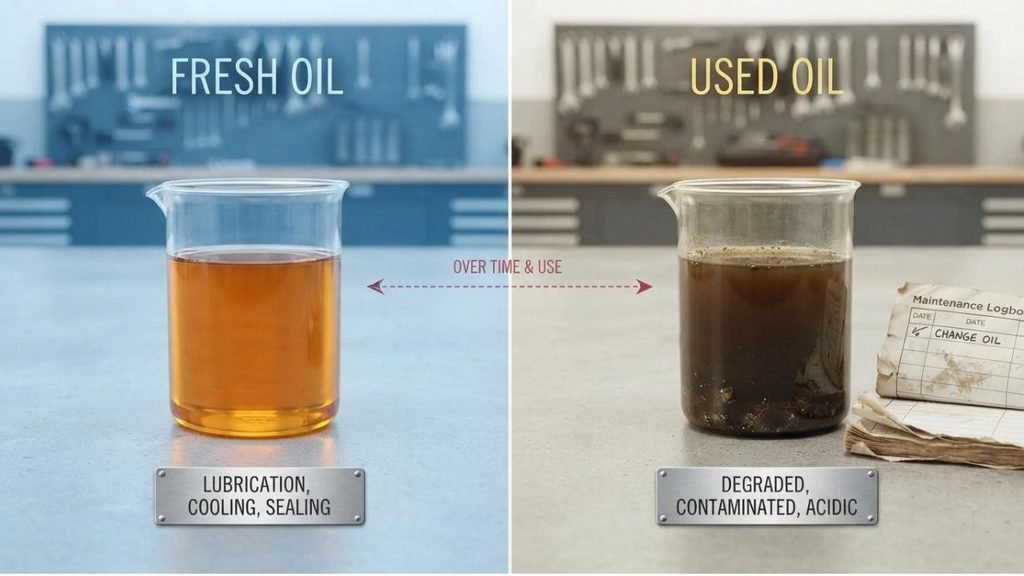
Compressor oil does much more than simply make moving parts slippery.
Its main functions include:
- Reducing friction
- Controlling wear
- Carrying heat away from moving components
- Helping protect metal from corrosion
- Flushing small contaminants toward the crankcase
- Supporting proper sealing in some compressor designs
Over time, the oil is exposed to heat, moisture, air, and contamination.
As the oil ages, it can:
- Oxidize
- Become darker
- Lose viscosity
- Form deposits
- Accumulate metal particles
- Absorb moisture
- Lose protective additives
Fresh oil restores proper lubrication and reduces unnecessary wear.
Read More: how much oil does an air compressor take
Does Every Air Compressor Need an Oil Change?

No.
Air compressors generally fall into two broad lubrication categories:
Oil-Lubricated Air Compressors
These compressors have oil inside the pump or airend.
You may see:
- Oil sight glass
- Oil fill plug
- Oil dipstick
- Oil drain plug
These machines require periodic oil inspection and replacement.
Oil-Free Air Compressors
An oil-free air compressor normally uses permanently lubricated bearings, special coatings, or low-friction materials instead of a serviceable oil-filled crankcase.
If your compressor is oil-free, you generally do not add or change pump oil.
Never add oil simply because another compressor of a similar size uses it.
Check the model specifications first.
How Often Should You Change Oil in a Piston Air Compressor?
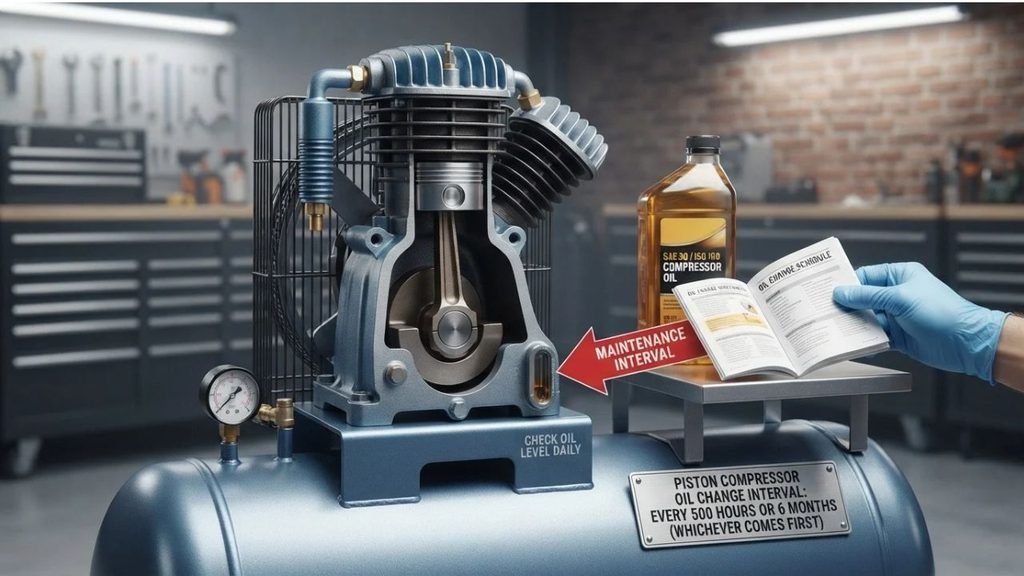
A reciprocating or piston compressor uses a crankshaft and pistons similar in concept to an engine.
Oil-lubricated piston compressors commonly require relatively frequent oil changes because the oil is exposed to repeated heat cycles.
A general range is approximately:
500 to 1,000 operating hours
or
every 6 to 12 months
For a homeowner who uses the compressor occasionally, annual servicing may occur before the compressor reaches the hour limit.
For a professional shop where the compressor runs several hours every day, the operating-hour limit may arrive first.
How Often Should You Change Oil in a Rotary Screw Compressor?

Rotary screw compressors use two rotating screw-shaped elements rather than pistons.
Many oil-injected rotary screw systems can use their lubricant for longer intervals than small piston compressors.
Depending on the compressor and oil, maintenance intervals may be around:
- 2,000 hours
- 4,000 hours
- 8,000 hours
or another manufacturer-specified interval.
Special synthetic compressor lubricants may support longer service intervals than conventional mineral oils.
However, you should never extend the interval simply because the oil is synthetic.
Rotary screw systems often use the lubricant for:
- Lubrication
- Cooling
- Sealing
- Heat removal
Oil condition is therefore especially important.
Follow the manufacturer’s hour and calendar limits.
Does Synthetic Air Compressor Oil Last Longer?
Often, yes.
Synthetic compressor oil generally offers better resistance to oxidation and high-temperature breakdown than conventional mineral oil.
Potential benefits include:
- Longer oil life
- Better performance at high temperatures
- Reduced sludge formation
- Improved cold-temperature flow
- Better oxidation resistance
However, synthetic oil still needs to be changed.
Moisture, contamination, and additive depletion can affect synthetic lubricants even when the base oil remains chemically stable.
Do not automatically double the change interval unless the compressor manufacturer allows it.
Mineral Oil vs. Synthetic Compressor Oil Change Intervals
The exact interval varies, but conventional oil generally needs replacement sooner than a quality synthetic lubricant.
| Oil Type | Typical Characteristics |
| Mineral compressor oil | Lower cost, often shorter service interval |
| Synthetic compressor oil | Better high-temperature stability and often longer life |
| Manufacturer-specific lubricant | Designed for a particular compressor and service schedule |
Some compressor manufacturers require or recommend a specific oil formulation.
Using the wrong viscosity or oil chemistry can affect performance and warranty coverage.
When Should You Change the Oil in a New Air Compressor?
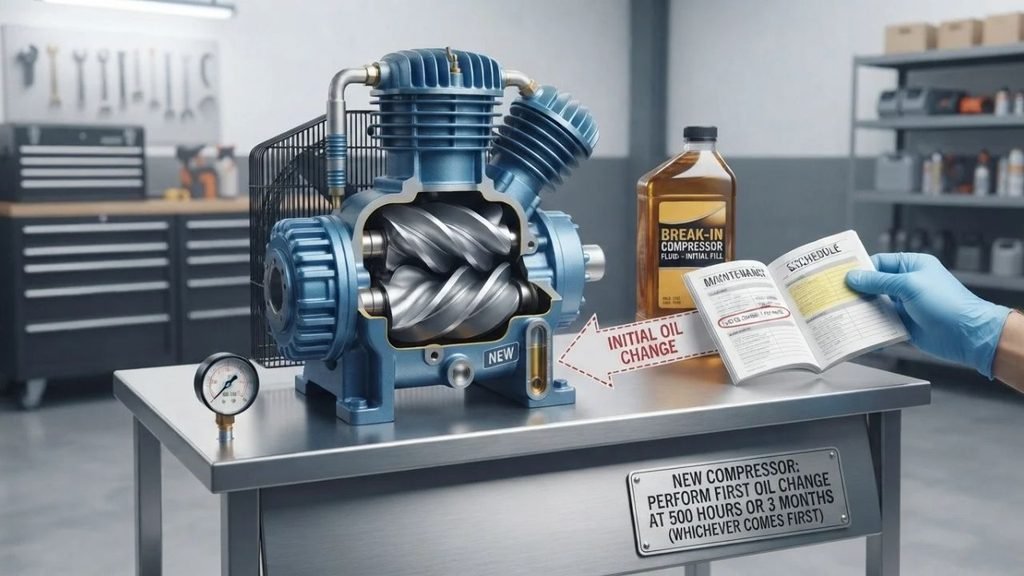
A new oil-lubricated compressor may require an early first oil change after the break-in period.
This first change is important because microscopic particles can be produced as new internal components wear into their operating surfaces.
Depending on the manufacturer, the first change may be required after:
- Several hours
- 20 hours
- 50 hours
- 100 hours
or another specified break-in interval.
Do not assume the normal yearly schedule applies to the first oil change.
Check the manual for a dedicated break-in maintenance requirement.
How Often Should a Home Garage Air Compressor Get an Oil Change?
For an oil-lubricated compressor used occasionally in a home garage, changing the oil about once a year is a reasonable general guideline if that agrees with the owner’s manual.
A DIY compressor may only operate during:
- Tire inflation
- Nail-gun projects
- Occasional impact-wrench use
- Cleaning
- Small automotive repairs
Because operating hours may remain low, the calendar interval often matters more than running time.
Oil can still absorb moisture and age even when the compressor is not used heavily.
How Often Should a Commercial Shop Compressor Get an Oil Change?
Commercial compressors usually accumulate operating hours much faster.
A repair shop, body shop, manufacturing facility, or tire shop may run a compressor for many hours every working day.
In this environment, oil changes should normally be scheduled by operating hours, not simply by months.
For example, a compressor running six hours a day for five days per week accumulates:
6 × 5 = 30 hours per week
At that rate, 500 operating hours would be reached in roughly:
500 ÷ 30 ≈ 17 weeks
That is only about four months.
A compressor used heavily may therefore require several oil changes per year.
What Conditions Make Compressor Oil Wear Out Faster?
Operating conditions can shorten oil life considerably.
High Temperatures
Heat accelerates oil oxidation.
A compressor operating in a hot room or with poor ventilation may degrade oil faster than one running in a cool, well-ventilated environment.
Heavy Duty Cycles
A compressor that runs almost continuously produces more heat than one that cycles occasionally.
Long run times increase thermal stress on the lubricant.
Dusty Environments
Dust and airborne contaminants can eventually reach internal components if filtration or sealing is poor.
Construction sites, woodworking shops, and industrial areas can be particularly demanding.
High Humidity
Compressors draw atmospheric air into the pump.
Moisture from humid air can contribute to oil contamination and internal corrosion.
Frequent Start-Stop Operation
Repeated heating and cooling can contribute to condensation and oil degradation.
Poor Maintenance
Dirty intake filters, clogged coolers, low oil levels, or restricted ventilation can increase operating temperature and shorten oil life.
Signs Your Air Compressor Oil Needs Changing
You should not rely only on time.
Inspect the oil periodically.
Oil Is Much Darker Than Normal
Fresh compressor oil is often clear, amber, or lightly colored depending on the formulation.
Oil that has become very dark may be oxidized or contaminated.
Color alone does not always prove the oil has failed, but a significant change deserves attention.
Oil Looks Milky
Milky or cloudy oil can indicate water contamination.
This is more likely in humid conditions or in compressors that do not run long enough to evaporate internal moisture.
Water-contaminated oil should be investigated and replaced according to manufacturer guidance.
Oil Contains Visible Particles
Metallic particles or unusual debris may indicate wear or contamination.
A small amount of discoloration during initial break-in may occur, but obvious metal debris deserves closer inspection.
Oil Smells Burnt
A burnt odor can indicate overheating or oxidation.
Check for causes such as:
- Low oil level
- Poor ventilation
- Excessive duty cycle
- Cooling-system problems
- Incorrect lubricant
Compressor Runs Hotter Than Normal
Old or low oil can increase friction.
However, overheating can also be caused by other issues, so inspect the whole system.
Oil Has Thickened
Oxidized oil may become unusually thick or sticky.
Sludge or varnish deposits can restrict lubrication.
Should You Change Compressor Oil Based on Color?
Not by color alone.
Some oils naturally darken as they age without immediately losing their lubricating ability.
A better approach is to consider:
- Operating hours
- Calendar age
- Appearance
- Odor
- Contamination
- Manufacturer recommendations
If the specified interval has arrived, change the oil even if it still looks relatively clean.
How to Check Air Compressor Oil Level
Many oil-lubricated compressors use either a sight glass or dipstick.
Sight Glass
The sight glass is commonly mounted near the bottom of the compressor pump.
The correct oil level is often near the center of the sight glass, but designs vary.
Do not assume “completely full” is correct.
Dipstick
Some compressors use a dipstick integrated into the fill cap.
Depending on the design, you may need to:
- Screw it fully in
- Rest it on the threads without screwing
- Check between minimum and maximum marks
Follow the manufacturer’s procedure.
Can You Just Add Oil Instead of Changing It?
Adding oil and changing oil are different maintenance tasks.
If the level is low, topping it off restores the proper amount of lubricant.
However, adding fresh oil does not remove:
- Oxidized oil
- Moisture
- Dirt
- Metal particles
- Degraded additives
If the service interval has arrived, drain the old oil and replace it rather than simply topping it off.
Also investigate why the oil level became low.
Compressors should not normally consume large amounts of oil between routine services without a reason.
What Type of Oil Should You Use in an Air Compressor?
Use the compressor manufacturer’s specified lubricant whenever possible.
Common recommendations may include:
- Non-detergent compressor oil
- SAE 20 compressor oil
- SAE 30 compressor oil
- ISO VG 46 compressor oil
- ISO VG 68 compressor oil
- Manufacturer-specific synthetic lubricant
The correct viscosity depends on the pump and operating conditions.
Do not assume ordinary automotive engine oil is equivalent to compressor oil.
Some compressors can use specific engine oils, but only when the manufacturer explicitly permits it.
Can You Use Motor Oil in an Air Compressor?
Sometimes, but not universally.
Traditional reciprocating compressor pumps often use non-detergent compressor oil because it is formulated differently from modern automotive motor oil.
Automotive engine oils contain detergent and additive packages designed for internal combustion engines.
Those additives may not be appropriate for every compressor.
Use motor oil only if your compressor manufacturer’s manual lists it as acceptable.
Otherwise, use a dedicated compressor lubricant of the specified viscosity.
How to Change Oil in an Air Compressor
Changing oil is usually straightforward on a small piston compressor.
1. Turn Off the Compressor
Disconnect electrical power.
For a portable electric compressor, unplug it.
For a permanently wired compressor, follow the proper electrical isolation procedure.
2. Let the Pump Cool
Do not drain oil from a dangerously hot compressor.
Slightly warm oil can drain more easily, but the pump should be cool enough to handle safely.
3. Relieve Tank Pressure if Required
Follow the manufacturer’s servicing procedure.
Do not work around pressurized components unnecessarily.
4. Locate the Drain Plug
The oil drain plug is usually near the bottom of the compressor pump crankcase.
Place a drain pan underneath.
5. Open the Fill Plug
On many compressors, loosening or removing the oil fill plug helps air enter the crankcase so the old oil drains more freely.
6. Remove the Drain Plug
Allow the old oil to flow completely into the drain pan.
Observe the oil for:
- Water
- Metal particles
- Sludge
- Burnt odor
7. Reinstall the Drain Plug
Clean the plug and sealing area.
Reinstall and tighten it according to manufacturer instructions.
Do not overtighten plugs threaded into aluminum compressor housings.
8. Add the Correct New Oil
Fill with the correct lubricant.
Add gradually while checking the sight glass or dipstick.
9. Do Not Overfill
Too much oil can cause:
- Foaming
- Oil carryover
- Excessive crankcase pressure
- Leakage
- Poor compressor performance
Stop at the specified level.
10. Run and Recheck
After reassembly, operate the compressor according to the service procedure.
Then shut it down, allow the oil to settle, and recheck the level.
Inspect around the drain and fill plugs for leaks.
How Much Oil Does an Air Compressor Need?
Oil capacity varies greatly.
A small portable compressor may hold only several ounces, while a large industrial unit can hold several quarts or gallons.
Do not fill based solely on compressor tank size.
A 60-gallon compressor tank does not automatically indicate a particular crankcase oil capacity.
Instead, check:
- Compressor model
- Pump model
- Owner’s manual
- Sight glass
- Oil capacity specification
Tank capacity and oil capacity are separate specifications.
Can Too Much Oil Damage an Air Compressor?
Yes.
Overfilling can be almost as problematic as running low.
Too much oil may cause the crankshaft or moving components to whip the oil into foam.
Foamed oil lubricates less effectively and may be pushed into areas where it should not go.
Possible symptoms include:
- Oil leaks
- Oil coming from the breather
- Excessive oil carryover
- Unusual smoke or odor
- Reduced efficiency
Maintain the level specified by the manufacturer.
What Happens if an Air Compressor Runs Low on Oil?
Insufficient oil can cause serious internal wear.
Possible consequences include:
- Excessive friction
- Overheating
- Bearing damage
- Cylinder or piston wear
- Crankshaft damage
- Premature pump failure
- Seizure in extreme cases
If the compressor repeatedly loses oil, find the cause rather than simply continuing to refill it.
Possible sources include external leaks, worn internal components, or oil carryover.
What Happens if You Never Change Compressor Oil?
Oil gradually loses its protective properties.
Eventually you may experience:
- Increased operating temperature
- Sludge
- Varnish deposits
- Accelerated bearing wear
- Increased friction
- Corrosion
- Shortened compressor life
- Pump failure
Skipping an inexpensive oil change can therefore lead to a much more expensive pump repair.
Does Tank Size Affect How Often You Change Compressor Oil?
Not directly.
A 20-gallon, 30-gallon, 60-gallon, or 80-gallon tank does not determine the oil-change interval.
The oil is located in the compressor pump or airend, not the storage tank.
Two 60-gallon compressors can have completely different:
- Pumps
- Motors
- Duty cycles
- Oil capacities
- Lubricants
- Service intervals
Use the pump manufacturer’s schedule rather than tank capacity.
Should You Change Oil Before Winter?
It can be useful if the normal service interval is approaching.
Oil becomes thicker when cold.
If your compressor operates in an unheated garage during winter, using the manufacturer-approved lubricant for the expected temperature range can make starting easier and improve lubrication.
Do not simply install thinner oil without checking the approved viscosity.
Should You Change Oil Before Long-Term Storage?
If the oil is old or contaminated, changing it before long-term storage can be beneficial because fresh oil provides better corrosion protection.
Also:
- Drain moisture from the air tank
- Store the compressor in a dry area
- Follow the manufacturer’s storage procedure
Water left inside the receiver tank can promote internal corrosion.
How Often Should You Check Compressor Oil?
Check oil level much more frequently than you change it.
For regularly used compressors, a good habit is to inspect the oil:
- Before each major use
- Weekly in a busy shop
- At the maintenance interval specified by the manufacturer
An oil level check takes only a few seconds and can prevent expensive damage.
Keep an Air Compressor Maintenance Log
If the compressor sees regular use, record:
- Date
- Operating hours
- Oil change
- Oil type
- Oil quantity
- Air filter replacement
- Belt inspection
- Tank draining
- Other repairs
A maintenance log makes hour-based servicing easier, particularly in commercial environments where several people use the same compressor.
Other Maintenance to Perform With an Oil Change
Oil changes are a good opportunity to inspect other compressor components.
Drain Water From the Tank
Compressed air creates condensation inside the receiver.
Drain the tank according to the manufacturer’s schedule.
Check the Air Filter
A dirty intake filter reduces airflow and can increase operating temperature.
Clean or replace it when necessary.
Inspect the Drive Belt
On belt-driven compressors, inspect for:
- Cracks
- Fraying
- Glazing
- Incorrect tension
Check for Air Leaks
Listen for leaks around:
- Fittings
- Hoses
- Regulator
- Drain valve
- Connections
Air leaks make the compressor run more frequently, increasing heat and wear.
Inspect Cooling Surfaces
Keep cooling fins and ventilation openings free of heavy dust.
Proper cooling helps extend oil and compressor life.
Common Air Compressor Oil Change Mistakes
Waiting Until the Oil Looks Terrible
Oil can lose protective performance before becoming obviously black or thick.
Follow the scheduled interval.
Using the Wrong Oil
Incorrect viscosity or additives can reduce lubrication quality.
Use the specified compressor lubricant.
Overfilling the Crankcase
More oil is not better.
Fill only to the correct level.
Ignoring the First Break-In Oil Change
The initial change can remove particles produced during early wear-in.
Forgetting Calendar Time
Low operating hours do not mean oil lasts forever.
Moisture and oxidation can still affect lubricant during storage.
Changing the Oil but Ignoring Overheating
If new oil quickly becomes dark or smells burnt, diagnose the underlying heat problem.
FAQs About How Often to Change Oil in Air Compressor
How Often Should I Change the Oil in My Air Compressor?
For many oil-lubricated piston compressors, a common general interval is about 500 to 1,000 operating hours or every 6 to 12 months.
Always follow the service interval specified for your exact compressor.
How Often Should You Change Oil in a 60-Gallon Air Compressor?
Tank size alone does not determine the interval.
Many oil-lubricated 60-gallon piston compressors may need oil approximately every 500 to 1,000 hours or annually, but the actual schedule depends on the pump manufacturer.
Do Air Compressors Need an Oil Change Every Year?
Many oil-lubricated compressors benefit from an annual oil change when operating hours do not reach the manufacturer’s hour limit first.
Oil-free compressors normally do not have serviceable pump oil.
How Do I Know if My Air Compressor Oil Is Bad?
Signs include oil that is unusually dark, milky, thick, contaminated with particles, or has a burnt smell.
Increased compressor temperature can also indicate a lubrication problem.
What Happens if I Don’t Change Air Compressor Oil?
Old oil can oxidize and lose its ability to protect moving parts.
This may cause increased heat, sludge, accelerated wear, bearing damage, and premature compressor failure.
Can I Change Compressor Oil Too Often?
Changing clean oil earlier than necessary generally does not harm the compressor if the correct lubricant and filling procedure are used, but it wastes oil and money.
Following the manufacturer’s schedule is more practical.
Should I Change Air Compressor Oil When It Is Hot or Cold?
Oil drains more easily when slightly warm, but the compressor should not be dangerously hot.
Turn off and isolate the compressor and allow it to cool enough to service safely before draining.
Does an Oil-Free Air Compressor Need Oil Changes?
No. A true oil-free compressor does not normally have user-serviceable pump oil.
Do not add oil unless the manufacturer’s instructions specifically call for it.
Conclusion
Knowing how often to change oil in air compressor equipment depends primarily on compressor type, operating hours, lubricant, and working conditions. For many oil-lubricated piston compressors, roughly 500 to 1,000 operating hours or every 6 to 12 months is a useful general guideline, but the manufacturer’s schedule should always be followed.
A new compressor may require an earlier break-in oil change, while synthetic lubricants and rotary screw compressors can have considerably longer service intervals. Heavy use, high temperatures, dust, and moisture may shorten oil life.
Check the oil level regularly, watch for dark, milky, burnt, or contaminated oil, use the correct compressor lubricant, and avoid both underfilling and overfilling. Regular oil changes are inexpensive maintenance that can significantly reduce wear and help an oil-lubricated air compressor deliver reliable service for years.