
Oil vs Oil Free Air Compressor: Complete A-to-Z Comparison Guide
Choosing between an oil-lubricated and oil-free compressor can be confusing because both can produce the same basic result: compressed air. The real difference is what happens inside the compression system, how the compressor handles friction and heat, how much maintenance it requires, and whether oil can enter the compressed-air stream.
For most home users who want a portable, low-maintenance compressor for inflation, nail guns, and occasional projects, an oil-free model is usually the easier choice. For demanding shop work and frequent use, a quality oil-lubricated compressor often offers smoother operation and long service life. When even tiny amounts of compressor oil could contaminate a product or process, a properly specified oil-free system is the appropriate choice.
The oil vs oil free air compressor decision cannot be made from the word “oil” alone. Compressor type, CFM output, PSI, tank size, duty cycle, operating environment, air-quality requirements, noise, maintenance, and total ownership cost all matter.
It is also important to separate small consumer compressors from large industrial systems. An inexpensive oil-free pancake compressor and a sophisticated industrial oil-free rotary screw compressor are both technically oil-free, yet their capabilities, price, duty cycle, and service life can be dramatically different.
This pillar guide covers oil free vs oiled air compressor, oil vs no oil air compressor, and oiled vs oilless air compressor comparisons from A to Z, including how each works, advantages and disadvantages, maintenance, longevity, noise, performance, applications, air purity, painting, automotive work, air tools, home garages, industrial use, and how to decide which type you actually need.
Oil vs Oil Free Air Compressor: What Is the Main Difference?
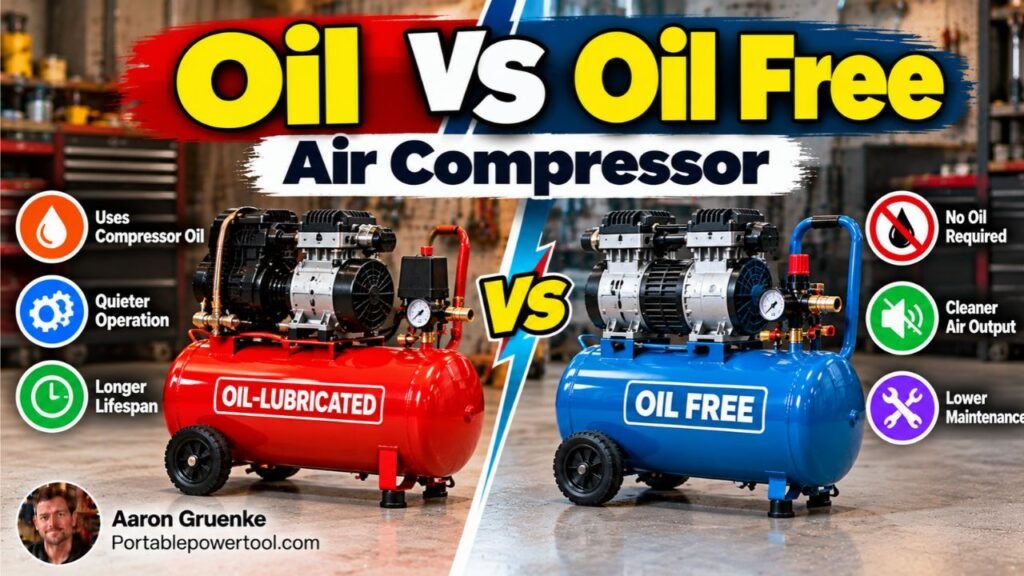
The main difference is how the compressor handles lubrication inside the compression chamber.
An oil-lubricated air compressor uses compressor oil in or around the compression mechanism. Depending on the compressor design, the oil can lubricate moving components, remove heat, help seal internal clearances, and reduce friction.
An oil-free air compressor is designed so that oil is not used in the compression chamber. Instead, it may rely on self-lubricating materials, low-friction coatings, special piston rings, non-contacting compression elements, water cooling, air cooling, or other engineering methods.
Here is the broad comparison:
| Feature | Oil-Lubricated Compressor | Oil-Free Compressor |
| Oil in compression process | Yes | No |
| Oil changes required | Yes, on applicable models | No compressor-pump oil changes |
| Air contamination risk from compressor oil | Higher | Much lower/eliminated from compression chamber |
| Routine maintenance | More oil-related maintenance | Less oil-related maintenance |
| Noise | Often quieter in comparable consumer piston designs | Some consumer models are louder |
| Heat management | Oil helps lubricate and remove heat | Uses alternative cooling/design methods |
| Weight | Often heavier | Many small models are lighter |
| Portability | Often lower | Often higher for consumer units |
| Purchase price | Varies; often reasonable for conventional shop compressors | Consumer units can be affordable; industrial oil-free systems can be expensive |
| Service life | Often long with maintenance | Varies widely by design and quality |
| Heavy-duty use | Excellent when correctly sized | Excellent with industrial-grade oil-free designs |
| Air purity | Requires treatment where oil carryover matters | Preferred where compressor-added oil cannot be tolerated |
| Best typical use | Workshops, automotive, general industrial work | Home DIY, portable use, sensitive production processes |
The table is useful for orientation, but several of these points need qualification. For example, it is incorrect to say that every oil-free compressor has a short lifespan or cannot run continuously. Industrial oil-free screw, scroll, centrifugal, and other compressors can be designed for demanding continuous service.
What Is an Oil-Lubricated Air Compressor?
An oil-lubricated air compressor, sometimes simply called an oiled compressor, uses oil as part of the compressor’s operating system.
In a traditional reciprocating piston compressor, oil lubricates components such as:
- Crankshaft
- Bearings
- Connecting rods
- Cylinder-related moving components
In an oil-injected rotary screw compressor, oil has several important functions. It can:
- Lubricate the screw elements and bearings
- Remove compression heat
- Help seal clearances between rotors
- Reduce internal leakage
- Reduce wear
After compression, oil-injected systems use separators and other components to recover most of the oil before the air travels downstream.
Some oil can still remain as aerosol or vapor, which is why applications requiring especially clean compressed air use appropriate filtration, air treatment, or an oil-free compressor system.
What Is an Oil-Free Air Compressor?
An oil-free air compressor compresses air without introducing lubricating oil into the compression chamber.
Depending on its design, it may use:
- Low-friction piston rings
- PTFE-type or other specialized coatings
- Sealed bearings
- Non-contacting compression elements
- Timing gears
- Air cooling
- Water cooling or water injection on certain industrial machines
- Multi-stage compression with intercooling
“Oil-free” does not necessarily mean there is literally no lubricant anywhere inside the entire machine.
For example, an industrial oil-free rotary screw compressor may still use oil to lubricate gears or bearings inside a separate sealed system. The important distinction is that this oil is kept away from the compressed-air path and compression chamber.
Similarly, small consumer oil-free compressors may have sealed or permanently lubricated bearings even though users never add compressor oil.
Oil-Free, Oilless, and Oil-Less: Are They the Same?
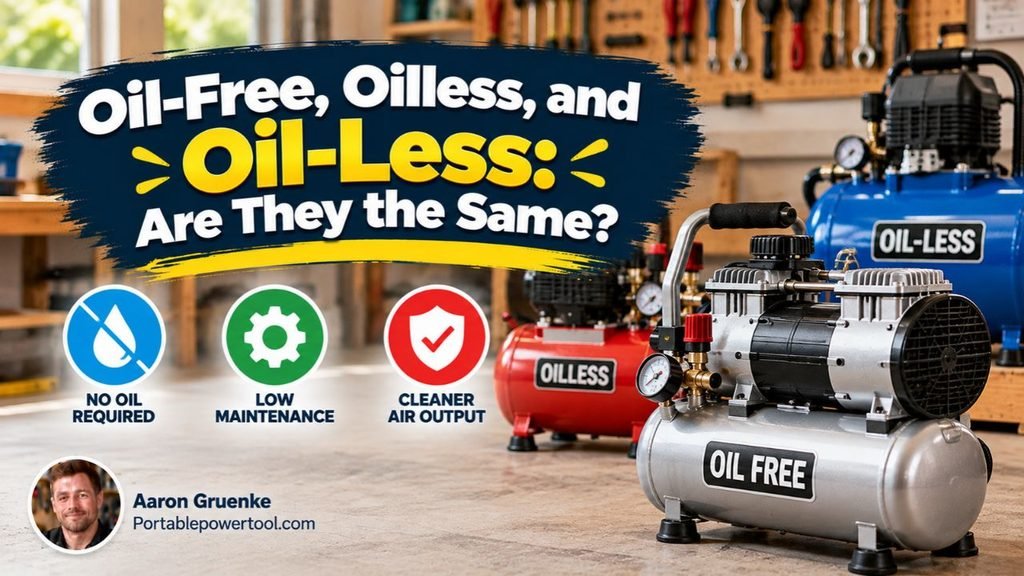
In everyday consumer compressor terminology, oil-free, oilless, and oil-less are frequently used interchangeably.
They generally describe a compressor that does not require the user to add lubricating oil to the pump’s compression mechanism.
However, manufacturer terminology can vary.
For that reason, when evaluating a compressor, look beyond the label and determine:
- Whether oil is present in the compression chamber
- Whether pump oil changes are required
- What air-quality specification the compressor meets
- What maintenance the manufacturer requires
For a homeowner comparing small portable compressors, “oil-free” and “oilless” usually point toward the same practical ownership experience: no routine compressor-pump oil changes.
How Does an Oil-Lubricated Piston Air Compressor Work?
A reciprocating compressor works somewhat like an engine piston, although its purpose is to compress air rather than burn fuel.
The process generally follows four stages.
1. Air Enters the Compressor
Atmospheric air is drawn through an intake filter.
2. The Piston Compresses the Air
A piston moves inside a cylinder, reducing the available space and increasing air pressure.
3. Oil Lubricates Moving Components
Oil reduces friction between internal components and helps control wear and heat.
4. Compressed Air Enters the Tank
The pressurized air moves through the discharge system into the receiver tank, where it is stored until needed.
Because oil is present in the compressor mechanism, very small amounts can potentially migrate into the compressed air.
How Does an Oil-Free Piston Air Compressor Work?
An oil-free piston compressor follows the same basic intake-and-compression process but eliminates oil lubrication from the compression chamber.
Instead, it commonly uses specialized piston rings or coatings designed to operate with little friction without liquid compressor oil.
This makes the pump:
- Simpler for the owner to maintain
- Easier to transport
- Less likely to introduce compressor oil into the air
However, friction and heat still exist.
The manufacturer must control them through materials, cooling, operating speed, and compressor design.
How Oil-Injected Rotary Screw Compressors Work
Large workshops and industrial facilities frequently use rotary screw compressors instead of reciprocating piston compressors.
An oil-injected screw compressor uses two intermeshing rotors.
As the rotors turn:
- Air enters the screw element.
- Air becomes trapped between the rotors and housing.
- Available volume becomes smaller.
- Pressure increases.
- Oil lubricates, cools, and helps seal the compression process.
- The oil-air mixture leaves the compression element.
- A separator removes most of the oil.
- Oil is circulated back through the compressor.
These systems are popular for high-demand compressed-air applications because they can provide a smooth, consistent supply of air.
How an Oil-Free Rotary Screw Compressor Works
An oil-free screw compressor keeps oil out of the compression chamber.
Rather than relying on oil to seal and lubricate the rotors, the machine uses precision engineering so the compression elements can operate without oil injection into the air stream.
Oil-free screw compressors often use multiple compression stages because controlling discharge temperature without injected oil requires a different approach.
They are widely used where compressed-air contamination could affect:
- Food
- Beverages
- Pharmaceuticals
- Electronics
- Chemical processes
- Sensitive manufacturing
These are very different machines from inexpensive household oil-free compressors and should not be judged by the same assumptions about durability or duty cycle.
Major Types of Oil-Free Air Compressors
Oil-free technology is available in several forms.
Oil-Free Reciprocating Compressors
Common in:
- Home garages
- Portable compressors
- Dental applications
- Laboratories
- Small workshops
Smaller consumer models may be designed primarily for intermittent use.
Oil-Free Scroll Compressors
A scroll compressor uses two spiral-shaped elements to compress air.
One remains stationary while the other moves in an orbital motion.
Oil-free scroll compressors are popular where:
- Clean air is important
- Noise should be controlled
- Air demand is moderate
Oil-Free Rotary Screw Compressors
These are designed for larger industrial air demands and can support demanding operating schedules when appropriately engineered.
Centrifugal Compressors
Centrifugal compressors use high-speed rotating impellers rather than traditional positive-displacement pistons.
They are commonly found in larger industrial installations requiring substantial air volume.
Water-Injected Compressors
Certain compressor designs use water rather than oil in the compression process for cooling and sealing.
These systems serve specialized industrial applications.
Oil vs Oil Free Air Compressor Air Quality
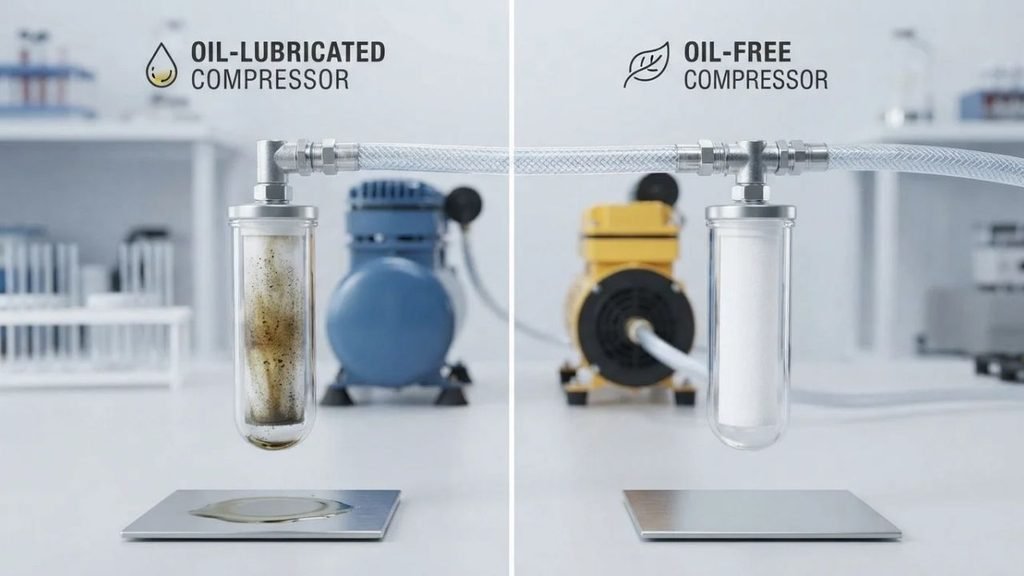
Air quality is one of the biggest differences between the two technologies.
Oil-Lubricated Compressor Air
An oil-lubricated compressor can introduce small amounts of:
- Oil aerosol
- Oil vapor
- Oil-related contaminants
into the compressed-air stream.
Separators and downstream filters can remove extremely small amounts of oil contamination, allowing oil-lubricated systems to provide very clean air for many applications.
However, there remains a potential source of compressor oil in the system.
Oil-Free Compressor Air
Because oil is not present in the compression chamber, the compressor itself does not inject lubricant into the compressed-air stream during compression.
That makes oil-free compressors desirable when contamination has serious consequences.
However, oil-free does not automatically mean contaminant-free air.
Atmospheric intake air may contain:
- Dust
- Water vapor
- Hydrocarbons
- Smoke
- Other airborne contaminants
The compressor also does not automatically remove moisture.
Filters, dryers, and other air-treatment equipment may still be required.
What Does ISO 8573-1 Class 0 Mean?
Industrial compressed-air purity is commonly discussed using ISO 8573-1, which classifies contaminants such as particles, water, and oil.
An important point is that Class 0 does not literally mean there can be zero molecules of contamination.
For a Class 0 specification, the permitted contamination level is specifically defined and must be more stringent than Class 1 for the contaminant being specified.
For total oil, Class 1 allows a maximum concentration of 0.01 mg/m³ under the standard’s applicable conditions, while a Class 0 requirement must specify a more stringent value.
This detail matters because marketing terms such as “100% oil-free” should not be confused with the precise technical meaning of an ISO purity classification.
If your business has a regulatory or process requirement, specify the required delivered-air purity at the point of use, rather than relying only on the words “oil-free compressor.”
Does an Oil-Free Compressor Produce Dry Air?
No.
Oil-free and moisture-free are not the same thing.
All air compressors draw in atmospheric air containing water vapor.
Compression changes the air’s temperature and moisture behavior. As compressed air cools, water can condense inside:
- Receiver tank
- Air lines
- Filters
- Tools
An oil-free compressor can therefore produce considerable water condensation.
Depending on the application, you may still need:
- Tank draining
- Moisture separator
- Refrigerated dryer
- Desiccant dryer
- Point-of-use filtration
This is particularly important for painting, sandblasting, pneumatic controls, and sensitive industrial processes.
Oil vs No Oil Air Compressor Maintenance
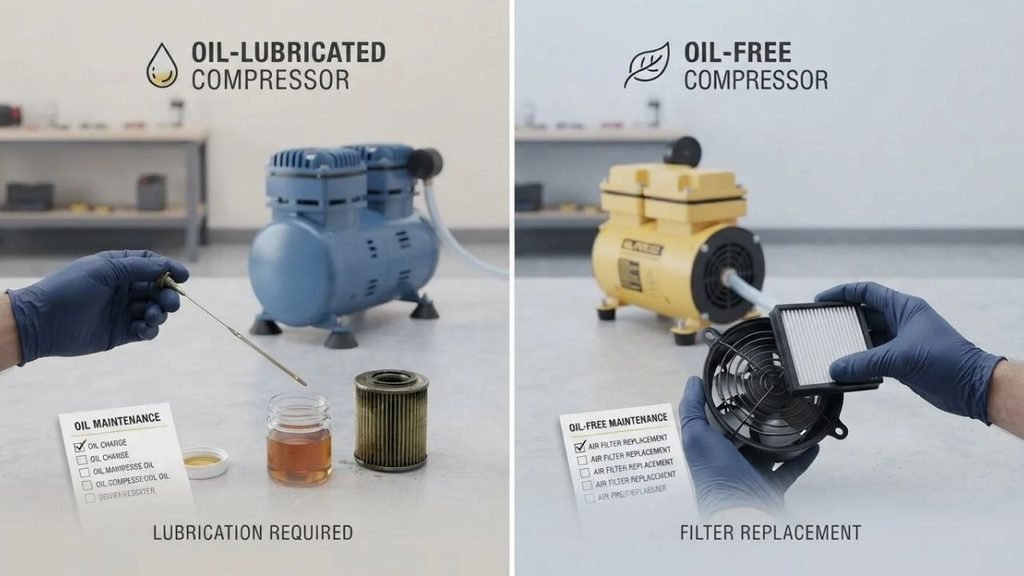
Oil-lubricated and oil-free compressors have different maintenance requirements.
Oil-Lubricated Compressor Maintenance
Depending on the compressor design, maintenance can include:
- Checking oil level
- Changing compressor oil
- Replacing oil filters
- Replacing air filters
- Replacing oil separators on screw compressors
- Draining tank moisture
- Inspecting belts
- Inspecting valves
- Cleaning cooling surfaces
- Checking for leaks
Oil-change intervals vary significantly between manufacturers, oils, compressor types, and operating conditions.
Always use the service interval in the compressor manual.
Oil-Free Compressor Maintenance
Oil-free does not mean maintenance-free.
Maintenance may still include:
- Draining the tank
- Cleaning or replacing intake filters
- Checking valves
- Inspecting piston rings or seals
- Checking belts where fitted
- Cleaning cooling fins
- Inspecting electrical components
- Maintaining dryers and filters
- Replacing worn compressor elements when required
The main convenience is that there is no routine oil change for the compression mechanism.
Which Compressor Is Easier to Maintain?
For a typical homeowner, an oil-free portable compressor is easier to maintain.
You do not need to:
- Check crankcase oil before use
- Buy compressor oil
- Perform routine oil changes
- Worry about spilling oil during transportation
You still need to drain tank water and perform basic inspections.
For industrial operations, maintenance comparisons are more complicated. An advanced oil-free compressor can have specialized components and service requirements that are more complex than a small oil-lubricated piston compressor.
Oiled vs Oilless Air Compressor Lifespan
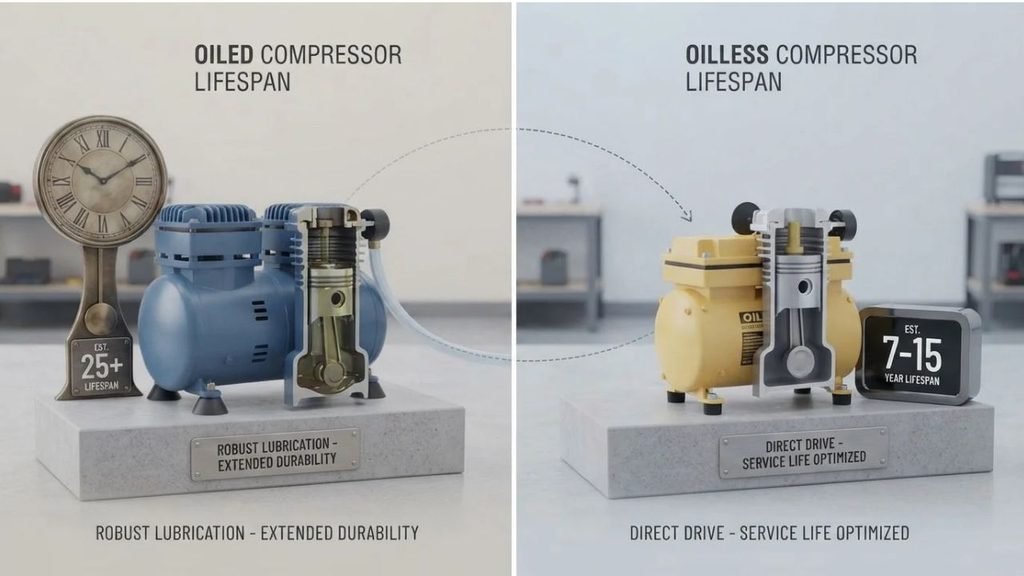
There is no universal number of years or operating hours that applies to either type.
Service life depends on:
- Compressor quality
- Pump speed
- Operating temperature
- Duty cycle
- Maintenance
- Ambient dust
- Moisture
- Installation
- Operating pressure
- Workload
For comparable traditional piston compressors, a well-maintained oil-lubricated pump often has strong longevity advantages because liquid lubrication reduces friction and wear.
Low-cost oil-free consumer compressors can wear faster because their friction-control components eventually degrade.
However, saying “all oil-free compressors have a short lifespan” is incorrect.
Industrial oil-free compressors can be engineered for long-term, high-duty operation.
The correct comparison is therefore:
Compare compressors within the same quality and application class—not simply oil vs oil-free labels.
Which Air Compressor Is Quieter?
Oil-lubricated piston compressors are often quieter than conventional high-speed oil-free piston compressors of comparable size.
Oil can help reduce mechanical friction and noise.
Some inexpensive oil-free units operate at high pump speeds and can be noticeably loud.
However, compressor design matters more than the oil label alone.
Modern “quiet” oil-free compressors may use:
- Lower pump speeds
- Multiple cylinders
- Vibration isolation
- Acoustic enclosures
- Improved intake mufflers
Industrial scroll and enclosed screw compressors can also operate at relatively low noise levels.
Therefore, if noise is important, compare the manufacturer’s dBA rating instead of assuming one technology will always be quieter.
Which Compressor Runs Cooler?
Oil provides valuable cooling in many lubricated compressor designs.
In an oil-injected rotary screw compressor, oil absorbs a significant amount of compression heat.
Oil-free compressors must control heat using different methods, such as:
- Cooling fans
- Large cooling surfaces
- Intercoolers
- Water cooling
- Multi-stage compression
- Specialized materials
Small oil-free piston compressors can become quite hot during extended operation.
That does not automatically indicate failure, but exceeding the designed duty cycle can accelerate wear or trigger thermal protection.
Oil vs Oil Free Air Compressor Duty Cycle
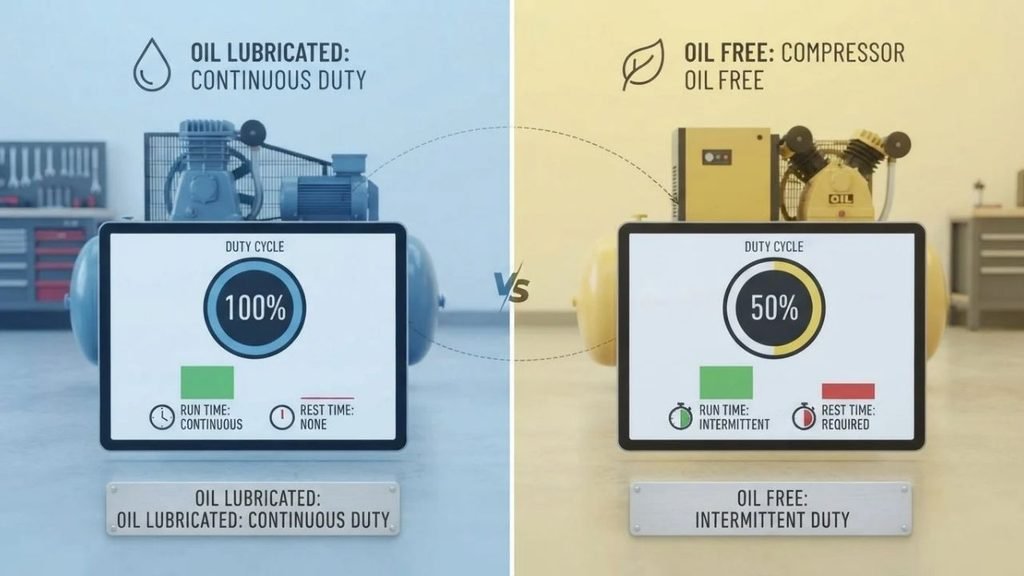
Duty cycle describes how much of a given period a compressor can operate without exceeding its intended thermal limits.
For example, a compressor designed for intermittent use must periodically stop and cool.
Many small oil-free consumer compressors have limited duty cycles because they prioritize:
- Low weight
- Low cost
- Portability
Oil-lubricated shop compressors are often better suited to longer working periods, but this is not universal.
Industrial oil-free screw and centrifugal systems can be designed for continuous-duty operation.
Always check the compressor’s actual duty-cycle rating rather than choosing from the lubrication type alone.
Does an Oil Compressor Make More CFM?
Not automatically.
CFM, or cubic feet per minute, measures airflow.
Air delivery depends on:
- Motor horsepower
- Pump displacement
- Pump efficiency
- Operating pressure
- Compressor design
- Number of compression stages
Both oil-lubricated and oil-free compressors can produce high CFM.
When comparing compressors for tools, focus on delivered CFM at the required PSI, not merely lubrication type.
For example, if an impact wrench needs 5 CFM at 90 PSI, your compressor needs enough usable output at approximately that pressure regardless of whether it uses oil.
Does an Oil Compressor Produce More PSI?
Again, not automatically.
Both oil and oil-free compressors are available at many pressure ratings.
Maximum PSI tells you the highest pressure the system is designed to reach.
It does not tell you how quickly the compressor can supply air.
For air tools, CFM is often more important than simply buying the compressor with the highest PSI number.
Oil-Free vs Oiled Air Compressor for Air Tools
For intermittent tools such as:
- Brad nailers
- Finish nailers
- Pin nailers
- Staplers
- Blow guns
an oil-free compressor is often ideal.
These tools generally have modest air consumption.
For demanding tools such as:
- Impact wrenches
- Air grinders
- Die grinders
- Sanders
- Cutoff tools
airflow becomes much more important.
A larger oil-lubricated shop compressor can be an excellent choice for frequent use because these tools may consume air continuously.
A sufficiently large industrial-quality oil-free compressor can also run them, but oil-free technology itself does not compensate for insufficient CFM.
Oil vs Oil Free Air Compressor for a Home Garage
For most home garages, the decision depends on how the compressor will be used.
Choose Oil-Free If You Mainly:
- Inflate tires
- Blow dust from equipment
- Use a brad nailer
- Use a finish nailer
- Perform occasional DIY projects
- Need to move the compressor frequently
- Prefer minimal maintenance
Consider Oil-Lubricated If You:
- Use pneumatic tools regularly
- Work on vehicles frequently
- Want a larger stationary compressor
- Run air tools for longer periods
- Value quieter mechanical operation
- Are comfortable maintaining compressor oil
For occasional use, convenience often makes oil-free the better value.
For an active workshop, an oil-lubricated compressor can make more sense.
Oil vs Oil Free Air Compressor for Automotive Work
Automotive air requirements vary dramatically.
Tire Inflation
Either type works.
An oil-free portable compressor is usually more convenient.
Impact Wrench
Either type works if CFM and pressure are sufficient.
For repeated shop use, a larger compressor with substantial reserve capacity is preferable.
Air Ratchet
Moderate airflow is required, so compressor CFM should be checked.
Die Grinder and Air Sander
These tools can consume large amounts of air continuously.
A small portable compressor—oil-free or oiled—may struggle to keep up.
For frequent automotive air-tool use, a larger shop compressor is usually the better choice.
Oil vs Oil Free Air Compressor for Nail Guns
Oil-free compressors are extremely popular for nail guns.
Why?
Nail guns consume air in short bursts rather than continuously.
A compact oil-free pancake or hot-dog compressor can often operate:
- Brad nailers
- Finish nailers
- Pin nailers
- Staplers
very effectively.
Framing nailers also work well with many portable compressors because each shot uses a relatively small volume of air, although rapid production work increases air demand.
For nailers, portability often matters more than having an oil-lubricated pump.
Oil vs Oil Free Air Compressor for Painting
Painting deserves special attention.
An oil-lubricated compressor can be used for spray painting, but the compressed air should be properly treated.
Paint air should ideally be free of:
- Compressor oil
- Water
- Dirt
- Rust particles
Oil contamination can contribute to finish defects.
A good painting setup may include:
- Moisture separator
- Coalescing filter
- Appropriate air dryer
- Point-of-use filtration
An oil-free compressor reduces one source of potential contamination but still does not eliminate moisture.
For occasional automotive painting, air capacity is also critical. Many spray guns require substantial continuous CFM.
Do not choose a tiny oil-free compressor simply because the air is cleaner if it cannot supply the spray gun’s airflow requirement.
Oil-Free Compressor for Food and Beverage Applications
Compressed air can directly or indirectly contact:
- Food
- Ingredients
- Packaging
- Production equipment
Oil contamination can therefore become a serious process-quality concern.
Oil-free compressor systems are commonly preferred for sensitive food and beverage applications.
However, simply buying a machine labeled oil-free is not enough for every facility.
Proper compressed-air quality management can also involve:
- Particulate filtration
- Moisture control
- Microbiological risk management
- Air-quality testing
- Point-of-use requirements
Industrial users should define the required compressed-air purity for the actual process.
Oil-Free Compressor for Medical and Dental Applications
Medical, laboratory, and dental applications can require especially clean compressed air.
Oil-free compressors are commonly used because they eliminate compressor oil from the compression chamber.
Additional system requirements may include:
- Drying
- Filtration
- Bacterial control
- Redundancy
- Specific air-quality standards
A general-purpose garage oil-free compressor should not be assumed suitable for medical or breathing-air use.
Never use ordinary shop compressed air as breathing air unless the complete system is specifically designed, treated, tested, and approved for that purpose.
Oil-Free Compressors for Electronics
Oil and moisture can interfere with sensitive electronic manufacturing.
Oil-free compressor systems are therefore common in applications such as:
- Electronics assembly
- Semiconductor manufacturing
- Instrumentation
- Precision manufacturing
Air treatment remains necessary because oil-free compression does not eliminate airborne particles or water vapor.
Which Compressor Is Better for Woodworking?
For woodworking, both can work.
Oil-Free Is Excellent For:
- Brad nailers
- Finish nailers
- Staplers
- Blow guns
- Portable jobsite work
Oil-Lubricated May Be Better For:
- Larger permanent workshops
- Long operating periods
- Multiple users
- High-CFM pneumatic sanders
- Continuous-production environments
If you mostly use electric sanders and only need compressed air for nailers, an oil-free unit is generally more convenient.
Which Compressor Is Better for Construction?
Portable oil-free compressors are popular on construction sites because they:
- Require less routine maintenance
- Can be transported without worrying about crankcase oil orientation on many designs
- Work well with pneumatic nailers
- Are readily available in compact sizes
However, larger construction equipment may require much greater airflow than a small portable compressor can supply.
Again, select by CFM, PSI, duty cycle, and portability first.
Which Is Better in Cold Weather?
Cold temperature can increase oil viscosity in an oil-lubricated compressor, potentially making startup harder if the oil is not appropriate for the temperature.
Oil-free compressors avoid crankcase-oil viscosity issues in the compression mechanism.
However, cold weather can still affect:
- Condensation
- Valves
- Electrical components
- Batteries on cordless compressor systems
- Lubricants elsewhere in machinery
Follow the manufacturer’s specified operating-temperature range.
Do not assume every oil-free compressor can be operated safely in extreme cold.
Which Is Better in Hot Weather?
High ambient temperature is difficult for any compressor.
An oil-lubricated compressor benefits from oil’s cooling and lubricating properties but can still overheat if:
- Ventilation is poor
- Oil level is low
- Cooling fins are dirty
- Duty cycle is exceeded
Oil-free compressors also require good airflow around their cooling system.
Never place a compressor in a small enclosed cabinet unless the installation is designed for adequate ventilation.
Is an Oil-Free Compressor Really Maintenance-Free?
No.
This is one of the biggest misconceptions about oil-free compressors.
Oil-free means you eliminate oil-related pump maintenance, not every maintenance task.
You may still need to:
- Drain water
- Clean filters
- Replace filters
- Inspect seals
- Check cooling systems
- Inspect hoses
- Tighten connections
- Service valves
- Replace worn piston rings
- Maintain dryers
- Check tank condition
The manual’s maintenance schedule still matters.
Does an Oiled Compressor Put Oil in the Tank?
Small amounts of oil can potentially travel downstream from an oil-lubricated compressor.
The amount depends on:
- Compressor condition
- Design
- Oil separator efficiency
- Piston-ring condition
- Operating temperature
- Maintenance
- Filtration
Excessive oil in the tank or air line may indicate compressor wear or another problem.
Water is much more commonly found in receiver tanks because atmospheric moisture condenses as compressed air cools.
Is Oil in Compressed Air Bad for Air Tools?
Not necessarily.
Many traditional pneumatic tools actually require lubrication.
Small amounts of tool oil are sometimes intentionally introduced through:
- Manual oiling
- Inline lubricators
to protect internal air-tool components.
However, the lubrication needs of the air tool should not be confused with compressor oil carryover.
Certain applications require oil-free air even if other air tools benefit from lubrication.
Can You Use an Oil-Free Compressor With Tools That Need Oil?
Yes.
Oil-free compressed air does not prevent you from lubricating an air tool.
If the tool manufacturer requires pneumatic tool oil, add it according to the tool instructions or use an appropriate inline lubricator.
This approach can actually provide better control because the compressor air remains clean until lubrication is intentionally added near the tool.
Can an Oil-Lubricated Compressor Produce Clean Air?
Yes.
A properly designed air-treatment system can remove extremely small concentrations of compressor oil, moisture, and particles.
Depending on the required purity, treatment can include:
- Aftercooler
- Water separator
- Coalescing filters
- Activated carbon filtration
- Refrigerated dryer
- Desiccant dryer
For general automotive and manufacturing work, an oil-lubricated compressor with appropriate filtration can provide excellent air quality.
Where oil contamination presents a critical product or safety risk, eliminating oil from the compression process itself may provide a more appropriate risk-control strategy.
Oil-Free vs Oiled Compressor Energy Efficiency
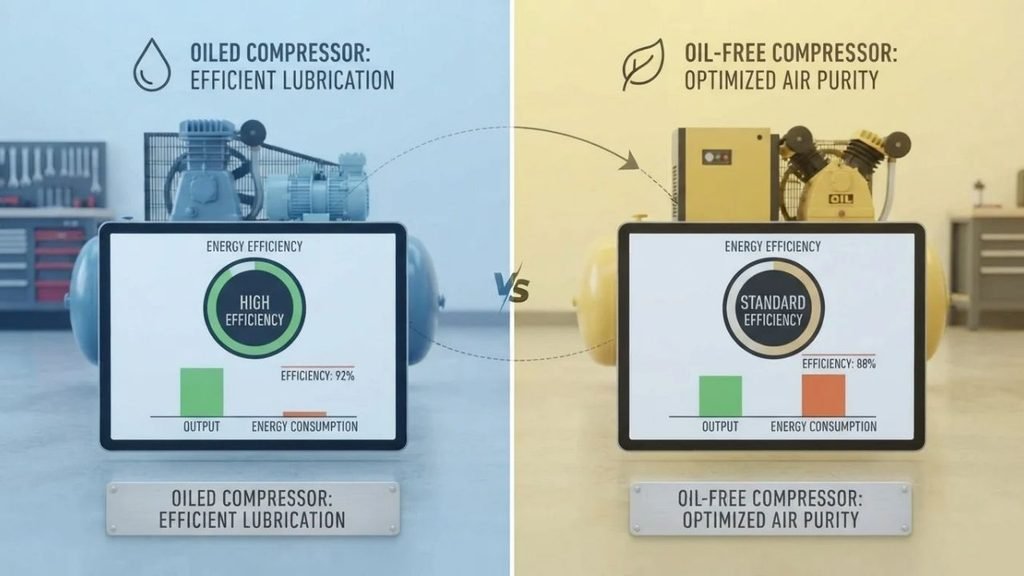
There is no simple rule that one type always consumes less electricity.
Energy efficiency depends heavily on:
- Compressor technology
- Motor efficiency
- Control system
- Load profile
- Operating pressure
- Air leaks
- Pressure drop
- Maintenance
- Compressor sizing
Oil in an injected screw compressor helps seal internal clearances and absorb heat, which can contribute to efficient compression.
Oil-free compressors use different engineering approaches and may require multiple compression stages or additional cooling.
For industrial systems, energy consumption should be evaluated using actual performance data rather than assuming one lubrication type is automatically more efficient.
Initial Purchase Cost
Cost comparisons depend heavily on compressor category.
Small Consumer Compressors
Oil-free compressors are widely available at affordable prices.
Their simple ownership requirements make them attractive to homeowners.
Traditional Shop Compressors
Oil-lubricated piston compressors can range from moderately priced garage units to expensive professional machines.
Industrial Compressors
Industrial oil-free systems can cost significantly more upfront because producing clean air without oil in the compression chamber requires specialized engineering.
Therefore, the claim “oil-free is cheaper” or “oil-free is more expensive” is incomplete without specifying the type of compressor.
Total Cost of Ownership
Purchase price is only part of compressor cost.
Consider:
- Electricity
- Oil
- Oil filters
- Air filters
- Separator elements
- Repairs
- Replacement parts
- Downstream filters
- Dryers
- Condensate treatment
- Downtime
- Labor
- Expected service life
An oil-free system can reduce oil-related maintenance and contamination-control expenses.
An oil-lubricated system may provide excellent long-term economics for general-purpose compressed air where oil-free air is unnecessary.
The best value depends on the application.
Environmental Considerations
Oil-lubricated compressors create used oil and potentially oil-contaminated condensate that must be handled appropriately.
Oil-free compressors eliminate compressor oil from the compression chamber and can simplify certain waste-management requirements.
However, environmental impact is also influenced by:
- Electricity consumption
- Equipment lifespan
- Manufacturing
- Replacement components
- Disposal
- Air leaks
Compressed-air leaks can waste substantial energy regardless of compressor type.
Maintaining a leak-free system can therefore matter more than the oil/no-oil decision for energy consumption.
Portability and Weight
Small oil-free compressors tend to dominate the portable consumer market.
Without a traditional oil-filled crankcase, manufacturers can build compact compressors suited to:
- Jobsite work
- Home repair
- Tire inflation
- Nail guns
Many oil-lubricated compressors are heavier and intended to remain relatively stationary.
That said, portable oil-lubricated units also exist.
If portability matters, compare actual weight and handle/wheel design.
Can You Lay an Air Compressor on Its Side?
For an oil-lubricated compressor, transporting it on its side can allow oil to move into places where it should not be.
Unless the manufacturer specifically allows horizontal transport, keep an oiled compressor upright.
Many oil-free portable models are more tolerant of transport orientation because they do not contain a conventional oil sump.
Still, follow the manufacturer’s instructions because receiver tanks, valves, and other components may have transportation requirements.
Advantages of Oil-Lubricated Air Compressors
The major advantages include:
- Excellent lubrication of moving components
- Good heat management
- Often long pump life with proper maintenance
- Often lower mechanical noise in comparable piston designs
- Strong suitability for demanding workshop use
- Proven technology
- Wide selection of high-capacity shop models
- Excellent option for high-demand general compressed air
For users comfortable performing routine maintenance, these advantages can outweigh the inconvenience of oil changes.
Disadvantages of Oil-Lubricated Air Compressors
Potential disadvantages include:
- Requires oil checks and changes
- Potential compressor-oil carryover
- More oil-related maintenance
- Used oil requires proper disposal
- Can be heavier
- Transportation orientation can matter
- Additional filtration may be required for clean-air applications
None of these disadvantages make oiled compressors inherently inferior. They simply make them better suited to certain applications than others.
Advantages of Oil-Free Air Compressors
Oil-free compressors offer:
- No compressor-pump oil changes
- Cleaner compressed-air path
- Reduced risk of compressor-oil contamination
- Easy ownership for occasional users
- Many lightweight portable options
- Convenient transportation
- Strong suitability for nailers and home DIY
- Specialized options for critical industrial air-purity applications
For the average homeowner, low maintenance is often the biggest benefit.
Disadvantages of Oil-Free Air Compressors
Potential disadvantages include:
- Some inexpensive piston units are noisy
- Some consumer models have limited duty cycles
- Low-cost models may wear sooner under heavy continuous use
- Compression components can run hot
- Industrial oil-free technology can be expensive
- Oil-free does not eliminate moisture or other contaminants
The exact drawbacks depend strongly on the design and quality of the compressor.
Oil vs Oil-Free Compressor: Best Choice by Application
| Application | Better Starting Choice | Why |
| Tire inflation | Oil-free | Portable and low maintenance |
| Brad nailer | Oil-free | Low air demand and easy portability |
| Finish nailer | Oil-free | Convenient for intermittent use |
| Framing nailer | Oil-free | Portable models usually work well if CFM is adequate |
| Occasional impact wrench | Either | Choose based on CFM |
| Continuous air tools | Oil-lubricated or industrial oil-free | High airflow and duty cycle matter |
| Home garage | Oil-free for light use; oiled for heavier use | Depends on workload |
| Professional auto shop | Often oil-lubricated rotary screw/piston | Strong continuous-air capability |
| Spray painting | Either with correct air treatment | Moisture and contamination control are critical |
| Woodworking | Usually oil-free for nailers | Portable and convenient |
| Food production | Properly specified oil-free system | Reduces compressor-oil contamination risk |
| Pharmaceutical production | Properly specified oil-free system | High air-purity requirements |
| Electronics manufacturing | Oil-free often preferred | Contamination control |
| Dental applications | Purpose-built oil-free | Clean air and application-specific design |
| General factory air | Either | Depends on required air purity and economics |
How to Choose Between Oiled vs Oilless Air Compressor
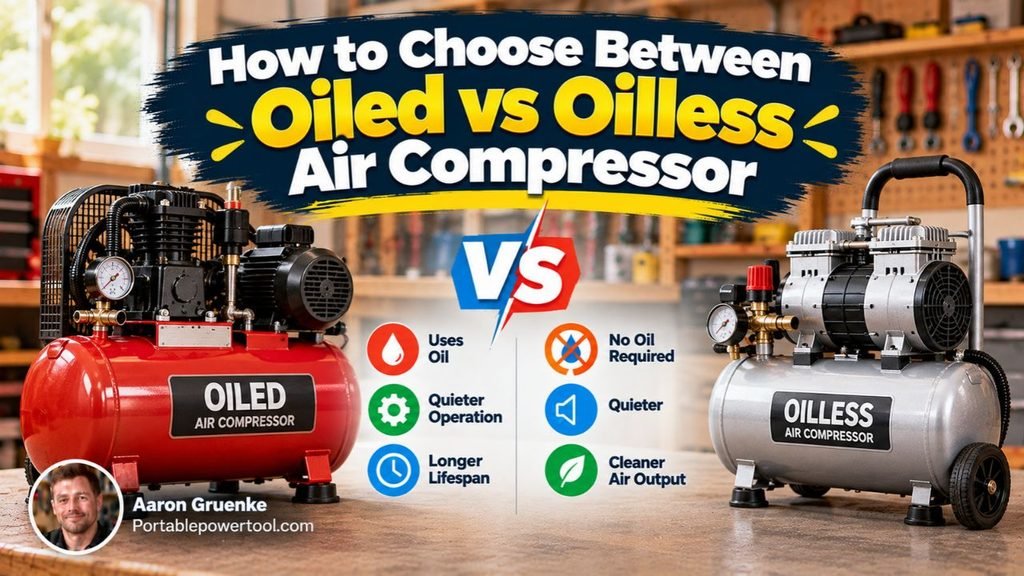
Rather than asking only whether you want oil, answer these questions.
1. What Tools Will You Run?
List every pneumatic tool and find its required:
- CFM
- PSI
Size the compressor around the most demanding realistic use.
2. How Often Will You Use It?
For occasional weekend projects, a small oil-free compressor may be ideal.
For hours of daily operation, consider a compressor designed for a high duty cycle.
3. Does Air Purity Matter?
If compressed air contacts food, pharmaceutical products, sensitive electronics, or another contamination-sensitive process, air-quality requirements may determine the compressor type.
4. How Important Is Noise?
Compare published sound ratings.
Do not rely only on oil vs oil-free assumptions.
5. Do You Need Portability?
A lightweight oil-free unit is often easier to carry to different locations.
6. Are You Comfortable With Maintenance?
If you prefer minimum routine maintenance, oil-free has a clear advantage.
If periodic oil changes do not bother you, an oiled compressor remains a strong option.
7. How Long Will the Compressor Run at Once?
Check the manufacturer’s duty-cycle rating.
A high-CFM tool can overwhelm a compressor even if the tank initially provides enough air.
8. What Is Your Budget?
Consider the total system—not just the compressor.
You may also need:
- Hose
- Regulator
- Filters
- Dryer
- Fittings
- Electrical circuit
- Air-tool lubricator
- Drain system
Don’t Choose an Air Compressor by Tank Size Alone
A large tank does not necessarily mean a compressor can run demanding tools continuously.
The tank stores compressed air.
The compressor pump determines how quickly that air can be replaced.
For example, a large tank connected to a low-CFM pump may run an air sander briefly, but tank pressure will eventually fall because the tool consumes air faster than the pump produces it.
Prioritize:
- Required CFM
- Required PSI
- Duty cycle
- Tank capacity
- Compressor type
Tank size is important, but it should not be the first specification you consider.
Common Myths About Oil vs Oil Free Air Compressors
Myth: Oil-Free Compressors Never Need Maintenance
False.
They eliminate pump oil changes but still require maintenance.
Myth: Oil-Free Compressors Always Have Short Lives
False.
Some inexpensive consumer units are designed for intermittent service, but industrial oil-free compressors can provide demanding long-term operation.
Myth: Oiled Compressors Always Produce Dirty Air
False.
Proper separation and downstream treatment can produce very clean compressed air.
Myth: Oil-Free Air Contains No Water
False.
Oil contamination and moisture contamination are separate issues.
Myth: An Oiled Compressor Is Always More Powerful
False.
Power and air delivery depend on compressor design, motor size, and operating pressure.
Myth: Oil-Free Is Always Better for Painting
Not necessarily.
Clean, dry air is essential, but an undersized oil-free compressor may perform worse than a properly filtered, adequately sized oil-lubricated compressor.
Myth: Higher PSI Means a Better Compressor
False.
For many tools, adequate CFM at working pressure matters more.
Safety Considerations for Both Compressor Types
Compressed air stores significant energy.
Regardless of lubrication type:
- Never exceed rated tank pressure.
- Do not operate a badly rusted or damaged receiver tank.
- Drain accumulated water as instructed.
- Inspect hoses for damage.
- Use properly rated fittings.
- Keep guards installed.
- Provide adequate cooling ventilation.
- Disconnect electrical power before servicing.
- Do not direct compressed air at yourself or another person.
- Use appropriate eye and hearing protection.
- Follow tool pressure limits.
Receiver-tank corrosion deserves particular attention because accumulated moisture can attack steel from the inside.
Never weld, drill, or modify a pressure vessel unless the work is performed under an appropriate engineered procedure by qualified personnel.
Which One Is Better Overall?
There is no universal winner.
For a typical homeowner:
Oil-free usually wins for convenience.
For a serious home or professional workshop:
A quality oil-lubricated compressor can be an excellent long-term choice, particularly for sustained air-tool use.
For contamination-sensitive production:
A properly specified oil-free compressed-air system is generally the better approach.
The best compressor is the one that provides enough air at the required pressure and duty cycle while meeting your maintenance, noise, portability, and air-quality needs.
FAQs About Oil vs Oil Free Air Compressor
Which is better, oil or oil-free air compressor?
Neither is better for every application.
Oil-free compressors are generally easier to maintain and are excellent for portable home use or applications where compressor oil contamination must be avoided. Oil-lubricated compressors are often an excellent choice for demanding workshop use because of their lubrication, heat control, and long-term durability.
Do oil-free air compressors last as long as oiled compressors?
It depends on design and quality.
A low-cost oil-free piston compressor used beyond its intended duty cycle may wear faster than a quality oil-lubricated unit. Industrial oil-free compressors, however, can be designed for long-term continuous operation.
Are oil-free air compressors louder?
Many traditional consumer oil-free piston compressors are louder than comparable oil-lubricated models, partly because of pump design and operating speed.
However, modern quiet oil-free compressors can have low sound levels. Compare actual dBA specifications.
Does an oil-free air compressor need oil?
Oil-free compressors do not use oil in the compression chamber and normally do not require compressor-pump oil changes.
Some designs may still contain lubricated bearings or gears isolated from the compressed-air path.
Is an oil-free compressor better for a home garage?
For tire inflation, nailers, blow guns, and occasional DIY projects, yes, an oil-free model is often more convenient.
For frequent use of high-CFM pneumatic tools, a larger oil-lubricated shop compressor may be a better choice.
Is an oiled compressor better for air tools?
Not automatically.
Air tools primarily care about receiving sufficient CFM and PSI. Both compressor types can run pneumatic tools if properly sized.
Oil-lubricated compressors are simply common in high-demand workshops because many models are built for sustained operation.
Can I paint a car with an oil-lubricated compressor?
Yes, provided the compressor has sufficient airflow and the air is properly treated.
Use suitable moisture and oil filtration so contamination does not reach the spray gun.
Is oil-free air completely clean?
Not automatically.
Oil-free compression removes the compressor lubricant as a source of oil contamination, but intake air can still contain dust, hydrocarbons, moisture, and other contaminants.
Filtration and drying may still be required.
Does an oil-free compressor produce less water?
No.
Moisture comes primarily from water vapor already present in atmospheric air.
Both oiled and oil-free compressors can accumulate significant condensate.
Is oil-free better for a nail gun?
Usually, yes, especially for homeowners and contractors who value portability.
Nail guns use air intermittently, so many small oil-free compressors can keep up easily.
Which compressor is better for an impact wrench?
Either can work.
Look at the impact wrench’s CFM requirement and choose a compressor that can deliver enough air at the required PSI.
If you use the impact wrench frequently along with other air tools, a larger high-duty compressor is preferable.
Which is cheaper to maintain?
For small consumer units, oil-free compressors generally require less routine maintenance because there is no compressor oil to check or replace.
Industrial total maintenance cost is more complicated and depends on compressor design, filters, air treatment, service intervals, and operating conditions.
Can I convert an oil compressor to oil-free?
Generally, no.
The compressor was engineered around a specific lubrication system. Simply removing the oil would quickly damage an oil-lubricated pump.
If oil-free air is required, use appropriate downstream treatment or purchase a compressor designed for oil-free compression.
Is oil-free the same as maintenance-free?
No.
You still need to maintain the intake filter, drain moisture, inspect the tank, maintain cooling airflow, check hoses and fittings, and perform any service listed by the manufacturer.
Is oil-free air required for breathing?
An ordinary oil-free shop compressor does not automatically produce breathable air.
Breathing-air systems require specific purification, testing, monitoring, and safety controls. Never breathe directly from a general-purpose compressor simply because it is labeled oil-free.
Conclusion
The oil vs oil free air compressor choice comes down to far more than whether you want to perform oil changes.
Oil-lubricated compressors use oil to reduce friction, manage heat, and—in some designs—help seal the compression process. They are excellent choices for many garages, workshops, and industrial applications where dependable high-demand compressed air is more important than eliminating compressor oil from the air stream.
Oil-free compressors keep lubricant out of the compression chamber. Small oil-free models offer excellent portability and low maintenance for tire inflation, nail guns, and general DIY work, while advanced industrial oil-free systems provide compressed air for applications where compressor-oil contamination needs to be tightly controlled.
For a homeowner using a compressor occasionally, oil-free is usually the most convenient choice. For frequent pneumatic-tool use in a workshop, a well-built oil-lubricated compressor may provide better long-term value. For food, pharmaceutical, medical, electronics, or other contamination-sensitive processes, choose a properly engineered oil-free system that meets the required delivered-air purity specification.
Whichever type you choose, do not base the decision on oil alone. Match the compressor’s CFM, PSI, tank size, duty cycle, noise level, air quality, portability, and maintenance requirements to the actual work you plan to do. That approach will give you a far better compressor than simply choosing between “oiled” and “oil-free” on the label.