
Do Fire Protection Air Compressors Need Oil? Explained
Fire protection air compressors are commonly used with dry pipe and pre-action fire sprinkler systems to establish and maintain the required air pressure inside the sprinkler piping. Because these compressors may sit quietly for long periods and operate only when system pressure drops, their lubrication requirements can be easy to overlook.
Some fire protection air compressors need oil, while oil-less models do not require you to add or change compressor oil. The correct answer depends entirely on the compressor design.
So, do fire protection air compressors need oil? An oil-lubricated fire protection compressor has an oil reservoir or crankcase and requires the manufacturer-specified compressor oil at the correct level, along with periodic oil maintenance. An oil-less compressor uses a different pump design and normally has no crankcase oil that the owner needs to fill or change.
Both types are available specifically for fire sprinkler applications. Neither design is automatically right for every installation. Compressor size, sprinkler system volume, mounting arrangement, maintenance requirements, environmental conditions, manufacturer specifications, and applicable fire protection standards all need to be considered.
This guide explains how oil-lubricated and oil-less fire protection compressors differ, how to identify which type you have, what oil a lubricated model requires, maintenance considerations, and what can happen if the wrong lubrication procedure is used.
Do Fire Protection Air Compressors Need Oil?
Whether fire protection air compressors need oil depends on whether the compressor is oil-lubricated or oil-less.
An oil-lubricated fire protection air compressor requires oil for the compressor pump. The oil reduces friction, helps manage wear, and protects moving internal parts.
An oil-less fire protection air compressor does not require routine compressor-oil filling or oil changes. These compressors are specifically designed to operate without an oil-filled crankcase.
A simple comparison looks like this:
| Compressor Type | Need to Add Compressor Oil? | Routine Oil Changes? |
| Oil-lubricated | Yes | Yes, according to manufacturer |
| Oil-less | No | No |
| Permanently lubricated components | Normally no user-added oil | Follow manufacturer instructions |
Never add oil to an oil-less compressor unless the manufacturer specifically identifies a lubrication point that requires it.
What Is a Fire Protection Air Compressor?
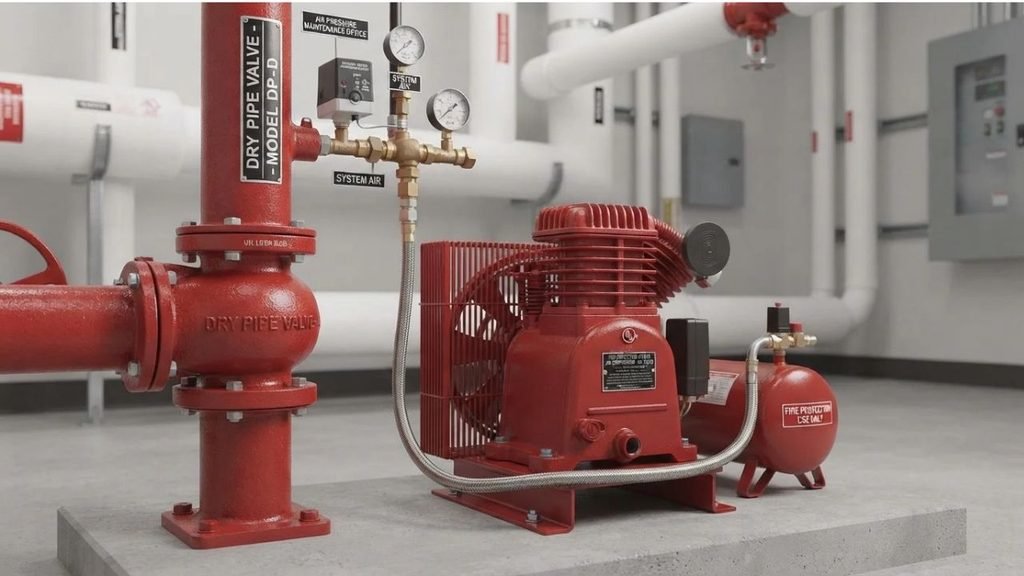
A fire protection air compressor is a compressor specifically used to provide compressed air for certain fire sprinkler systems.
It is particularly common in:
- Dry pipe sprinkler systems
- Pre-action sprinkler systems
- Some supervisory air applications
A wet pipe sprinkler system normally keeps the sprinkler piping filled with water, so it generally does not require an air compressor for maintaining system air pressure.
Dry and pre-action systems work differently.
Dry Pipe Systems
A dry pipe sprinkler system keeps pressurized air or nitrogen inside the piping instead of keeping the pipes continuously filled with water.
When a sprinkler operates, system air pressure drops. The dry pipe valve then operates so water can enter the sprinkler piping.
These systems are commonly used in locations where water-filled piping could freeze.
Pre-Action Systems
A pre-action system also normally has air or nitrogen in portions of its sprinkler piping, but water admission is controlled by an additional detection or release arrangement.
Pre-action systems are often selected for areas where accidental water discharge could cause substantial damage.
The air compressor helps establish and maintain the required supervisory pressure in these systems.
Oil-Lubricated Fire Protection Air Compressors
An oil-lubricated compressor contains a pump that relies on lubricating oil.
The oil helps protect moving components such as:
- Bearings
- Connecting rods
- Crankshaft components
- Other internal friction surfaces
Depending on the design, you may see:
- Oil sight glass
- Oil fill plug
- Oil drain plug
- Oil-level markings
If your compressor has an oil sight glass or crankcase fill location, that is a strong indication that it is a lubricated model.
Why Oil Is Needed
Metal components inside a compressor move rapidly while the unit operates.
Without adequate lubrication, friction can cause:
- Excessive heat
- Accelerated wear
- Bearing damage
- Pump seizure
- Reduced compressor life
The oil creates a lubricating film between moving components.
Oil-Less Fire Protection Air Compressors
An oil-less air compressor uses a pump design that does not require the user to maintain an oil-filled compressor crankcase.
These compressors may use materials and components designed to operate with little or no service lubrication in the compression mechanism.
Some components may be permanently lubricated at the factory.
That does not mean the entire compressor literally contains no lubricants anywhere. It means there is no routine compressor-oil reservoir that the owner needs to fill and change.
Advantages of Oil-Less Fire Protection Compressors
Oil-less models can offer several practical advantages:
- No compressor oil changes
- Reduced routine maintenance
- No need to monitor a crankcase oil level
- No risk of accidentally operating with low crankcase oil
- Less potential for oil carryover from the compression mechanism
For installations where minimizing routine compressor maintenance is a priority, oil-less designs can be attractive.
Oil-Lubricated vs Oil-Less Fire Protection Air Compressors
Neither type should be selected solely because one sounds more advanced.
Both can be appropriate when properly sized and installed for the sprinkler system.
| Feature | Oil-Lubricated | Oil-Less |
| Compressor oil required | Yes | No routine pump oil |
| Oil-level checks | Required | Not required |
| Oil changes | Required periodically | Not required |
| Maintenance level | Higher | Generally lower |
| Pump lubrication | Compressor oil | Oil-less design |
| Risk from low oil | Yes | No crankcase oil to run low |
| Oil carryover potential | Possible depending on design | Reduced/avoided from crankcase lubrication |
| Typical use | Dry pipe/pre-action systems | Dry pipe/pre-action systems |
The manufacturer’s instructions should always determine how a specific compressor is serviced.
How Can You Tell If Your Fire Protection Compressor Needs Oil?
Do not guess.
Start by checking the compressor identification plate and model information.
Look for words such as:
- Oil-lubricated
- Lubricated
- Oil-less
- Oilless
- Oil-free
Then check the manufacturer’s operating and maintenance manual.
Look for an Oil Sight Glass
Many lubricated reciprocating compressors have a round sight glass on the pump crankcase.
Oil can be seen through the glass.
The manufacturer’s instructions specify where the level should be.
Read More: how much oil does an air compressor take
Look for an Oil Fill Plug
A lubricated compressor normally has a place where oil can be added.
This may have:
- Oil cap
- Breather cap
- Fill plug
Do not remove random plugs from the compressor unless you know their purpose.
Check the Model Number
If the markings are unclear, use the exact:
- Manufacturer
- Model number
- Serial information
to identify the compressor specification.
The model manual is much more reliable than determining compressor type by appearance alone.
What Oil Does a Fire Protection Air Compressor Use?
An oil-lubricated fire protection compressor should use the compressor oil specified by its manufacturer.
Do not assume ordinary automotive engine oil is acceptable.
Compressor manufacturers may specify a particular:
- Oil formulation
- Viscosity
- Compressor lubricant
- Part number
Some manufacturers supply or sell compressor oil specifically for their fire protection compressor models.
Using the correct lubricant helps maintain:
- Proper lubrication
- Pump temperature
- Seal compatibility
- Component life
Can You Use Motor Oil in a Fire Protection Air Compressor?
Not unless the compressor manufacturer specifically approves it.
Automotive engine oil and compressor oil are formulated for different equipment and operating conditions.
Motor oils may contain additive packages intended for internal-combustion engines rather than compressor pumps.
Using an unapproved lubricant can lead to:
- Deposit formation
- Poor lubrication
- Foaming
- Seal compatibility problems
- Excessive wear
Use the lubricant specified in the compressor’s operating manual.
How Much Oil Does a Fire Protection Air Compressor Need?
There is no universal quantity.
Oil capacity varies by:
- Compressor model
- Pump size
- Horsepower
- Crankcase design
Some small compressors require only a few ounces, while larger pumps may require substantially more.
Many lubricated compressors use a sight glass to indicate the correct oil level rather than relying only on an exact measured quantity.
Follow the manufacturer’s specified level.
Do not assume that filling the sight glass completely is correct. On many designs, the proper operating level is somewhere around the center portion of the sight glass, but the exact requirement must come from the compressor manufacturer.
What Happens If an Oil-Lubricated Compressor Runs Low on Oil?
Low oil can seriously damage the compressor pump.
Potential consequences include:
- Increased friction
- Excessive operating temperature
- Bearing wear
- Connecting-rod damage
- Scoring of internal components
- Pump seizure
- Complete compressor failure
A fire protection air compressor has an important system function, so reliability matters.
An oil leak or unexpectedly falling oil level should be investigated instead of repeatedly topping off the compressor without finding the cause.
Can Too Much Oil Damage the Compressor?
Yes.
Overfilling is not better than maintaining the proper level.
Too much oil may contribute to:
- Oil foaming
- Increased oil carryover
- Excessive internal resistance
- Leakage
- Abnormal operating conditions
Use the sight glass, dipstick, or other level indicator exactly as described by the manufacturer.
How Often Should Fire Protection Compressor Oil Be Changed?
Oil-change intervals vary between manufacturers and compressor models.
The required interval may be based on:
- Operating hours
- Calendar time
- Compressor duty cycle
- Environmental conditions
A compressor that runs frequently because the sprinkler system has excessive air leakage may accumulate operating hours much faster than expected.
Never create a generic oil-change interval and apply it to every fire protection compressor.
Follow the specific maintenance manual.
Check Oil Level Between Oil Changes
Oil-lubricated compressors may require regular oil-level inspection even when the oil is not due for replacement.
Check for:
- Low oil
- Oil discoloration
- Leakage
- Abnormal contamination
The compressor should generally be level when checking a sight glass, unless the manufacturer’s procedure says otherwise.
Why Is My Fire Protection Compressor Running Frequently?
Frequent compressor operation is not necessarily an oil problem.
It may indicate that the sprinkler system is losing air.
Possible causes include:
- Piping leakage
- Fitting leaks
- Valve leakage
- Air maintenance device problems
- Pressure switch problems
- Loose connections
A properly operating compressor should maintain the required pressure without cycling excessively because of an unresolved system leak.
Excessive operation increases:
- Compressor wear
- Electricity consumption
- Heat
- Maintenance requirements
If run frequency changes noticeably, the system should be evaluated by qualified fire sprinkler service personnel.
Does Compressor Oil Enter the Sprinkler Piping?
Oil-lubricated compressors can potentially introduce some oil carryover into the compressed-air stream depending on their design and condition.
This is one reason compressor condition and maintenance matter.
Oil-less compressors eliminate crankcase lubrication from the compression process, reducing this particular source of oil contamination.
However, moisture and corrosion are also important concerns in dry and pre-action sprinkler piping.
The appropriate air supply strategy should be selected as part of the overall fire protection system design.
Moisture Is Also Important in Dry Sprinkler Systems
Compressed atmospheric air contains moisture.
As conditions change inside the piping, moisture can condense.
Water accumulation inside dry sprinkler piping can contribute to:
- Internal corrosion
- Microbiologically influenced corrosion under appropriate conditions
- Pinhole leaks
- Obstructions
- Freeze problems in cold areas
Proper system drainage, inspection, compressor operation, and corrosion-management practices are therefore important even when an oil-less compressor is used.
Some installations use nitrogen instead of ordinary compressed air for corrosion-control purposes.
Does NFPA Require an Oil-Lubricated or Oil-Less Compressor?
Fire sprinkler requirements focus on having an appropriate, dependable air or approved gas supply and maintaining the system pressure required for the particular sprinkler system.
The choice between an oil-less and oil-lubricated compressor is generally based on the approved equipment, system design, manufacturer’s requirements, and applicable installation standards rather than a universal rule that all fire protection compressors must use one lubrication type.
Requirements can also depend on:
- System size
- Compressor capacity
- Number of systems served
- Air maintenance arrangement
- Applicable edition of NFPA standards
- Local fire and building codes
Fire protection equipment should be selected and installed according to the system design and the requirements of the authority having jurisdiction.
What Is an Air Maintenance Device?
An air maintenance device, often abbreviated AMD, regulates the air supply entering a dry or pre-action sprinkler system.
Its purpose is different from compressor lubrication.
An air maintenance device can help maintain appropriate system pressure while controlling airflow from the compressor or air supply.
Depending on the configuration and applicable requirements, an air maintenance device may be used with:
- Tank-mounted compressors
- Plant air supplies
- Multiple sprinkler systems
The exact arrangement should follow fire protection system design requirements.
Does the Air Compressor Need an Air Tank?
Some fire protection compressor installations use a receiver tank, while others use a small riser-mounted or base-mounted compressor without a separate receiver.
The correct design depends on:
- Compressor capacity
- Number of sprinkler systems
- System configuration
- Applicable NFPA requirements
- Manufacturer instructions
Whether a compressor needs an air tank is separate from whether it needs lubricating oil.
Both oil-less and lubricated compressors are available in different mounting and receiver arrangements.
Maintenance for Oil-Lubricated Fire Protection Compressors
Routine maintenance may include:
- Checking compressor oil level
- Changing oil as specified
- Checking for oil leaks
- Inspecting the air filter
- Inspecting belts when applicable
- Checking mounting hardware
- Monitoring operating pressure
- Checking pressure switch operation
- Inspecting unusual noise or vibration
- Monitoring excessive cycling
Because this equipment supports a fire protection system, maintenance should follow the manufacturer’s instructions and applicable inspection, testing, and maintenance requirements.
Maintenance for Oil-Less Fire Protection Compressors
Oil-less compressors eliminate oil-level checks and crankcase oil changes, but they are not maintenance-free.
Depending on the model, maintenance can include:
- Air filter inspection
- Intake cleaning
- Belt inspection if belt-driven
- Pressure switch inspection
- Checking electrical connections
- Monitoring operating hours
- Checking vibration
- Checking compressor performance
- Inspecting for air leakage
“Oil-less” should never be interpreted as “no maintenance required.”
Should You Add Oil to an Oil-Less Compressor?
No, not to the compressor pump unless the manufacturer specifically instructs you to do so.
Trying to add oil to an oil-less pump can damage the equipment.
If you cannot find an oil-fill location, do not drill, remove plugs, or pour oil into the intake.
Confirm the compressor model first.
An oil-less compressor is designed to operate without routine oil inside its compression mechanism.
What If You Do Not Know Which Compressor You Have?
Check the equipment before servicing it.
A good identification process is:
- Find the manufacturer name.
- Record the complete model number.
- Record the serial number if needed.
- Look for an oil sight glass or fill cap.
- Find the manufacturer’s operating manual.
- Confirm whether the unit is lubricated or oil-less.
- Follow the exact lubrication specification.
If the compressor is part of an active fire sprinkler system and the documentation is unavailable, contact a qualified fire protection contractor rather than experimenting with lubrication.
When Should a Fire Protection Contractor Be Called?
Professional inspection is appropriate when:
- Compressor cannot maintain system pressure
- Compressor runs continuously
- Oil level repeatedly falls
- Compressor overheats
- Pump makes abnormal noises
- Pressure switch does not operate correctly
- Sprinkler system has persistent air leaks
- Equipment needs replacement or resizing
- Air maintenance equipment is malfunctioning
- You are unsure about required system pressure
Fire sprinkler systems are life-safety systems. Repairs that affect system operation should be performed by properly qualified personnel in accordance with applicable codes and local requirements.
Oil-Less or Lubricated: Which Is Better?
Neither is automatically better for every installation.
Oil-Less May Be Better When:
- Lower routine maintenance is a priority.
- Eliminating oil changes is desirable.
- The specified model meets system requirements.
- Simpler servicing is valuable.
Lubricated May Be Better When:
- The selected compressor is designed for long service in the application.
- The facility has a maintenance program capable of monitoring oil.
- A lubricated model better meets capacity or equipment requirements.
System design and approved equipment should determine the final choice.
Common Mistakes With Fire Protection Compressor Oil
Adding Oil to an Oil-Less Compressor
Oil-less pumps are not designed for routine oil filling.
Using Automotive Engine Oil Without Approval
Use the compressor manufacturer’s specified lubricant.
Overfilling the Crankcase
Maintain the proper level rather than filling the reservoir completely.
Ignoring Low Oil
A lubricated compressor operating with insufficient oil can suffer serious pump damage.
Ignoring Oil Leaks
Repeated topping-off without repairing a leak does not address the underlying problem.
Assuming Oil-Less Means Maintenance-Free
Oil-less compressors still require inspection and maintenance of other components.
FAQs About Do Fire Protection Air Compressors Need Oil
Do All Fire Protection Air Compressors Use Oil?
No.
Fire protection air compressors are available in both oil-lubricated and oil-less designs.
Oil-lubricated compressors require the correct compressor oil, while oil-less models do not require routine compressor-oil filling.
How Do I Know If My Fire Sprinkler Compressor Takes Oil?
Check the manufacturer’s model information and operating manual.
An oil sight glass, crankcase, drain plug, and oil-fill cap usually indicate a lubricated compressor.
What Kind of Oil Goes in a Fire Protection Air Compressor?
Use the compressor oil specified by the manufacturer.
Do not substitute automotive motor oil or another lubricant unless the manufacturer explicitly approves it.
Can an Oil-Less Fire Protection Compressor Run Without Oil?
Yes. The compressor pump is specifically designed to operate without a user-maintained oil-filled crankcase.
Some internal components may be permanently lubricated from the factory.
What Happens If I Put Oil in an Oil-Less Air Compressor?
Adding oil where it is not designed to go can contaminate or damage the compressor.
Do not add oil unless the manufacturer’s instructions identify a specific lubrication point.
What Happens If a Lubricated Fire Compressor Runs Without Oil?
Internal friction can increase dramatically, potentially causing overheating, accelerated wear, bearing damage, or compressor pump failure.
Check and maintain the oil level according to the manufacturer’s instructions.
How Often Should I Check the Oil in a Fire Protection Compressor?
Follow the maintenance schedule supplied with the specific compressor.
Oil inspection and oil-change intervals vary by manufacturer, model, operating hours, and installation conditions.
Are Oil-Less Compressors Better for Dry Pipe Sprinkler Systems?
Oil-less compressors are commonly used and can reduce routine maintenance, but they are not universally the best choice.
The compressor must be correctly sized and suitable for the particular sprinkler system and installation.
Conclusion
So, do fire protection air compressors need oil? Some do and some do not. An oil-lubricated fire protection air compressor needs the manufacturer-specified compressor oil and periodic lubrication maintenance. An oil-less fire protection compressor is designed to operate without routine crankcase oil filling or oil changes.
Never determine lubrication requirements by assumption. Identify the exact compressor model, check its operating manual, and follow the manufacturer’s oil specification and maintenance procedures.
Because these compressors support dry pipe and pre-action fire sprinkler systems, reliability is especially important. Keeping a lubricated compressor at the correct oil level—or correctly maintaining an oil-less compressor—helps ensure the air supply remains dependable when the fire protection system needs it.