
Do All Air Compressors Need Oil? Types and Maintenance Guide
Air compressors use motors, pistons, bearings, rotors, and other moving components that create friction and heat. Because of this, it is easy to assume that every compressor needs lubricating oil added by the owner. That is not actually the case.
No, not all air compressors need oil. Oil-lubricated compressors require compressor oil in the pump, while oil-free compressors are specifically designed to operate without adding oil to the compression chamber.
So, if you are wondering do all air compressors need oil, the answer depends entirely on the compressor’s design. Many large shop and industrial piston compressors are oil-lubricated and require regular oil-level checks and changes. By contrast, many portable pancake, hot-dog, and small electric compressors are oil-free and should never have compressor oil added to their pump.
This distinction is important. Running an oil-lubricated compressor without enough oil can quickly damage the pump, but adding oil to a compressor designed to be oil-free can also cause problems. The safest approach is to identify the compressor type before performing any lubrication.
This guide explains how to tell whether your air compressor needs oil, whether electric compressors require oil, where oil goes in an oil-lubricated compressor, how often it should be checked, and what can happen if you use the wrong oil or operate the compressor without enough lubrication.
Do All Air Compressors Need Oil?
No. Do all air compressors need oil? The answer is no because modern compressors are available in both oil-lubricated and oil-free designs.
Oil-lubricated compressors use oil in the pump or compression mechanism to reduce friction, control heat, help seal moving components, and reduce wear.
Oil-free compressors use other methods, such as:
- Self-lubricating piston rings
- PTFE or composite materials
- Special cylinder coatings
- Permanently lubricated bearings
- Precision clearances
- Isolated lubrication systems
An oil-free compressor can therefore operate without the owner adding pump oil.
The label, owner’s manual, and physical design of the compressor will normally tell you which type you have.
Do Electric Air Compressors Need Oil?
An electric motor does not determine whether the compressor requires oil.
Electric air compressors can be either oil-lubricated or oil-free.
The word “electric” only describes how the compressor is powered.
An electric compressor may use:
- Oil-lubricated piston pump
- Oil-free piston pump
- Oil-free scroll mechanism
- Oil-injected rotary screw
- Oil-free rotary screw
Therefore, if you are asking do electric air compressors need oil, check the pump design rather than assuming that electrically powered compressors are automatically oil-free.
Small Electric Portable Compressors
Many modern portable electric compressors are oil-free.
Common examples include:
- Pancake compressors
- 1-gallon portable compressors
- 3-gallon compressors
- 6-gallon compressors
- Small hot-dog compressors
- Trim-nailer compressors
These usually do not have:
- Oil fill cap
- Oil sight glass
- Oil drain plug
That is a strong clue that no pump oil is required.
Larger Electric Shop Compressors
Many larger electric compressors use oil-lubricated piston pumps.
These are common in:
- Home garages
- Automotive shops
- Fabrication shops
- Commercial workshops
They may have:
- Oil sight glass
- Oil dipstick
- Fill plug
- Drain plug
- Crankcase
These compressors require routine oil maintenance.
Do I Need to Oil My Air Compressor?
If you are asking do I need to oil my air compressor, first identify whether your compressor is oil-lubricated.
Do not add oil until you know.
Check:
- Compressor label
- Owner’s manual
- Pump housing
- Oil sight glass
- Dipstick
- Oil fill cap
If the manual describes the compressor as:
- Oil-free
- Maintenance-free
- Oil-less
- Oilless
you generally do not need to add compressor pump oil.
If the compressor has an oil-filled crankcase, you do need to maintain the oil at the specified level.
How to Tell If Your Air Compressor Needs Oil
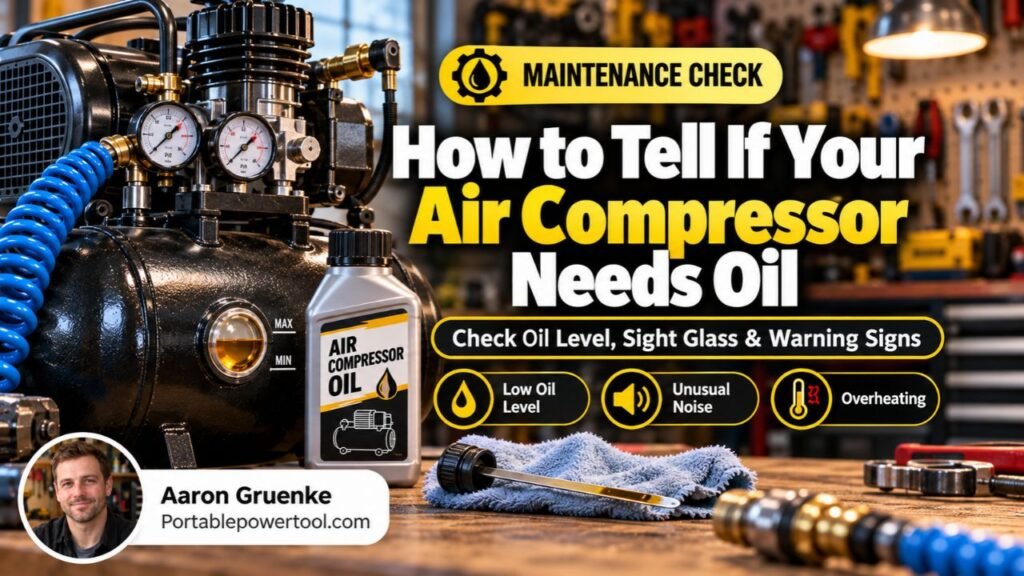
Several clues can help you identify the compressor type.
Look for an Oil Sight Glass
An oil-lubricated compressor commonly has a small round window on the crankcase called an oil sight glass.
You may see:
- Clear oil
- Oil-level markings
- A center reference mark
If the compressor has a sight glass, the pump almost certainly requires oil.
Look for a Dipstick
Some compressor pumps use a screw-in or push-in dipstick.
The dipstick may be attached to the oil fill cap.
It often includes:
- Minimum mark
- Maximum mark
- Crosshatched safe range
This is another strong sign of an oil-lubricated compressor.
Look for an Oil Fill Plug
A pump oil fill port may be located on the crankcase.
The cap may be labeled:
- Oil
- Fill
- Compressor oil
Do not confuse an oil fill plug with other service plugs.
Look for an Oil Drain Plug
Oil-lubricated pumps usually have a drain plug near the bottom of the crankcase.
This allows old oil to be removed during servicing.
Read the Compressor Label
Many oil-free compressors have clear labels such as:
- OIL FREE
- OIL-FREE
- OILLESS
- MAINTENANCE-FREE PUMP
If you see this, do not add pump oil unless the manual specifically identifies another lubrication point.
Why Do Some Air Compressors Need Oil?
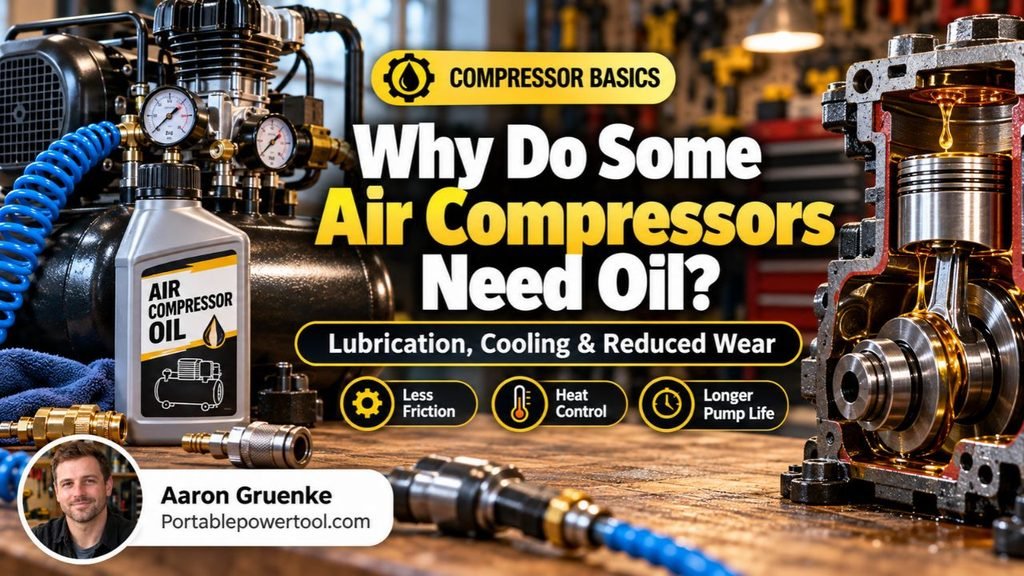
Oil performs several important functions inside a lubricated compressor.
Reduces Friction
Metal components moving against one another create friction.
Oil forms a lubricating film that helps prevent direct metal-to-metal contact.
Reduces Wear
Proper lubrication protects:
- Bearings
- Crankshaft
- Connecting rods
- Cylinder surfaces
- Other moving components
Without enough oil, these components can wear rapidly.
Helps Control Heat
Compressing air produces considerable heat.
Oil can absorb and transfer some of that heat away from moving components.
Helps Seal Clearances
In some compressor designs, oil helps improve sealing between moving surfaces.
Better sealing can improve compression efficiency.
Protects Against Corrosion
Compressor oil can help protect internal metal components from corrosion.
How Do Oil-Free Compressors Work Without Oil?
Oil-free compressors use designs that reduce or eliminate the need for oil inside the compression chamber.
A small oil-free piston compressor commonly uses a self-lubricating piston ring.
The ring may contain low-friction materials such as PTFE-based composites.
Instead of a metal piston relying on an oil film, these materials move against a specially designed cylinder surface.
Other oil-free designs use completely different mechanisms.
Oil-Free Scroll Compressor
A scroll compressor uses:
- One fixed scroll
- One orbiting scroll
The scrolls create shrinking pockets of air that move toward the center.
These compressors can be designed without oil injection in the compression chamber.
Oil-Free Rotary Screw Compressor
Industrial oil-free rotary screw compressors use precision rotors without injecting oil directly into the compression chamber.
Timing gears and separate lubrication systems may be used to keep the compression elements properly synchronized.
Oil-Lubricated vs. Oil-Free Air Compressors
Both designs have advantages.
| Feature | Oil-Lubricated | Oil-Free |
| Pump oil required | Yes | Usually no |
| Oil changes | Required | Not required for compression pump |
| Routine maintenance | Higher | Generally lower |
| Portability | Often heavier | Often lighter |
| Home DIY use | Good | Very common |
| Heavy shop use | Excellent on suitable models | Model dependent |
| Oil contamination risk | Higher without filtration | Lower from compression process |
| Cold-weather convenience | Oil viscosity can matter | Often easier |
| Noise | Design dependent | Design dependent |
Do not assume oil-lubricated automatically means better or oil-free automatically means cheaper.
The right choice depends on the application.
Read More: which is better oil or oilless air compressor
Where Do You Put Oil in an Air Compressor?
On an oil-lubricated piston compressor, oil typically goes into the pump crankcase.
Look for an oil fill plug or cap.
Never pour compressor oil into:
- Air intake
- Air tank
- Hose connection
- Pressure switch
- Regulator
- Electric motor
The oil lubricates the compressor pump; it does not belong in the receiver tank.
Always add oil according to the manufacturer’s specified procedure.
How Much Oil Does an Air Compressor Need?
There is no universal amount.
A small pump might require only a few ounces, while a large industrial compressor can require considerably more.
Use:
- Sight glass
- Dipstick
- Manufacturer-specified capacity
rather than guessing.
Overfilling is not better.
Too much oil can create problems such as:
- Foaming
- Excess oil carryover
- Leakage
- Increased crankcase pressure
Keep the oil within the specified range.
Read Complete Guide : how much oil does an air compressor take
How Often Should Compressor Oil Be Checked?
Check the owner’s manual for the exact schedule.
For an oil-lubricated compressor, the oil level should generally be inspected regularly, especially before extended use.
Frequency depends on:
- Operating hours
- Compressor type
- Workload
- Temperature
- Manufacturer instructions
A compressor used every day needs closer monitoring than one used occasionally for tire inflation.
How Often Should Compressor Oil Be Changed?
Oil-change intervals vary widely.
Some manufacturers specify the first oil change relatively early because a new pump is still breaking in.
Later oil changes may be scheduled according to:
- Operating hours
- Calendar interval
- Oil condition
Do not assume a generic “once a year” recommendation applies to every compressor.
Follow the service schedule for your specific model.
Read Complete Guide : how often to change oil in air compressor
What Type of Oil Does an Air Compressor Need?
Use oil that meets the compressor manufacturer’s specifications.
Many reciprocating compressors use dedicated air compressor oil.
Depending on design and operating conditions, manufacturers may specify particular:
- Viscosity grades
- Synthetic oils
- Mineral compressor oils
- Additive packages
Do not assume that motor oil, hydraulic oil, or another lubricant is interchangeable.
Why Automotive Engine Oil May Be Wrong
Automotive engine oil is formulated for internal combustion engines.
It can contain detergent and additive packages designed for:
- Combustion contaminants
- Engine bearings
- High-temperature engine operation
Those properties may not match what a compressor pump requires.
If your compressor manufacturer specifies a non-detergent compressor oil, use the correct product.
What Happens If an Oil-Lubricated Compressor Runs Without Oil?
Running an oil-lubricated pump with insufficient oil can cause serious damage.
Possible consequences include:
- Rapid bearing wear
- Overheating
- Crankshaft damage
- Connecting rod failure
- Scoring
- Seizure
- Complete pump failure
A compressor that suddenly becomes unusually noisy or hot should be shut down and inspected.
Do not continue running a pump that is known to be low on oil.
What Happens If You Put Oil in an Oil-Free Compressor?
Do not add oil to the compression pump of a compressor labeled oil-free unless the manufacturer specifically instructs you to lubricate a particular component.
Adding oil to the wrong area can:
- Contaminate compressed air
- Damage seals or materials
- Attract dirt
- Interfere with normal operation
- Void warranty coverage
Oil-free compressor pumps are engineered to operate without owner-added crankcase oil.
Adding oil does not turn them into oil-lubricated compressors.
Does an Oil-Free Compressor Need Any Lubrication?
Possibly, but not necessarily from the owner.
Some components may have:
- Sealed bearings
- Permanently lubricated bearings
- Factory grease
- Isolated gearbox oil
These lubricants may be intended to last for a specific service interval or the life of the component.
An oil-free rating refers primarily to the compression process, not necessarily every bearing or mechanical component in the entire machine.
Do Air Tools Need Oil If the Compressor Is Oil-Free?
This is a separate issue.
An oil-free compressor can still power an air tool that requires lubrication.
Some pneumatic tools need air-tool oil added to the tool or supplied through an inline lubricator.
Examples may include certain:
- Impact wrenches
- Air ratchets
- Die grinders
- Pneumatic drills
Other air tools may be designed differently.
Always follow the tool manufacturer’s lubrication instructions.
The fact that the compressor is oil-free does not automatically mean the connected air tool should run dry.
Does an Air Compressor Motor Need Oil?
Most modern compressor electric motors use sealed or permanently lubricated bearings and do not require routine oiling by the owner.
Some larger industrial motors may have specific bearing lubrication requirements.
Do not add oil to an electric motor unless the manufacturer provides a lubrication point and procedure.
Read the Complete Guide : can i use motor oil in my air compressor
Does Tank Size Tell You Whether a Compressor Needs Oil?
No.
Oil requirements are unrelated to receiver size.
You can find oil-free and oil-lubricated compressors in many capacities, including:
- 1 gallon
- 3 gallon
- 6 gallon
- 10 gallon
- 20 gallon
- 30 gallon
- 60 gallon
- 80 gallon
The pump design determines lubrication requirements.
Are 6-Gallon Air Compressors Oil-Free?
Many popular 6-gallon pancake compressors are oil-free, but not every possible 6-gallon compressor must be.
Read the product label or manual.
Do not use tank capacity as the deciding factor.
Are 20-Gallon Air Compressors Oil-Free?
Some are and some are not.
Twenty-gallon compressors are available with:
- Oil-free pumps
- Oil-lubricated pumps
Check for a sight glass, dipstick, oil fill cap, or manufacturer’s specification.
Are 60- and 80-Gallon Compressors Oil-Lubricated?
Many large stationary piston compressors use oil-lubricated pumps because they are designed for heavier workloads.
However, tank size alone still does not guarantee the pump type.
Always verify the model.
Should Oil Appear in the Compressed Air?
An oil-lubricated compressor can produce a small amount of oil carryover, depending on design and condition.
Excessive oil downstream may indicate:
- Overfilled crankcase
- Worn piston rings
- Incorrect oil
- Internal pump wear
- Separator problems on relevant compressor types
For applications such as painting, food processing, or sensitive manufacturing, suitable filtration and air-treatment equipment may be required.
Does Oil-Free Mean Maintenance-Free?
No.
An oil-free compressor still needs maintenance.
Depending on the model, you may need to:
- Drain tank moisture
- Clean intake filters
- Replace intake filters
- Inspect hoses
- Check fittings
- Repair air leaks
- Clean cooling fins
- Inspect safety valves
- Replace worn piston rings or other components eventually
Eliminating oil changes reduces maintenance but does not eliminate it.
Common Mistakes With Compressor Oil
Adding Oil Without Checking the Compressor Type
Never assume every air compressor needs oil.
Running an Oil-Lubricated Pump Low on Oil
Low oil can quickly damage moving components.
Overfilling the Crankcase
More oil is not better.
Maintain the specified level.
Using the Wrong Oil
Motor oil, hydraulic oil, and compressor oil are not automatically interchangeable.
Adding Oil to the Air Tank
Compressor pump oil does not belong in the receiver.
Confusing Air-Tool Oil With Compressor Oil
These products serve different purposes.
Oil used to lubricate pneumatic tools is not necessarily the correct oil for the compressor pump.
FAQs About Do All Air Compressors Need Oil
Does an air compressor need oil?
Some air compressors do.
Oil-lubricated pumps require the correct compressor oil, while oil-free compressors are designed to operate without adding oil to the compression chamber.
Do electric air compressors need oil?
Some do and some do not.
An electric motor can drive either an oil-lubricated or oil-free compressor pump. Check the pump design and owner’s manual.
Do I need to oil my air compressor?
You need to maintain pump oil only if your compressor is an oil-lubricated model.
If it is labeled oil-free or oilless, do not add pump oil unless the manufacturer provides a specific lubrication instruction.
Do I need to put oil in my air compressor before first use?
Only if the manufacturer’s instructions require it.
Some oil-lubricated compressors are shipped with oil already installed, while others may require oil before startup. Oil-free compressors do not require crankcase oil.
Always read the setup instructions before turning on a new compressor.
How can I tell whether my compressor is oil-free?
Look for an oil-free label and check whether the pump has an oil sight glass, dipstick, fill cap, or drain plug.
The owner’s manual provides the most reliable answer.
What happens if I forget to put oil in an oil-lubricated compressor?
The pump can overheat and suffer severe mechanical wear or seizure.
If you suspect the compressor has been run without oil, stop using it and inspect the oil level and pump condition.
Can I put motor oil in my air compressor?
Only if the compressor manufacturer specifically permits a particular motor-oil specification.
Many compressors require dedicated compressor oil, so do not substitute automotive engine oil automatically.
Does an oil-free compressor last without lubrication?
Yes, because it is designed around self-lubricating materials, coatings, sealed bearings, or other methods that do not require owner-added oil in the compression chamber.
Its wear components can still eventually require service or replacement.
Conclusion
The final answer to do all air compressors need oil is no. Air compressors fall into both oil-lubricated and oil-free categories, and using the correct maintenance approach depends on which pump design you own.
An oil-lubricated compressor needs the proper type and amount of compressor oil to control friction, heat, and wear. Running one with little or no oil can cause expensive pump damage. An oil-free compressor, on the other hand, is specifically engineered to operate without owner-added oil in the compression chamber, so adding oil where it does not belong can create contamination or mechanical problems.
The same rule applies if you are wondering do electric air compressors need oil, do I need to oil my air compressor, or do I need to put oil in my air compressor: do not make the decision based on whether the compressor is electric, portable, or a certain tank size. Check the pump label, sight glass, dipstick, and owner’s manual. Once you identify whether the compressor is oil-lubricated or oil-free, following the correct lubrication and maintenance procedure is the best way to protect its performance and service life.